PART 1
The first thing I saw when I pulled into the driveway after six years of working myself raw in Houston was not the white house with the red roof I had paid for so my parents could finally grow old without fear. It was not the long front porch my mother used to talk about, the one where she said she wanted to sit in the evenings with a cup of coffee, a thin blanket over her knees, and the sunset warming her face.
It was not the little three-acre field behind the house I bought so my father could grow what he wanted instead of breaking his back for someone else’s table.
The front yard looked like a wrecking yard.
Two rusted pickup trucks sat on bald tires in the high grass, oil pooling under their cracked pans. An expensive, brand-new bass boat on a double-axle trailer took up the center of the gravel drive, hooked to an electric cord running through the living room window. There were empty aluminum beer cans crushed into the flower beds my mother was supposed to plant, and three giant black plastic trash bags piled against the cedar posts, torn open by crows.
I sat behind the wheel of my truck with the air conditioner humming, my hands trembling against the steering wheel. My knuckles were pale. For six years, I had worked eighty-hour weeks as an industrial pipe inspector along the ship channel.
I ate canned soup out of the tin to save quarters. I lived in a damp, windowless basement apartment with mold in the bathroom ceiling, sending home twenty-four hundred dollars every single month to clear the mortgage and pay the county property taxes on this land. I had missed my twenties. I had ruined my lower back and breathed chemical dust every day so my mother would never cry over an eviction notice again.
Then the front screen door banged open.
A young woman walked out wearing an oversized football jersey and pink foam slippers. She had a toddler balanced on one hip and a lit cigarette between her fingers. She tossed the cigarette butt straight into the dry grass, stepped down the porch stairs, and stopped dead when she saw my truck.
I opened my door and stepped out into the humid Texas heat.
“Can I help you?” she called out, squinting in the afternoon glare.
Her tone was sharp, defensive, like I was trespassing on private property. “If you’re looking for someone to buy scrap iron, we don’t sell to strangers.”
I walked toward the gate, my boots crunching on the loose gravel. “Where are Frank and Martha?”
She frowned and shifted the child to her other hip. “Who?”
“Frank and Martha Higgins,” I said, my voice thick in my throat. “The people who live here. My parents.”
Her expression changed from hostile to uneasy, her eyes darting toward the front door. “Oh. You must be Dennis. The older brother.”
“Where are my parents?” I repeated, coming up to the bottom step of the porch.
Before she could answer, the screen door flew open again, and my younger brother, Kevin, stepped out. He was barefoot, wearing gym shorts, his face bloated and flushed with sleep. Kevin was twenty-seven, four years younger than me. The last time I saw him in person, he was asking me for two thousand dollars to pay off a reckless driving fine so he wouldn’t go to jail.
Kevin froze when his eyes locked on mine. The color drained out of his cheeks.
“Dennis?” he stammered, pulling the screen door shut behind him. “What… what are you doing here? You said you weren’t coming down until Thanksgiving.”
“My contract wrapped up early,” I said, looking from his face to the boat in the yard, and then to the woman standing beside him. “What is all this, Kevin? Where are Mom and Dad?”
Kevin cleared his throat, scratched the back of his neck, and wouldn’t look me in the eye. “Look, man, let’s go inside. It’s hot out here. Let’s not make a scene in the yard.”
“Where are they?” I took one step up onto the porch.
Kevin backed up an inch, his shoulders rounding like a cornered dog. “They aren’t here, Dennis. They haven’t been here in eight months.”
PART 2
The air went completely out of my chest. I stared at my brother, unable to process the words coming out of his mouth.
“What do you mean they aren’t here?” I asked. “I sent the mortgage payoff check to the county deed office in March. I sent Mom three thousand dollars in June for a new air conditioning unit for this house. She sent me a picture of the porch swing.”
Kevin rubbed his mouth with the back of his hand. His eyes flicked to the woman, who was already backing away toward the kitchen door, pulling the child behind her.
“Mom sent you an old picture from two years ago, Dennis,” Kevin muttered, staring down at his bare feet. “Look, the farm was too much for them. Dad’s hip was acting up, and Mom couldn’t handle the stairs. They needed something smaller. Something manageable.”
“Where are they living, Kevin?”
“Over in town,” he said quietly. “In the old apartments behind the lumber yard. On Elm Street.”
My stomach dropped into a sickening void. The Elm Street apartments were notorious in our county. They were subsidized, flat-roofed brick boxes built in the late seventies, infested with roaches, surrounded by chain-link fences, and sitting right next to the freight rail line. My father had spent forty years working two jobs specifically so his family would never have to live in a place like that.
“You put them in the Elm Street flats?” My voice rose, cracking with pure fury. “I bought this land! The deed is in my name and Dad’s name! How are you living in my house?”
“Dad signed the property transfer over to me last November!” Kevin snapped back, his voice suddenly loud and petulant. The guilty hesitation vanished, replaced by the ugly entitlement he had carried his whole life. “He had full power of attorney on your behalf while you were away! He signed it, Dennis! It’s legal! I have a family now. Kayla and the baby needed a yard. You were off making oil money in Houston, living large, and I had nothing! Mom and Dad agreed I needed the help more than you did!”
“Living large?” I stepped right into his face. I smelled stale beer and cigarettes coming off his skin. “I lived in a six-hundred-square-foot cellar under a machine shop! I worked twelve-hour shifts on Christmas Day so I could wire money to the bank! You think that was living large?”
“Well, you didn’t need a four-bedroom house in the country, did you?” he yelled, his chest heaving. “You weren’t even here! You were always too good for this town anyway! You think just because you write checks you get to run everybody’s life?”
I didn’t hit him, though every nerve in my hands screamed to grab him by the throat. Instead, I turned on my heel, walked back to my truck, and slammed the door shut.
My hands were shaking so badly I dropped the keys twice before I could get the engine started. I pulled out of the driveway, gravel spitting against the underside of the wheel wells, and drove the nine miles into town with tears blurring the highway.
I found the apartment complex on Elm Street. It was worse than I remembered. The exterior walls were stained with water runoff, half the screens were torn from the windows, and the sound of heavy freight trains rattled the concrete foundation every twenty minutes.
I walked down the narrow, dark exterior breezeway on the first floor until I found unit 104. There was a cheap plastic wreath hanging on the door, crooked and faded by the sun.
I knocked softly.
The deadbolt turned slowly. The door cracked open, held by a short security chain. Through the gap, I saw my mother’s face.
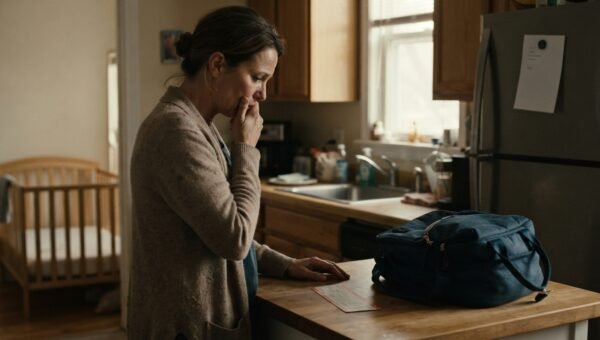
She looked ten years older than the last video call we had six months ago. Her gray hair was pulled back in a brittle bun, her skin was paper-thin, and her shoulders were hunched forward under a worn cotton cardigan.
“Dennis?” she whispered, her hands flying to her mouth. “Oh, dear Lord. Dennis.”
PART 3
She unhooked the chain and threw her arms around my neck. Her body felt frail, like a bundle of dry sticks. She broke down into heavy, silent sobs against my chest right there in the doorway, shaking with a terror that made my stomach turn.
Inside the tiny, dim living room, the heat was suffocating. A single window unit rattled in the corner, blowing lukewarm air into the room. My father was sitting in a faded recliner with his legs propped up, an old wool blanket tucked over his knees despite the humidity. Beside his chair sat a rusted aluminum walker.
The walls were bare except for a small wooden cross and two framed photographs: one of my high school graduation, and one of Kevin holding his high school baseball trophy.
“Dad,” I said, my voice breaking.
My father looked up. His eyes were milky with cataracts, his face hollowed out. When he realized it was me, he tried to push himself up from the chair, but his knees buckled. I rushed across the linoleum and caught him by the forearms, easing him back down into the cushions.
“Son,” he rasped, his chin quivering. “You weren’t supposed to see this. We didn’t want you to know.”
“Why did you do it?” I pulled a hard wooden kitchen chair over and sat directly in front of him. “I bought the farm for you. I gave you power of attorney four years ago only so you could sign the agricultural tax exemption papers and handle the county drainage easement while I was stuck on the refinery rigs. Why did you give the deed to Kevin?”
My mother sat down on the edge of the worn sofa, wringing a damp dishtowel in her lap, tears streaming down her hollowed cheeks.
“He said he was going to lose his son, Dennis,” she sobbed quietly. “Kayla’s parents were threatening to take the baby to court for full custody because Kevin didn’t have a stable residence. He came over here every night for a month, crying at the kitchen table. He said if he had a deed in his name, if he owned land, the state wouldn’t take his boy. He promised he would build a little mother-in-law cottage behind the main house for us. He said we would all live together.”
“And the money?” I asked, my heart hammering against my ribs. “The three thousand dollars I sent in June for the air conditioning?”
My father lowered his head, unable to meet my eyes.
“Kevin took the debit card,” Dad whispered. “He told your mother the unit on the house was shot and the compressor was completely burned out. He said he needed the cash in hand for the installer. Then he bought that bass boat from a boy down in Ganado. He said it was an investment. He said he was going to run weekend fishing charters out of Matagorda to pay us back.”
“Did you sign the deed transfer, Dad?” I asked. “Look at me. Did you sign it?”
My father looked up. A single tear cut a clean path through the gray stubble on his cheek.
“I signed what he brought me, Dennis. He brought a notary to the kitchen table. He said it was an affidavit showing he had permission to live there so he could register the boy for county healthcare. I didn’t have my reading glasses on. I trusted him. He’s my son.”
The room went completely quiet except for the rattling of the broken air conditioner.
I stood up, walked into the tiny kitchen, and pulled out my phone. I dialed the direct office line of Arthur Vance, an attorney in Wharton who had handled the original land purchase for me six years ago. Arthur had been my father’s friend for forty years.
“Arthur,” I said when he answered. “This is Dennis Higgins. I need you to pull the county deed records for the three-acre parcel on Old Nursery Road right now.”
There was a pause on the other end, the sound of keys clicking against a keyboard.
“Dennis? What’s going on? I saw the filing come through last winter,” Arthur said, his voice dropping into a serious, guarded tone. “I almost called you in Houston, but the clerk’s office showed a full statutory power of attorney attached to the conveyance deed, stamped and recorded.”
“Did you read the original power of attorney we filed in your office in 2020, Arthur?”
“Of course I did. I drafted it.”
“Then you know,” I said, staring through the grimy kitchen window at the gravel parking lot below, “that paragraph four explicitly stated my father had authority over agricultural leases, easements, and municipal permits, but zero authority to transfer, gift, or encumber the fee-simple title without my notarized, written consent.”
Arthur was quiet for three long seconds.
“Dennis,” Arthur said, his voice completely cold now. “If that’s what was filed, the county clerk accepted an ultra vires deed. If your father used a limited instrument to execute a full warranty conveyance to a third party, that deed is void ab initio. It isn’t just defective. It’s illegal. And if Kevin knew the limits of that document, that constitutes felony deed fraud.”
“I’m coming to your office in twenty minutes,” I said. “Bring the original file out of the safe.”
ENDING
I didn’t sleep that night. I stayed on the floor of my parents’ apartment with a thin throw pillow under my head, listening to the freight trains shake the windows every hour on the hour.
By ten o’clock the next morning, Arthur Vance and I were sitting in the office of the Wharton County Sheriff.
We had the original 2020 power of attorney document with its clear restrictions, the fraudulent deed Kevin had filed with a rubber-stamp notary from a strip-mall check-cashing shop, and the bank statements showing the three thousand dollars I had wired directly into my father’s checking account, which was withdrawn via counter check forty-eight hours later by Kevin at a branch teller window.
The sheriff, a man named Tom Garza who had gone to school with my father, looked over the paperwork with a heavy scowl.
“Dennis,” Sheriff Garza said, taking off his hat and setting it on the desk. “If we execute this, your brother is going to county jail. He’s facing third-degree felony charges for document tampering and exploitation of an elderly person’s assets. There won’t be any talking him out of it once the warrant is signed.”
I looked out the office window at the courthouse square. I thought about the six years I spent inhaling chemical vapor in Houston. I thought about my mother weeping into a damp dishtowel, and my father sitting in a sweltering brick room behind a lumber yard, too ashamed to look his eldest son in the eye.
“Sign the warrant, Tom,” I said.
Two squad cars pulled into the gravel drive on Old Nursery Road at two o’clock that afternoon. I followed behind them in my truck.
Kevin was out on the porch when we pulled up, holding a cold can in his hand. When he saw the sheriff get out of the patrol car, he didn’t run. He just stood there, his mouth slightly open, the arrogance draining out of his posture until he looked small, thick, and utterly defeated.
Kayla came to the door screaming, holding her child, cursing at the deputies as they walked up the porch steps. They didn’t argue with her. They turned Kevin around, pushed him against the white porch railing I had paid for, and clicked the handcuffs shut around his wrists.
“Dennis!” Kevin screamed at me as they walked him down the steps past the rusted trucks. “Dennis, you’re putting your own brother in jail! Over dirt? You’re doing this over dirt?”
I didn’t answer him. I didn’t even look him in the eye.
“You have forty-eight hours to get your belongings and that boat off this property,” I told Kayla, keeping my voice dead level. “After that, I’m bringing a flatbed trailer and an auction crew, and anything left on this grass is going straight to the county dump.”
It took three weeks to clean the place.
I hired a local hauling crew to drag the junk trucks away, clear out the beer cans, and haul twelve loads of trash to the landfill. I had a licensed contractor install a brand-new, four-ton heat pump system with digital thermostats in every room. I spent four days scrubbing the kitchen walls, painting the living room a clean, warm cream, and fixing the latch on the front screen door.
On a Saturday morning in late October, I backed my truck up to the breezeway of unit 104 on Elm Street.
It took less than an hour to load everything my parents owned into the bed of the truck. They didn’t have much. Just their clothes, their medication, my father’s recliner, and the two framed photographs.
When we pulled back into the driveway on Old Nursery Road, the sun was sitting low over the three-acre field behind the house. The grass was mowed clean. The porch was swept, and two sturdy wooden rocking chairs sat side by side near the front rail, with a soft wool blanket folded over the back of each one.
My mother got out of the passenger side slowly. She stood on the fresh gravel, looking up at the red tin roof, her hand covering her mouth as the tears started again. But this time, her shoulders weren’t shaking.
My father took his walker, gripped the aluminum frame with his calloused hands, and made his way up the low ramp I had built over the front steps. He stopped at the front door, turned around, and looked out over the pasture toward the tree line.
“Dennis,” he said softly, his voice steady for the first time in months. “The soil back there is good. If we get the disc plow out next week, we can still put some winter greens in the ground.”
“We can do that, Dad,” I said, putting my hand on his shoulder. “We’ve got all the time in the world.”
Kevin took a plea deal four months later. Two years probation, mandatory restitution of the three thousand dollars, and two hundred hours of community service picking up trash along the county highways. He hasn’t called my parents, and they haven’t asked about him.
Some wounds in a family don’t heal with a conversation. Some lines, once crossed, leave you standing on opposite sides of a locked gate forever. But every evening when I sit on that porch with my mother and father, watching the Texas sun sink into the timber, I know I didn’t lose my family. I just took back the only part of it that was ever worth saving.