PART 1
Last Tuesday morning at 8:15, my phone buzzed on the kitchen counter while I was packing my lunch for work. It was a text from my nineteen-year-old daughter, Chloe. She attends the state university about twenty miles up the highway and lives in our finished basement suite while finishing her sophomore year.
The text was frantic. She said she had forgotten about an emergency biology lab manual and equipment fee that had to be paid in cash or debit by 10:00 AM at the science department office, or she would be dropped from the course.
The amount was exactly $300. I work as an office manager at an orthopedic clinic, and money is tight, but I have always prioritized her education above everything else. Her father walked out when she was six, leaving me to handle the mortgage, the groceries, and every single school expense on one paycheck. I did not even hesitate. I opened my banking app and transferred the $300 directly to her checking account via instant transfer.
She texted back three heart emojis and said she loved me and was hurrying to class.
An hour later, around 9:30, I was sitting at my desk at the clinic taking a short coffee break. I opened my personal phone to check a notification from OfferUp, a local resale app I had downloaded two years ago when we cleared out my mother’s estate. The alert was a generic neighborhood ping, but my thumb accidentally tapped on the local feed.
Right at the top of the listings was an item posted just eleven minutes earlier.
The profile picture on the seller account made my stomach drop. It was a picture of our golden retriever, Daisy, sitting on our back patio, a photo that Chloe had taken herself last summer. The seller name was just “C_Resale.”
The listing was for a brand-new MacBook Air in a sealed box. The seller had priced it at $450, which is roughly half of what it sells for in any store. But it was the written description beneath the photo that made the blood rush straight to my ears. It read: “Brand new, never opened. Need fast cash. Parent bought wrong model, won’t notice.”
I stared at the screen, my hands trembling. I had not bought Chloe a laptop. For high school graduation, my brother had bought her an entry-level Dell, which she still used daily.
But two weeks ago, I had finally replaced my own dying work laptop using my holiday bonus from the clinic. I had left the unopened box in the back of my bedroom closet behind my winter coats because I had not yet found the time to transfer my files.
I grabbed my car keys, told the front receptionist that I had a family emergency, and drove home.
When I reached the house, Chloe’s car was gone from the driveway. She was scheduled to be on campus until 2:00 PM. I went straight up the stairs to my bedroom and opened the closet door. I reached behind the heavy wool coats on the high shelf where the white electronics box had been tucked away.
The space was completely empty.
I stood there in the quiet bedroom, listening to the hum of the refrigerator downstairs, trying to make sense of what I was looking at.
My daughter had not just asked me for $300 under false pretenses. She had stolen a $900 computer from my closet and put it up for sale to strangers on the internet for pennies on the dollar.
I walked down the stairs to the basement suite. Her room was usually messy, with textbooks and laundry scattered across the rug, but today the bed was made. I started looking for the original packaging or a shipping box, checking her closet and her desk drawers. Under the foot of her bed, pushed far back against the baseboard, my fingers brushed against cold metal.
I pulled it out. It was a heavy, brushed-aluminum document briefcase that had belonged to my late father. It had a four-digit rolling combination lock on the latch.
I knelt on the carpet and tried the first number that came to mind: 0-4-1-2. Chloe’s birthday, April 12th.
The latches snapped open with a sharp, heavy click.
Inside the case, there were no college textbooks, no biology lab manuals, and no study notes. The briefcase was packed with neatly stacked envelopes, pawn shop receipts, and small velvet jewelry pouches. And right on top lay my grandmother’s gold filigree engagement ring, a family heirloom that was supposed to be resting safely inside the wooden jewelry box on my dresser.
PART 2
I picked up the velvet pouch with shaking fingers. My grandmother had worn that ring for fifty-four years before passing it to my mother, who gave it to me on my thirtieth birthday. I had promised myself I would hand it down to Chloe on her wedding day. Beside it lay four yellow pawn tickets from a business on 4th Street, dated over the last three months.
I picked up the first slip. It was dated January 18th, detailing a gold watch for $140. That was my father’s retirement watch from the rail company, an item I had kept in my nightstand drawer for fifteen years. The second slip, dated February 2nd, was for a silver tea service I thought was packed in the attic crawlspace: $85. The third slip listed two antique cameras from my father’s collection: $120.
At the bottom of the briefcase was a standard spiral notebook. I opened the cover. The pages were covered in Chloe’s neat handwriting, laid out in columns. On the left side of each page were lists of personal items with estimated dollar amounts next to them. On the right side were dates, names of online accounts, and numbers crossed out in red ink.
Near the top of the newest page, she had written: “Mom’s laptop: $450.” Right underneath it was: “Lab fee lie: $300.”
Next to those two entries was a single bold total circled three times: “$750.”
Beneath that total, she had written a short, cold sentence: “Need $2,200 by Friday or he tells the school.”
I sat on the basement floor surrounded by the remnants of my family’s history, unable to breathe properly. My daughter was not pawning our lives away for clothes or party money. She was being extorted, or she was deeply involved in something dangerous. The name written beside the $2,200 figure was “Marcus V.”
I did not touch the cash envelopes or move the briefcase. I took out my phone and took clear, high-resolution photographs of every single pawn slip, every page of the notebook, the OfferUp listing, and the jewelry. Then I carefully closed the briefcase, spun the combination lock back to zero, and pushed it back under the bed exactly where I had found it.
I went upstairs, locked the front door, and sat down at the kitchen table with my phone. I searched the local university directory for “Marcus V.” Only one name matched: Marcus Vance, a senior listed as an officer in a campus business fraternity.
I looked up the campus police department number, but I paused before dialing. If I involved the police right now without understanding what Marcus Vance held over her head, I did not know what damage it would cause to her academic standing or her life. But I also knew I could not simply hand her another dime or pretend I had not seen her notebook.
At 1:45 PM, I heard her car pull into the driveway.
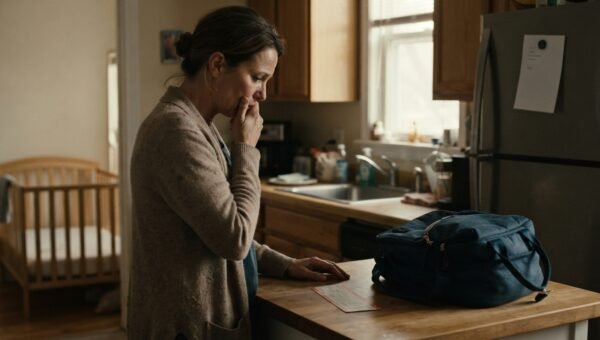
I sat completely still at the kitchen table. The $300 confirmation screen from my bank was still open on my tablet, sitting directly in front of me alongside my car keys.
The back door opened. Chloe walked in carrying her canvas backpack, wearing her winter jacket. She looked exhausted, with dark circles under her eyes that I had previously written off as late-night studying.
“Hey, Mom,” she said, kicking off her boots by the mat. “Thanks again for the transfer. You totally saved my life. Professor Miller was literally about to drop me from the roster.”
“Sit down, Chloe,” I said. My voice was entirely flat.
She paused, looking at me with a nervous smile. “What’s wrong? Did something happen at the clinic?”
“Sit down,” I repeated, pointing to the chair opposite me.
She slowly slid her backpack off her shoulder and sat down on the edge of the wooden chair. Her eyes darted to the tablet on the table, then to my face.
“I took a drive home at ten o’clock this morning,” I said quietly. “I went up to my closet to get my new work computer. It wasn’t there.”
Her face went pale instantly. The color drained from her lips so fast she looked like she might pass out.
“Mom, I can explain,” she began, her voice cracking.
“Do not lie to me,” I said, leaning forward. “Do not tell me a friend borrowed it. Do not tell me you took it to campus to set it up for me. I saw your listing on OfferUp. I saw Daisy’s picture. I saw the words: ‘Parent bought wrong model, won’t notice.’ And twenty minutes ago, I opened your grandfather’s briefcase under your bed.”
Chloe covered her face with both hands and let out a choked sob.
“Who is Marcus Vance?” I asked. “And why are you stealing from your own family to pay him twenty-two hundred dollars?”
PART 3
Chloe broke completely. The defensive posture she usually took during arguments vanished. She slumped forward against the table, crying so hard her shoulders shook violently.
For twenty minutes, between ragged breaths, the truth finally spilled out.
It had not started with Marcus Vance. It had started six months earlier with an online sports gambling app that several students in her economics study group used. She had placed small twenty-dollar bets on college basketball games, winning a few hundred dollars early in the fall semester. Then she began losing. To cover her losses, she had borrowed money from an off-campus acquaintance who introduced her to an unregulated private betting site.
When her debt hit $1,500 in November, Marcus Vance, who ran the local collection for the ring on campus, stepped in. He had offered to pay off her initial sportsbook balance if she did private accounting work for his fraternity’s off-the-books social fund. But when she tried to walk away in January, Marcus informed her that the accounting ledger she had managed contained clear evidence of student fee embezzlement, and that her student ID and signature were on every transaction.
He told her that if she did not pay a weekly penalty of $500, he would hand the ledger over to the dean of academic integrity, which would result in her immediate expulsion and potential criminal charges.
“I was terrified, Mom,” she wept, looking at me with red, swollen eyes. “I couldn’t tell you. You worked so hard to get me into this school. If I got expelled, your whole life’s work for me would be ruined. I started taking things I thought you wouldn’t notice. I was going to buy them all back from the pawn shop as soon as summer started and I could work two jobs. I swear to God, I was going to buy them all back.”
“You took your grandfather’s watch,” I said, my voice thick with tears I refused to shed. “You took my grandmother’s ring. You took money out of my checking account this morning while looking me in the eye and lying about a biology fee.”
“I had to give him seven hundred and fifty today by three o’clock,” she whispered, looking down at her hands. “The laptop buyer backed out. I didn’t know what else to do.”
I stood up from the table. My heart felt bruised and battered, but a cold clarity settled over me. The maternal instinct to shield my child was warring directly with the absolute necessity to hold her accountable. If I paid this debt for her, she would never learn the cost of theft, and the extortion would never stop.
“Where is my computer right now?” I asked.
“In the trunk of my car,” she said in a small voice. “In a backpack.”
“Get the keys. Bring it in here right now.”
She stood up immediately, hurried outside into the cold, and returned thirty seconds later holding the sealed box. She placed it gently on the kitchen table.
“Now get your coat,” I said, picking up my purse and car keys.
“Where are we going?” she asked, her voice trembling. “To Marcus?”
“No,” I said. “We are going to the campus police department. And on the way, we are stopping at the 4th Street pawn shop.”
“Mom, please! If we go to the police, they’ll kick me out!” she screamed, dropping to her knees by the kitchen counter. “Please don’t ruin my life!”
“You compromised your own life the day you stole from this house,” I said firmly, staring down at her. “I am not paying twenty-two hundred dollars to a criminal. And I am not letting you stay in school under the threat of blackmail for the next two years. We handle this today, through the front door, with the truth. Get up.”
ENDING
We walked into the campus police precinct at 2:30 PM. I asked to speak directly with the duty detective and laid out every single piece of evidence on the stainless-steel desk: the printed screenshots of Chloe’s notebook, the text messages from Marcus Vance detailing the payment deadlines, and the bank transaction records.
Chloe sat beside me, her voice shaking as she answered every question the detective asked. She admitted to her gambling debts. She admitted to helping balance the fraternity ledger. She admitted to stealing from our home. She held nothing back, because I sat right next to her and corrected her whenever she tried to soften her actions.
The campus police already had an open inquiry into Marcus Vance regarding illegal gambling operations on university property. Chloe’s notebook and the text message threads provided the corroborating evidence they needed to secure a search warrant for his off-campus apartment.
By 5:00 PM, university administrators were involved. Because Chloe came forward voluntarily and cooperated fully with the campus investigation, the dean of students suspended her for two full semesters rather than issuing an immediate expulsion. She was placed on mandatory academic probation, required to complete one hundred hours of community service, and ordered to attend weekly counseling sessions for behavioral health.
When we left the station, we drove straight to 4th Street.
I stood at the pawn shop counter and used my own emergency savings to redeem my father’s rail watch, the silver tea set, and his vintage cameras. The total cost to reclaim our family possessions was $412. Chloe stood silently beside me, watching the clerk slide the items across the glass counter into my hands.
When we got back to the house that evening, I laid the ground rules out on the kitchen table.
I had her sign a formal repayment contract. She was to begin working full-time at the local grocery store starting the following Monday. Every single dollar of the $300 fraudulent transfer, the $412 pawn redemption fees, and her portion of the household utilities would be deducted directly from her biweekly paychecks until the balance was zero. I took her car keys and her phone, replacing her smartphone with a basic prepaid flip phone for emergency use only.
That was four months ago.
Marcus Vance was formally charged with extortion and running an illegal gambling enterprise, and he has since been permanently expelled from the university.
Chloe works forty hours a week stocking shelves and running the cash register on the night shift. Every other Friday, she places an envelope containing $150 on the kitchen table before going to her counseling appointment. She has paid back $550 so far.
We do not talk much during the evenings. The easy, casual trust that once defined our home is gone, replaced by a quiet, structured routine. It breaks my heart to see the distance between us, but I know that saving her from the consequences of her choices would have destroyed her far more thoroughly than any suspension ever could.
Last night, she knocked softly on my bedroom door. She handed me an envelope containing her weekly counseling reflection worksheet. Tucked inside was a handwritten note.
“Thank you for not letting me get away with it,” she had written.
I folded the paper and placed it in my nightstand drawer, right next to my father’s watch. Healing will take years, and forgiveness will take even longer, but for the first time in months, my daughter is finally standing on honest ground.