PART 1
My wife, Sarah, stopped inviting my mother to Sunday family dinners right after one particularly ugly argument in our kitchen three years ago. Things had been tense for a long time, but that afternoon the wall finally came down. Mom said some biting things about how Sarah ran our home, and Sarah simply looked at her, told her she was no longer welcome at our table until she could learn basic respect, and walked out of the room.
I understood the boundary even though it put me directly in the middle. I loved my wife, and I knew she had taken more than her share of unfair criticism, but Mom was still my mother. Two years passed with a cold, heavy silence between them. I visited Mom alone twice a month, feeling like a spy in my own life, always careful not to mention Sarah’s name too often. Then, out of nowhere, Mom caught a sudden, aggressive pneumonia and passed away within four days at the hospital before we could even process how fast she was declining.
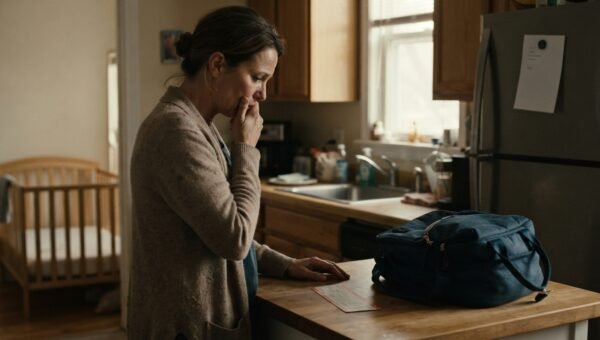
The hardest part fell on me: cleaning out the small, cluttered two bedroom apartment she had lived in for fifteen years. My sister, Brenda, lived three hours away and claimed she was too overwhelmed with her job and teenage kids to help, so I spent my Saturday mornings alone in that stale, dusty rooms smelling of old paper and peppermint candy.
I sorted through decades of memories, boxing up old photos, cheap knickknacks, and stacks of utility bills.
In the back of Mom’s mahogany dresser, underneath a pile of heavy winter sweaters she hadn’t worn in years, I found a shoebox wrapped tightly with a thick rubber band. Inside were twenty-four heavy cream envelopes, all addressed in neat, familiar handwriting to my mother’s apartment. Every single one had a return address bearing Sarah’s name and our home street. They were unopened. My heart dropped right into my stomach. For two years, I had believed that Sarah was completely hardhearted, refusing to ever extend an olive branch. Yet here was proof that Sarah had tried to reach out, month after month, and Mom had simply let them sit in a drawer without opening a single one.
I felt a sudden, sharp wave of anger at my dead mother for being so stubborn, mixed with an overwhelming rush of guilt for ever doubting Sarah’s capacity for forgiveness.
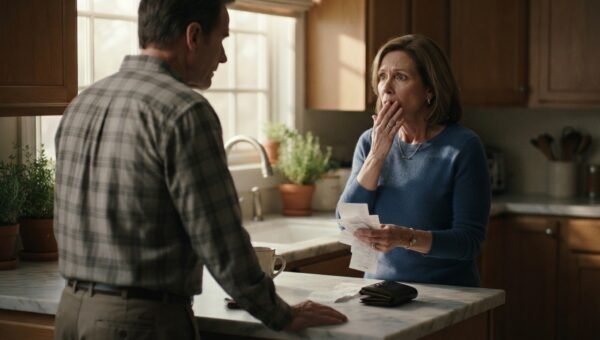
I carried the shoebox straight out to my car, placed it on the passenger seat, and drove home with my hands gripping the steering wheel so tightly my knuckles turned white. When I walked through our front door, Sarah was standing at the kitchen island chopping vegetables for dinner. I set the shoebox down on the counter between us, my voice shaking as I laid the envelopes out. I told her I found them hidden in Mom’s dresser, and I apologized with tears in my eyes for never knowing she had tried to make peace all this time. I told her how sorry I was that Mom had ignored her efforts. Sarah stopped chopping, wiped her hands on a dish towel, and stared down at the cream-colored envelopes. Her face went completely pale, and she whispered that she never wrote those.
PART 2
I stood there in the quiet kitchen, blinking at Sarah, half-expecting her to crack a smile or admit she was just trying to protect her pride.
But her face had lost all its color, and her hands were trembling slightly as she hovered over the counter. I told her not to joke about something like that, pointing out that the return address was ours, the handwriting looked identical to the grocery lists and birthday cards she wrote every single week, and her full name was signed neatly on the back flap.
Sarah backed away from the counter as if the shoebox were venomous. She told me to look closer at the return address. I picked up the topmost envelope and squinted at the printed label. It had our street name and zip code, but the house number was completely wrong. It listed a number that didn’t even exist on our block. Then I looked at the ink. Sarah always used black rollerball pens that she bought in bulk from the office supply store down the road. This ink was a deep, dark blue fountain pen ink, something neither of us had owned in the ten years we lived in this house.
My breath caught. I grabbed a kitchen shears and snipped open the top of the envelope nearest to me. I pulled out a heavy sheet of matching cream paper and unfolded it. The words hit me like physical blows. It was a vicious, calculated letter. It didn’t ask for peace or invite Mom out for coffee. Instead, it mocked Mom for living in a cramped apartment, criticized her housekeeping, and cruelly rubbed it in that I preferred Sarah’s family over hers anyway. It ended with a barbed instruction never to contact us again.
My stomach churned. It was sickeningly mean, written in a voice that mimicked Sarah’s cadence just enough to fool anyone who only knew her casually, but laced with hostility neither of us would ever use. I pulled out a second envelope, and a third. Every single letter followed the same sick pattern. They were designed to infuriate Mom, to reinforce every nasty prejudice she already held against Sarah, and to make reconciliation completely impossible. Someone had gone to extraordinary lengths to wage a silent war using both of our names as weapons.
PART 3
We sat at the kitchen table for hours as the sun dipped below the horizon, emptying the shoebox envelope by envelope, looking for a clue that would make sense of the nightmare. Sarah was crying now, realizing that for the last two years of my mother’s life, Mom had gone to her grave believing my wife was a cold, hateful monster who spent her free time writing poison pen letters. And I had spent those same two years silently blaming Sarah for holding an unforgiving grudge.
We laid the envelopes chronologically across the wooden table, examining the postmarks like detectives. The most recent ones bore local sorting facility stamps from our own city, but as we worked our way down to the bottom of the stack, digging into the older envelopes from eighteen months prior, the postmarks changed.
The oldest envelope had a postmark from the small town three hours away where my sister, Brenda, lived with her husband.
My mind resisted the conclusion at first. Brenda? My own sister? It made no sense. Brenda was the quiet one, the busy mother of two who always claimed she wanted to stay out of family drama. But as I stared at the blurry postmark, the puzzle pieces violently clicked into place. Brenda was the only person who visited Mom frequently before the big argument, and she was the only one who stayed close with Mom afterward. Brenda knew every detail of our household, knew Sarah’s handwriting style well enough to forge it after years of receiving birthday and holiday cards, and had every motive in the world to keep Mom and me isolated.
I remembered how Brenda used to whisper to me during Mom’s final months, subtly reinforcing how unforgiving Sarah supposedly was, shaking her head and telling me I was a saint for putting up with it. She wasn’t playing peacemaker. She was the architect of the entire war.
ENDING
The next morning, I didn’t call Brenda. I didn’t send a text. I drove straight to her house three hours away, carrying the shoebox of forged letters on the passenger seat like a lead weight. When Brenda opened her front door in her old gardening clothes, looking startled to see me standing on her porch unannounced without calling first, I didn’t wait for her to invite me inside. I pushed past her into the hallway, dropped the heavy shoebox right onto her entryway table, and lifted the lid.
She took one look at the cream envelopes spilling out over the polished wood, and all the color drained straight out of her face. She didn’t even try to deny it. Her mouth opened and closed a few times before she whispered that she just wanted Mom to stop complaining about Sarah all the time, that she wanted to protect our family peace. I looked at my sister, realizing I was staring at a stranger who had deliberately poisoned my mother’s final years and almost destroyed my marriage out of some twisted, spiteful need for control.
I told her she was dead to me, turned on my heel, and walked out the door without looking back. The drive home was the longest of my life, but as I pulled into our driveway and saw Sarah waiting for me on the front porch, I knew the poison had finally stopped. We still had to live with the grief of what was stolen from us, but the lie was dead, and we were finally standing in the truth together.