PART 1
For sixteen years, every single Saturday morning started the exact same way in our house. Grover would wake up at six, shave with the peppermint cream I bought him at the pharmacy, and put on his navy blue windbreaker with the veteran patch sewn over the left pocket. He would sit at the kitchen table, drink two cups of black coffee, and fold up four hundred-dollar bills from our shared emergency envelope.
He always said the post needed it more than we did. He told me the kitchen roof at the hall had a chronic leak, or that old Frank needed his heating oil covered, or that the post auxiliary was putting together holiday care baskets for the boys overseas. Four hundred dollars a month was not a small amount on Grover’s pension and my wages from the county clerk’s office, but I never argued. Grover served two tours before we got married in 1984. The men down at the hall were his brothers, or at least that was what he told me every time he kissed my forehead on his way out the back screen door.
He would stay gone until four or five in the afternoon. When he came home, he usually smelled like stale draft beer, menthol cigarettes, and sometimes a faint, sweet trace of floral perfume. If I mentioned the perfume while taking his windbreaker to hang on the peg, he would chuckle, shake his head, and say, “You know Martha behind the bar, Brenda.
She hugs everyone who sets foot through that front door, and she wears half a bottle of drugstore rosewater just to cover up the fryer grease.”
I believed him because thirty-eight years of marriage teaches you to choose your battles, and I never wanted to be a suspicious wife. We had two grown daughters, Kelly and Megan, who were out on their own with decent jobs and children of their own. We had a paid-off split-level on Oak Street, a gravel driveway, and Sunday dinners with pot roast. I told myself that if Grover needed a place to hide away with other old men every Saturday to escape the quiet of our empty nest, it was a harmless price to pay.
Then came the second Saturday in October. Our ten-year-old granddaughter, Chloe, made the regional fall softball tournament. Megan had called me on Thursday night practically beside herself with pride, begging us to come out and watch the double-header.
The games were scheduled out in Millersville, nearly forty miles north of us, at a massive county sports complex right along Route 9.
Grover made an excuse right off the bat on Friday night. He rubbed the bridge of his nose and said his bad knee was acting up with the cold front moving through, and that he had promised the commander he would oversee the kitchen inventory for the annual turkey raffle. He told me to take the Buick, take lots of pictures of Chloe running the bases, and tell the kids he loved them. I felt a small pang of disappointment, but I packed my stadium blanket, stopped at the ATM to grab spending cash for snacks, and made the drive alone.
The Millersville sports complex was huge. Chloe’s game was on diamond four, which sat directly behind the local American Legion building and shared a gravel overflow parking lot with their pavilion.
Between Chloe’s first and second game, Megan sent me up to the main concession stand to buy two large diet sodas and a bag of warm salted peanuts.
The line was six people deep, moving slowly in the chilly autumn air. I was pulling my wallet out of my purse when a woman in her late forties, wearing an orange booster club sweatshirt and a knitted headband, turned around to grab a paper napkin dispenser from the counter beside me.
She caught my eye, stopped dead in her tracks, and gasped. Before I could even step back, she reached out and wrapped both arms around my shoulders in a tight, familiar embrace that smelled sharply of vanilla lotion and fried onions.
“Oh my gosh, you made it!” she beamed, pulling back and gripping my forearms with genuine excitement. “Grover said you usually stayed home on game weekends because of your arthritis, but look at you! You must be so proud. Best coach and dad this league has ever had. Your boys are absolute naturals out there.”
My stomach dropped straight through my shoes. The noise of the parents shouting behind us and the hum of the deep fryer suddenly went dead quiet in my ears. My mouth went completely dry, like I had swallowed a spoonful of chalk.
“I’m sorry,” I managed to whisper, pulling my arms back against my chest. “I think you have the wrong person. We don’t have boys. Grover and I only have daughters.”
The woman laughed, giving me a light swat on the shoulder as if I had made an inside joke. “Oh, stop it! Look right there on field two!”
She turned and pointed through the chain-link fence toward the adjacent diamond. Two tall, lean teenage boys in red and white jerseys were warming up between innings. One of them took off his batting helmet to wipe his forehead, and my heart stopped beating.
He had Grover’s exact crooked grin, the slight bump in the bridge of his nose, and the unmistakable way Grover stood with his left shoulder tilted slightly higher than his right. Then the boy turned around to pick up a bat. Printed across the back of his red jersey in bold white block letters was a name that made the world spin around me: GROVERSON.
PART 2
The name on that jersey was not Grover’s full last name, but it was close enough to leave no doubt. Our last name is Groverson. On the back of the teenager’s shirt, printed plain as day in block lettering, was GROVER.
The woman in the booster sweatshirt was still chattering away beside me, oblivious to the fact that my knees were shaking so badly I had to grab the edge of the concession counter to stay upright.
“I told Grover just this morning that Tyler is going to make varsity next spring without even trying,” she said, nodding toward the taller boy near first base. “And little Mason has Grover’s arm from behind the plate. It is an absolute blessing the way Grover stepped in when their mama had her surgery three years back. Sixteen years of running that Saturday morning clinic out here. Honestly, Brenda, half the families in this township don’t know what they’d do without him.”
The breath left my lungs in one cold, ragged hitch. She knew my name. She knew about Tyler and Mason. And she had just said the exact number of years Grover had been leaving my house at six o’clock every Saturday morning: sixteen.
“Excuse me,” I said, my voice shaking so hard it sounded like paper tearing. “Who is their mother?”
The woman’s smile finally slipped. A flicker of confusion crossed her face, replaced instantly by deep embarrassment. She looked at my face, took a small step backward, and lowered her voice. “Wait. You are… you’re Brenda, aren’t you? Grover’s wife from down in Oak Street?”
“Who is their mother?” I repeated.
“Tammy,” she whispered, her cheeks turning bright red under her knit headband. “Tammy Miller. She runs the front desk at the township pool. Brenda, please don’t do this here. Grover told everybody you two had an arrangement years ago. He said you knew all about the boys, that you just didn’t want to be involved because of the old history.”
I did not wait to hear another word. I turned around, left the sodas on the counter, and walked away from that concession stand as fast as my stiff knees would carry me. I did not go back to diamond four. I could not face Megan or look at little Chloe running around those bases with my world collapsing in my chest. I pulled out my flip phone, sent Megan a quick text saying I had a sudden stomach migraine and had to go home, and walked out to the gravel parking lot.
Sitting in the front seat of the Buick, my hands shook so violently I dropped my keys twice onto the rubber floor mat. I sat there in the cold car, staring through the windshield at the chain-link fence of field two. A man had just walked into the dugout from the third-base side. He was wearing gray sweatpants, a red windbreaker, and a baseball cap pulled low over his eyes.
Even from fifty yards away, I would know that walk anywhere. It was the same lumbering stride that had crossed my kitchen floor that morning at six o’clock. It was the same man who told me his knee was too swollen to sit on the bleachers for our granddaughter.
I sat in that parking lot for three hours with the engine off. I watched him throw batting practice to the two boys. I watched him high-five the taller one, Tyler, and hand a blue Gatorade to the younger one, Mason. At one point, a slender blonde woman in her late thirties walked up to the dugout fence, handed him a clipboard, and he rested his hand casually on her hip for two seconds while they looked over the lineup card together. It was not the gesture of an acquaintance or a volunteer coach. It was the easy, practiced intimacy of a husband.
I drove the forty miles back to Oak Street in complete silence. My mind did not race; it froze solid. For sixteen years, four hundred dollars a month had left our joint checking account. That was four thousand eight hundred dollars a year. Over sixteen years, that was seventy-six thousand eight hundred dollars. It was not going to a leaky roof at the VFW post. It was not buying heating oil for an old veteran named Frank. It was buying cleats, batting gloves, school clothes, and grocery money for a second family forty miles up the highway.
I got home at two o’clock. The house was dead quiet. I went straight down into the basement where Grover kept his metal military footlocker and his gun safe.
He always kept the footlocker padlocked with a small brass master lock, telling me it held his old service records, personal letters from his buddies in the Gulf, and tax papers from before we merged our finances. The key had hung on the ring behind the furnace pipe for as long as I could remember.
I took the key, knelt on the cold concrete floor, and clicked the lock open.
The top layer of the trunk was filled with old camouflage jackets, a folded flag, and his honorable discharge certificate. But underneath the heavy wool blankets, stacked neatly in cardboard file folders, was sixteen years of a secret life.
There were bank statements from a regional credit union two towns over, opened under Grover’s name and Tammy Miller’s name. There were birth certificates. Tyler Michael Miller, born June 14, 2010. Mason Cole Miller, born March 3, 2012. On both certificates, the line for the father’s name was typed out clean and clear: Grover Allen Groverson.
Tucked into the bottom of the folder were rent receipts from a duplex on Elm Street in Millersville, dated every month from 2011 through 2019, followed by mortgage payment stubs for a modest ranch house on the outskirts of the same town. Every month, a four-hundred-dollar transfer from our shared checking account had landed in that credit union account, matching the exact deposit dates on the slips.
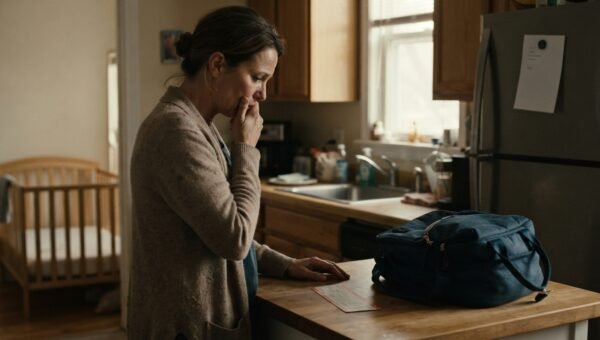
I did not scream. I did not cry. I carefully put the folders in my canvas tote bag, closed the footlocker, clicked the brass padlock shut, and put the key back behind the furnace pipe. Then I walked upstairs to the kitchen, made a pot of black coffee, and sat at the table to wait.
PART 3
At quarter past five, the gravel crunched in the driveway. The car door slammed, and a moment later, the back screen door squeaked open.
Grover stepped into the kitchen, carrying his navy blue windbreaker over his arm. He looked tired, with ruddy windburn on his cheeks and that same familiar smell trailing behind him: menthol smoke, fried food, and that faint, powdery floral perfume that I now knew was not drugstore rosewater on an old barmaid.
“Hey, Brenda,” he said, hanging the windbreaker on the wooden peg by the door just like he had done thousands of times before. “How’d Chloe do? Megan call you with the final score?”
I sat perfectly still with both hands wrapped around my coffee mug. “Chloe won her first game eight to three. I didn’t stay for the second one.”
He stopped untying his work boots and looked up, his brow furrowing. “You didn’t? What happened? Your hip giving you grief again?”
“No, Grover. My hip is fine.” I looked directly into his eyes, keeping my voice as level as a sheet of glass. “I went to the concession stand behind field four to get a soda. A woman named Darla hugged me. She told me to be proud of the best coach in the league. Then she pointed me toward field two.”
The color drained from Grover’s face so fast it looked like someone had pulled a plug in the bottom of his boots. His hands stopped moving on his shoelaces. His mouth opened slightly, but no sound came out.
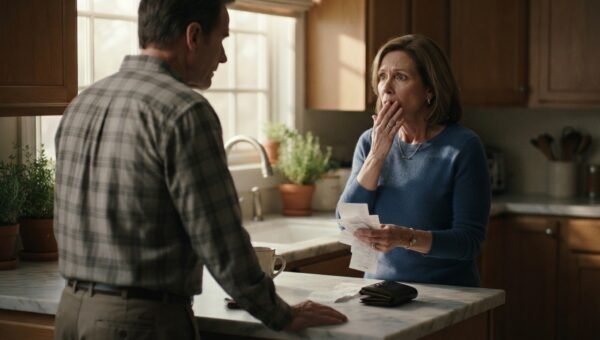
“Brenda,” he finally croaked, his voice dropping into that low, cautious tone he always used when he thought an argument was brewing. “Now, listen to me for a second before you get worked up. You don’t understand what happened.”
“I understand seventy-six thousand eight hundred dollars,” I said, pointing to the canvas tote bag resting on the chair across from me. “I understand Tyler. I understand Mason. I understand Tammy Miller and the house on Elm Street, and the house with the mortgage you’ve been paying forty miles up the road while I clipped coupons to pay for Megan’s braces.”
He dropped heavily into the chair opposite me. The confidence that usually carried him through any room vanished entirely. For the first time in thirty-eight years, I saw my husband look small, cornered, and utterly terrified.
“It started sixteen years ago,” he whispered, staring down at the linoleum floor. “Tammy’s older brother was in my platoon. When he passed, she reached out to the post for help with some paperwork. One thing led to another, Brenda. It was stupid. It was the biggest mistake of my life, but then Tyler came along. What was I supposed to do? Abandon a child? I couldn’t just walk away from my own blood.”
“You walked away from me every Saturday for sixteen years,” I said, the words cutting right through his excuses. “You walked away from your daughters. You told Kelly you couldn’t help with her college textbooks because the budget was tight, while you were handing Tammy four hundred dollars a month out of our grocery money.”
“I never loved her like I love you,” he pleaded, reaching across the table to grab my hand.
I pulled my hand back before his fingers could touch my skin. The look on his face changed from guilt to panic.
“Brenda, please,” he said, tears actually welling up in the corners of his eyes. “We’re sixty-two years old. We have thirty-eight years together. You can’t throw away a whole life over this. I’ll quit the coaching. I’ll cut them off completely. I’ll sign the house over to you right now. Just don’t destroy our family. Think about the girls. Think about Chloe.”
“Don’t you dare speak our daughters’ names to protect yourself,” I said. “You didn’t think about Kelly or Megan when you signed those birth certificates. You didn’t think about Chloe when you lied to my face this morning about your bad knee so you could go play daddy to another woman’s boys.”
He started to speak again, but I stood up from the table. I picked up my purse and the canvas bag full of his secret records.
“I’m going to Megan’s house for the night,” I told him quietly. “Do not call my phone. If you are still in this house when I come back on Monday morning with a lawyer, the police will be the ones helping you pack your clothes.”
ENDING
I did not sleep at all that Saturday night on Megan’s fold-out sofa. When I finally told Megan and Kelly what I had discovered, the kitchen went dead silent, followed by the kind of deep, furious tears that only betrayal can bring. My daughters were not just angry for me; they were mourning the father they thought they had known their whole lives.
Kelly remembered how Grover had refused to help pay for her nursing school application fees because he claimed money was scarce, while Megan remembered him missing three of her high school track meets because of urgent Saturday volunteer shifts at the post. The pieces of their childhood shifted into something ugly and distorted right before their eyes.
On Monday morning, I walked into the office of a family law attorney named Richard Vance in downtown Oak Street. I laid the canvas bag on his desk: the birth certificates, the dual bank accounts, the mortgage stubs, and thirty-eight years of joint tax returns.
Richard looked through the records with the calm, practiced eye of a man who had seen every variety of human deceit. Because Grover had commingled marital funds for sixteen years to support another household and buy real estate without my knowledge, the legal leverage was entirely on my side. In our state, that constitutes massive dissipation of marital assets.
Grover did not fight the divorce. When Richard served him with the papers and a formal demand for an accounting of every dollar funneled into the Millersville accounts, Grover’s lawyer advised him to settle immediately to avoid a public trial and potential fraud claims regarding the joint accounts.
The house on Oak Street was put up for sale in the spring. We sold it for three hundred and ten thousand dollars, and per the settlement agreement, eighty percent of the net proceeds came to me to compensate for the sixteen years of stolen income. I also received half of his military pension and half of his county retirement benefits, garnished directly at the source every single month so he could never withhold a penny.
Grover moved up to Millersville permanently. From what mutual acquaintances have told me, he tried to move into the ranch house with Tammy, but the reality of living together without the romance of a secret weekend escape proved disastrous. Within nine months, they had split up, and Grover ended up renting a one-bedroom apartment above a laundromat near the industrial park. He still coaches baseball, but nobody in our hometown speaks to him anymore. When Megan had her second baby that winter, she did not even send him an announcement.
As for me, I bought a small, two-bedroom brick bungalow three miles from Megan and the grandkids. It has a screened-in back porch that catches the morning sun, a tidy flowerbed full of yellow daylilies, and no gravel driveway for anyone to sneak out of at six in the morning.
Every Saturday morning now, I wake up when I feel like it. I grind fresh hazelnut coffee, sit on my quiet porch wrapped in a warm fleece cardigan, and listen to the birds in the maple trees. At ten, I drive over to the ballfields to watch Chloe play second base. I sit in the front row of the bleachers right next to my daughters, cheering until my voice is hoarse, surrounded by the only family that ever truly mattered.