PART 1
The mirror cost me eighty dollars in cash at an outdoor flea market two towns over. It was heavy, with a dark walnut frame and silvering that had started to cloud along the bottom edge, but the glass itself had an odd, clear bevel that caught the morning sun. The seller was an older man sitting on a lawn chair who didn’t even stand up when I handed him the four twenty-dollar bills.
He just told me it came out of an estate cleanout near the county line and waved his hand.
I hauled it into my kitchen and set it flat against the table so I could clean thirty years of dust off the wood. When I wiped a damp rag across the top rim, my thumb caught on a loose brad. The backing wasn’t solid board. It was thin, dried-out plywood held in place by small finishing nails that had rusted loose. As I pressed down to wipe the corner, the seam gave way with a faint crack.
There was a hollow gap of about an inch between the silvered glass and the wood backing.
I took a butter knife from the drawer and gently worked the edge open. I thought maybe I’d find an old newspaper or some carpenter’s notes. Instead, a thick stack of small squares slid forward and spilled across my kitchen table.
They were Polaroids.
My hands went completely still. There were twenty-six of them. In every single picture, a young woman was lying in bed, fast asleep. The angle was identical in each shot: low, looking slightly upward between two slats of louvered wood, clearly taken from inside a dark closet.
The woman was curled on her right side under a faded yellow quilt with blue cornflowers. Behind her head, peeling slightly near the molding, was pale yellow wallpaper patterned with tiny brown sparrows.
I knew that wallpaper. I knew that quilt. My mother had sewn it from remnant cotton in the spring of 1996.
It was my childhood bedroom. And the girl sleeping in those photos was my older sister, Laura.
Laura vanished on October 14, 1999. She was twenty-one years old. She worked the evening shift at the community clinic on Route 4, and one Thursday night she simply never came home.
Her car was found two days later parked behind an abandoned service station with the keys on the floorboard and her purse untouched on the passenger seat. For twenty-seven years, my parents and I lived in the hollow space she left behind. My mother passed away six years ago still checking the mailbox twice a day, convinced Laura had run off or lost her memory.
I picked up the top photo with trembling fingers. On the white lower margin, stamped in faded purple ink, was the date: *OCT 02 1998*. Exactly one year before she disappeared.
Someone had been living in our closet. Someone had watched my sister sleep night after night, months before she vanished, and had hidden the proof inside a mirror that sat somewhere in our county for nearly three decades.
I didn’t call the main dispatch line. I drove straight down to the township municipal building.
Detective Frank Miller had retired four years back, but he still kept an honorary desk in the records annex two mornings a week. He was the one who had sat in our living room in 1999, drinking my mother’s weak coffee, taking notes in a spiral pad while promising he wouldn’t let Laura become a cold file.
When I walked into his small basement office, Frank looked up over his reading glasses, his face weathered and graying.
“Maggie?” he said, pushing his chair back. “What’s happened?”
I didn’t speak. I laid the stack of twenty-six Polaroids flat on his blotter.
Frank reached out and touched the glossy edge of the top photo. His breath hitched. He recognized Laura immediately. He worked through the first four pictures without making a sound, his jaw tightening until the muscle in his cheek jumped.
Then he stopped at the fourteenth photo. The timestamp on that one read *SEP 18 1999*. Less than a month before she vanished.
Frank turned it over.
Written on the gray cardboard backing in thick, permanent black marker was a handwritten street address and three short words: *She knows now.*
Frank stared at the ink. The color drained from his skin so fast that his lips looked gray. He pushed his chair back hard enough that the metal legs screeched against the linoleum.
“Maggie,” he whispered, looking up at me with eyes full of a dread I had never seen in him. “This address belongs to my brother.”
PART 2
The room went dead quiet except for the hum of the fluorescent light above Frank’s desk.
“Your brother?” I asked. My voice didn’t sound like mine. It sounded small and dry, like paper tearing. “Ray?”
Ray Miller was four years older than Frank. Back in the late nineties, Ray was the county building inspector. He was the man who came out when people added sunrooms or replaced septic tanks. He was also the man who had done the permit check on our house when my parents converted our attic into two small bedrooms in the fall of 1997. I remembered him. He was quiet, polite, always carrying a clip-board and a heavy metal flashlight, always wearing clean canvas work jackets.
Frank didn’t answer right away. He stood up, walked to the frosted glass door of his office, and pulled the yellowed blind shut. When he turned back, his hands were shoved deep into his trouser pockets.
“Ray owned a cabin on Old Mill Road,” Frank said softly. “He sold it in 2004 when he moved down to Georgia. That’s the address on the back of this photo. 412 Old Mill Road.”
“Frank,” I said, leaning over the desk. “You worked her case. You were in our house every week for six months. Ray was your brother. Did you know he had access to our house?”
“He inspected the framing,” Frank said. His eyes wouldn’t meet mine. “He was up in that hallway three times while the drywall was going in. But Maggie, I swear to God, I never knew this. I never saw these.”
“He was inside her closet,” I said. I pointed at the stack between us. “Look at the dates. October 1998 to September 1999. That’s an entire year. Someone was sliding behind the louvered door while she was asleep. The latch on that door always stuck. We thought it was just the house settling.”
Frank sat back down slowly. He picked up the photo with the writing on the back. His fingers left faint damp smudges on the cardboard.
“Ray died two years ago, Maggie,” Frank said. “A stroke down in Savannah. He’s gone.”
A sick, cold knot tightened in my stomach. “Then who has that house now?”
“Nobody,” Frank said. “The county took it over for back taxes about eight years back. It’s inside the state watershed preserve now. It’s just sitting there behind the timber gate. Overgrown.”
“Then we’re going out there,” I said.
Frank shook his head quickly. “I can’t do that. I’m retired, Maggie. I don’t have active authority. If this is evidence in an open homicide investigation, I have to call Sheriff Vance. We have to log chain of custody on the mirror, on the photos, on the flea market vendor.”
“You log whatever you need to log,” I told him, my voice steadying with a sudden, bitter clarity. “But you’re not locking these in a steel drawer while some committee decides whether to reopen a twenty-seven-year-old missing persons case. My mother died waiting on a phone call from this building. If your brother did this, you owe me twenty minutes in that truck.”
Frank looked down at the photo of Laura sleeping. She looked so young, barely more than a kid, with her hair tangled across the pillowcase my grandmother had hand-embroidered.
“Give me ten minutes,” Frank said. He opened his desk drawer, took out an evidence bag, and slid the Polaroids inside. “I’m calling the duty sergeant to sign out a field kit. Then we go.”
We drove out in Frank’s old Ford pickup. Neither of us turned on the radio. The road out toward Old Mill was gravel, winding through dense stands of scrub pine and swamp oak that had grown wild since the lumber mills closed down in the eighties.
About four miles past the state marker, Frank pulled the truck onto a washed-out shoulder in front of a rusted iron gate wrapped in heavy chain. A Department of Natural Resources sign hung crooked from the top bar.
Frank got out, took a pair of heavy bolt cutters from the truck bed, and snapped the master lock in one sharp press. He didn’t ask for permission. In that moment, watching his shoulders hunch against the damp wind, I realized something important: Frank wasn’t just coming to help me. Frank was terrified of what his own blood had done, and he had to see it for himself before the rest of the world found out.
We walked three hundred yards up an overgrown dirt track until the cabin appeared through the trees.
It was small, sided in dark cedar shingles that had turned black from moisture. Most of the windows were intact, covered in grime from years of neglect. But right beside the small front stoop, resting against the stone foundation, was an old cast-iron well cover that had been shifted about four inches to the side.
Frank stopped dead in his tracks.
“That was never there,” he muttered.
“What?”
“The well,” Frank said, his voice dropping to a harsh whisper. “When Ray bought this place in ninety-six, the water line was hooked to the county main down at the road. He told me he filled that old dug well with gravel so nobody’s dog would fall in.”
Frank pulled a heavy flashlight from his jacket pocket and stepped toward the stone foundation. I followed right behind him, my heart hammering against my ribs until I could hear it in my ears.
He wedged the toe of his boot under the iron lip and pushed. The rusted disc slid back with a grinding groan, scraping against the damp rock.
Frank switched on the light and aimed the beam down into the dark.
PART 3
The shaft was dry, lined with fieldstone. And it wasn’t filled with gravel.
About twelve feet down, resting on an old wooden platform that had been built into the stone wall, lay the remnants of a faded floral duffel bag. Beside it, wedged against the rock, was a dark blue nylon clinic windbreaker with the words *County Health* stitched in yellow thread across the back.
Laura’s work jacket.
Frank took two steps back and dropped his flashlight into the weeds. He turned his face away from the opening, his hands gripping the hood of his truck so hard his knuckles were chalk white.
“He lied to me,” Frank said. It wasn’t an excuse. It was the sound of a man watching his entire life, his career, and his family name collapse into the dirt. “In ninety-nine, when we found her car at the service station, Ray told me he’d been up at the cabin all night working on the roof. I never searched this ground. I wrote it down in the supplemental log that his whereabouts were verified by family.”
“You covered for him,” I said.
“I didn’t know, Maggie!” Frank turned on me, his eyes wide and wet. “I swear on my mother’s soul, I thought he was just an alibi. I didn’t think he was capable of this. I thought she took off with some boy from the university. That’s what Ray told me. He said he saw her talking to some guy in a blue sedan at the clinic.”
“He watched her for a year, Frank,” I said, pointing toward the open well. “He built that mirror. He slipped behind the paneling he installed in our attic. And when she caught him, he killed her.”
I took out my cell phone. My fingers were cold, but they didn’t shake.
“Who are you calling?” Frank asked. His voice had a desperate edge now. “Maggie, wait. Just let me think for a minute. Let me figure out how we handle this with the county.”
“There is no handling it,” I said. “I’m calling the state police. Not your department. Not your friends. The state bureau in capital district.”
Frank looked at me, then looked down at the open hole in the ground. For three seconds, five seconds, I saw the calculations running behind his tired eyes. He was thinking about his pension. He was thinking about thirty years of being the town’s good cop. He was thinking about the newspaper headlines that would say the lead detective on the county’s most famous cold case had protected his own brother while an innocent girl lay twelve feet under a rusted iron plate.
Then his shoulders dropped. The fight drained right out of him.
“Tell them to send the forensic unit from Troop G,” Frank said quietly, leaning his forehead against the truck door. “Tell them to bring a recovery hoist. And tell them Detective Miller is on scene, waiting to give a sworn statement.”
I dialed the number.
The state troopers arrived forty-five minutes later. Three cruisers first, tires crunching over the gravel, followed by an unmarked black SUV and the coroner’s van. They treated the entire cabin clearing as an active crime scene. A young investigator named Captain Ross took my statement by the tailgate of his car while two technicians in white paper suits lowered equipment into the well.
Frank sat on the bumper of his truck the entire time, his hands folded between his knees, answering questions from two state detectives who didn’t look at him like an old colleague anymore. They looked at him like a suspect’s brother who had questions to answer under oath.
By four in the afternoon, they brought the duffel bag up.
Inside was Laura’s driver’s license, her silver wristwatch with the broken band that had stopped at 9:14, and her clinic badge. Her remains were wrapped in the heavy canvas drop cloth Ray had used during the attic renovation twenty-seven years ago. The state crime scene team found his initials still stenciled on the hem of the canvas: *R. MILLER – CONST.*
The proof was absolute. It was clean, brutal, and undeniable.
The vendor from the flea market was tracked down two days later. He had bought the contents of an old storage unit in Savannah that had defaulted after Ray died. The antique mirror had been stored in the back of that unit for decades, wrapped in moving blankets, holding the photographs Ray had kept like trophies until the day he died.
ENDING
The state police spent four months running a full independent review of the 1999 investigation.
They found three separate supplemental reports that Frank had quietly filed without logging into the county database, notes where neighbors had mentioned seeing a county building inspector truck parked on our road late at night in the weeks before Laura disappeared. Frank had dismissed them as routine permit follow-ups. Whether he did it back then out of genuine blindness or deliberate loyalty to his older brother didn’t matter in the end. The state attorney’s office stripped him of his honorary status, revoked his retired officer credentials, and published the complete, unredacted file.
Frank sold his house in town that November. The last I heard, he moved to an unincorporated township two counties north, living alone in a trailer near the river. Nobody from our church talks to him. Nobody mentions his name.
I didn’t keep the mirror.
Captain Ross offered to return the frame to me after the forensics team finished dusting it, but I told him to dispose of it. I didn’t want eighty dollars worth of wood and glass that had held a monster’s secrets hanging on my wall.
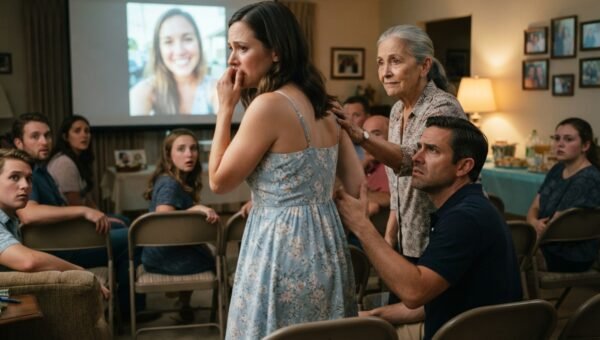
Instead, on a cold Saturday in late November, we held a service for Laura at St. Jude’s Cemetery.
It was small. Just me, my husband, our two grown children, and three of Laura’s old friends from the clinic who were now women in their fifties with gray hair and reading glasses, just like me. We buried her right beside my mother and father.
I stood between the two headstones while the minister read the twenty-third psalm. The wind was bitter, blowing dry maple leaves across the grass, but the sun was clear and bright.
For twenty-seven years, my family had lived in a quiet prison of our own imagination. My mother had blamed herself for letting Laura take that night shift. My father had blamed himself for not driving out to look for her car earlier that evening. Every holiday, every birthday, every graduation had an empty chair that felt like an open wound that never formed a scab.
Now the truth was here. It wasn’t a comforting truth. It didn’t bring my sister back, and it didn’t give her the life she should have had: the husband she never met, the children she never held, the gray hair she never grew to wear.
But when the service was over and the others walked back down the paved path toward their cars, I stayed by the open ground for a few minutes alone.
I reached into my coat pocket and pulled out the small silver wristwatch they had recovered from the well. The face was scratched and the leather strap had rotted away decades ago, but the hands were still frozen right where they stopped that Thursday night.
I laid it gently in the center of the fresh earth, turned my back on the empty house on Old Mill Road, and walked home.