PART 1
For seven years running, the rhythm of our December was as predictable as the frost on the windshield. My brother-in-law, Gary, would show up at our family dinner with a tight, apologetic smile, a cheap bottle of wine under his arm, and a story about a cash-flow crunch tied to his landscaping contracting business. Every Christmas, Gary needed a short-term bridge loan to cover payroll or equipment maintenance through the dead of winter.
And every year, without fail, my husband, Tom, would transfer eight thousand dollars from our joint account into Gary’s hands. By April, when the spring thaw hit and residential landscaping contracts kicked back into gear, Gary would wire the money back with a polite text of thanks.
I never loved the arrangement, but I tolerated it because Tom was a man of routines and loyalty, and because the money always came back. Gary’s wife, Cheryl, usually sat across from me at those holiday dinners, picking at her turkey and talking about her online boutique or her latest attempt at flipping vintage furniture, acting as though financial distress was just a mild seasonal inconvenience. I worked part-time as an administrative coordinator at a local orthopedic clinic, and every dollar in our checking account represented decades of steady overtime and sensible budgeting. Eight thousand dollars was not an amount we could casually throw away, but as long as the ledger balanced by April, I chose peace over conflict.
This past December, the routine stuttered. Gary didn’t ask for the money at our dinner table; he cornered Tom in the garage while we were loading leftovers into tupperware. I only found out about it three days later when I checked our online banking balance to pay the property tax installment and saw the eight-thousand-dollar deficit glaring back at me.
When I confronted Tom in the kitchen while he was emptying the dishwasher, he didn’t look defensive. He just wiped his hands on a dish towel and gave me that heavy, weary sigh he reserved for family obligations.
“Gary’s in a tighter spot than usual this time,” Tom said, leaning against the counter. “His main commercial client delayed their winter retainer. He needs it for truck repairs so he can keep plowing. It’ll be back by April, Sarah. Just like always.”
“You didn’t discuss this with me,” I said, my voice dropping into that cold, quiet register I used when I was trying very hard not to throw a ceramic mug against the backsplash. “That’s our liquid savings, Tom. Not a revolving credit line for your brother’s poor planning.”
“He’s family,” Tom muttered, the standard family shield raised to deflect any further debate. “It’s handled.”
I was angry—furious, even—at the unilateral decision-making, but my anger was rooted in old familiarity. I assumed it was just another repeat of the same exhausting December script. I didn’t feel a shred of suspicion. Not yet. Not until Tuesday evening when I went to hang Tom’s winter coat in the hall closet and found something heavy rattling in the deep pocket.
PART 2
I reached into the dark wool pocket of Tom’s coat expecting a stray pair of work gloves or a crumpled receipt for gas. Instead, my fingers grazed a small, folded piece of thermal paper. When I pulled it out under the hallway light, it was a customer receipt from Apex Pawn and Fine Jewelry on Route 9, dated the previous afternoon.
The description printed on the receipt stopped my breath: Vintage 14k gold filigree bracelet, diamond chips.
A cold numbness spread outward from my chest. That bracelet wasn’t just jewelry. It was the single tangible piece I possessed from my maternal grandmother, Nana Clara, who had worn it every Sunday of her life until the day she passed. I kept it locked in the small velvet-lined wooden box in our bedroom closet, a box I hadn’t opened in perhaps six months.
I walked into our bedroom, my heart hammering a frantic rhythm against my ribs, and pulled open the closet door. I reached past winter sweaters and old tax folders, slid the jewelry box out, and popped the brass latch.
Empty. The velvet indentation where the filigree bracelet had rested for fifteen years was bare.
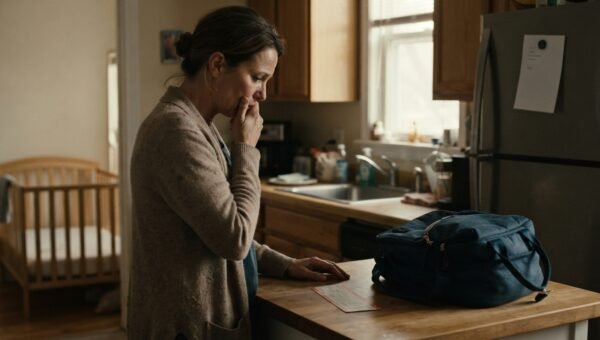
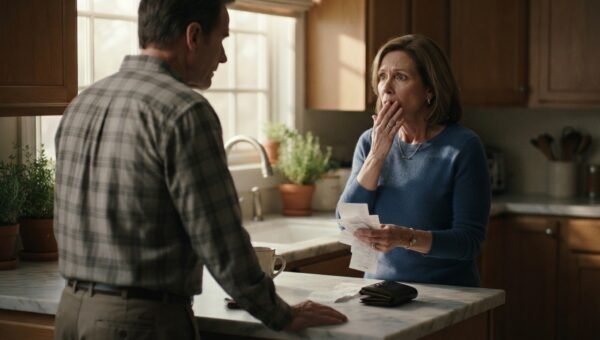
When Tom walked through the front door an hour later from his job at the municipal water utility, his lunch pail in one hand and mail in the other, I was waiting at the kitchen island with the pawn receipt and the empty velvet box.
“Explain this,” I said, sliding the thermal paper across the granite top.
Tom froze, his coat still half-zipped. The color drained from his face so fast it looked like someone had switched off a light. He didn’t try to deny it; he didn’t even ask what I was talking about. He just dropped his keys on the counter with a heavy, metallic clatter and ran a hand over his face.
“Where did you find that?” he whispered.
“In your coat pocket. And the bracelet is gone from the box, Tom. Don’t lie to me. What did you do?”
“Gary,” he said, his voice cracking. “It was Gary. His cash flow was worse than he let on. He didn’t just need the eight thousand; he had some private debt collectors breathing down his neck that week, threatening to repossess his commercial truck. If he lost the truck, his business was dead, and he couldn’t pay us back in April. He came to me desperate, Sarah. He said he needed collateral to secure a bridge loan from a private lender in town. Just for a few weeks. He promised he’d redeem it and put it back before I ever noticed.”
I stared at him, the room tilting slightly on its axis. “You pawned my grandmother’s legacy? My only heirloom? For your brother?”
“I didn’t want to!” Tom yelled, his own frustration flaring up to match mine. “He swore it was temporary. He said it was the only way to save his business so he could make things right for all of us. I’m going to get it back, Sarah. I get paid on Friday; I was going to go down there and buy it out before you ever had to know.”
“You gave my grandmother’s jewelry to a pawn shop,” I repeated, each word flat and heavy as a stone. “And you didn’t even have the decency to tell me.”
PART 3
I didn’t wait for Friday, and I didn’t wait for Tom to fix his mess. The next morning, I called in sick to the clinic, grabbed my handbag, and drove out to Route 9.
Apex Pawn was a squat, concrete-block building wedged between a tire repair shop and a laundromat, with iron bars on the windows and a neon sign buzzing faintly in the gray morning light. Inside, the air smelled of old electronics, ozone, and floor wax. A middle-aged man with graying hair and a heavy silver watch sat behind a thick sheet of bulletproof glass, sorting through a tray of pocket knives.
I laid the thermal receipt on the counter and pushed it through the narrow transaction slot.
“I’m here to redeem this,” I said, my voice steady despite the trembling in my hands. “Item number four-eight-two-nine. Vintage gold bracelet.”
The clerk looked at the receipt, then looked up at me through the glass. He picked up a barcode scanner, beeped the slip, and typed a few keys on his terminal. A faint frown creased the corners of his mouth.
“Let’s see here,” he muttered, turning his monitor slightly. ” Fourteenth of December. Cash payout of twelve hundred dollars.” He looked closer at the screen, tapping his finger against the glass. “Hold on a second.”
“Is there a problem?” I asked. “I have the cash. I want to buy it back right now.”
“Well, ma’am, you can certainly buy it back if you have the redemption fee plus interest,” the clerk said slowly, squinting at the monitor. “It’s still within the thirty-day hold window. But looking at the intake record here…” He paused, his expression turning quizzical. “Ma’am, your husband didn’t bring this in.”
My hand froze on my purse strap. “What do you mean, my husband? That’s his receipt.”
“Oh, I’m sure it’s his account or his name on the paperwork,” the clerk said, turning the screen slightly toward me so I could see the digital intake log. “We cross-reference ID for all precious metal transactions. The fellow on the account is Thomas Miller. But the person who actually stood at this counter and handed the item over wasn’t Thomas.”
He reached for a mouse, clicked twice on a security archive folder, and pulled up a still frame captured by the overhead counter camera at 3:14 PM on December fourteenth.
I leaned forward, pressing my face as close to the glass as the slot would allow.
The image was crisp, high-definition color. Standing at the counter, handing over my grandmother’s gold bracelet, was a woman with blonde hair cut into a neat asymmetrical bob. She was wearing a thick, emerald-green cable-knit sweater with silver buttons along the shoulder seams—the exact same Christmas sweater Cheryl had worn to our house two nights before for dinner.
ENDING
The clerk kept talking, his voice sounding distant and muffled, as if he were speaking from the bottom of a well.
“The lady said her husband sent her because he was stuck at work,” the clerk was saying, pointing a finger at the screen. “Said they needed grocery money for the kids before the weekend. Real polite about it, too.”
I couldn’t hear the rest. The blood rushed in my ears like a rising tide, drowning out the hum of the neon sign and the traffic outside on Route 9.
Gary hadn’t needed collateral for a business loan. Gary and Cheryl had engineered a lie, using Tom’s blind spot for family loyalty to siphon off our savings, and when that wasn’t enough, Cheryl had walked right into a pawn shop with my grandmother’s soul in her pocket to squeeze out an extra twelve hundred dollars of cash—cash they undoubtedly needed for things that had nothing to do with truck repairs or payroll.
When I got back to the house, Tom was sitting at the kitchen table, his head in his hands, waiting for me. He must have seen my face the moment I walked through the door because he stood up immediately, his chair scraping loudly against the hardwood.
“Sarah,” he started, taking a step forward. “Did you—did you get it back?”
I didn’t yell. I didn’t cry. I simply pulled my phone from my pocket, brought up the snapshot I had snapped of the security monitor at Apex Pawn, and laid the screen face-up on the table right where the receipt had been.
“Your brother didn’t pawn my grandmother’s bracelet, Tom,” I said, my voice colder than the winter air outside. “Your sister-in-law did. Now pack your bags and go find out what else your family has been stealing from us, because you are not sleeping another night under this roof.”