PART 1
For five months, I thought my seven-year-old son, Toby, was finally going through a growth spurt.
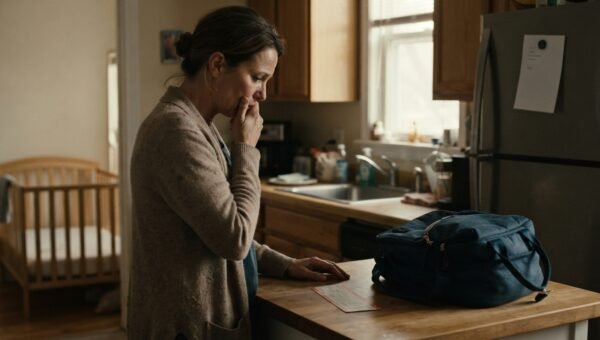
Every single morning before school, I stood at the kitchen counter and packed his brown paper bag. I made him a thick roasted turkey sandwich on whole wheat, cut a crisp Honeycrisp apple into even slices, tossed in a cheddar cheese stick, and added an organic juice box. On Fridays, I tucked a homemade chocolate chip cookie wrapped in plastic wrap into the bottom.
Between the cold cuts, fresh produce, and snacks, it cost me about forty-five dollars a week.
Every afternoon at three-fifteen, when Toby climbed into the back seat of my minivan, his lunch bag was completely empty. Not a crust left. Not an apple core. I would hand him a granola bar or a string cheese on the ride home because he always looked pale and complained that his stomach hurt. I thought he was burning through calories on the playground. I even bragged to my sister over the phone that Toby had finally stopped being such a picky eater.
Then came a Tuesday afternoon in early February.
My phone rang at one-twenty, right in the middle of my work shift. The caller ID showed Oak Creek Elementary. A mother’s heart always drops when the school number pops up during class hours, so I answered immediately, bracing myself for a fever or a scraped knee.
It was not the school nurse.
“Mrs. Anderson?” a woman asked softly. Her voice sounded older, worn around the edges, with the low hum of an industrial cafeteria kitchen behind her. “My name is Martha Jenkins. I work the lunch line here at the school.”
“Is Toby okay?” I asked, gripping the steering wheel of my parked work car.
“Toby is fine physically, dear,” she said, pausing long enough to make my stomach knot up. “I probably shouldn’t be calling you directly on my personal phone, but I couldn’t sleep last night thinking about it. Mrs. Anderson, your boy gives his entire lunch away every single day. He has been doing it since September.”
The air left my lungs. “He doesn’t eat it?”
“Not a bite of it,” Martha said. “He sits down at the middle table, unzips his bag, and hands the sandwich, the fruit, the drink, everything, straight across to the same little girl.
Every day. She never brings food from home. Not a lunchbox, not a brown bag, nothing. She doesn’t even have a school meal account set up.”
“Who is she?” I whispered.
“Her name is Lily,” Martha told me, her voice dropping lower. “She is in Toby’s second-grade class. Same faded blue sweater every week. Sleeves pulled down past her knuckles. And yesterday, when she reached across the table to take the sandwich from Toby, the cuff slid back. She had a dark purple mark wrapped right around her wrist. It looked like fingerprints, Mrs. Anderson. I reported it to the front office this morning, but they said paperwork takes days to process through the district liaison. I just couldn’t sit on it.”
I did not go back inside my office. I told my supervisor I had a family emergency, clocked out, and drove straight to Oak Creek Elementary.
The twenty-minute drive felt like an hour. My mind raced through every afternoon since the start of the school year.
I remembered Toby coming home tired, sluggish, and quiet. I remembered him asking me one night in November why some people had locks on their kitchen cabinets. I had brushed it off as a question about childproofing for babies. My throat felt tight with guilt. My seven-year-old had been starving himself for five months to feed a classmate, and I had been too blind to notice.
When I arrived at the school, it was recess time. I checked in at the main office with my visitor badge, walked past the administrative desk without waiting for an escort, and walked out toward the blacktop.
The winter air was brisk, and most of the children were running around the jungle gym, screaming and laughing. Near the brick wall of the gymnasium, away from the kickball game, Toby was sitting on a green wooden bench next to a tiny girl with tangled, mousy brown hair.
She looked small enough to be in kindergarten. She wore a washed-out navy sweater that was fraying at the collar, and her thin knees were pulled up against her chest. Toby was sitting beside her, showing her a small plastic dinosaur from his jacket pocket.
I walked across the damp asphalt, trying not to startle them.
“Hey, Toby,” I said gently.
My son looked up, his eyes widening. “Mom? What are you doing here?”
I knelt on the cold pavement right in front of the bench. The little girl instantly drew back, pressing her back against the brick wall. Her arms were crossed tight over her chest, both hands buried inside her long sleeves. She looked terrified, like a stray cat waiting to be kicked.
“Hi, Lily,” I said, keeping my voice as soft and quiet as I could. “I’m Toby’s mom, Sarah.”
She did not answer. Her eyes darted toward the teacher on duty across the yard, then down to her worn sneakers, which were held together with gray duct tape around the left toe.
I looked down at her hands. As she shifted, the sleeve of her sweater pulled back slightly. Just above her right wrist was a dark, mottled purple bruise. It was clearly the shape of four fingers and a thumb.
Toby looked between me and Lily. He saw me looking at her wrist. His chin trembled, and he reached over, leaning his head close to my ear.
“Mom,” Toby whispered, his breath warm and trembling against my neck. “Don’t be mad at her. She told me her dad locks the fridge. She doesn’t get dinner either.”
PART 2
Hearing those words come out of my seven-year-old child’s mouth felt like being hit with a sledgehammer.
I looked back at Lily. Her eyes were wide, glassy with unshed tears, and she had pulled her sweater sleeves all the way over her fingers again. She looked terrified that she had done something wrong.
“Nobody is in trouble, sweetheart,” I told her, keeping my voice steady even though my hands were shaking inside my coat pockets. “Toby, stay right here with Lily for a minute.”
I stood up, walked directly inside to the front office, and pulled the principal into a private conference room. I told her what Martha had seen, what my son had said, and the bruise I had just witnessed with my own eyes. When the principal started talking about district protocols and scheduling an intake meeting for Thursday, I cut her off.
“I am not waiting until Thursday,” I said flatly. “I am walking out to my car and calling Child Protective Services right now.”
I sat in the front seat of my minivan in the school parking lot, dialing the county emergency child abuse hotline. My knuckles were white against the steering wheel. I gave the intake officer every single detail: the five months of skipped lunches, the bruise shaped like an adult handprint on a seven-year-old’s wrist, the duct-taped shoes, and the locked refrigerator.
The dispatcher heard the urgency in my voice. Because there was an active, documented physical mark on a minor, she marked it as an immediate welfare check.
Forty minutes later, a county vehicle pulled into the school lot. A caseworker named Evelyn Miller got out. She was a woman in her late forties with a calm, no-nonsense demeanor. Two uniformed patrol officers in a squad car pulled up behind her. Oak Creek Elementary brought Lily into a private guidance counselor’s office, where Evelyn spent twenty minutes gently talking with her while a school nurse took photographs of the marks on her wrists and upper arms.
I waited in the hallway with Toby, holding his small, cold hand. When Evelyn stepped out of the office, her face was completely pale. The calm expression she had worn when she arrived was gone, replaced by a grim, hard line.
“She confirmed the address,” Evelyn told the police officers quietly. “The father’s name is Wayne Vance. The girl says there is a heavy chain and a padlock on the kitchen refrigerator, and she hasn’t had a meal at home since Sunday morning. The school nurse also documented ligature marks on her ankles.”
My stomach turned over violently. Ligature marks.
Evelyn looked at me. “Mrs. Anderson, thank you for making this call. We are heading to the residence right now.”
“Can I follow you?” I asked immediately. “If she needs clothes or food, or if she has to wait somewhere while you sort this out, I want to help.”
Evelyn hesitated, then gave a brief nod. “You can drive down the street, but you stay in your vehicle. Police will secure the scene first.”
Toby and I followed the police cruiser and Evelyn’s sedan five miles out of town, past the newer suburban developments and down an old gravel road bordered by overgrown pine trees. The Vance house was a dilapidated single-story ranch with peeling yellow siding and rusted car parts littering the front yard. The front porch steps were sagging, and the front windows were covered from the inside with thick cardboard and duct tape.
The two officers walked up the wooden steps, their hands resting near their duty belts. Evelyn stood on the gravel driveway, her phone ready. I stayed parked across the dirt road with Toby buckled securely in the back seat.
The lead officer knocked hard on the front door. “Sheriff’s Department. Welfare check.”
A minute passed in heavy silence. Then the front door swung open.
A tall, broad-shouldered man in his late thirties stepped onto the threshold. He wore clean blue jeans and a fresh button-down work shirt. His hair was neatly combed, and he had a wide, warm smile on his face that looked so thoroughly rehearsed it made my skin prickle.
“Afternoon, officers,” Wayne Vance said, sounding completely relaxed and polite. “What can I do for you folks today?”
“Mr. Vance, we have a caseworker here from Child Protective Services,” the officer said. “We’re here regarding your daughter, Lily.”
The man chuckled softly, shaking his head with an exasperated sigh, like a patient parent dealing with an imaginative toddler. “Oh, brother. Did she tell stories at school again? I swear, that girl has an active imagination. She’s fine, officers. Truly. Kids make things up when they don’t want to do their chores.”
“We need to step inside, sir,” the officer replied, his voice dropping into authority. “We need to inspect the premises.”
Wayne Vance’s smile did not drop, but his eyes turned completely cold. “Do you have a warrant?”
“We have exigent circumstances based on documented physical injury on a minor currently in state custody,” Evelyn said, stepping up the stairs. “Step aside, Mr. Vance.”
The man realized he was cornered. He stepped back into the dark hallway, leaving the front door wide open.
Through the doorway, I could see down the central hall of the house. The living room was spotless. There was a leather recliner, a large flat-screen television, and framed landscape prints on the walls. It looked like an ordinary, decent home.
Then the officers turned the corner into the kitchen.
A moment later, one of the officers called out over his shoulder, his voice tight and angry. “Get the county photographer in here right now.”
PART 3
Through the open door, I heard the metallic rattle of heavy chain links hitting linoleum.
Just as Lily had told Toby, the double-door refrigerator was wrapped in a thick, industrial steel chain, secured with a heavy brass Master Lock. Next to it, the tall pantry cabinet had a welded steel hasp screwed directly into the wooden doorframe, sealed with a combination lock. Wayne Vance had literally starved his daughter while keeping hundreds of dollars worth of fresh groceries padlocked five feet away from her.
The officers moved further down the hallway toward the back bedrooms.
Wayne’s master bedroom was fully furnished, warm, and comfortable. But when the officers reached the door at the very end of the hall, they stopped.
The door was made of solid wood, and mounted on the outside frame was a heavy-duty deadbolt. There was no handle or lock on the inside. It could only be locked or unlocked from the hallway.
“Open it, Mr. Vance,” the officer ordered.
Wayne didn’t move. He stood against the kitchen counter, his arms crossed, staring at the floor in sullen silence.
The officer kicked the frame once, right next to the deadbolt. The wood splintered with a sharp crack, and the door swung inward into pitch blackness.
The officer flicked on his tactical flashlight. The beam cut through the dust in the air, and what it revealed made the second officer curse out loud.
There was no bed in the room. There was no dresser, no toys, no rug, and no heater. In the center of the bare plywood subfloor was a thin, stained dog bed. Bolted directly into the baseboard next to the dog bed was an iron eyelet, with a length of nylon tow strap looped through it. The window had been painted black from the inside and screwed shut with three-inch drywall screws so it could not be opened.
There was no heat vent. The room was freezing, matching the February chill outside.
Sitting on the floor by the dog bed was an empty plastic margarine tub filled with an inch of murky tap water, and a stack of torn notebook paper covered in child’s handwriting.
Evelyn Miller walked into the room, shining her own light on the papers. Later, during the court proceedings, those papers were entered into evidence. Lily had been using stubby golf pencils to write out lists of foods she dreamed of eating: *Pancakes with syrup. Macaroni and cheese. Toby’s turkey sandwich. Apples.*
She had spent months locked in the dark, kept like an animal, while her father lived in warmth and comfort fifty feet away. The only nutrition she had received five days a week since September had come from the brown paper bag my son carried to school.
Wayne Vance did not say another word. When the officers stepped back into the hallway, they did not ask him any more questions. They turned him around, shoved him against the wall, pulled his arms behind his back, and clicked the steel handcuffs shut around his wrists.
As they led him down the wooden porch steps toward the squad car, he saw me sitting in my minivan across the road. He glared at me with pure, unadulterated venom. I stared right back at him, holding Toby’s hand in mine, refusing to look away until the officers shoved his head down and slammed the cruiser door shut.
Evelyn came down the driveway, her eyes wet with tears. She walked over to my car window.
“The department is taking emergency physical custody,” Evelyn said, her voice shaking. “We’re transporting her to the regional children’s hospital for a full pediatric medical evaluation. Severe malnutrition, dehydration, and contusions.”
“Where will she go after the hospital?” I asked, my heart breaking for the little girl.
“Temporary emergency foster care,” Evelyn replied. “She doesn’t have any local relatives on record. Her mother passed away three years ago, which is apparently when this abuse started.”
I looked back at Toby in the rearview mirror. He was watching us quietly, clutching his plastic dinosaur.
“Can we visit her at the hospital?” I asked. “Toby is the only friend she has.”
Evelyn looked at Toby, then back at me. She nodded softly. “Room 314 at Valley Children’s. Give the nurses two hours to get her settled.”
ENDING
That evening, Toby and I walked through the sliding glass doors of Valley Children’s Hospital carrying two large bags.
We had stopped at the grocery store on our way. I bought fresh grapes, sliced strawberries, string cheese, vanilla pudding cups, and four large bakery cupcakes with pink frosting. We also stopped at the department store and bought three soft, warm fleece pajama sets, a pair of brand-new pink running shoes that actually fit her, and a large plush stuffed bear.
When we walked into Room 314, Lily looked even smaller in the giant hospital bed. She had an IV line taped to the back of her left hand, and she was wrapped in three thick hospital blankets. But for the first time since I had met her on the school blacktop, the deep terror in her eyes was beginning to fade.
When she saw Toby walk through the door, her whole face transformed. A shy, beautiful smile broke across her face.
“Toby,” she whispered.
“I brought you the bear,” Toby said proudly, walking over and setting the giant plush toy right beside her pillow. “And my mom brought real cupcakes. The ones with the sprinkles.”
The pediatric nurse standing by the bed smiled gently at me. “She can have soft foods in small amounts. Her stomach needs time to adjust, but a little vanilla pudding and a couple of strawberries will do wonders for her spirit.”
I sat in the chair beside her bed while Toby sat on the edge of the mattress, showing her how to play a game on my phone. Lily took small, careful bites of the strawberry slices I handed her, chewing slowly as if she couldn’t quite believe the food was real, or that nobody was going to snatch it away from her.
Over the next six weeks, Wayne Vance sat in the county jail without bail, facing multiple felony counts of aggravated child abuse, unlawful imprisonment, and child endangerment. With the evidence collected from the house, the photographs from the school nurse, and the testimony from the cafeteria staff, his public defender knew he didn’t have a chance. In April, he accepted a plea agreement that sentenced him to twenty-two years in state prison without the possibility of early parole. He signed away his parental rights completely.
During those same six weeks, my husband, Mark, and I attended mandatory county foster certification classes four nights a week.
When a child has no living kin, the state prioritizes placement with families who already have an established, trusted connection to the child. The county caseworker supported us from day one. Toby had already proven that he loved Lily like a brother. Mark and I knew we had more than enough room in our home and in our hearts to give her the safety she had been denied for so long.
On a warm, sunny Friday in late March, Lily walked through our front door carrying a brand-new purple backpack.
Her hair was clean, brushed, and clipped back with little yellow barrettes. Her cheeks had regained their color, and the dark purple bruise on her wrist had completely faded, leaving behind only smooth, healthy skin.
Toby immediately took her by the hand and led her straight into the kitchen.
The first thing he showed her was the refrigerator.
There were no locks. There were no chains. Toby pulled the wide stainless-steel door open, showing her the shelves packed with fresh milk, sliced fruit, yogurt, and lunchmeat.
“See?” Toby told her, pointing to the bottom shelf where I had put a row of juice boxes and cheese sticks right at eye level. “You can open it whenever you’re hungry. Even in the middle of the night. Mom said so.”
Lily stood in front of the open door for a long moment, the cool air washing over her face. Then she turned around, wrapped her thin arms around my waist, and buried her face against my apron. I held her tight, feeling her small shoulders rise and fall with steady, peaceful breaths.
Every morning now, I stand at the kitchen counter and make two lunches. Two roasted turkey sandwiches, two bags of crisp Honeycrisp apples, two juice boxes, and two homemade cookies wrapped in plastic.
And every afternoon at three-fifteen, when my minivan doors slide open, two empty lunch bags are tossed onto the floorboard by two happy, healthy kids who finally know that love is something you never have to beg for.