PART 1
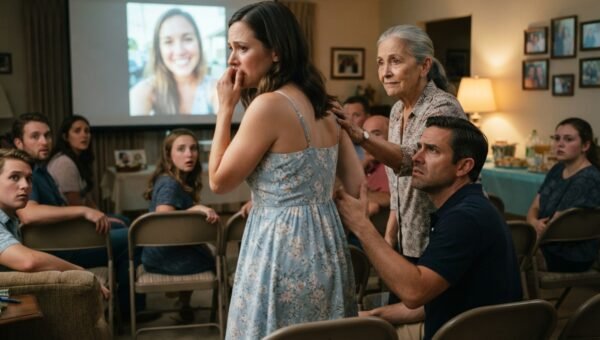
When Aunt Clara passed away last winter at eighty-four, her adult children were stunned by her final will. Clara had three children of her own—two daughters who lived in suburban Atlanta and a son out in Denver—and everyone in the family assumed her estate would be divided equally down the line. Instead, her legal executor called a family meeting in her cluttered, sunlit living room to read the final paperwork.
Most of her modest savings and her home went into a trust for the kids, exactly as expected. But her prized possession, a heavy mahogany upright piano built back in the nineteen-sixties, was left specifically to me.
I sat on the edge of a floral sofa, staring at the lawyer, feeling my face heat up under the sharp gazes of my cousins-in-law. I cannot play a single note. I took three months of clumsy lessons when I was nine years old and gave up out of sheer frustration. Everyone in the family knew it. Clara knew it better than anyone, having watched me stumble through basic holiday visits where I could barely manage Chopsticks.
My husband, Mark, squeezed my knee under the table, sensing my discomfort. As soon as the lawyer finished reading the formal clauses, Clara’s oldest daughter, Brenda, stood up so fast her chair scraped loudly against the hardwood floor.
“This is ridiculous,” Brenda said, her voice shaking with a mixture of grief and pure indignation. “Mom knew perfectly well that you don’t play. She knew Brenda and Dave live out of state, but I live ten minutes away and my daughter is taking serious conservatory lessons. That piano belonged in our branch of the family. Why on earth would Mom leave it to you?”
I swallowed hard, looking around the room at faces that had suddenly turned cold. I felt like an intruder holding a prize I hadn’t earned and didn’t even want. “Brenda, honestly, I don’t know,” I said, keeping my voice as gentle as possible. “If you want it in your house for your daughter to practice on, let’s talk to the executor. Maybe we can arrange something.”
The family lawyer adjusted his glasses and cleared his throat, tapping a thick manila folder against the mahogany coffee table. “Before anyone makes any informal agreements, let me read the specific codicil attached to this bequest,” he said.
He flipped a page and read aloud: ‘The upright piano located in the front parlor shall be delivered directly to the residence of my niece-by-marriage, Sarah. Furthermore, it is my explicit instruction that the instrument must remain inside her primary residence for a period of no less than twelve full months from the date of probate. If the instrument is removed, sold, or transferred prior to that twelve-month mark, the bequest is voided, and ownership defaults to the estate’s general liquid fund.’
The room went entirely silent. Twelve months. A full year of housing a massive, heavy piece of furniture that would just sit in our living room like an expensive monument to family friction. Brenda crossed her arms, glaring at me. “Fine. Keep your trophy for a year. But the moment those twelve months are up, you had better hand it over, because it doesn’t belong in your house.”
Two weeks later, movers padded our hardwood floors, carefully sliding the heavy mahogany beast against the long wall of our living room. Mark helped them position it, wiping a smudge of dust off the polished wood. For the first few months, it felt like an awkward guest. I placed a framed photograph of Mark and me on top, along with a glass bowl for our mail, trying to make it useful. Mark would occasionally walk past it, run a hand across the smooth top wood, and smile faintly. He had been close to Aunt Clara; she had practically raised him after his own mother passed away when he was a teenager. Whenever I apologized for the awkwardness with Brenda and the rest of the family, Mark would just wave his hand dismissively and tell me not to worry. Clara was eccentric, he reminded me. She did things her own way, and arguing with her ghost was a complete waste of time. So the piano stayed, holding our mail and gathering a thin layer of dust, while the calendar pages slowly turned toward the finish line of our twelve-month obligation.
PART 2
Ten months slipped by quietly, marked by changing seasons and the slow routine of our daily life. The piano had simply become part of the living room architecture. I had almost stopped thinking about the family drama surrounding it. But as the autumn air turned crisp, a strange mechanical issue popped up. Whenever I walked past the instrument and absentmindedly brushed against the keys, I noticed that the middle C key felt dead. It didn’t bounce back right, giving off a dull, muted thud instead of a clear note.
Since the twelve-month restriction was nearly up and we were planning to offer the piano back to Brenda once the legal window closed, I figured we ought to have it tuned so nobody could complain about us returning a broken instrument. I called local piano tuner named Arthur, an elderly man with silver hair and a worn leather toolkit who had serviced instruments in our town for decades.
On a rainy Thursday afternoon, Arthur arrived at the front door. I led him into the living room, offered him a cup of coffee, and pointed him toward the mahogany upright. Arthur set his case on the floor, snapped the brass latches open, and went right to work. He unscrewed the front panel, lifting the heavy wooden board away to reveal the complex tangle of felt hammers, steel strings, and delicate wooden dampers inside.
I sat across the room reading a magazine, half-listening to the soft clinking of his tools. After about twenty minutes, Arthur stopped moving. The silence in the room grew heavy. I looked up and saw him staring intently at the inner workings near the bass section, his flashlight beam fixed on a narrow space deep behind the action mechanism.
“Is something wrong with the hammers, Arthur?” I asked, setting my magazine down.
He didn’t answer right away. He reached out with a pair of long-nosed metal tweezers, sliding them slowly into the tight gap between the cast-iron plate and the wooden case. With a delicate pinching motion, he withdrew a flat, cream-colored envelope. It was slightly yellowed at the edges, sealed tightly with dried paper glue, and covered in a thick layer of fine household dust.
“Found this wedged right behind the pinblock,” Arthur said, turning around to face me. He held the envelope out between two fingers, as if it were fragile enough to disintegrate. “Looks like it’s been tucked in there for a very long time, ma’am. Probably decades.”
I stood up, wiping my palms nervously on my jeans, and walked over to take it. The front of the envelope wasn’t blank. Written across it in sharp, familiar, unmistakable cursive was a single name: Mark. My husband’s name. Not mine.
PART 3
My heart gave a sharp, painful lurch against my ribs. I turned the envelope over in my hands. The paper was thick linen stationery, the exact kind Aunt Clara used to use for holiday greeting cards. Why would Clara hide a letter to my husband deep inside the mechanical core of a piano she was leaving to me?
Arthur politely packed his tools while I stood frozen by the living room window, staring at the handwritten name. By the time he let himself out, my hands were trembling slightly. I placed the envelope on the coffee table and waited.
Ten minutes later, the front door clicked open and Mark walked in, shaking the autumn rain off his umbrella. He looked tired from a long day at the office, loosening his tie as he stepped into the hallway.
“Hey,” Mark said, tossing his keys onto the mail bowl on top of the piano. “How did the tuning go? Is the middle C fixed?”
I didn’t answer right away. I pointed a finger toward the coffee table. Mark followed my gaze, and the easy, tired smile instantly vanished from his face. He froze mid-step, his eyes locked onto the cream-colored envelope. The color drained from his skin so fast he looked ghost-white under the living room lights.
“What is that?” Mark asked, his voice dropping to a rough whisper.
“The tuner found it wedged behind the hammers,” I said, trying to keep my voice steady. “Inside the piano. It has your name on it, Mark. Not mine.”
He walked over slowly, his movements stiff and mechanical, like a man stepping onto thin ice. He picked up the envelope, his fingers shaking so badly he almost dropped it. He broke the brittle old seal with his thumb, pulled out a folded sheet of matching linen paper, and unfolded it.
Mark stood by the coffee table and began to read. He read in absolute, suffocating silence. Minute after minute ticked by. His eyes scanned the lines over and over, as if he couldn’t process the words his brain was feeding him. His breathing turned shallow and ragged. He swayed slightly on his feet, grabbing the edge of the bookshelf to steady himself.
“Mark, you’re scaring me,” I said, stepping closer. “What does it say?”
He didn’t answer. He couldn’t. His eyes were wide, filled with a look of absolute, shattering shock. Finally, after what felt like an eternity, he let out a choked breath, lowered his hands, and silently handed me the first page.
I looked down at the neat, sharp handwriting. The opening lines hit me like physical blows:
“I promised your mother I would never tell you who your father was unless you married someone I trusted.”
ENDING
The words blurred in front of my eyes as my mind scrambled to catch up with the sheer magnitude of the secret sitting in my hands. I looked up from the page at my husband, the man I had built a life with for over twelve years, and realized I was looking at a stranger trapped inside an elaborate web of family history.
Aunt Clara had known. She had known all along. The entire setup—the unexpected inheritance, the stubborn one-year rule forcing the instrument into my home, the deliberate delay—hadn’t been an act of spite toward her children at all. It had been a carefully engineered trap designed to wait patiently in our living room until the right moment arrived, and until the truth had a safe place to land.
Mark sank slowly onto the sofa, burying his face in his hands as the quiet realization of a lifetime of hidden lies finally caught up with him. The piano sat silent behind us, its dusty mahogany case no longer just a piece of awkward furniture, but a vault that had finally opened its doors to the past.