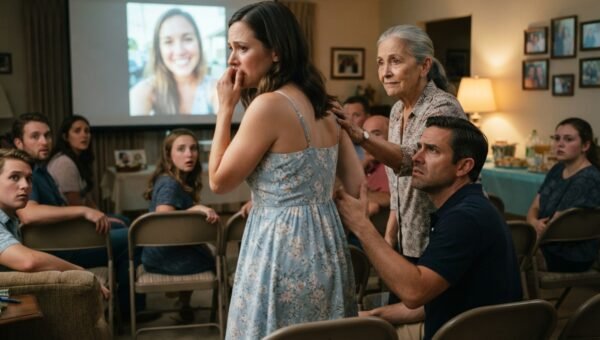
PART 1
Sunday dinner at Mom’s house had a routine that hadn’t changed in twelve years, ever since Dad passed. I arrived an hour early to carry the heavy groceries in from my car, check the water softener in the basement, and set out the good ceramic plates. My sister, Brenda, usually arrived twenty minutes late with an expensive bakery pie and a story about traffic on the interstate.
That Sunday in late May, Brenda walked in right on time. She set a plastic container of store-bought cookies on the counter, kissed Mom on the cheek, and sat at the head of the table where Dad used to sit.
She didn’t offer to pour water, and she didn’t help dish out the pot roast. She just watched me move between the stove and the table with a strange, tight little smile on her face.
Mom looked tired. Her hands had been shaking more that spring, and she kept her eyes fixed on her water glass. I thought she was just worn out from her doctor’s appointment the previous Thursday, which I had taken a half-day off work to drive her to.
We were halfway through dinner when Brenda tapped her fork against her glass.
“Before we have dessert,” Brenda said, leaning forward on both elbows, “I think we should clear the air about summer plans. Mom and I had a long talk on Friday, and we’ve handled the cabin situation once and for all.”
I stopped cutting my meat. “What cabin situation?”
“The upkeep,” Brenda said smoothly. “The fact that it’s just sitting up there in Crow Wing County becoming a burden.
Mom signed the lake cabin over to me this week. We decided it makes the most sense because I have the financial flexibility to manage the repairs, and frankly, I’m the responsible one.”
The room went dead silent. The only sound was the refrigerator compressor humming in the kitchen.
I stared across the table at Brenda, waiting for the punchline, but her chin was tilted up in that familiar posture she used whenever she felt she had won an argument. Then I looked at Mom.
“Mom?” I asked gently. “Is that what happened?”
Mom kept her head down. Her fingers fidgeted with the edge of her cloth napkin, rolling the hem between her thumb and index finger over and over.
“Brenda thought it was best, Carol,” Mom whispered. She wouldn’t look me in the eye. “She said it would take the load off your shoulders.”
“Take the load off?” I couldn’t help the tremor in my voice. “Mom, who put the metal roof on the cabin four years ago after the oak tree came down?
I took out an eight-thousand-dollar personal loan to do that because we didn’t want to touch your pension. Who drives you up every single June to open the pipes, air out the mattresses, and check the foundation? Brenda hasn’t set foot on that dock in three years.”
“That was your choice to do all that manual labor, Carol,” Brenda interrupted, waving a dismissive hand. “Nobody forced you to play handyman. But legal ownership requires capital and long-term planning. I’m taking over the expenses from here on out. The paperwork is done. The matter is settled.”
I looked back at Mom. My heart was pounding against my ribs, hot and heavy. “Mom, look at me. Did you really want to sign the cabin away to Brenda?”
Mom’s shoulders slumped. She gave one brief, miserable nod toward her plate. “She said it was simpler this way, honey. For the taxes.”
I didn’t yell. I didn’t push my chair back or slam my napkin down.
When our father died, I had promised him I would keep the family peaceful, and for twelve years I had swallowed Brenda’s snide remarks and her endless excuses about money. I stood up, cleared my plate, and carried the dirty dishes to the sink.
“I’m glad your taxes will be simpler, Brenda,” I said quietly, turning on the hot water.
Brenda left twenty minutes later, looking triumphant. Mom went straight to bed with a headache, still unable to meet my eyes when I brought her nightly glass of water to her nightstand. I locked the front door, checked the porch light, and drove home in silence, feeling hollowed out from the inside.
Three days passed. It was Wednesday afternoon, and I was sitting at my desk at the regional dental office where I worked as an office manager. My phone buzzed with an unfamiliar local number from the county seat where the cabin was located.
I answered, expecting a telemarketer or an automated utility survey.
“Carol Jenkins?” a woman’s voice asked. It sounded brisk, professional, and slightly hurried.
“Yes, speaking.”
“This is Darlene from the Crow Wing County Recorder’s Office,” she said. “I’m calling because we have a quitclaim deed submission here for parcel 44-012, the property on Pelican Lake under Evelyn Jenkins. Your name came up on our cross-reference screen because you’re listed on an active utility easement and shared driveway agreement recorded back in 2018.”
“Right,” I said, sitting up straight. “When the county widened the access road. I had to sign off because I handled the septic permit.”
“Exactly,” Darlene said. “Well, that’s why your contact number is flagged in our system. The reason I’m calling is that a transfer deed was filed on Monday morning attempting to deed the full parcel from Evelyn Jenkins to Brenda Miller. But our chief examiner caught a fatal discrepancy during initial intake, and the recording was formally rejected yesterday afternoon.”
My breath caught. “Rejected? Why?”
“Miss Jenkins, I can’t discuss the full administrative details over the phone,” Darlene said, her tone lowering just a bit. “All I can tell you is that there is a major problem with the execution of the instrument. It was brought in by a third-party courier, but the signature page has serious issues. Under our state statutes, because you hold an recorded interest in the access parcel, you have the right to inspect filings affecting the property before they are resubmitted or purged.”
“What kind of issues?” I pressed.
“You need to see the signature page yourself,” Darlene said flatly. “If you can drive up to the courthouse before four o’clock tomorrow, I will pull the rejected file for you. I think you’ll understand immediately why my examiner refused to stamp it.”
PART 2
I left work early on Thursday morning. The drive up to the county seat took two hours, past the flat farmland and into the pine country where Dad used to take us every summer. My hands gripped the steering wheel so hard my knuckles were pale.
The Crow Wing County Government Center was a quiet brick building that smelled of old floor wax and paper files. I walked up to the counter in the Recorder’s Office, where a woman in her late fifties wearing reading glasses on a beaded chain looked up from behind a glass partition. Her desk nameplate read Darlene Vance.
“I’m Carol Jenkins,” I said. “You called me yesterday about my mother’s property.”
Darlene’s expression softened. She nodded, got up from her chair, and stepped into an inner office. A minute later she returned carrying a manila folder with a bright yellow rejection slip stapled to the front. She motioned for me to follow her over to a small viewing table against the wall.
“We keep rejected recordings in a temporary holding queue for ten business days in case the filing party requests a formal conference,” Darlene said, opening the file. “A courier delivered this package on Monday morning. It contains a standard Minnesota quitclaim deed transferring the cabin from Evelyn Jenkins to Brenda Miller for one dollar and valuable consideration.”
She turned the page. The bottom of the sheet had two signature lines.
The line for the Grantor read *Evelyn Jenkins*.
I leaned down and looked closely at the ink. My heart gave a violent thud.
My mother was seventy-eight years old. She had developed an intentional tremor in her right hand about four years ago. Her signature on birthday cards and grocery checks was always shaky, slanted backward, and light, with broken strokes where her pen lifted off the paper.
The signature on this deed was written in bold, confident blue ballpoint. The letters were tall, perfectly rounded, and tilted sharply to the right. Every ‘e’ was looped with a distinct, sharp flourish, and the crossbar on the ‘t’ extended half an inch past the upright stroke.
It wasn’t Mom’s handwriting.
It was Brenda’s.
Brenda had written like that since high school. She wrote all her family greeting cards in that exact same flourishing, decorative script. She had tried to alter it slightly by making the letters smaller, but she hadn’t been able to hide her distinctive flourishes. Anyone who had ever opened a Christmas card from Brenda would know that hand instantly.
“The signature didn’t match the signature card we had on file from your mother’s 2018 easement filing,” Darlene said quietly, pointing a pen tip at the bottom corner. “Our chief examiner noticed the variance immediately. But that wasn’t the only reason it was kicked back.”
Darlene pointed to the notary block on the lower right side.
There was an official circular notary stamp, legible and clean, bearing the name *Marcus Vance – Notary Public, State of Minnesota*.
“Do you know a Marcus Vance?” Darlene asked.
“No,” I said, my voice barely audible. “No relation to you, I assume?”
“None,” Darlene said firmly. “Marcus Vance is a mobile notary who works out of a strip mall shipping store in South Minneapolis, about three miles from where your sister lives. The document claims your mother appeared in person before Marcus Vance on Friday, May 16th, at two-thirty in the afternoon, presented a valid state driver’s license, and executed this deed.”
I stared at Darlene. A cold wave of clarity washed over me.
“That’s impossible,” I said. “Last Friday afternoon, my mother was sitting in an exam room at the Fairview Geriatric Clinic from two o’clock until nearly four. I was sitting right beside her the entire time. Her doctor gave her an EKG and reviewed her blood pressure medication. She never left the building, and she certainly didn’t visit a notary in South Minneapolis.”
Darlene folded her arms. “Then your sister had someone else impersonate your mother, or the notary stamped a document without the principal physically present. Either way, this instrument is fraudulent. It’s a felony to knowingly record a forged document in this state.”
“What happens now?” I asked.
“Right now, it’s just a rejected filing sitting on my desk,” Darlene explained. “Our office doesn’t initiate criminal charges automatically. We issue a notice of rejection to the submitting party, which in this case was an online filing service Brenda used. But if you take a certified copy of this to the sheriff or county attorney, an investigation opens.”
I paid five dollars for a certified copy of the deed and the rejection form. As I walked out to my car in the gravel parking lot, my hands were steady. The hurt and disbelief from Sunday dinner had completely vanished, replaced by a cold, protective rage.
Mom hadn’t agreed to give the cabin away. Brenda had bullied her, manipulated her, and when Mom hesitated, Brenda had taken matters into her own hands and faked the paperwork. That was why Mom had looked so terrified at dinner. Mom knew she hadn’t signed anything, but Brenda had told her it was already done.
I pulled out my phone, sat in the front seat, and dialed my mother’s landline.
PART 3
Mom answered on the fourth ring. Her voice sounded thin and anxious.
“Carol? Is everything okay?”
“Mom,” I said, keeping my tone calm and steady. “I’m sitting outside the county recorder’s office in Crow Wing. I’m looking at the deed Brenda tried to file for the cabin.”
There was a sharp intake of breath on the other end of the line, followed by a long silence. Then came a quiet sob.
“Oh, Carol,” Mom whispered. “I’m so sorry. I didn’t know what to do.”
“Mom, tell me the truth. Did you sign anything for Brenda last week?”
“No,” Mom cried softly. “She came over on Thursday night after you dropped me off. She had a folder of papers. She told me the roof was going to leak again, that the county was raising the property taxes by three thousand dollars, and that if the state saw I owned real estate, they would cut off my Medicare benefits if I ever needed a nursing home. She told me I was going to lose everything unless I put her name on the deed.”
My jaw tightened. Brenda knew perfectly well that standard Medicare wasn’t asset-tested, but she had used Mom’s deepest fear—being a burden and running out of money—to terrify her.
“What did you tell her, Mom?”
“I told her I couldn’t do that to you,” Mom said, her voice shaking. “I told her you were the one who saved the cabin, and that Dad wanted both of you to share it. Brenda got furious. She slammed her purse on the table, took her folder, and yelled that I was letting sentimentality ruin our family. Then on Sunday, she walked in and told you it was already done. I was so confused, Carol. I thought maybe I had signed something years ago that I forgot about. I was too ashamed to say anything in front of her.”
“You didn’t do anything wrong, Mom,” I said gently. “Brenda signed your name herself. She had a dishonest notary stamp it, and the county clerk caught it immediately. It’s not registered. The cabin is still yours.”
Mom breathed out a long, ragged sigh of relief. “What is she going to do now?”
“Nothing,” I said. “Because you and I are going to handle this right now.”
I told Mom to stay put and drove straight to Brenda’s house in Edina. It was a manicured two-story house with a pristine lawn and a brand-new luxury SUV parked in the driveway.
I parked at the curb, took the manila envelope from the passenger seat, and walked up to the front door. I rang the bell once.
Brenda opened the door wearing gym clothes, a smoothie in her hand. When she saw me, her expression instantly shuttered into defensive irritation.
“Carol? What are you doing here? I’m in the middle of a conference call.”
“We need to talk about Crow Wing County,” I said.
Brenda’s eyes flickered, but she held her ground. “I told you on Sunday, the cabin is handled. If you’re here to beg for summer weeks, you’re wasting your time. I’m having a contractor look at modernizing the deck next week.”
“You won’t be having any contractor look at that cabin, Brenda,” I said. I stepped past her into the tiled foyer. She backed up a step, startled by my presence.
I opened the manila folder and pulled out the certified copy of the quitclaim deed, holding it up right in front of her face. The bright yellow rejection slip was clearly visible.
“The county recorder rejected your filing on Tuesday,” I said, keeping my voice level and controlled. “The chief examiner flagged the signature within two minutes. And then Darlene Vance, the clerk, called me because my name is on the easement.”
Brenda’s face went completely white. The smugness drained from her features so fast it was like watching a mask crack in half.
“That’s… that’s just a clerical error,” she stammered, looking away from the paper. “The online service must have uploaded the wrong draft.”
“Don’t lie to me, Brenda,” I said, stepping closer. “Look at that signature. Look at the loops on the letters. Look at the cross on the ‘t’. You signed Mom’s name yourself. And you had your local notary, Marcus Vance on 66th Street, notarize it without Mom being there. Friday at two-thirty in the afternoon. Mom was at Fairview Clinic with me the entire time.”
Brenda opened her mouth, but nothing came out. Her throat bobbed as she swallowed.
“Do you know what this is?” I continued, tapping the yellow slip. “It’s criminal fraud. It’s forging a public instrument and attempting to defraud an elderly parent of real property. If I drive this document forty minutes south to the county attorney’s office, you won’t be thinking about modernizing the cabin deck. You’ll be hiring a criminal defense attorney.”
Brenda’s smoothie glass rattled against the entryway table as she set it down. Her hands had started to shake.
“Carol, please,” she whispered, her voice suddenly cracking. “You wouldn’t do that to your own sister. I did it for the family. You know Mom can’t manage things anymore. If something happens to her, the cabin will be tied up in probate for years. I was just trying to protect the asset.”
“You weren’t protecting an asset,” I said. “You were stealing it. You lied to Mom about her Medicare. You terrified an old woman in her own kitchen, and then you forged her signature because you wanted a lake house you never lifted a finger to maintain.”
“What do you want?” Brenda asked, tears of panic finally springing to her eyes. “Are you going to the police?”
ENDING
I stood in Brenda’s front hall for a long moment, looking at my sister. The anger inside me had cooled down into something hard and permanent. I wasn’t going to send my sister to prison, not because she didn’t deserve the shock, but because having her arrested would completely destroy what little peace our mother had left. Mom would blame herself, and her health couldn’t take the public humiliation of a family court scandal.
“Here is exactly what is going to happen,” I said.
Brenda looked at me, terrified to speak.
“First, you are going to call Marcus Vance right now and tell him that Crow Wing County rejected the filing due to fraudulent notarization. You’re going to tell him that if he ever touches another document with our family’s name on it, I will file a formal complaint with the Secretary of State’s notary board and have his commission revoked.”
Brenda nodded frantically. “I’ll call him today. Right now.”
“Second,” I said, “tomorrow morning at ten o’clock, you and I are meeting at Mom’s attorney’s office in Minneapolis. Mom is signing a revocable transfer-on-death deed for the cabin. It will place the property into a formal family trust upon her death, with me designated as the sole managing trustee. You will receive an equal share of the equity if it is ever sold, but you will have zero legal authority over the property, zero access to the deed, and you will not make a single decision about who stays there or what happens to it.”
Brenda swallowed hard, looking down at the tile floor. “And if I don’t agree?”
“If you don’t show up tomorrow morning, I take this file directly to the Crow Wing County Attorney,” I said evenly. “And I’ll call the Minnesota Department of Commerce about your real estate broker’s license while I’m at it. I think they’d be very interested to know one of their licensed professionals is forging deeds.”
Brenda closed her eyes. A heavy tear slipped down her cheek. “I’ll be there at ten.”
“Good,” I said. “And one last thing. You are never to speak to Mom about money, property, or legal affairs again. Not a single word. If you want to visit her, you bring her cookies, you ask about her garden, and you act like a daughter. If you bring up finances to her one more time, our deal is off.”
I took my folder, turned around, and walked out to my car without waiting for an answer.
The next morning, Brenda showed up at the attorney’s office wearing a dark suit and no makeup. She sat across the conference room table in complete silence while the lawyer went over the trust documents with Mom. Mom looked rested. With the truth out in the open, the heavy cloud that had been hanging over her all week had lifted. She signed the trust papers with her shaky, light hand, and I signed as the primary trustee.
When the lawyer finished stamping the final pages, Brenda stood up, muttered a quiet goodbye, and walked out before the door had even fully swung shut.
Mom reached across the table and took my hand. Her fingers were still trembling, but her grip was firm.
“Thank you, Carol,” she said softly. “Your father would have been proud of how you handled that.”
“I just wanted to make sure you were safe, Mom,” I said.
Memorial Day weekend arrived two weeks later. I drove Mom up north for our annual trip to open the cabin. The early summer air smelled of pine needles and damp earth as I pulled into the gravel drive.
I spent the afternoon unlocking the shutters, turning on the main water valve, and clearing the fallen pine cones from the path leading down to the lake. Mom sat in her favorite wicker chair on the screened porch, wrapped in an old woolen blanket Dad had bought in Duluth forty years ago, watching the loons dive out on the calm water.
The cabin wasn’t modern, and the deck still needed a fresh coat of sealant, which I planned to do in July. But the roof over our heads was solid, the deed was locked safely in a trust where no one could touch it, and for the first time all year, Mom was smiling.