PART 1
My sister Karen called me the first week of October to ask if I would take Thanksgiving because her kitchen was being torn down to the subfloor. I told her yes before she could even finish apologizing. That was my first mistake, jumping in to make life easier for someone who had never once worried about making mine easy.
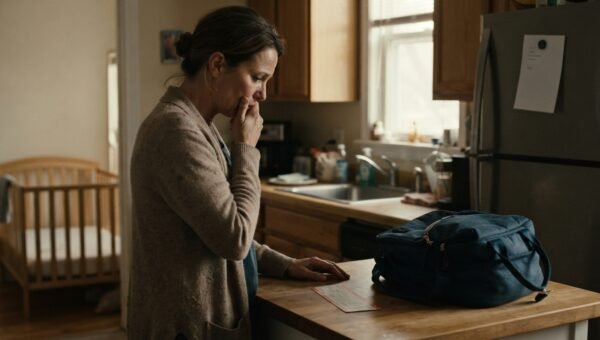
I cooked for twenty people. I started on Tuesday morning with the pies, baking four pumpkin and two apple, and by Wednesday night my feet were swollen into my shoes from standing on the linoleum.
I spent two solid days scrubbing the bathrooms, ironing the cloth napkins my mother left behind, and bringing folding chairs up from the basement. I wanted the house to feel warm. My husband, Dave, passed away three years ago, and while the quiet in the rooms usually doesn’t bother me, having family around a full table still mattered.
Karen arrived forty-five minutes late on Thursday. She walked in empty-handed, leaving the front door wide open to the November draft while she kicked off her boots in the entryway. She didn’t bring the cranberry relish she had promised, and she didn’t offer an excuse. Her husband, Greg, carried in their coats, tossed them on my spare armchair, and headed straight for the den without saying hello.
Dinner went the way dinners usually go with Karen. She poked at the dressing, pushed the green beans to the rim of her plate, and remarked that the turkey breast seemed dry compared to what a brine usually does.
I took a swallow of water, swallowed the irritation with it, and told myself it was just her way. Karen had been pointing out flaws in my cooking since we were girls sharing a bedroom on Elm Street.
What broke me happened an hour later in the kitchen.
I was standing by the stove, scraping gravy into a glass jar, when Karen walked into the adjoining pantry to grab a soda from the spare fridge. Our Aunt Evelyn was in there with her, folding up a loaf cake she had brought.
“It’s an awful lot of work for one person,” Evelyn said softly. “Sarah really wore herself out.”
“Oh, please,” Karen said, her voice flat and dismissive. “Sarah volunteered because she’s lonely. If she wasn’t running herself ragged for us, she’d just be sitting here watching television in the dark. It gives her something to do.”
The grease on the stove seemed to blur. My hands tightened on the rim of the gravy boat until my knuckles went white.
I didn’t yell. I didn’t drop the dish. I simply walked out the back door onto the back porch, stood in the cold air without a sweater, and waited for my breathing to slow down so I wouldn’t say something ugly in front of the grandchildren.
When I came back in, the kitchen was noisy again. My sixteen-year-old niece, Chloe, Karen’s youngest, was stacking the heavy stoneware platters near the sink.
“Aunt Sarah, do these go downstairs in the fruit cellar like last year?” Chloe asked.
“Yes, honey,” I said, keeping my voice steady. “Down the basement stairs, in the cupboard with the metal latch.”
I picked up the roasting pan to follow her down, needing to get away from the sound of Karen’s laugh in the dining room. Downstairs, the basement smelled like concrete and laundry detergent. Chloe was standing in front of the old green utility cabinet against the far wall, the door hanging open.
She was looking at something on the top shelf, past the canning jars and extra roasters.
“Aunt Sarah, this was tucked behind the vinegar bottles,” she said.
She turned around holding a thick, discolored manila envelope. The edges were curled, and across the front, in our mother’s firm, slanted cursive with a blue ballpoint pen, were seven words:
*Do not open until Karen knows the truth.*
Chloe handed it to me. The paper felt brittle and heavy under my fingers. My mother had been dead for nine years, and she had never mentioned hiding anything in the basement fruit cellar.
“Is it a will or something?” Chloe whispered.
“I don’t know,” I said.
I didn’t open it. I knew the rules of that house, and I knew my mother. If she wrote Karen’s name on it, she meant for Karen to carry the weight of it.
I walked up the basement stairs with the envelope in my hand. Karen was standing near the foot of the stairs, checking her watch and telling Greg to find the car keys.
“Karen,” I said, stepping into the hall.
She turned, her brows furrowed like I was interrupting her schedule. “What is it, Sarah? We have to beat the traffic on the bridge.”
I held out the envelope without a word. She looked at the blue ink, recognized our mother’s handwriting instantly, and the impatient look vanished from her mouth. She pulled the flap open with her thumb, took out the single folded sheet inside, and read the first line.
Her knees seemed to loosen completely, and she sat down hard right there on the bottom basement step.
PART 2
The house was still noisy around us. Greg was laughing at something on the television in the other room, and one of the kids dropped a fork on the dining room hardwood with a sharp clatter. Karen didn’t look up. She sat on that painted wooden step with her knees apart and her coat half-fastened, staring at the paper in her hands.
“Where did this come from?” she asked. Her voice didn’t have any of the sharp edge it had twenty minutes earlier in the pantry. It sounded small, like she was nine years old again and had just broken a dish.
“Chloe found it behind the jars in the basement cupboard,” I said. “What is it, Karen?”
She didn’t answer me. She folded the letter back up along its yellowed crease, her fingernails digging into the paper, and tried to slide it back into the envelope. Her hands were shaking so hard she missed the opening twice.
“It’s nothing,” she said, pulling herself up by the handrail. “It’s just some old personal notes Mom left. Family business. Nothing to do with today.”
“If it was family business, Mom wouldn’t have hidden it next to the pickling salt,” I told her, stepping directly into the path between the stairs and the coat rack. “And she wouldn’t have put your name on it with a warning.”
Aunt Evelyn came out of the kitchen with her purse over her arm, stopping short when she looked at the two of us. She had known my mother since high school; they used to share a ride to the textile plant back in 1968. Evelyn looked at Karen’s face, then down at the blue ink on the envelope, and her expression changed entirely.
“You found that,” Evelyn said quietly, not asking a question at all.
Karen turned on her instantly. “Did you know about this?”
“Your mother told me the year before she passed,” Evelyn said, keeping her voice low so the younger ones in the den wouldn’t wander out. “She told me she left it where it belonged, in the house that paid for it. She told me she couldn’t bring herself to hand it to you while she was still breathing because she didn’t want to spend her final years listening to you make excuses.”
My stomach turned over. “Paid for what, Evelyn? What are you talking about?”
Karen pushed past me toward the front closet, grabbing Greg’s coat off the armchair. “We’re leaving. Greg, get the car started. Now.”
“No,” I said.
I didn’t yell, but the word came out hard enough that the television in the den went quiet. Greg appeared in the doorway holding a half-eaten roll, looking back and forth between his wife and me.
“Sarah, let it go,” Karen muttered, her face flushed red, reaching for her boots. “It’s ancient history. It doesn’t help anybody to drag it out over Thanksgiving.”
“You stood in my kitchen thirty minutes ago and told our aunt that I took in twenty people because I was pathetic and had nowhere else to be,” I said, my voice steady, though my chest felt tight. “You ate my food, you complained about my cooking, and you treated my home like a cafeteria. If there is something my mother left in this cellar with your name on it, you are going to tell me what it is before you walk out that door.”
Greg looked at Karen. “What’s she talking about, honey?”
“Stay out of it, Greg,” Karen snapped, but her voice cracked on his name. She stood in the foyer, holding the envelope against her winter coat like a shield. She looked at Evelyn, then at me, realizing for the first time that Evelyn wasn’t going to cover for her.
“Read it, Sarah,” Evelyn said from the kitchen doorway. “If she won’t tell you, you have every right to read the handwriting your mother left behind.”
Karen closed her eyes. For a second, I thought she was going to run out into the November cold without her boots on. Instead, her shoulders slumped, and she handed me the yellow sheet.
PART 3
The paper was three-hole punched notebook paper, the cheap kind our mother used to keep on the kitchen desk for grocery lists. It was dated October 14, 2014, eleven months before Mom died of pancreatic cancer.
The handwriting was shaky toward the bottom, but the first paragraph was clear:
*To Karen: If you are reading this, it means you finally had to face what you took, or Sarah finally found out why her life got so hard after your father passed.*
I looked up at Karen. She was staring at the floorboards, refusing to meet my eyes.
I read the rest of it standing under the foyer light while the draft from the front door blew across my ankles.
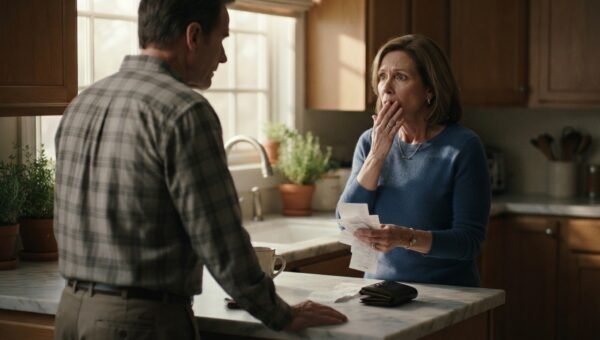
In the spring of 2008, right after our father died from his second stroke, Karen had gone to our mother with a story about an audit at Greg’s small contracting business. She had told Mom that without eighty-five thousand dollars by the end of that month, Greg was facing criminal charges for unpaid state payroll taxes, and that the bank would foreclose on their house on Maple Street. She had begged Mom not to tell me, claiming that my husband Dave was too close with the county clerk and that the embarrassment would ruin their family in town.
Mom didn’t have eighty-five thousand dollars sitting in checking. What she had was our father’s life insurance policy, a payout of one hundred thousand dollars meant to clear the mortgage on this house so Mom could live here comfortably, and an agreement that whatever remained would be split evenly between Karen and me.
Instead, Mom took out a second mortgage on this house to cover the bank note, handed Karen eighty-five thousand dollars in cashier’s checks, and made Karen sign a promissory note pledging to repay the loan at five hundred dollars a month.
The note attached to the letter was the original promissory agreement. Karen had made exactly three payments in 2008, totaling fifteen hundred dollars, and then stopped entirely.
When Mom asked for the money in 2010 because the adjustable rate on the second mortgage jumped, Karen had told her that the business had failed anyway, the money was gone, and that if Mom tried to take her to court, Karen would never let her see the grandchildren again.
*I kept the house from foreclosure by taking a part-time job at the dry cleaners when I was seventy-one years old,* Mom wrote in the letter. *Sarah never knew why I took that job. She thought I was bored after your father died. She brought me groceries every Sunday and paid my fuel oil bill every winter because she thought my pension was small. You let your sister pay my heating bills while you drove a new Buick.*
The letter ended with one final instruction:
*You will tell Sarah the truth, or you will forfeit every single dime of the land your father owned in Greenup County. If you try to take that land, this letter goes to the probate judge.*
I stood there with the paper in my fingers. The pieces of the past fifteen years rearranged themselves in my mind so fast it made me dizzy.
I remembered Mom working twenty-five hours a week at the cleaners, her arthritis so bad her fingers looked swollen like ginger roots, telling me she just liked being around the ladies at the counter. I remembered Dave and me going without a vacation for five years so we could pay off the fuel oil company and keep Mom’s furnace running. And all the while, Karen had been living three miles away, renovating her bathrooms, buying new cars, and talking about how “frugal” Mom had become in her old age.
“You let her work at the cleaners,” I said. My voice was barely a whisper.
“We were drowning, Sarah,” Karen said, her face blotchy and wet. “You and Dave had good state jobs. You had pensions coming. Greg was about to lose everything. What was I supposed to do?”
“You threatened to keep the kids from her,” I said.
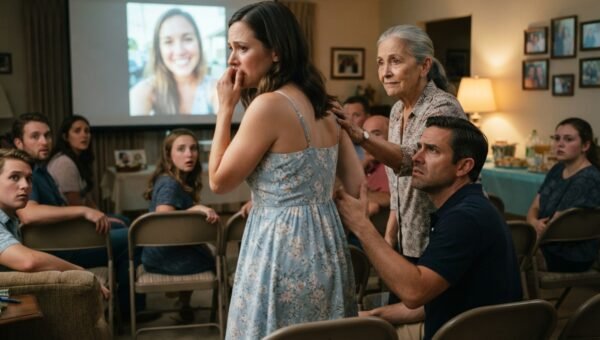
“I was desperate!” she cried out, and for the first time, Greg stepped away from her, his face completely pale.
“You told me your mother gave you that money from an old inheritance, Karen,” Greg said, his voice trembling with a disgust I had never heard in him before. “You told me it was your share from your grandmother.”
“Shut up, Greg!” she screamed.
“No,” Greg said, backing toward the front door. “You told me we were square with your family. You let me sit at this table for fifteen years thinking your mother gave us a gift.”
ENDING
The house cleared out faster than it ever had on a holiday.
Greg took the car keys from Karen’s hand, walked out to the driveway, and sat in the car with the heater running while Karen gathered her things in complete silence. Chloe stayed in the entryway for a minute, looking at me with tears in her eyes, before I hugged her gently and told her none of this belonged to her. It wasn’t her burden to carry.
When Karen picked up her purse, she looked at me one last time from the threshold.
“What are you going to do?” she asked, her voice hollow.
“I’m going to see Lawyer Henderson on Monday morning,” I told her. “The Greenup County land has been sitting in probate limbo since Mom died because you refused to sign the partition papers. You are going to sign the deed over to me, Karen. Every square foot of it. You took Mom’s security, and you took Dave’s and mine while we tried to keep her afloat. You don’t get another inch.”
She looked like she wanted to argue, but Aunt Evelyn was still standing right behind me, watching every move she made. Karen didn’t say goodbye. She pulled her coat tight around herself and walked down the porch steps into the dark.
After they were gone, Evelyn helped me clear the rest of the table. We didn’t talk much. We packed the turkey into plastic containers, wiped down the counters, and put the pies in the pantry. When we were done, Evelyn kissed my cheek, told me Mom loved me more than she was ever able to say out loud, and drove home.
By nine o’clock, the house was completely still.
I made a cup of black tea, took Mom’s yellowed letter, and walked back down into the basement. I didn’t hide it behind the vinegar bottles this time. I brought it upstairs, laid it flat on the kitchen desk next to my checkbook, and placed Mom’s old brass paperweight on top of it.
I looked around my kitchen. The dishes were clean, the counters were dry, and the rooms were quiet.
For three years, I had let Karen make me feel small for living alone in this big house, as if being by myself meant I had failed at something. But sitting there in the warm kitchen, I realized I wasn’t lonely at all. I had spent fifteen years carrying this family on my back without even knowing it, and for the first time in my life, the weight was entirely gone.