PART 1
The day Maya moved into our guest room, she carried everything she owned in two heavy-duty black trash bags and a canvas tote bag from a grocery store. She was nineteen years old, tall and narrow-shouldered, with dark, watchful eyes that looked like she was constantly calculating the quickest path to the nearest exit.
My husband, David, carried the bags upstairs for her. I showed her where the extra sheets were in the hallway linen closet, gave her the Wi-Fi password written on a piece of yellow legal paper, and pointed out the shelf in the pantry where she could keep her own snacks if she wanted.
She stood with her hands folded over her belt loops, nodding at every single sentence like a soldier receiving barracks instructions.
“Thank you, Aunt Sarah,” she whispered. Her voice was barely louder than the hum of our refrigerator. “I will keep it clean. You won’t even know I’m here.”
“Maya, you’re family,” I told her, setting a clean towel set on the foot of the bed. “You don’t have to hide. You can make noise. You live here now.”
She offered a tight, polite smile that didn’t reach her eyes, and she kept her hands folded.
Maya had aged out of the state foster care system six months earlier. In our county, once you turn eighteen and finish high school, the monthly stipend stops, the case manager closes the file, and the bed in the group home belongs to the next kid in line. David’s family had always known about Maya in an abstract, uncomfortable way.
We were told years ago that David’s estranged younger brother, Mark, had fathered a baby with a woman who took off, and that the child had ended up in the system after Mark got tangled up in trouble out west and disappeared entirely.
When David learned from an old family friend that Maya was sleeping on a coworker’s pull-out sofa and working seventy hours a week between a diner counter and an auto parts warehouse, he came home with tears in his eyes. We had a four-bedroom colonial in Ohio that had felt hollow ever since our two boys moved out for college. We had the space. We had the grocery budget. Taking her in wasn’t charity to us; it was simply the decent thing to do.
David’s sister, Evelyn, saw it very differently.
The following Sunday, Evelyn drove over to our house after church without calling first. She sat down at our oak dining table, refused my offer of iced tea, and smoothed the pleats of her tailored navy skirt.
“You and David are being entirely too soft-hearted,” Evelyn said, her voice carrying that sharp, clipped cadence she used whenever she felt someone in the family was making an embarrassment of themselves. “Mark made his bed twenty years ago, and bringing his consequences under your roof is foolish. You don’t know this girl. You don’t know what kind of habits she picked up in those institutions.”
“She works from six in the morning until nine at night, Evelyn,” I said, keeping my tone level as I dried a mug with a dish towel. “She doesn’t drink, she doesn’t smoke, and she washed her dinner plate before she even sat down to eat her sandwich last night.”
“It’s about the principle, Sarah,” Evelyn insisted, tapping her manicured nails on the wood. “Handouts breed entitlement. When you reward bad choices, people never learn to stand on their own two feet. Mark never did, and you’re setting this girl up for the exact same failure.”
“What bad choices did Maya make?” David asked, walking into the kitchen from the garage with grease on his knuckles. “Tell me one bad choice she made. She was six months old when the state took custody. Did she plan that out?”
Evelyn’s mouth tightened into a pale, bloodless line. She gathered her purse and stood up. “Mark dragged this family’s name through the mud for a decade. All I’m saying is that you shouldn’t be surprised when she takes advantage of you. Blood doesn’t guarantee character.”
For six months, Maya proved Evelyn wrong every single day.
She worked the breakfast shift at the diner on Route 4, and by two in the afternoon, she was stocking heavy brake pads and alternator boxes at the distribution warehouse near the bypass. She never missed a rent contribution, even though David and I refused to touch the envelopes of cash she slipped under our bedroom door. We opened a separate savings account at our credit union and deposited every dollar she gave us, planning to hand it back to her whenever she felt ready to look for her own apartment.
She was so quiet you could forget she was in the house. She never brought friends over. She ate her dinners at the kitchen counter, rinsed her fork immediately, and spent her evenings reading thick paperback novels or staring at her laptop with headphones on. If David or I walked into the kitchen while she was making toast, she would instantly step aside to give us room, as if she were taking up space she hadn’t paid for.
Then came a rainy Tuesday morning in early October.
David woke up at five-thirty to start the coffee pot. By six-fifteen, he noticed the light in the hallway wasn’t on. Maya’s first shift started at six-thirty, and she was usually out the door by six. He knocked lightly on her bedroom door. There was no answer. He pushed it open just an inch, thinking she might have overslept from exhaustion.
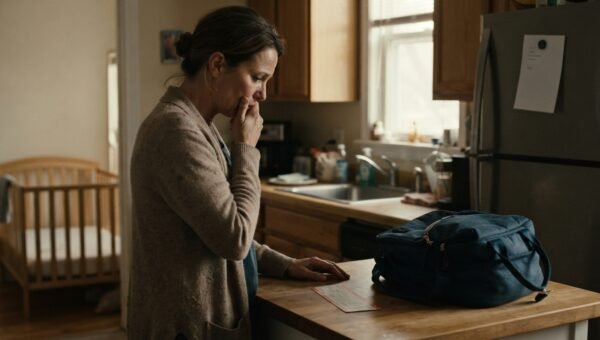
The bed was made with military precision. The hospital corners were tucked tight, and the pillows were aligned neatly against the headboard. The two trash bags she had arrived with were gone. The closet door hung open, completely empty except for the bare wire hangers we had given her.
On the small desk beside the window lay her house key, a brass key ring David had bought for her, and a single sheet of lined notebook paper.
David called my name from the stairs, his voice cracking in a way I hadn’t heard since his father passed away. I ran up in my bathrobe.
The note was written in blue ballpoint ink, neat and small:
*Thank you for everything you did for me. You were kinder to me than anyone has ever been. Please don’t look for me. I have to finish this myself.*
I checked the bathroom. Her toothbrush was gone. The shampoo bottle she bought herself was gone. She hadn’t taken a single thing that belonged to us, not even the extra wool throw blanket I had left on her chair for cold nights.
“Why would she leave?” David kept asking, pacing the hallway floorboards. “Did we say something? Did someone make her feel unwelcome? Did Evelyn talk to her?”
I dialed Evelyn immediately. Her phone rang five times before she answered, sounding annoyed by the early morning disturbance.
“Did you say something to Maya?” I demanded without hello.
“Good morning to you too, Sarah,” Evelyn sighed. “No, I haven’t spoken a word to that girl since Labor Day. Why? Did something happen?”
“She’s gone,” I said. “She packed her things in the middle of the night and left a note.”
There was a pause on the line, short and cold. “Well,” Evelyn said softly. “I told you she would run off when she got bored of playing house. That’s what people like her do. Don’t waste your energy chasing after someone who doesn’t want to be found.”
I hung up on her. David called Maya’s phone. It rang twice and went straight to a generic voicemail greeting. By noon, her phone was completely disconnected. We drove down to the diner; the manager behind the register told us Maya had given her two weeks’ notice the previous Friday, claiming she was relocating for a personal family emergency. The warehouse manager told us the exact same story. She had planned this down to the hour.
David looked shattered. “She was terrified of something, Sarah. You don’t walk out of a safe house at midnight with two trash bags unless you’re running away from something or running toward something.”
At three that afternoon, we walked into the local police precinct and filed a missing persons report. The desk officer was polite but unhurried. Maya was nineteen, an adult with no documented mental illness and no signs of foul play at the scene. He took her description, her license plate, and the note, but he warned us frankly that an adult has a constitutional right to walk away from their life whenever they choose.
For forty-eight hours, neither David nor I slept more than two hours at a stretch. Every set of headlights that turned down our quiet suburban street made us pull back the living room blinds.
On Thursday morning, forty-eight hours after we found the note, David’s cell phone rang while we were sitting at the kitchen table over cold mugs of coffee. The caller ID showed the county sheriff’s department.
David hit the speaker button. “Hello? Is this about Maya?”
“Mr. Miller? This is Detective Miller with the County Family Court liaison unit,” a calm, measured voice answered. “I’m calling regarding a Maya Lynn Miller. We have a notification flagged in our system from an adult missing persons report you filed two days ago.”
“Did you find her?” David asked, leaning his elbows on the table. “Is she safe?”
“She is physically safe, Mr. Miller,” the detective said. “She wasn’t found on the street. About three hours ago, she walked into the county clerk’s office downtown accompanied by a legal aid attorney. She filed a formal petition to unseal a closed dependency case from twenty years ago, and she listed your residence as her legal mailing address.”
David looked at me, his brow furrowed. “A petition? To unseal what?”
“Her original infant abandonment and surrender records,” Detective Miller said. “Because she listed your home as her address and there was an active missing person flag on her Social Security number, our system alerted me to verify her safety. She authorized me to release a copy of the petition cover sheet and the attached identifying intake documents to you so you would know she wasn’t in danger. I can email the PDF over to your personal address right now.”
“Please,” David whispered. “Send it.”
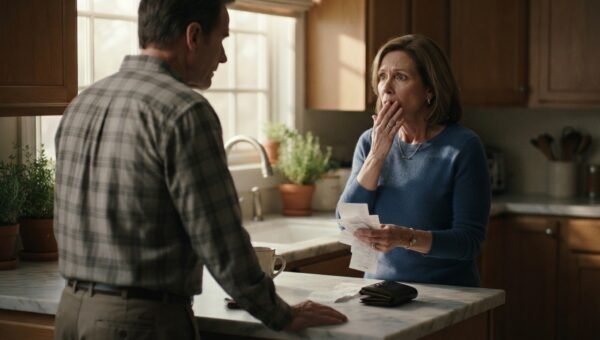
Ten minutes later, the chime sounded on David’s laptop. We leaned over the screen together.
The document was an official state petition for the release of sealed adoption and foster placement records. Attached to the third page was a grainy, scanned black-and-white photocopy of an intake Polaroid from November 2004, taken in the emergency room of St. Jude’s Memorial Hospital.
The photo showed a young woman sitting on an examination table with her face turned three-quarters toward the camera. She had sharp, elegant cheekbones, dark hair pulled back in a silver clip, and an unmistakable birthmark—a tiny, pale crescent shape—just below her left collarbone.
David stopped breathing.
His hand came off the mouse. He took one step back from the desk, his knees buckling so suddenly that he had to catch the arm of the swivel chair to keep from hitting the floor. He sat down heavily, his face turning the color of wet chalk.
“David?” I touched his shoulder. “David, what is it?”
He pointed a shaking finger at the screen, but he couldn’t speak for nearly thirty seconds.
“That isn’t a stranger,” David whispered, his voice trembling so hard the words barely came out. “That isn’t a runaway girl Mark met in California. That’s Evelyn. That’s my sister.”
PART 2
The room felt entirely airless. I leaned closer to the monitor, staring at the grainy black-and-white photocopy until my vision blurred.
I had known Evelyn for nearly thirty years, ever since David and I started dating in college. The woman in the hospital photograph was twenty-four years old, her face hollowed by exhaustion, but there was no mistaking the line of her jaw, the distinctive slope of her nose, or that small, pale crescent mark beneath her collarbone. I had seen that exact birthmark every summer when we took the kids to the lake cabin and Evelyn wore her scoop-neck swimsuits.
“She told everyone she took a semester off to do mission work in South Carolina,” David said, his voice flat and hollow. He stared at the screen without blinking. “It was the fall of 2004. She was gone from August until January. She said she was working with a rural church outreach program. She came back, finished her business degree, met Greg two years later, and never spoke about that winter again.”
“And Mark?” I asked, my heart pounding against my ribs. “Evelyn told your parents that Mark was the one who had a baby with an addict.”
David pulled up the second page of the petition. The text was bureaucratic and cold, a summary prepared by the county child protective services intake worker from November 14, 2004.
The report stated that an infant female, approximately three days old, had been brought to the emergency department by a woman identifying herself only as “a family acquaintance.” The infant was wrapped in a clean yellow receiving blanket, healthy, full-term, and showed no signs of physical trauma. The woman had refused to provide her own identification, stated that the mother was unable to care for the child, and left the building before hospital security could obtain a vehicle registration.
Attached to the intake sheet was a copy of the handwritten note left in the carrier with the baby:
*Her name is Maya. Her father is Mark Miller. He cannot care for her. Please find her a good home.*
“She pinned it on Mark,” David whispered, rubbing his palms against his temples. “Mark was already drinking back then. He was in and out of county jail for petty theft, and he was sleeping on couches in Cincinnati. Nobody questioned it. When the social workers tracked down Mark through his arrest records, Mark was so burned out he didn’t even remember half the women he’d been with. He told them he didn’t have a kid, signed the surrender papers without reading them, and skipped town.”
“Evelyn used her own brother as a scapegoat,” I said, cold fury rising in my chest. “She abandoned her baby, put Mark’s name on the note to throw everyone off, and let that child bounce through seven foster homes for eighteen years.”
David’s phone lit up on the desk. It was an unfamiliar local number with the downtown area code. David reached out and pressed the green icon, switching it to speaker.
“Uncle David?”
It was Maya. Her voice was steady, but there was a tight, brittle edge to it.
“Maya,” David said, his voice catching in his throat. “Honey, where are you? Are you alright?”
“I’m at a women’s transition house downtown,” she said quietly. “My legal aid lawyer helped me get a temporary bed. I’m sorry for leaving the way I did. I didn’t want you and Aunt Sarah to get dragged into this. I know she’s your sister.”
“You knew?” David asked. “How long did you know?”
“Three weeks,” Maya answered. I could hear the faint rustle of paper on her end of the line. “When Aunt Evelyn came over in September for your birthday dinner, she left her jacket on the hall coat tree. Her car keys fell out of the pocket when I went to hang up my own jacket. There was an old engraved brass locket on the key ring with initials on it. M. L. M.”
I remembered that locket. David’s father had bought matching engraved lockets for Evelyn and their mother twenty-five years ago.
“My intake file in foster care had one personal item listed,” Maya continued, her voice remarkably controlled. “A hospital bassinet card that the intake worker had stapled to the folder before it got sealed. It had my birth weight, the date—November 11, 2004—and the initials M. L. M. written in green ink at the top. The worker had written down that the woman who left me was wearing a silver chain with that same locket.”
Maya took a deep, shuddering breath over the line.
“I looked at Aunt Evelyn at the dinner table that night,” Maya said. “She was sitting across from me, telling David that people from the system carry bad blood. She looked directly at me when she said it. She looked at me like I was dirt on her shoe, David. I stared at her hands, and I realized her fingers were shaped exactly like mine. The exact same long knuckles. The exact same thumbnail.”
“Oh, sweetheart,” I choked out, tears finally spilling over my eyelashes. “Why didn’t you come to us? We would have helped you.”
“Because you love her,” Maya said simply. “She’s your sister. She’s got the big house on the golf course, she sits on the school foundation board, and everybody thinks she’s perfect. If I had accused her, you would have thought I was crazy or trying to extort her. I needed the legal petition filed first. I needed a judge to order the DNA comparison with the archived infant blood spot from the state newborn screening lab. My lawyer filed the emergency motion this morning.”
David straightened his shoulders. The despair on his face vanished, replaced by an expression of cold, deliberate resolve I had never seen on him in thirty years of marriage.
“Where is your lawyer’s office, Maya?” David asked.
“On Fourth Street. Third floor.”
“Sarah and I are getting in the car right now,” David said. “We’re going to pay your filing fees, we’re going to sign whatever affidavits they need, and then you’re coming back to our house. You don’t sleep in a shelter. Not while I have breath in my body.”
There was a long silence on the other end, and then a soft, stifled sob that Maya tried desperately to hide. “Okay,” she whispered. “Okay.”
PART 3
We spent Thursday afternoon in the cramped, fluorescent-lit office of Maya’s legal aid attorney, a sharp young woman named Clara Vance. Clara laid out the facts plainly on her scarred laminate desk.
Because Maya had been legally surrendered as a dependent child under false pretenses—with a fraudulent paternity statement and an unidentified mother—the court had jurisdiction to unseal the records upon a showing of potential fraud or medical necessity. Furthermore, Clara had already filed an expedited subpoena for the sealed newborn blood spot card, which the state health department retains for twenty-five years for genetic research and metabolic screening.
“If Evelyn refuses a cheek swab,” Clara explained, adjusting her glasses, “we can compel it through a court order once the judge reviews the ER intake photograph and the timeline. But it will go much faster, and be far less damaging to Maya, if she complies voluntarily.”
“She won’t comply voluntarily,” David said, his jaw locked tight. “Evelyn’s entire life is built on reputation. Her husband, Greg, runs the regional bank branch. Her daughter, Chloe, is a junior at Vanderbilt. Evelyn would rather burn the courthouse down than admit she gave birth in a county hospital at twenty-four and dumped the baby in the ER.”
“Then we give her one chance to do it quietly,” I said. “Tonight.”
We brought Maya home with us. She sat in the back of David’s sedan, silent and clutching her canvas tote bag, looking at the familiar autumn trees along our road as if she were seeing them from behind bulletproof glass. When we pulled into the driveway, she didn’t move until David opened her door and held out his hand.
“You aren’t a secret anymore, Maya,” he told her gently. “Not in this house.”
At six that evening, David called Evelyn. He kept his voice flat, neutral, and casual. He told her there was an urgent matter regarding their late father’s estate trust documents that needed her immediate signature, and asked if she and Greg could stop by after dinner.
Evelyn arrived at seven-fifteen alone. Greg was at a Rotary Club dinner, she said, brushing past me into the foyer in an ivory wool coat that smelled heavily of lavender perfume.
“I only have twenty minutes, David,” she said, pulling off her leather gloves. “The country club gala committee meets at eight. Where are the papers?”
David didn’t answer. He walked into the living room and gestured toward the couch.
Evelyn walked in, dropped her purse on the coffee table, and froze.
Sitting in the wingback armchair across from the sofa was Maya. Next to Maya on the side table sat three manila folders, and on the glass coffee table lay a single eight-by-ten glossy printout of the ER intake Polaroid from November 14, 2004.
Evelyn’s eyes flicked from the girl to the photograph. For a fraction of a second, every ounce of color drained from her cheeks, leaving her face as gray as wet cement. Her lips parted slightly, but no sound came out.
“Sit down, Evelyn,” David said, his voice dangerously low.
“What is this?” Evelyn recovered her composure with terrifying speed, her voice instantly hardening into righteous indignation. “Is this a joke? David, what is she doing back here? I told you she was unstable.”
“The woman in that picture is wearing your silver locket, Evelyn,” David said, pointing at the printout. “She has your crescent birthmark right there under her collarbone. And she left a baby in the St. Jude’s ER twenty years ago with a note saying Mark was the father.”
Evelyn didn’t sit down. She folded her arms tightly across her chest, her posture rigid. “That photo is completely unidentifiable. It’s a blur. If you think some street grifter can walk in here, dig up some ancient file, and shake down my family for money, you’ve lost your mind.”
“Nobody asked you for money,” Maya spoke up. Her voice didn’t shake. She sat upright in the armchair, her hands resting quietly in her lap, looking straight into Evelyn’s eyes. “I don’t want a dime from you. I’ve supported myself since the day I turned eighteen.”
“Then what do you want?” Evelyn snapped, her voice rising an octave. “Why are you doing this? To humiliate me? To destroy my marriage?”
“I wanted to know who I was,” Maya said. “I wanted to know why I spent my eighth birthday in an emergency shelter with two broken ribs from a foster father who drank too much. I wanted to know why nobody ever came to pick me up on visiting days. And I wanted to know why you stood in that kitchen six months ago and told my uncle that I had bad blood.”
Evelyn flinched. It was small, barely a twitch of her eyelid, but it was there.
“You were twenty-four, Evelyn,” David said, stepping between his sister and the front door. “You were living in an apartment three miles from our house. You vanished for four months, lied to Mom and Dad, dumped your own daughter on the state, and let Mark take the blame for twenty years. Mark died of an overdose in an alley in Reno believing he was a worthless deadbeat who abandoned a kid he couldn’t even remember.”
“Mark *was* a deadbeat!” Evelyn hissed, her mask completely shattering now. Her voice was raw, venomous, and shaking with decades of buried terror. “Mark was a disaster, and you know it! If I had kept that baby, my life would have been over! Do you have any idea what Mom and Dad would have done? Dad would have cut me off completely. I wouldn’t have finished school. Greg would have never looked at me. My entire life would have been ruined because of one stupid, drunken mistake with a guy from the gym who didn’t even remember my name!”
The silence that followed was suffocating.
Evelyn realized what she had just said. Her hand flew to her mouth, her eyes darting between David, me, and Maya.
“One stupid mistake,” David repeated, his voice barely a whisper. “That’s what you call your daughter.”
“David, please,” Evelyn stammered, stepping toward him, her hands trembling. “You don’t understand the pressure I was under. Dad was so strict. He would have disowned me. I made sure she was left in a hospital! I didn’t leave her in an alley! I made sure she was safe!”
“You left her to be raised by strangers,” David said coldly. “And then, when she survived it and ended up under my roof, you stood in my kitchen and tried to get me to throw her out onto the street.”
ENDING
David reached over to the side table, picked up the legal folders, and set them directly in front of Evelyn on the coffee table.
“Here is what happens now,” David said. “Clara Vance has a motion ready to serve on you at your house tomorrow morning. It requests a court-ordered DNA test. If you force Maya’s lawyer to serve that motion, it becomes a matter of public record. It will be filed in county court, where Greg’s colleagues at the bank read the legal notices. It will be served by a sheriff’s deputy at your front door.”
Evelyn swallowed hard, staring at the papers as if they were venomous snakes. “What do you want?”
“You will go to the independent lab on Elm Street tomorrow at nine in the morning,” David told her. “You will submit a voluntary cheek swab for genetic comparison. When the results come back, you will sign the amended birth certificate paperwork establishing your maternity, which will allow Maya’s legal counsel to unseal her medical and identity records without a contested court hearing.”
“And then?” Evelyn whispered, tears finally smearing her mascara. “What do you tell Greg? What do you tell Chloe?”
Maya stood up from the armchair. She was taller than Evelyn, standing straight and calm in her worn jeans and faded work sweater.
“I don’t care about your husband, and I don’t care about your country club,” Maya said, her voice completely devoid of anger, which made it far more devastating. “I am not going to call you Mom. I will never call you Mom. But my little sister, Chloe, has a right to know she has an older sister. And more importantly, I have a right to know what genetic diseases run in my body when I have children of my own.”
Evelyn looked down at the floor, unable to meet her daughter’s eyes. She slowly nodded her head once, reached out with trembling fingers, picked up the address sheet for the testing lab, and walked out of our house into the dark rain without saying another word.
The lab results came back six days later. The probability of maternity was 99.98 percent.
Faced with undeniable scientific proof and the threat of an immediate public filing, Evelyn signed the voluntary acknowledgment of maternity in Clara Vance’s office with her own attorney present. She kept her coat on the entire time and refused to look at Maya, who sat on the other side of the table signing the court petitions.
The truth did not stay hidden behind closed doors. Evelyn confessed everything to Greg that weekend. The fallout was swift and severe; Greg moved into a corporate apartment downtown three weeks later, unable to reconcile the woman he had been married to for eighteen years with the person who had abandoned a newborn in an emergency room and slandered her own dead brother to protect her social standing. Chloe, devastated and furious, refused to speak to her mother for two months before reaching out to David to ask if she could meet Maya.
Their first meeting took place at our kitchen table on a Sunday afternoon in November. Chloe was nervous, clutching a coffee cup with shaking hands, but within an hour, the two girls were sitting side-by-side looking at photos of David’s parents, tracing the family traits that had skipped a generation.
As for Maya, she moved back into our guest room for good.
We used the money we had saved from her weekly envelopes to pay off the remaining balance on a reliable used Honda Civic, giving her reliable transportation for her new job as an administrative assistant at the county health clinic—a job Clara Vance helped her secure through the legal aid network.
Last night was Thanksgiving.
Our house was filled with the smell of roasted turkey, sage stuffing, and pumpkin pie. David sat at the head of the dining table, with our two sons home from college sitting on one side, and Chloe and Maya sitting together on the other. Evelyn was not invited. She spent the holiday alone in her big, quiet house across town, nursing the ruins of a reputation she had sacrificed her own flesh and blood to protect.
Before we carved the turkey, David reached out and took my hand on his right, and Maya’s hand on his left.
“We have a lot to be grateful for this year,” David said, looking around the crowded table, his eyes wet with quiet joy. “Especially the family that finally found its way home.”
Maya looked up at him, and for the first time since the rainy morning she carried two trash bags up our front porch steps, her smile was completely open, bright, and free. She squeezed David’s hand, squeezed Chloe’s hand, and whispered, “Pass the potatoes, Uncle David. I’m home.”