PART 1
When my daughter Chloe packed up her life and moved back into my house after her divorce, I told her the spare room was hers for as long as she needed it. She was thirty-four, exhausted, and carrying the quiet, hollow look of someone whose world had quietly caved in while she was asleep. For the first two weeks, she barely left her bed except to make tea.
I let her be. Grief and humiliation have their own timetables, and I knew better than to crowd her.
By the third week, however, Chloe shifted gears with a fierce, sudden energy that took me by surprise. She landed a job as an administrative assistant at a local dental office, bought herself a secondhand Honda Civic that hummed like a sewing machine, and started filling my kitchen counters with groceries she paid for out of her own pocket. Whenever I tried to hand her a twenty for gas or pitch in for utilities, she pushed my hand away.
“Mom, stop it,” she said, her voice firm and slightly defensive in that way young adults get when they are trying to prove they can stand on their own two feet. “I am not here to be a parasite. I don’t want your money. I want to earn my way back to zero.”
I watched her hustle every morning, rushing out the door by seven-thirty with her travel mug and her hair pulled back into a practical clip, and my chest swelled with a complicated mix of pity and pride. I thought, *She learned something from all this. She is going to be fine.* My husband, Arthur, had been gone for six years, and the house had felt awfully empty since he passed. Having Chloe around, despite the circumstances of her return, brought a human pulse back into the hallways. I liked hearing the kettle whistle again. I liked folding laundry that wasn’t just mine and Arthur’s old flannel shirts.
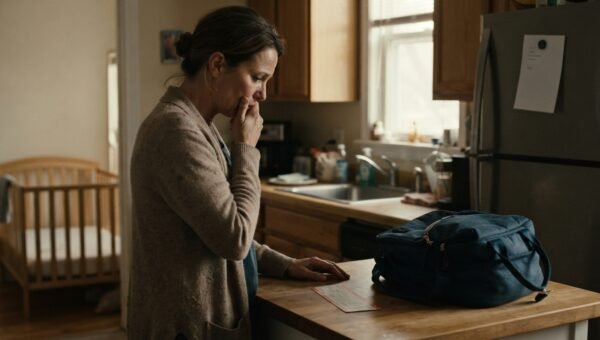
The illusion shattered on a Tuesday afternoon while I was deep-cleaning the kitchen. I was reaching behind the microwave to scrub away a sticky film of grease—one of those neglected spots you only notice when the afternoon sunlight hits just right—and my fingers brushed against a thick stack of folded paper wedged tightly between the appliance wall and the tile backsplash.
I pulled it out, frowning, expecting a stray takeout menu or a collection coupon. Instead, I found three official-looking envelopes, all unopened, all bearing my full legal name and home address.
My heart did a strange, heavy stutter against my ribs. I sat down right there at the kitchen table, my knees suddenly watery, and tore open the first one. It was a past-due notice from a major credit card issuer, demanding an immediate payment of nine thousand eight hundred dollars on an account I had never applied for, let alone used. The second envelope was a collection notice for a personal loan originating from an online lender I had never heard of, showing an outstanding balance of eleven thousand four hundred dollars. The third was a formal demand letter threatening legal action over a retail store card balance of thirty-four hundred dollars.
The total came to twenty-four thousand six hundred dollars.
The room seemed to tilt slightly on its axis. I sat there in the quiet kitchen, the hum of the refrigerator sounding unnaturally loud, as I stared at the dates on the statements.
They were all stamped within the last four months—right around the time Chloe had moved back into my house, right when she was swearing up and down that she was trying to rebuild her life with clean hands.
My mind raced through the only possible explanations, and every single one of them led directly back to the spare bedroom down the hall. Chloe had access to my desk, my mail, my social security number, and every shred of personal data I had accumulated over thirty years of living in this zip code. The anger that rose up inside me wasn’t a slow burn; it was a hot, blinding flash of betrayal that made my ears ring.
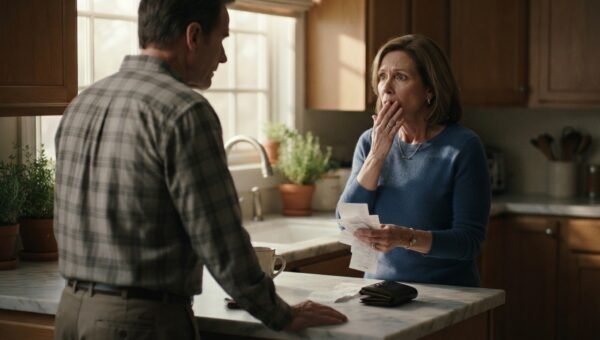
When I heard her car pull into the driveway at five-fifteen, the gravel crunching under her tires, I didn’t wait for her to come inside and unpack her bag. I stood by the kitchen island with the stack of notices fanned out in my hand like a cruel hand of cards, waiting for the front door to open.
PART 2
The door swung open, and Chloe walked in balancing a brown paper bag of groceries against her hip. The smile on her face died the second she looked at me. I didn’t bother with pleasantries. I dropped the letters onto the wood surface between us with a sharp thud.
“Explain this,” I said, my voice shaking so badly I barely recognized it as my own. “Explain why I have twenty-four thousand dollars in debt sitting behind the microwave in my own kitchen.”
Chloe stared at the envelopes. The color drained from her face so fast her freckles stood out like splashes of mud against her skin. She didn’t lunge for the papers, and she didn’t immediately burst into tears—reactions I might have expected if she had been caught red-handed in a sudden panic. Instead, she just looked… confused. Deeply, genuinely bewildered.
“Where did you find those?” she whispered.
“Behind the microwave,” I snapped, stepping closer. “Don’t play stupid with me, Chloe. You’re the only other person living in this house. You have my social, you know where I keep my tax returns, and you’ve been sitting here playing the dutiful daughter while you open lines of credit in my name. How could you do this to me? After everything I’ve done to help you?”
“Mom, stop,” she said, her voice rising sharply as she backed up against the hallway wall, dropping her grocery bag with a dull thud. “I didn’t do this. I swear to God, I didn’t touch your credit.”
“Then how did these get behind the microwave?”
“I don’t know!” she cried, her hands flying up to her hair. “I found them there!”
“You found them?” I let out a harsh, humorless laugh. “What kind of an excuse is that? You just happened to find twenty-four thousand dollars in fraudulent debt addressed to me while you were looking for what, a stray crumb?”
“No!” Chloe shouted, tears finally spilling over her lashes. “I found them a week ago when I was cleaning behind the counter to plug in my phone charger. I didn’t know what they were. I thought they were Dad’s.”
The name hung in the air between us like a physical weight. Arthur had been dead for six years. His old filing cabinet still sat in the corner of the basement, stuffed with past returns, medical bills from his final months, and old bank statements we never had the heart to shred.
“Your father has been gone for six years, Chloe,” I said, my voice dropping to a dangerous, icy whisper. “Arthur didn’t open a credit card four months ago.”
“I know that!” she sobbed, stepping forward and grabbing my wrists. Her hands were ice cold. “That’s why I panicked! I saw the names and the dates, and I thought… I thought maybe Dad had left some secret mess behind before he died, or maybe someone was digging up old accounts, and I didn’t want to worry you while you were already stressed about me moving back in. I was going to look into it on my lunch break this week. I swear to you, Mom, I didn’t open those accounts. I wouldn’t do that to you. I love you.”
I looked into her eyes. I wanted to see the telltale shift of a liar, the darting glance or the forced breath that usually gave away her childhood fabrications. But all I saw was stark, unadulterated terror.
Slowly, the white-hot rage in my chest cooled just enough to let a cold, creeping dread take its place. Because if Chloe was telling the truth—if she really hadn’t done it—then someone else had access to my life. And worse, someone else knew how to use my personal information with terrifying precision.
PART 3
We didn’t sleep that night. By midnight, we were sitting side by side at the kitchen table with my laptop glowing between us in the dark. Chloe sat with her knees pulled up to her chest, watching the screen as if it might bite.
I logged into my annual credit report through a secure government-approved portal, my fingers trembling slightly as I typed in my social security number, my previous addresses, and answered the identity-verification security questions. When the dashboard finally loaded, a comprehensive list of active and closed accounts populated the screen.
We scrolled down past the mortgage from twenty years ago, past the car loan Arthur had paid off before he passed. And then we hit the red flags.
There they were. Five separate tradelines opened within the last six months. Two credit cards, one personal installment loan, and a revolving line of credit at an electronics retailer. The total liabilities listed on the credit bureau report didn’t stop at the twenty-four thousand we had found behind the microwave; when added up with the other two hidden accounts, the total exposure was nearly thirty-eight thousand dollars.
My breath caught. I clicked on the detailed history of the largest credit card account, the one with the nine-thousand-dollar balance. The screen displayed the primary contact email address associated with the online profile setup.
It wasn’t mine. It was an address I had never seen before: `jake.miller.design92@gmail.com`.
I stared at the string of letters, turning the name over in my head like a foreign coin. Jake Miller. I didn’t know any Jake Millers. I didn’t work with any Jake Millers. None of my neighbors, cousins, or church acquaintances bore that name.
“Do you know a Jake Miller?” I asked, looking over at Chloe.
She was staring at the screen, her mouth slightly open, the color completely drained from her face once again. But this time, it wasn’t the look of someone caught in a lie. It was the look of someone watching a trap snap shut on someone they loved.
“Mom,” Chloe whispered, her voice shaking so badly I could barely hear her. “That’s Marcus’s middle name. And his email handle from college. His full name is Marcus James Miller.”
Marcus.
My son. Chloe’s older brother by four years, who lived three hours away in Columbus, working as a freelance graphic designer. Marcus, who called every Sunday like clockwork, who always asked about my blood pressure, who had come to Thanksgiving dinner with a box of expensive pastries and a warm hug. Marcus, who had spent the last two years complaining about his precarious freelance income, his studio rent, and the crushing weight of his student loans.
“No,” I said, shaking my head violently. “No, absolutely not. That is absurd. Marcus is your brother. Marcus has a career. Marcus checks in on me every single week.”
“Mom, look at the email,” Chloe insisted, her voice rising with a frantic edge as she pointed a trembling finger at the screen. “Look at the domain. `jake.miller.design`. He uses that exact handle for his Behance portfolio. He’s had it since we were kids. He used to joke about going by his middle name because he thought it sounded more professional.”
I reached for my phone, my thumb hitting speed dial before my brain could fully catch up with my instincts. I pressed the phone to my ear, listening to the monotonous ringing tone through the speaker. One ring. Two rings. Three rings.
On the fourth ring, a familiar, smooth voice answered.
“Hey, Mom! Good timing, I was just about to call you. Everything okay?”
Marcus sounded cheerful, relaxed, and entirely normal. He sounded like a son who had nothing to hide in the world.
For a long moment, I couldn’t speak. The silence stretched down the phone line until Marcus’s voice broke through it again, laced with a sudden, anxious note.
“Mom? Are you there? Is everything alright?”
“Marcus,” I said, and my voice sounded like grinding stones. “I am looking at my credit report right now. I am looking at thirty-eight thousand dollars in debt opened in my name over the last six months. And the email address attached to the primary accounts is `jake.miller.design`. Care to explain why?”
The line went completely dead silent. Not a breath, not a shuffle of paper, not a word. Just the hollow, heavy hum of a long-distance connection spanning three hours of highway between us.
ENDING
Marcus didn’t confess right away. For about thirty seconds, he tried the old playbook—denial, confusion, suggesting my identity had somehow been compromised by a data leak, asking if I had clicked on any suspicious links in my email. But his voice lacked the crisp conviction of an innocent man. It sounded thin, rushed, and brittle, like cheap glass about to shatter.
When I didn’t interrupt him, when I simply let the silence stretch out until his excuses sputtered and died on his lips, the tone shifted.
“Mom,” he finally whispered, and the sound was small and pathetic. “Mom, I was going to pay it back. I swear to God I was. I just needed a bridge loan until the agency contract went through. Everything was crashing down. They were going to repossess my car, and I couldn’t work without it—”
I ended the call. I didn’t scream, I didn’t curse, and I didn’t let him finish his sentence. I simply pressed the red button on the screen and laid the phone face down on the kitchen table.
Chloe sat across from me, her head bowed into her hands, crying silent, heavy tears that soaked into her palms. We didn’t talk about forgiveness that night. We didn’t talk about family loyalty, or how we were going to face Thanksgiving, or how I was going to explain thirty-eight thousand dollars of fraudulent debt to a fraud investigator.
Instead, the next morning, I picked up the phone and dialed the local police department to report identity theft.
Marcus called every day for the next week. He left voicemails that ranged from desperate apologies to angry accusations about me ruining his life and his credit score before he even had a chance to build a real future. I didn’t listen to a single one. I forwarded every message, along with the IP logs from the online lenders and the copies of the notices I found behind the microwave, straight to the detective handling our case.
My son thought he was just borrowing a bridge to cross a temporary chasm in his life. But as I sat at that kitchen table, watching the morning sunlight hit the empty coffee mug where Arthur used to sit, I knew the only bridge left standing was the one I was going to burn to the ground to protect what little peace I had left.