PART 1
My son, David, sat across from me at my kitchen table three months ago, looking down at his coffee mug like he could not bear to look me in the eye. He told me that his wife, Brenda, felt I was calling too late and checking in too often. He said she thought I was too involved in their family decisions, and he asked me to make a hard rule: no calling their house after 8:00 p.m. under any circumstances.
It stung. I am sixty-one years old, and since my husband passed four years ago, David and his nine-year-old son, Toby, have been my whole world. But I swallowed my pride, nodded, and told him that if that was what they needed to keep peace under their roof, I would respect it. For twelve weeks, my phone went silent at eight every single night. Even when I missed Toby terribly or wanted to hear how a soccer game went, I kept my word.
Then came a rainy Tuesday night. It was 11:40 p.m. when my nightstand began to buzz.
I scrambled out of sleep, my heart hammering in my chest. When I picked up the phone, I expected a telemarketer or an emergency from an old friend. Instead, it was Toby. He was whispering so low and fast I could barely make out the words through the receiver.
“Grandma, please come,” he breathed. “I am locked in the hallway bathroom.
Mom and Dad are downstairs, and they are screaming really bad. Mom threw something big, and I heard glass smash everywhere.”
In the background behind his little voice, a muffled, furious shout cut through the line, followed by another sharp shatter.
“Toby, listen to me,” I said, my hands trembling as I threw back the quilt and shoved my feet into my sneakers. “Stay right there on the bathroom floor. Keep the door locked. Do not come out until I get there. Grandma is leaving right this second.”
I grabbed my keys, threw a raincoat over my nightshirt, and rushed out the door. Their subdivision was only a twelve-minute drive, but that night it felt like an eternity. The rain was coming down in thick sheets, blurring my windshield as my tires splashed through standing puddles. All I could picture was Toby huddled on the cold tile, terrified in the dark.
When I turned onto their street, their two-story house was blazing with light. Front porch, living room, upstairs windows, everything was lit up. In the driveway, Brenda’s silver SUV was completely gone.
Sitting on the concrete curb in the pouring rain was my son.
David was slumped over, his elbows on his knees, his face buried in his hands. I slammed the car into park, threw open my door, and ran through the rain toward him. When he lifted his head, my breath caught in my throat. He had a deep, ragged cut along his cheekbone, and the entire collar of his gray work shirt was soaked with dark red blood.
“David! My god, what happened?” I dropped to my knees on the wet asphalt beside him, trying to touch his face, but he jerked back.
“Mom, go home,” he muttered, his voice raw and shaking. “Just get back in your car and go home. Why are you even here?”
“Toby called me,” I said, panic rising in my throat. “He was terrified in the bathroom. Where is Brenda? What did she do to you?”
“Nothing,” he snapped, pressing the heel of his palm against the cut. “It was just an argument. We had a disagreement about bills, and things got out of hand. A lamp fell over and broke. I cut myself cleaning it up, okay? She just drove off to cool down. Go home, Mom. Please.”
“You are bleeding through your clothes, David! You do not look like a man who had a simple disagreement.”
Before he could answer, blue and red lights flashed at the end of the street. A neighbor had clearly heard the commotion and dialed 911. A county patrol cruiser pulled up right behind my car, followed quickly by a second one. Two officers stepped out into the rain, their flashlights cutting across David’s bleeding face and the shattered fragments of a planter near the porch steps.
One officer called for paramedics, while the other began questioning David. David kept repeating the exact same rehearsed story. He told the officer that his wife had stepped out, that they had only raised their voices over money, that he was clumsy and knocked over a glass fixture, and that he refused to press any charges. The officers checked the house. The living room was trashed, with glass ground into the rug and a side table overturned, but there was no sign of a weapon, no obvious domestic violence evidence that David would cooperate with, and no sign of Brenda.
That was when the front door slowly creaked open.
Toby was standing in the doorway in his flannel pajamas, holding his school tablet tightly against his chest with both arms. He looked pale and trembling. I ran up the porch steps and gathered him into my arms. He was shaking so hard his teeth were chattering.
“It is okay, sweetheart,” I whispered, rubbing his back. “Grandma is right here.”
Toby did not look at his father. Instead, he reached out and pulled the sleeve of the younger police officer who was standing near the door.
“Officer,” Toby whispered, his eyes wide. “Mom and Dad said I was supposed to be doing my reading homework on my tablet tonight. It has that screen-recording app for my school presentations. When the screaming started, I got scared and ran to the bathroom, but I forgot to turn the camera off. It was sitting on the kitchen counter the whole time. It recorded everything.”
The officer looked at Toby, then looked at me. “Can we see that, son?”
Toby handed the heavy black tablet over. David shot up from the curb, his face turning as white as a sheet despite the blood. “No, wait! That is private! Officer, you do not need to look at my kid’s school tablet!”
The officer held up a hand to stop David from advancing. He tapped the screen, hit play on the last video file, and turned the volume up.
At first, there was only the loud rustle of movement and the deafening crash of what sounded like a ceramic bowl striking a cabinet. Then Brenda’s voice ripped through the small speaker, sharp, hateful, and so loud it made Toby flinch against my side.
“You think you can tell me how to spend my time?” Brenda shrieked on the recording. “You don’t get to tell me anything, David! You are nothing in this house! You promised your mother would never find out whose money paid for this house, and if you open your mouth to her, I will take Toby and leave you with the debt you created!”
PART 2
The words hung in the damp night air like poison.
The officer stared at the screen, his face hardening as the recording continued with sounds of scuffling, another loud crash, and Brenda threatening to destroy David’s truck keys before the front door slammed shut. The officer looked up from the tablet and locked eyes with David, whose head was bowed so low his chin was touching his chest.
“Sir,” the officer said quietly, “this does not sound like a simple disagreement about a broken lamp. And it certainly does not sound like you were the one who broke it.”
David did not say a word. He looked utterly broken, sitting back down on the wet curb with the rain washing pale pink streaks of diluted blood down his neck. The paramedics arrived a minute later, ushering him into the back of an ambulance to clean the gash on his cheek and check for a concussion.
I took Toby by the hand and walked him inside out of the rain. The living room was worse than I thought. A heavy ceramic lamp lay in jagged pieces across the hardwood, the shade crushed flat. A decorative mirror had been ripped from the wall and shattered near the fireplace. Toby showed me where his tablet had been propped up against a fruit bowl on the kitchen island, pointing straight toward the living room archway.
The officer who held the tablet came inside and sat at the kitchen counter with me. He wrote down Toby’s statement gently, making sure the boy was safe, while the other officer went out to talk to the paramedics.
“Ma’am,” the officer told me, “your son is refusing to file a formal complaint or name his wife as an assailant, but based on the physical damage, the child’s call, and this audio recording, we have to file an incident report for domestic disturbance. With the mother absent and the father going to the hospital to get stitches, the boy needs to be somewhere safe tonight.”
“He is coming with me,” I said immediately. “I am his grandmother. I live five miles away.”
The officer nodded, verified my driver’s license, and helped me pack a small duffel bag with Toby’s clothes and schoolbooks.
Before the ambulance pulled away toward the hospital, I walked over to the back doors. David was sitting on the edge of the cot, a white gauze pad taped firmly across his cheek. His eyes were red and hollow.
“David,” I said, standing in the doorway of the ambulance. “Brenda said you promised I would never find out whose money paid for this house. What did she mean?”
He looked away, his jaw working as if he were trying to find an excuse, a lie, anything to throw me off. But he had no fight left in him.
“Mom, please,” he croaked. “Not tonight. My head is pounding.”
“Two years ago, you told me you qualified for a conventional mortgage through your credit union,” I said, my voice dropping to a harsh whisper. “You told me your down payment came from the savings you built up from your overtime shifts at the machine shop. You asked me to co-sign the secondary line of credit just to help you secure the lower interest rate, and you swore on your father’s memory that the primary mortgage was completely separate and paid up. David, whose money bought this place?”
“Just take Toby,” David whispered, a tear cutting through the dried blood on his face. “Please, Mom. Just keep Toby safe tonight. We will talk tomorrow.”
The paramedic gently pulled the doors shut, and the ambulance drove off into the darkness.
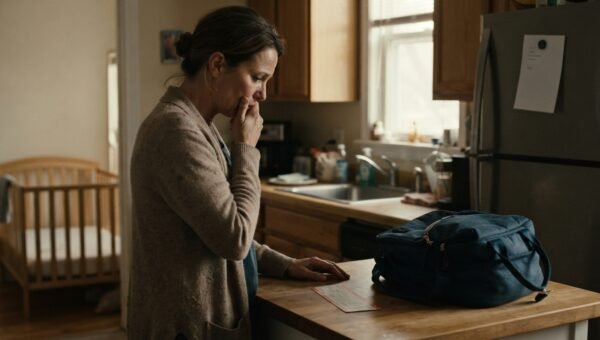
I brought Toby back to my house just after 1:30 in the morning. I made him a cup of warm milk, tucked him into the guest room bed that used to be his father’s old room, and sat beside him until his breathing slowed into deep, exhausted sleep.
I did not sleep at all.
I sat at my kitchen table with a pot of coffee, staring at the phone. My husband, Arthur, had spent thirty-five years working as a civil surveyor before lung cancer took him. When he died, he left me our paid-off house, a modest life insurance policy, and his pension. But he had also left a designated family reserve account, roughly ninety thousand dollars that was meant to sit untouched unless an absolute catastrophe occurred.
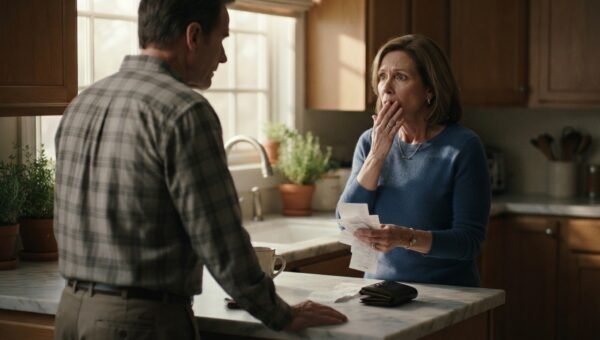
Two years ago, David came to me asking for a short-term favor. He said he and Brenda were buying their dream home in the Oakridge subdivision. He said his income was steady, but because of a minor clerical error on an old car loan, his credit score was temporarily dipped right as they were closing. He asked me to co-sign an equity bridge loan for forty thousand dollars through a local private lending agency to secure their closing date, promising it would be paid off in six months once his regular credit union loan finalized. He brought me papers to sign. I trusted my son. I signed where he pointed, believing I was only guaranteeing a temporary secondary buffer.
Now, Brenda’s screeching words played over and over in my mind like a siren: *You promised your mother would never find out whose money paid for this house.*
At 7:30 the next morning, I called my brother-in-law, Frank, who retired after thirty years as a title agent in our county.
“Frank,” I said, skipping the pleasantries. “I need you to pull the public land records and deed filings for David and Brenda’s house on Sycamore Drive. Right now.”
“Martha? What’s going on? You sound terrible,” Frank said.
“Just pull the file, Frank. Tell me whose name is on the deed, and tell me who holds the lien.”
There was a long silence on the line while Frank booted up his computer. I could hear the click-clack of his keyboard through the phone, every second stretching my nerves thinner.
“Alright, I’ve got the county recorder portal open,” Frank said after a couple of minutes. “Sycamore Drive. Purchased June of twenty-twenty-four. Martha… this isn’t a standard credit union mortgage.”
My stomach dropped into freefall. “What is it?”
“The deed is in Brenda’s name and her father’s name,” Frank said, his voice turning dead serious. “David isn’t even on the deed. Her father, Richard, put down two hundred thousand dollars in cash from a commercial property sale he had in Florida. But that’s only half of it. There’s a second lien filed thirty days after the purchase.”
“A lien held by who?” I asked, my knuckles turning white around the phone.
“Held by an estate management company,” Frank read slowly. “Secured against an annuity collateral assignment. Martha… the collateral attached to that secondary debt is Arthur’s survivor trust account. Your name is on the authorizing signature, but the disbursement went straight into an escrow account controlled by Brenda’s father.”
My world tilted on its axis.
David hadn’t just asked me to co-sign a temporary bridge loan. He had signed papers that used my late husband’s survivor benefits and our family reserve as collateral to satisfy Brenda’s father, who refused to front his half of the purchase without David putting up skin in the game. Brenda and her father owned the house. David was merely the unpaid servant living inside it, carrying a debt tied directly to my financial throat, while Brenda held the threat of exposing his fraud over his head to keep him quiet.
PART 3
At ten o’clock that morning, David showed up at my front door.
He looked terrible. He had eight dark stitches pulling the skin together along his cheek, dark purple bruising under both eyes, and his left arm was cradled against his ribs. He looked like a man who had barely survived a wreck.
“Where is Toby?” was the first thing he asked as he stepped into the foyer.
“Upstairs, watching cartoons in the guest room,” I said evenly. “He is safe. Sit down in the kitchen, David. We need to talk.”
He walked into the kitchen with a heavy, dragging gait and slumped into the wooden chair he had occupied three months earlier when he told me I was too involved. He stared down at the table just like he had done then.
I didn’t offer him coffee. I walked over to the counter, picked up a manila folder where I had printed the county land records Frank had just emailed me, and dropped it right in front of him.
The paper slapped against the wood with a sharp crack.
David glanced at the top page, saw the deed registry and the lien assignment with his father’s trust listed as collateral, and closed his eyes. His shoulders sagged completely.
“Frank pulled the records two hours ago,” I said, my voice shaking with a rage so cold I barely recognized myself. “You gave Brenda’s father sixty-five thousand dollars out of Arthur’s survivor fund. You put this house in Brenda’s name. You used your dead father’s money to buy your way into a marriage with a woman who beats you and smashes furniture against your face, and you let her hold it over you while you told me to stop calling your house because I was ‘too involved.'”
David buried his face in his uninjured hand and began to sob. It wasn’t a quiet cry. It was the deep, ugly, heaving sobs of a man whose entire house of cards had finally collapsed into dust.
“She told me we would never get a home of our own without her dad,” David wept, his voice muffled against his sleeve. “Her dad hated me, Mom. He said I was an hourly machinist who would never amount to anything. He said he would put up the cash for the house so Toby could live in a good neighborhood, but only if I matched his investment with a cash deposit for the equity build.”
“You didn’t have that cash!” I said, stepping closer. “You knew that money belonged to my retirement! You brought me those papers mixed in with the refinancing forms and told me it was just a signature for a line of credit!”
“I thought I could pay it back before you ever noticed!” David cried, lifting his swollen, tear-streaked face. “The loan was supposed to be repaid out of a machine shop contract I was bidding on. But the contract fell through. When Brenda found out I couldn’t cover the quarterly lien payments, she told her dad. Her dad threatened to foreclose on the trust collateral and take everything you had left. That is when Brenda took complete control of my paycheck.”
He wiped his nose on his bloody sleeve, his breath hitching.
“She took my credit cards, Mom. She took my access to the bank accounts. She told me if I stepped out of line, or if I told you what happened, her dad would trigger the default on the lien immediately, ruin you financially, and she would take Toby to Florida and ensure I never saw him again. That was why she made me tell you to stop calling. She saw you getting suspicious every time you visited. She knew you were noticing the tension, noticing that I didn’t have money for basic repairs. She wanted you cut off completely.”
“And last night?” I demanded. “What caused that?”
“A letter came in the mail yesterday afternoon,” David whispered. “The private lender sent a notice of acceleration. Her dad had stopped advancing the buffer payments, and the lender was preparing to seize the collateral account next month. I confronted Brenda when she got home from work. I told her we had to sell the house, pay back my mother’s trust, and get out from under her dad. She lost her mind. She told me I would die penniless in a ditch before she gave up that house. She picked up the ceramic lamp and swung it directly at my head.”
As if summoned by his words, heavy tires crunched loudly on the gravel of my driveway outside.
I looked through the kitchen window. Brenda’s silver SUV had just pulled in behind my car.
She got out, slamming her door with enough force to echo across the yard. She was dressed in her neat work slacks and a beige trench coat, her hair pulled back into a crisp ponytail, looking completely composed, as if she hadn’t turned a living room into a war zone twelve hours earlier.
David saw her through the window and instantly panicked. He stood up so fast his chair screeched against the linoleum. “Mom, don’t let her in. Don’t talk to her. She will destroy everything.”
“Sit down, David,” I commanded. My trembling had stopped. The panic was gone, replaced by a cold, steady clarity I hadn’t felt since the day I buried my husband. “Sit in that chair and do not say a word.”
I walked to the front door, turned the deadbolt, and pulled it wide open just as Brenda stepped onto my porch.
ENDING
Brenda didn’t look like an abuser on the run. She looked annoyed, like a parent arriving to pick up a misbehaving child from an inconvenient babysitter.
“Martha,” she said, offering a tight, practiced smile that didn’t reach her cold eyes. “I see David’s truck is here. I came to collect my husband and my son. We have things to handle at home.”
“You are not stepping one foot inside this house,” I said.
Brenda’s smile evaporated instantly. Her expression hardened into stone. “Listen to me, Martha. Whatever David told you last night is a complete exaggeration. He had an emotional breakdown, he threw a tantrum, and I had to leave for my own safety. He is unstable, and Toby belongs with his mother. Step aside, or I will call the police.”
“The police already have the video, Brenda.”
She froze. For a split second, her eyes flickered with genuine uncertainty. “What video?”
“Toby left his school tablet on the kitchen island last night with the screen recorder running,” I said, holding her gaze without blinking. “The officers watched it in your driveway while your husband was bleeding on the curb. They heard you scream that David promised I would never find out whose money paid for that house. They heard you threaten him. They heard the lamp smash.”
A blotchy red flush crept up her neck, staining her pale cheeks. She opened her mouth to argue, but I stepped closer, lowering my voice so it carried like iron.
“And two hours ago, my brother-in-law pulled the county land registry and the private equity lien. You and your father committed grand fraud against a senior citizen by forging documentation and assigning my late husband’s survivor trust as unauthorized collateral to cover your down payment. That isn’t just a domestic disturbance, Brenda. That is a state and federal financial felony.”
Her composure shattered completely. Her lips parted, but no sound came out.
“Here is what is going to happen,” I continued, every word deliberate and steady. “David is staying right here. Toby is staying right here. If you so much as tap on my window, step onto my grass, or have your father send one single threatening email about that lien, I will take Toby’s video, Frank’s title audit, and my husband’s original trust agreements directly to the district attorney’s office and the state financial crimes division.”
“You can’t do that,” she hissed, her voice trembling with venom. “It will ruin David too! He signed those papers!”
“David will answer for what he did,” I said. “He will face whatever legal and financial consequences he earned through his cowardice. But you and your father will be standing right beside him in front of a judge, and you will be the ones who lose that house, your assets, and your freedom. Now get off my porch, get in your car, and do not ever come near my grandson again.”
Brenda stared at me, her chest heaving with silent rage. She looked past me into the hallway, where David was standing in the kitchen doorway, watching her with a bandage on his face and his spine straight for the first time in two years.
She realized she had lost every single shred of leverage she had ever held over him.
Without another word, she spun on her heel, marched down the porch steps, got into her SUV, and tore out of my driveway, spitting loose gravel against the roadside bushes.
The silence that followed was heavy, but it was clean.
The months that followed were neither easy nor cheap. David had to face the ugly reality of what he had allowed to happen. With Frank’s help and an estate attorney I hired using the last of my liquid emergency funds, we filed a formal fraud dispute against the private lien. Because Brenda’s father knew the police had the video of the domestic assault and the evidence of the fraudulent transfer, he agreed to settle out of court. He liquidated his interest in the Oakridge house, paid off the private lien in full to clear my husband’s trust account, and took Brenda back to Florida.
David filed for divorce the following week, accompanied by a permanent restraining order based on the police report and Toby’s recording. He lost his truck and had to surrender his share of any marital assets, but he kept his job at the machine shop, and the court granted him supervised custody that transitioned into joint custody under my roof.
David moved into my spare bedroom. Every Friday, half of his paycheck goes into an escrow account to reimburse the legal fees and the damages he caused. He doesn’t complain. He works sixty hours a week, he is in weekly counseling for domestic abuse survivors, and every single evening when he comes home, he sits at the kitchen table and helps Toby with his fifth-grade math homework.
Last night, the clock on my kitchen wall chimed eight times.
Toby was sitting on the living room rug, building a complicated Lego tower, while David was drying the dinner dishes by the sink. My phone sat on the kitchen counter, silent and undisturbed.
I looked at my son, his cheek marked by a faint, pale scar that will never completely fade, and I looked at my grandson, safe and laughing in the warm light of our home.
David stopped drying a plate, looked over at me, and smiled a quiet, tired smile.
“Mom,” he said softly, “thank you for picking up the phone.”
I walked over, took the dish towel from his hands, and set it on the counter.
“I will always pick up the phone, David,” I told him. “No matter what time it is.”