PART 1
The graveside service was nearly finished when I noticed the woman standing fifty yards back near the cedar trees. She wore a plain dark coat, and on either side of her stood two tall, broad-shouldered young men in their late twenties. They looked so much like my father around the jaw and eyes that my throat tightened before I even understood what I was seeing.
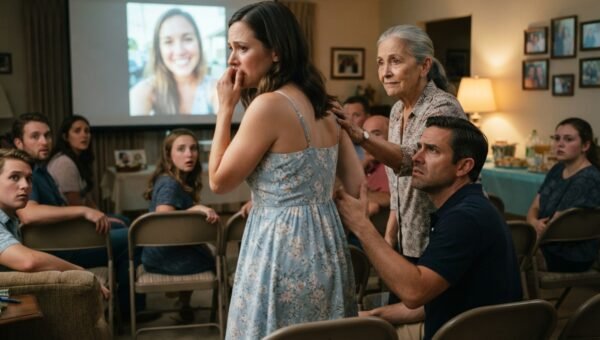
My mother was gripping my arm with both hands. When the minister closed his Bible, Mom turned slightly, caught sight of the three people near the tree line, and her knees went slack.
I had to brace my feet into the damp grass to keep her upright.
“Who is that, Helen?” she whispered. Her voice was thin and shaky. “Who are those boys?”
“I don’t know, Mom,” I said. “Just lean on me. Let’s get you to the car.”
Dad was seventy-one. For thirty-four years, he worked as an independent commercial refrigeration technician, which meant he spent three or four nights a week on the road servicing meatpacking warehouses and grocery distribution centers across northern Ohio. We lived in Mansfield. He was gone Tuesday through Thursday almost every single week of my life. When I was little, I thought every dad lived out of a canvas duffel bag and smelled like gear oil and diner coffee. He paid the mortgage on time, paid for my state college tuition, and sat in the front pew on Sundays with his arm around Mom’s shoulders.
I helped my mother into my brother Kevin’s sedan and told Kevin to take her straight back to our house.
I stayed behind under the green tent to sign the cemetery registry and thank the funeral director.
When I turned back toward the gravel drive, the woman was waiting twenty feet away, her hands tucked deep inside her pockets. Her two sons stayed five paces behind her, looking at the gravel like they were ashamed to be standing on the earth.
The woman was in her mid-fifties, maybe four years older than me. She had silver-streaked dark hair cut neat at her shoulders.
“You’re Helen,” she said. It was not an accusation. It was barely above a murmur.
“Yes,” I said. “And you need to tell me who you are before I call the sheriff.”
“I’m Linda,” she said. She did not flinch, but her mouth twitched with an unsteady tremor. “These are my boys, Marcus and Jesse. We didn’t know about you either.”
The wind caught the plastic grass around Dad’s vault and made it flap against the metal frame.
I wanted to hate her right there. I wanted to scream at her for showing up in front of my seventy-two-year-old mother on the worst day of our lives. But Linda looked dazed, like someone had hit her with a two-by-four an hour before she walked into the cemetery.
“What do you mean you didn’t know?” I asked.
“Ray told us he was divorced thirty years ago,” Linda said quietly. “He told us his first wife died in a car accident before the boys were born. He said he had no children from that life.”
Dad had lived two complete lives in towns only forty miles apart. Mansfield was where he slept Friday through Monday. Ashland was where he slept Tuesday through Thursday. Forty miles on State Route 42. A forty-five-minute drive.
The taller boy, Marcus, stepped forward. He reached into his coat and held out a heavy brass key attached to an embossed yellow plastic tag.
“He died on a Friday morning at the warehouse in Wooster,” Marcus said, his voice flat with restraint. “Two months ago, right after his heart gave him that first warning, he gave me this. He made me swear on my grandmother’s Bible that if we ever found out the truth, or if both families ever met, we had to open this together. He wrote the unit number and the address on the back.”
I looked down at the plastic tag. Scratched into the yellow plastic in my father’s distinct, blocky printing was an address on Route 250 outside Jeromesville, halfway between our two towns. Below it was written: Unit 14.
“Why would we go anywhere with you?” I said.
“Because he left four hundred thousand dollars in life insurance that vanished from our joint account three years ago,” Linda said, looking directly into my eyes. “And yesterday morning, his bank informed me that his name was also on a joint checking account in Mansfield with fifty thousand dollars in outstanding commercial equipment liens attached to my house.”
My stomach dropped. Dad had taken out a seventy-five-thousand-dollar home equity loan against my mother’s house six months ago, claiming he was upgrading his service truck and buying freon recovery pumps before retirement.
Marcus held the brass key out until I took it.
“We can follow each other out there right now,” Marcus said. “Or we can let the county probate court tear both our mothers apart.”
PART 2
We drove in two separate cars down Route 250 through the late-November drizzle. Marcus drove a gray Ford pickup with Linda in the passenger seat and Jesse in the back. I followed in my Subaru, my hands clenched so tight against the steering wheel that my knuckles stayed white the entire twenty miles.
Jeromesville Storage was an older, cinderblock complex behind a shuttered tractor dealership. A rusted chain-link fence surrounded three rows of long, low corrugated metal buildings.
We pulled up in front of Unit 14.
The brass key slid into the round padlock with a heavy click. Marcus pulled the bar down, grabbed the bottom handle of the overhead door, and shoved it upward. The metal track rattled and squealed in the damp air.
I expected to see Dad’s old Dodge Ram service truck, or stacks of freon tanks, or maybe a cot and a microwave where he hid out between shifts.
There was no vehicle. There were no tools, no equipment, and no boxes of cash.
In the center of the concrete floor sat a single eight-foot folding banquet table surrounded by six plain metal folding chairs. On top of the table was a green cardboard filing box and an electric kettle plugged into an extension cord running to a ceiling drop.
Along the entire twenty-foot back wall of the storage unit, Dad had installed sheets of corkboard. Pinned across the cork was a massive collage of family photographs.
I took three steps inside, and the breath left my chest.
On the left side of the wall were photos of my life. There was my third-grade school portrait with my missing front tooth. My high school graduation in the Mansfield gym. My wedding to Greg twelve years ago, with Dad walking me down the aisle in his rented charcoal tuxedo. Mom and Dad standing in front of our brick ranch on Linden Road for their twenty-fifth anniversary.
On the right side of the wall were photos of Linda’s family. Jesse holding up a smallmouth bass on a wooden dock. Marcus in a blue football jersey with the number 44 across his chest. Linda and Dad sitting on the porch of a yellow frame house in Ashland, laughing at a golden retriever puppy.
Every holiday, every birthday, every milestone of two separate households was laid out side by side. He had cut down the middle of nothing. He had cataloged every single year of both families with meticulous, terrifying care.
Linda walked slowly to the edge of the table and touched the back of one of the folding chairs. She stared at the pictures of my mother and me, her face completely still.
“He was at Marcus’s graduation on June sixth,” she said softly.
“He was at my house on June seventh for my daughter’s third birthday,” I said. “He brought a tricycle in the back of his van.”
“He told us his back was acting up that weekend,” Jesse muttered from the doorway. “He said he had to lay flat on a heating pad at a motel in Akron.”
Then Jesse walked past the table and stopped dead in front of the exact center of the cork wall.
“What is that?” he asked.
Pinned directly in the center, between a photo of my college graduation and Marcus’s high school diploma, was a single, faded black-and-white picture from the late 1960s. It did not belong to either family.
It showed three young men in military fatigues sitting on sandbags in front of a corrugated tin bunker. One of them was my father at nineteen years old, skinny and unsmiling, wearing dog tags outside his olive shirt. To his right was an older soldier with dark hair and a wide grin.
Taped right below the black-and-white photograph was a yellowed newspaper clipping from the Mansfield News Journal, dated August 14, 1974. The headline read:
*LOCAL MECHANIC DIES IN HIGHWAY COLLISION ON ROUTE 42; LEAVES WIDOW AND INFANT DAUGHTER.*
Linda stared at the clipping, then turned her head toward me with an expression of pure bewilderment.
“That’s my father,” Linda whispered. “His name was Thomas Miller. He died when I was two years old.”
PART 3
Marcus stepped toward the table and pulled the lid off the green cardboard box.
Inside were four thick manila folders, each labeled with a name in Dad’s unmistakable hand: *HELEN*, *LINDA*, *MOM (ELLEN)*, and *THE BOYS*.
Underneath the folders lay a spiral-bound notebook and a legal document sealed in a plastic sleeve. Marcus opened the plastic sleeve and handed the document to me.
It was a certified copy of a Department of Veterans Affairs investigation report from 1973, accompanied by a handwritten confession written by my father, Ray Evans, dated three months before he died.
I sat down on one of the cold metal folding chairs. Linda sat across from me. Marcus and Jesse stood on either side of their mother.
“My dad didn’t meet Linda thirty years ago,” I said, reading the first page of the handwritten letter. “He knew her mother before he ever met my mom.”
In 1968, Dad and Thomas Miller had served together in the Army’s 1st Cavalry Division in Vietnam. Thomas was Dad’s squad leader. During an ambush in the Que Son Valley, Thomas pulled Dad out of a burning personnel carrier, taking shrapnel to both legs in the process. Dad survived without a scratch. Thomas came home to Ohio with a permanent limp and a wife named Sarah, who had just given birth to Linda.
In August of 1974, Thomas and Dad were working together at an auto repair shop in Mansfield. One rainy Friday night, Dad borrowed Thomas’s car to drive back from a parts warehouse. On his way back along Route 42, Dad swerved into the oncoming lane while adjusting the radio, forcing a delivery truck off the road. The truck struck Thomas’s car broadside.
Thomas was in the passenger seat. Dad walked away with bruised ribs. Thomas died before the ambulance arrived.
Dad was twenty-four. He had lied to the state troopers that night, claiming the steering linkage on Thomas’s car snapped, avoiding criminal negligence charges. The guilt hollowed him out for the rest of his life.
“He promised Thomas when they were in the hospital in Da Nang that if anything ever happened, he would take care of his family,” I read aloud from Dad’s letter. “For five years after the crash, he sent anonymous cash to Sarah in Ashland. But Sarah died of cancer in 1988, leaving Linda alone with two small boys and twelve thousand dollars in medical debt.”
Linda’s hands began to shake against the table. “I met Ray in 1991 at the diner where I worked in Ashland,” she said, her voice cracking. “He came in every Tuesday. He was kind, he helped me fix my car, he paid off my oil heating bill that winter without telling me. After a year, he told me he loved me. He told me he was divorced and alone.”
“He wasn’t divorced,” I said. “He married my mother in 1976. He had me in 1975.”
Dad hadn’t started a second family out of casual lust or a double life of luxury. He had constructed an elaborate, fraudulent penance out of cowardice and misplaced duty. Instead of confessing the truth about Thomas’s death, he tried to be two fathers at once. He spent thirty years driving forty miles back and forth across Route 42, lying to my mother every Tuesday morning and lying to Linda every Thursday night.
“What about the money?” Marcus asked. His voice was hard. “The four hundred thousand from the insurance? The liens on our houses?”
I picked up the green folder labeled *THE BOYS*.
Inside were two deed certificates and an escrow statement from an agricultural title company in Wayne County.
Dad hadn’t stolen the money to gamble or spend on himself. Three years ago, when he realized his health was failing, he took out the equity loan against my mother’s house and drained the joint insurance annuity he shared with Linda. He combined both sums, four hundred and seventy-five thousand dollars, to purchase a two-hundred-and-ten-acre commercial grain and cold-storage parcel outside Wooster, deeded entirely to Marcus and Jesse Miller, with a lifetime commercial lease pre-paid to a regional logistics firm.
The lease paid sixty-eight thousand dollars a year in net commercial rent.
Folded inside the deed was a notarized trust agreement. The lease revenue was legally divided into three equal shares: one third to my mother for the rest of her life to cover her house and retirement, one third to Linda for her mortgage and living expenses, and one third to Marcus and Jesse to establish their own business.
Attached to the trust was a single yellow legal sheet addressed to all of us.
*I tried to pay a debt that wasn’t mine to pay in the way I chose,* Dad wrote. *I stole time from Ellen and Helen, and I built a home on a lie with Linda. I thought if I worked until I dropped, the money would make up for the fraud. It won’t. If you are reading this, you are in the garage on Route 250. The six chairs were so you would have to sit down together before the lawyers tore you apart. Forgive each other if you can. Don’t forgive me.*
ENDING
None of us spoke for a long time.
The rain drummed steady against the metal roof of Unit 14. Outside, a semi-truck rumbled past on the highway, its engine brake roaring in the distance.
Linda stood up from the table. She walked back to the corkboard wall, reached up with her right hand, and gently unpinned the faded 1968 black-and-white picture of her father sitting on the sandbags in Vietnam. She held it against her palm, staring at the face of the young man she had never known.
“All those years,” she said quietly. “He looked at me and saw my father.”
“He looked at my mother and saw his lie,” I said.
Marcus took the trust documents and the title papers and slid them back into the green folder. “We’re not keeping this land to ourselves,” he said, looking at me. “If this lease pays sixty-eight thousand a year, the first two years of our share go straight to paying off the equity loan Ray took out on your mother’s house.”
“You don’t have to do that,” I told him. “The trust gives you your share.”
“We’re not building a business on money stolen from an old woman who didn’t know her husband was sleeping forty miles down the road,” Jesse said. He sounded tired, but his eyes were steady.
We locked the storage unit an hour later. Marcus kept the brass key.
I drove back to Mansfield alone. The rain cleared just as I reached the county line, leaving the late afternoon sky gray and cold over the wet fields.
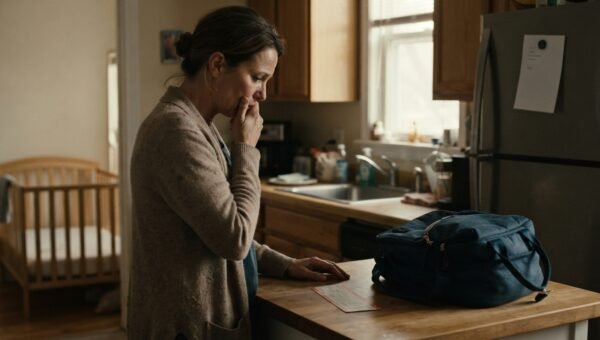
When I walked through the back door of our house on Linden Road, Mom was sitting at the kitchen table with a cup of chamomile tea that had gone cold. Kevin was in the living room, talking in hushed tones on the phone to our aunt.
Mom looked up at me, her eyes red-rimmed and swollen.
“Did you find out who they were?” she asked.
I sat down in the chair Dad had occupied at breakfast for over forty years. I took her small, cold hand between both of mine.
“Yes, Mom,” I said. “I found out.”
I didn’t tell her everything that evening. I didn’t tell her about the thirty years of Tuesday nights in Ashland, or the folding chairs in the storage unit, or the wall of photos where our lives were pinned alongside strangers. I protected her from the full weight of it until the estate lawyer could put the trust protections in place on Monday morning.
I told her only what she needed to know to survive the night: that Dad had left behind a mess from a debt he owed an old army friend, that the mortgage on our house was going to be paid off in full, and that the two boys at the cemetery were not our enemies.
She nodded slowly, looking down at the kitchen table, her thumb tracing the familiar grain of the wood.
“He always carried too much,” she whispered. “He never would just put it down.”
I didn’t correct her. I let her have that one piece of grace for the man she had buried three hours earlier.
The next morning, my phone buzzed on the counter. It was a text message from Marcus Miller with a scanned PDF of the title transfer and a single line of text: *We signed our waiver at the bank. Your mom’s lien will be cleared by the first of the month.*
I looked out the window at the empty driveway where Dad’s service truck used to park every Friday afternoon at four o’clock. The gravel was completely clean, and for the first time in my life, nobody was waiting for him to come home.