PART 1
My sister Brenda called me three days after Mom’s funeral with that strained, breathless tone she always uses when she needs to hand off a chore. She told me she could not bear to set foot inside Mom’s two-bedroom apartment on Sycamore Street. She said the smell of Mom’s lavender hand cream and the sight of her floral sofa made her chest seize up with grief. She said she could not handle the memories, and because I was always the steady one, she needed me to empty the place before the lease expired at the end of the month.
I understood. I really did. When our father passed away twelve years ago, Brenda fell apart for six months, leaving me to handle the burial arrangements, the probate paperwork, and the sale of his pickup truck. I was fifty-four, Brenda was fifty-one, and that dynamic had never shifted once in our lives. So I took a week off from my job at the county water authority, bought three rolls of packing tape, and drove over with two dozen flat-packed cardboard boxes in the trunk of my sedan.
Mom had lived in that modest garden apartment for nearly twenty years. She was a quiet, tidy woman who kept her receipts in shoe boxes and wiped down her baseboards every Saturday morning. Going through her things felt intimate and heavy, but entirely ordinary. I packed her wool sweaters into donation bags. I sorted through her chipped porcelain tea sets, set aside the silver brooch our grandmother had given her, and loaded her potted spider plants into the backseat of my car to take home.
By Thursday afternoon, the living room and bedroom were stripped bare. The only room left was the kitchen.
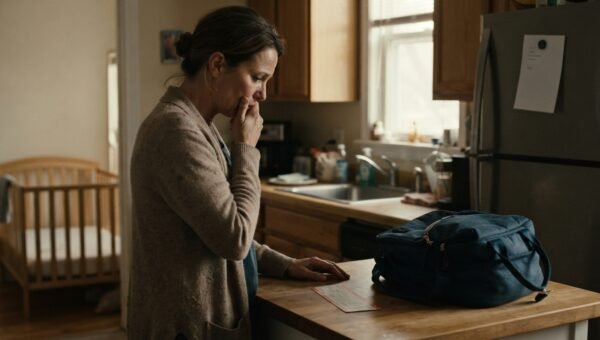
Mom lived on social security and a small widow’s pension, so she hated waste. Her refrigerator was organized down to the millimeter, with dated masking tape on leftover meatloaf and glass jars of homemade pickles. I worked through the shelves quickly, tossing expired condiments into a black trash bag.
Then I opened the small bottom freezer.
It needed defrosting. A thick crust of white frost coated the wire basket and the back wall. In the very back, wedged firmly behind three solid bags of frozen sweet peas and an old carton of vanilla bean ice cream, my fingers hit something hard and cold. It was not wrapped in butcher paper. It was solid metal.
I pulled out the frozen peas, setting them on the linoleum, and gripped the handle. It was an olive-green metal cash box, the heavy kind with a small brass latch on the front.
It was frosted over around the edges, cold enough that my skin stuck to the metal for a second.
I set it down on the clean kitchen counter and grabbed a dish towel to wipe away the melting ice. The latch was not locked. The tiny keyhole was empty, and when I flipped the catch, it popped open with a dry click.
I expected to find emergency cash, maybe a few crisp hundred-dollar bills or an old savings bond Mom had tucked away for a rainy day.
Instead, the box was filled to the brim with envelopes.
They were neatly stacked in a single, tight brick, tied together with a faded yellow sewing ribbon. On top of each envelope, written in my mother’s unmistakable, sloping cursive, was a single name: Samuel.
I pulled the ribbon loose. The paper of the envelopes had absorbed some moisture over the years, making them slightly stiff and brittle around the edges. I counted them right there at the counter. Exactly forty envelopes.
The top one was postmarked or dated just last year, 2025. The one beneath it was from 2024. As I flipped down toward the bottom of the stack, the years rolled backward steadily: 2010, 1998, 1991. The very bottom envelope was dated October 14, 1986.
None of them had ever been mailed. There were no canceled postage stamps, no postal barcodes, just Mom’s penmanship spelling out “To Samuel, on your birthday” across every single front cover.
My head spun trying to place the name. Samuel. I did not have an uncle named Samuel. My father’s brothers were Robert and Wayne. Mom was an only child whose parents died before I graduated high school. For a brief, strange minute, I wondered if Mom had an old flame from before she met Dad, or maybe a child she had babysat decades ago whom she simply could not forget. But nobody writes a yearly birthday card to a neighbor’s kid for forty straight years and buries them behind frozen peas.
I turned the oldest envelope over.
There was no stamped mailing address, but in the upper left-hand corner, Mom had written a return location in faint blue ink. It was St. Jude General Hospital, Maternity Ward, Room 304.
St. Jude was the county hospital in our hometown. It was the exact hospital where I had been born in the fall of 1971, and where Brenda had been born three years later.
My hands began to shake. I slipped my fingernail under the flap of that yellowed 1986 envelope and pulled out the folded card inside. The front showed a watercolor drawing of a brown teddy bear holding a yellow balloon. Inside, the printed greeting read, “Happy First Birthday, Little One.”
Below the printed verse, my mother had filled the entire white page with her handwriting:
“My dear son, your sister came home today, and I still don’t know how to tell her you came first.”
PART 2
I stood alone in that empty, echoing kitchen with the card trembling in my fingers. The hum of the unplugged refrigerator was gone, leaving only the sound of my own harsh breathing.
I read those opening words three times. “My dear son, your sister came home today, and I still don’t know how to tell her you came first.”
The date on the card was October 14, 1986. I was fifteen years old in October of 1986. Brenda was twelve. Neither of us had come home from anywhere that day; we had lived in our family house on Maple Street our entire lives. The realization hit me like a sudden drop in an elevator. The sister she was writing about was not Brenda. And it was not me.
There had been another child. A boy born in the autumn of 1985.
I sat down hard on the stepstool Mom kept near the pantry. One by one, with trembling fingers, I began opening the cards.
Card three, dated 1988: “You are three today. I saw a little boy with dark curly hair just like yours at the grocery store by the highway and I had to leave my cart in the aisle because I couldn’t breathe. Your father says it was for the best, that we had no money and your medical bills would have destroyed what little your sisters had, but he doesn’t hear you crying in the dark like I do.”
Card seven, dated 1992: “Seven years. The lawyer swore the couple who took you were good church people from up north. He said they had land and a house with a swing set. I pray every night that you are running in that grass.”
Card twelve, dated 1997: “Brenda found your little blue knitted booties in the cedar chest yesterday. She asked who they belonged to. I lied to her face, Samuel. I told her they were doll clothes from when I was a girl. The lie tasted like ash.”
Card after card laid out an agonized, forty-year paper trail of a secret that had eaten my mother alive from the inside out. In the late summer of 1985, my father had been laid off from the foundry. We were months behind on the mortgage. Mom had gotten pregnant unexpectedly at thirty-six, and the baby had been born with a severe congenital heart issue that required surgeries our bare-bones county clinic could not handle. A private adoption lawyer, working with a wealthy couple from upstate New York, had offered to pay all hospital expenses and medical treatments on one condition: total surrender, completely closed, with no contact ever permitted.
My parents had taken the deal to save their house and to keep Brenda and me fed. And then they had buried the boy’s existence so deeply that neither Brenda nor I ever heard his name spoken once.
I sat on that kitchen floor until my legs went numb. I was furious, heartbroken, and completely disoriented. My entire childhood felt like a stage set where the adults had been hiding an open wound behind the curtain.
At the bottom of the box, tucked beneath the final card from 2025, was a folded legal document yellowed with age. It was an informal receipt from an attorney named Arthur Vance, dated November 1985, listing a docket number from the Albany County family court and the boy’s original birth certificate name: Samuel Joseph Miller.
I took the cash box, locked the apartment door, and drove straight to Brenda’s house.
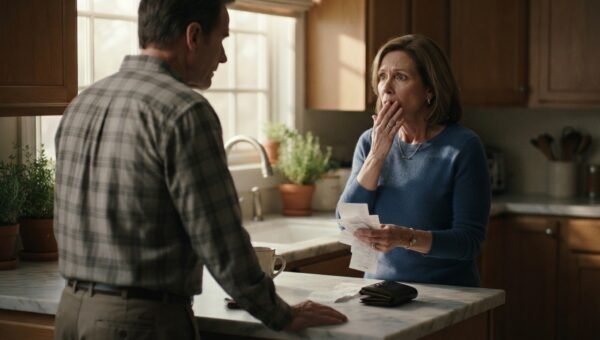
Brenda lived twenty minutes away in a neat brick ranch. When she opened the front door, she was wearing sweatpants, holding a mug of herbal tea, and looking at me with that soft, exhausted expression she wore whenever family burdens were mentioned.
“Did you finish the kitchen already, Karen?” she asked, stepping back to let me in. “You really didn’t have to push yourself so hard today.”
I didn’t say a word. I walked into her living room, set the green metal box on her coffee table, and dumped the forty cards and the lawyer’s paper directly onto the polished wood.
“What is this?” Brenda frowned, looking down at the pile. “Did Mom have old greeting cards saved? I told you, anything that isn’t valuable can just go to the church rummage sale.”
“Read one,” I said. My voice was dangerously flat. “Pick any one you want, Brenda. Read it.”
Brenda gave me an irritated look, clearly annoyed that I was disrupting her quiet afternoon, but she reached down and picked up an envelope from 1995. She slid the card out and started reading silently.
I watched her face change. The annoyance melted into confusion, then her mouth fell open, and all the color drained straight out of her cheeks. Her fingers began to shake so badly the paper rattled.
“Who is Samuel?” she whispered, looking up at me with wide, horrified eyes. “Karen, who is this?”
“He’s our brother,” I said. “And Mom kept him in the freezer for forty years.”
PART 3
Brenda broke down completely. For two hours, we sat on her living room floor, surrounded by four decades of unsent letters, crying and reading until our throats were raw.
Brenda was crushed by guilt. She remembered finding those tiny blue booties in the cedar chest when she was a teenager. She remembered Mom snatching them away with a look of pure panic on her face. “She carried this alone,” Brenda sobbed, pressing the 1999 card against her chest. “Dad died and she was totally alone with this. Why didn’t she tell us? We’re grown women. We could have helped her look for him.”
“Because Dad made her promise,” I said, pointing to the 2003 card where Mom wrote that our father took the lawyer’s phone number to his grave. “And because she was ashamed.”
Once the shock began to settle, a different feeling took hold of me. Mom had spent forty years writing into the void, trapped by a contract signed in desperation during the worst year of our family’s life. But Mom was gone now. And Samuel was out there somewhere, turning forty years old this coming October, entirely unaware that he had two sisters who wanted to know him.
“We have to find him,” I said firmly.
Brenda looked terrified. “Karen, what if he doesn’t know he’s adopted? What if his family is terrible? What if he hates us for what Mom and Dad did?”
“I don’t care,” I told her. “I’m not putting these cards in a shredder and pretending I never saw them. If he wants nothing to do with us, that’s his right. But Mom wrote forty letters to him, Brenda. The least we can do is find out where he is.”
The following Monday, I hired a licensed private investigator who specialized in historical adoption records and family reunification. I paid his fifteen-hundred-dollar retainer out of my own savings account. I gave him the docket number from Attorney Vance’s receipt, the exact birth date, the hospital name, and the state where the adoptive parents had resided in 1985.
It took three weeks. Three weeks of jumping every time my cell phone rang, barely able to concentrate on my desk work.
On a Tuesday morning in late April, the investigator called me. His voice was calm and professional.
“I found him, Mrs. Patterson,” the investigator said. “His name was changed upon finalization of the adoption to Samuel David Hayes. He grew up in Saratoga Springs, New York. His adoptive parents were an architect and a schoolteacher. Both passed away within the last six years.”
My heart pounded against my ribs so hard it hurt. “Is he… is he alive? Where is he?”
“He’s alive and well,” the man replied. “He’s thirty-nine years old, works as a structural civil engineer, and he lives in Rochester. He has a wife and two young daughters. And Mrs. Patterson? He’s been registered with the state voluntary adoption registry for nearly ten years, looking for biological family. He just never had a name to match against.”
I hung up the phone and burst into tears right at my kitchen table.
I didn’t want to show up unannounced on a stranger’s porch and ambush him with forty years of family trauma. Instead, through the intermediary services provided by the investigator, I sent a formal inquiry with Samuel’s original hospital record attached, along with my phone number and a short, simple note:
“Your birth mother loved you every single day of her life. When you are ready, your sisters are here.”
Four days went by in agonizing silence. I barely slept. I kept the green cash box on my nightstand, running my thumb over the brass latch every night before turning out the lamp.
On Saturday evening at 7:15 PM, my cell phone rang. It was an unfamiliar area code from western New York.
I picked it up on the second ring, my throat so tight I could barely draw breath. “Hello?”
There was a long pause on the other end of the line. I heard the faint sound of a dog barking in the distance, and then a man’s voice, deep and slightly trembling, broke through the static.
“Hello,” he said quietly. “My name is Sam Hayes. I think… I think you might be my older sister.”
ENDING
We talked for nearly three hours that first night.
Sam told me that he had always known he was adopted. His adoptive parents had been loving, honest people who never hid the truth from him, but because the records were sealed under an ironclad closed adoption in the mid-eighties, they had no names to give him. When his adoptive mother passed away from cancer six years ago, she had encouraged him to look for his roots, but every legal petition he filed hit a brick wall.
“I spent my whole life wondering if I was just an inconvenience,” Sam confessed to me, his voice cracking over the line. “I wondered if whoever had me just walked out of the hospital and forgot I existed.”
“She didn’t forget,” I choked out. “Sam, she never forgot for a single second.”
A month later, on a bright Saturday in late May, a blue crossover SUV pulled into my driveway. Brenda and I were standing on the front porch, clutching each other’s hands so tightly our knuckles were white.
When the car door opened and Sam stepped out, my breath caught in my throat.
He was tall, with the exact same wide, hazel eyes as our father and the slightly crooked smile that Brenda and I saw in the mirror every morning. He looked like us. There was no denying him.
He walked up the front path slowly, looking hesitant, as if he half-expected us to turn him away. But the moment he reached the porch steps, Brenda let out a sob and threw her arms around his neck. I wrapped my arms around both of them, and the three of us stood on that porch in the afternoon sun, crying together for the childhood we never got to share.
After we went inside and drank some coffee, I brought the green metal cash box out to the dining room table.
“These belong to you,” I told him, pushing the box across the wood. “Mom kept them in the freezer behind bags of vegetables because she was terrified Dad would find them and throw them away. She wrote one every year on your birthday.”
Sam looked at the box with reverence. He opened the latch and lifted the first card, running his thumb over Mom’s handwriting. He didn’t read them all at once. He couldn’t. He read the first one from 1986, the one where Mom called him her dear son, and he sat in my dining room with tears streaming silently down his cheeks, soaking into the paper.
“She kept me,” he whispered, looking up at us. “Even when she couldn’t keep me, she kept me.”
That was nearly six months ago now.
Healing a family that was broken before it even started does not happen overnight. We are careful with each other. We text throughout the week, we trade old family photographs, and last month, Sam and his wife brought their two little girls down to visit for a weekend barbecue. Watching those little girls run through my backyard, laughing with their father, felt like a debt of forty years had finally been lifted from our shoulders.
Last week, on October 14th, Sam turned forty.
Brenda and I didn’t hide anything. We drove up to Rochester together to take him out to dinner. And before we left, we went to the small, quiet cemetery where our mother is buried under an old oak tree.
We brought a fresh bouquet of yellow roses, Mom’s favorite. And right at the base of her headstone, tucked safely into the grass where the autumn wind couldn’t blow it away, we left a small white envelope.
Inside was a card signed by Brenda, Karen, and Samuel. And on the back, written in my own hand, were the words my mother had waited four decades to hear:
“He knows, Mom. He came home, and he has all your letters.”