PART 1
My husband David and I raised Toby from the time he was five years old. His mother, David’s younger sister Sarah, had dropped him off on our porch with two grocery bags of dirty clothes and an open warrant for missed court dates. She went into state-ordered rehab two weeks later. For four straight years, Toby slept down our hallway. We dealt with the night terrors, the chronic ear infections she had ignored, the speech therapy appointments, and the parent-teacher conferences. We loved that boy like our own blood.
Then Sarah completed her eighteen-month probation. She got a job at a retail distribution warehouse, moved into a two-bedroom rental on the south side of town, and showed up at our front door with a local deputy and a certified custody modification packet.
We had an informal kinship arrangement through child protective services that was never finalized into permanent guardianship. Our family lawyer told us the hard truth that afternoon at our kitchen table: legally, Sarah had completed her case plan, the court restored her parental rights, and we had zero legal standing to keep Toby against her will.
The day she took him back, Toby was nine years old. He clung to the banister of our front stairs until David had to gently unpeel his fingers. Toby cried so hard in the gravel driveway that he threw up his lunch right beside Sarah’s rusted sedan.
Sarah stood there with her arms crossed, glaring at me like I was a criminal, and shouted loud enough for the whole neighborhood to hear that we were trying to steal her son.
For six months, Sarah completely shut us out. She changed her cell number, blocked David on every social platform, and warned the elementary school front office that under no circumstances were Uncle David or Aunt Brenda allowed on the emergency pickup list. We mailed birthday cards and small packages of books for Toby. Every single one came back to our mailbox marked refused by sender. David spent months staring out the front window at four in the afternoon, which was the time the yellow school bus used to drop Toby off at the end of our lane.
Then, on a Tuesday night at eleven o’clock, headlamps cut across our living room blinds.
A county cruiser stood in our driveway with its engine idling. My heart dropped into my stomach.
I grabbed David’s arm, terrified that something awful had happened to that boy.
Officer Miller, a seasoned county deputy who knew our family from church, was standing on the porch. He took off his hat and looked at David. He told us Toby was alive and safe at the county sheriff’s department in an observation room with a social worker.
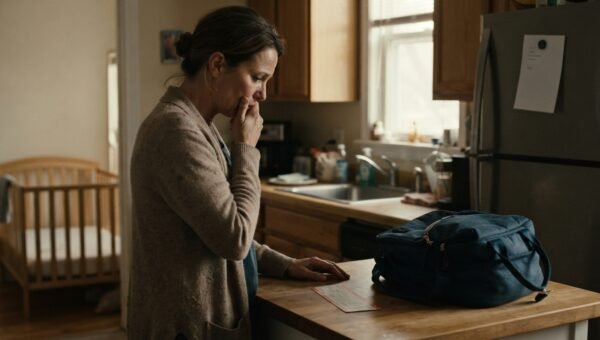
Then Officer Miller handed David Toby’s navy blue school backpack.
The deputy said the boy had refused to let anyone touch the bag until he was certain it would be brought directly to Uncle David.
Inside that backpack, buried under a crumpled windbreaker and two half-eaten granola bars, was a standard wide-ruled composition notebook.
David and I sat under the dining room light and opened it. Toby had filled twenty-four pages with neat, cramped handwriting. There were precise calendar dates, physical addresses across three different counties, and twenty-two distinct vehicle makes and license plate numbers.
On the final page, written in shaky, pressed-down pencil that had torn slightly through the paper, Toby had written: “If Mom takes me there again, call Uncle David.”
PART 2
The dates began just three weeks after Sarah took Toby from our home.
The first page was dated October 14th. Toby wrote about a gravel lot behind an abandoned carpet warehouse near the county line. He noted the time Sarah made him sit in the back seat with his jacket pulled over his head: forty-two minutes. He had written down the make of a silver pickup truck that parked beside them and copied the license plate digit by digit.
As David and I turned the pages, the pattern became sickeningly clear. Sarah had never stayed clean. She had simply learned how to fake compliance long enough to clear her probation officer’s random screens.
Toby had documented thirty separate trips. He had tracked Sarah’s movements using the digital clock on the car dashboard and the street signs he saw out his window. He wrote down what she told him to say if the police ever pulled them over: “Tell them we are visiting Grandma’s friend.” Grandma had passed away four years ago.
The entries grew more frantic by late January. Toby wrote about a house near the river with boarded-up porch windows. He wrote that a man named Curtis lived there, and that Curtis made Sarah leave Toby in an unheated utility shed out back whenever Curtis had “company” over. Toby recorded four different license plates from that shed window. He wrote that he had to pee in an empty plastic jug because Curtis locked the shed padlock from the outside.
The final entry was dated that very afternoon at four-thirty. Toby wrote that Sarah drove him to an apartment complex forty minutes south, told him to stay in the car, and went inside with Curtis. She left the engine running with the keys in the ignition and the windows cracked. Toby waited two hours. It got dark. He was freezing. He took the keys out of the ignition so nobody could steal the car with him in it, put his backpack over his shoulders, walked into a nearby gas station, and asked the woman behind the counter to call 911.
David and I did not sleep. We drove directly to the sheriff’s station.
When we walked into the small juvenile annex, Toby was sitting on a vinyl couch in an oversized county fleece. His hair was greasy, his knuckles were chapped and red, and he looked smaller than he had six months ago.
The moment he saw David, he did not run. He just froze, his chin started trembling, and he whispered, “Did you get my book?”
David went straight to his knees on that linoleum floor and pulled him in. Toby buried his face in David’s jacket and sobbed until his ribs were shaking.
A detective named Martinez called us into a conference room an hour later while a department advocate stayed with Toby. Sarah had been picked up at that apartment complex two hours after Toby walked into the gas station. She was found in possession of eighteen grams of methamphetamine packaged for resale, alongside Curtis, who was a convicted felon currently on parole.
Detective Martinez slid Toby’s composition notebook across the desk. He told us that the narcotic task force had been running a multi-county wire on Curtis’s distribution ring for five months, but they had struggled to track the secondary drop locations Curtis used to bypass routine surveillance.
Toby’s little notebook had just handed them seven active stash points and twenty-two verified buyer vehicles, complete with times of day and specific dates.
PART 3
By sunrise, the county prosecutor had authorized felony child endangerment and distribution charges against Sarah. Curtis was held without bond on federal weapons and drug trafficking charges.
Child Protective Services stepped in immediately, but this time the dynamic was completely different. The emergency caseworker who arrived at seven in the morning was the same worker who had handled Toby’s initial case four years prior. She remembered our home, our clean background checks, and the four stable years Toby had spent under our roof.
At nine o’clock Wednesday morning, an emergency dependency hearing was convened before a family court judge.
David and I sat on the petitioner side of the small courtroom. Sarah was brought in through the holding door in orange county jail scrubs and wrist shackles. She looked hollowed out. Her cheeks were sunken, her eyes darted frantically, and her hands shook constantly against the chain at her waist.
When she saw David, she started yelling that David had poisoned her child against her and that Toby was lying.
The judge did not entertain her for a single second. The county prosecutor presented a certified copy of the detective’s sworn affidavit, which included photocopies of Toby’s handwritten notebook alongside dispatch logs and photos of the unheated utility shed where Toby had been locked.
The prosecutor told the court plainly: “This child did not just survive his mother’s criminal activity. He conducted an entire intelligence operation against it to save his own life.”
The judge looked at Sarah and told her that her parental rights were being formally suspended pending a full termination proceeding. Then he turned his attention to David and me. He asked if our home was still open to Toby, and whether we were prepared to file for immediate, permanent legal guardianship with intent to adopt.
David answered before the judge could even finish the sentence. “He has had a room waiting for him every single night since October, Your Honor.”
The judge signed the emergency placement order right there on the bench.
By noon, we had Toby back in our car. He did not say much on the drive home. He just sat in the back seat, holding a bag of breakfast sandwiches David had bought him, looking out the window at the passing telephone poles as if he was waiting for someone to tell him it was a mistake.
ENDING
When we pulled into our driveway, Toby stepped out onto the gravel. He stood in the exact spot where he had thrown up six months earlier.
He stared at our front porch for a long time. Then he walked up the three wooden steps, put his hand on the front door handle, and looked back over his shoulder at David.
“Is my room the same?” he asked.
David stepped up behind him and opened the door. “Nothing was touched, buddy. Your baseball glove is on the desk. Your winter quilt is on the bed.”
Toby walked down the hall, pushed his door open, and just stood in the center of the rug. His clothes from six months ago were still folded in the dresser. His chapter books were stacked on the nightstand.
He sat down on the edge of the mattress, rubbed his hand over the blue cotton quilt, and finally let his shoulders drop.
Two months later, Sarah signed a voluntary surrender of parental rights from the state correctional facility after her public defender made it clear she was facing a mandatory eight-year prison sentence. She realized that going to trial would only put Toby on the witness stand to read his notebook aloud to a jury.
The adoption was finalized on a clear Friday in mid-May.
Toby is eleven now. He plays second base on the middle school junior varsity team, and he still likes his eggs scrambled dry with extra pepper.
That blue composition notebook is locked inside David’s metal firebox in our bedroom closet. We will never destroy it, but Toby never has to write in one again.
Last night, I went into his room to pull his shades down against the streetlights. Toby was sound asleep on his side, snoring softly with his arm tucked under his pillow.
On his nightstand, right where his notebook used to be, sat a library book about space travel and a permission slip for a sixth-grade field trip to the science museum.
David had signed his name on the parent line in dark blue ink.