PART 1
My wife’s father, Frank Henderson, had a specific way of looking through me. It was not loud, and it was not violent. It was the quiet, deliberate dismissal of a man who built commercial foundations for forty years and believed anything he did not pour himself was temporary dirt.
Sarah and I had been married twenty-two years. We raised three children in an honest, comfortable house forty minutes south of Frank’s spread in Butler County.
I run a regional HVAC supply depot. It is steady work. It paid for braces, church league basketball uniforms, family vacations to Lake Erie, and a solid chunk of our oldest boy’s college tuition. But to Frank, I was never a son-in-law. I was never even Brian. When he spoke to Sarah about household repairs or holiday travel schedules, I was always “the guy you married.”
At Thanksgiving, he would hand Sarah his coat and ask my brother-in-law, Kevin, how the market was moving. Kevin wore loafers with thin soles, worked in medical software, and leased a new Audi every twenty-four months. Frank understood men who took other people’s money and turned it into paperwork, and he understood men who laid block with their own hands. A middle manager who stocked heat exchangers and kept an inventory ledger did not register on his scale.
Sarah spent two decades trying to bridge that trench. She made his favorite vinegar coleslaw for Sunday dinners.
She kept track of his prescription refills after her mother died of pancreatic cancer nine years ago. She reminded him when property tax receipts were due on his three rental parcels. Frank took all of it like a toll collector taking loose change. He never said thank you, and he never invited us over unless a drain was backed up.
The breaking point happened on a humid Saturday evening in late June, at his seventieth birthday dinner.
Kevin and his wife, Amanda, organized the dinner at a private dining room inside a steakhouse off Route 19. It was expensive, stuffy, and crowded with Frank’s old business acquaintances, county township trustees, and the family. Sarah spent three hours beforehand ironing her dress and making sure our kids looked clean and respectable. Nathan was nineteen, home for the summer from Penn State. Tyler was seventeen, quiet and tall. Claire was fourteen, sitting on the edge of her seat with a handmade birthday card she had worked on for two nights.
Dessert came out, coffee was poured, and Frank stood up at the head of the table. He cleared his throat. Everyone got quiet.
He opened a black leather attache case he had carried into the restaurant himself.
“I’ve hit seventy,” Frank said, his voice flat and gravelly from four decades of dry wall dust and diesel fumes. “A man reaches this age, he has to start thinking about the bloodline and who carries the weight. I want my grandkids to know where they come from.”
First, he called up Kevin’s twelve-year-old son, Hunter. Frank pulled out his father’s gold pocket watch, an authentic Waltham piece that Frank’s grandfather had carried while working the Pennsylvania Railroad.
“You keep this clean, Hunter,” Frank said. Amanda practically wept into her linen napkin, snapping photos on her phone.
Next, Frank called up Kevin’s daughter, Paige. He handed her a velvet jewelry box containing his late wife Eleanor’s diamond-and-sapphire brooch.
He told Paige her grandmother would have wanted her to wear it on her wedding day.
Then he closed the attache case, snapped the brass latches shut, and sat down.
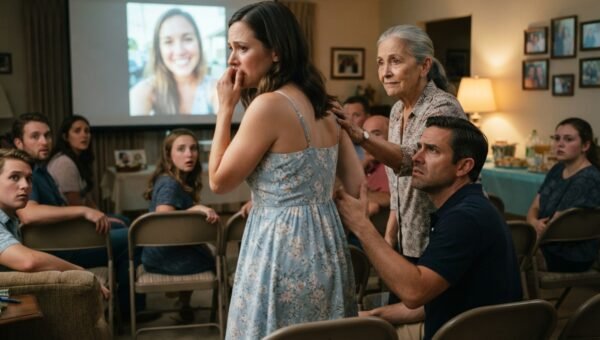
The table went completely silent.
Nathan looked down at his water glass. Tyler blinked, staring straight ahead at the white tablecloth. Claire held her handmade card in her lap, her fingers curling the edges until the paper bent.
Frank had five grandchildren sitting in that room. He gave heirlooms to two of them. My three children were handed nothing. Not a silver dollar, not a pocket knife, not an acknowledgment that they shared his daughter’s blood.
Sarah froze. Her face went pale, and then a blotchy, furious red crept up her throat. She looked at Kevin, who was busy refilling his wine glass, completely oblivious, and then she looked directly at her father.
“Dad?” Sarah’s voice was shaking. “Did you forget something in the car?”
Frank took a sip of his black coffee, set the thick mug down on the saucer with a hard ceramic clatter, and looked right past her.
“I brought what I meant to bring,” Frank said.
Sarah pushed her chair back so violently the legs scraped against the hardwood floor. Tears were spilling out of her eyes before she even cleared the table.
“Sarah, stop,” I said quietly under my breath, reaching out to catch her wrist.
“No, Brian,” she hissed, her voice cutting through the dining room chatter. “Twenty-two years of this garbage. Twenty-two years of pretending he’s just old-fashioned. He just erased our children in front of thirty people.”
“Leave it alone,” I told her, keeping my voice dead level. “Not here. Let’s get the kids in the car. We are leaving.”
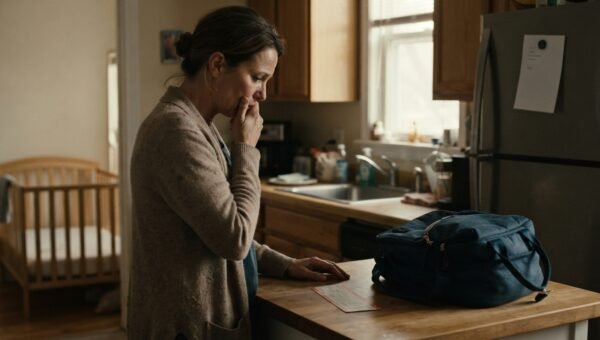
The drive home was forty minutes of pure, choking misery. Nathan sat in the front passenger seat staring out the window into the dark cornfields, his jaw set tight. In the back, Claire was crying against Tyler’s shoulder, crumpling the birthday card into a tight ball. Sarah stared straight ahead, tears running down her cheeks, her knuckles white on her purse.
“Don’t you ever ask me to go back there,” Sarah whispered as we pulled into our driveway. “He is dead to me, Brian. He hates you, and now he is punishing my babies because they belong to you.”
“I don’t care about his pocket watch,” I said, putting the car in park. “The kids know who loves them. That’s what matters.”
For seven days, our house was like a funeral parlor. Sarah didn’t call him. She screened her brother Kevin’s calls. She threw Frank’s spare house key into the junk drawer and refused to mention his name.
Then, on the following Monday afternoon, my cell phone rang while I was checking a shipping manifest on the loading dock at work.
The caller ID said Frank Henderson.
I answered, bracing for an argument or another dry complaint about a gutter.
“Brian,” Frank said. No greeting. Just my name.
“Yeah, Frank. What is it?”
“I need you to come out to the shop on Mill Creek Road. Tomorrow morning. Eight o’clock sharp.”
“Sarah isn’t ready to talk to you, Frank. And frankly, neither am I.”
“I didn’t call Sarah,” Frank said, his breath hitching slightly over the line. “I called you. Don’t bring her. Don’t tell her you’re coming. Come alone, or don’t bother coming at all.”
PART 2
The drive out to Mill Creek Road on Tuesday morning felt heavy. The morning sun was burning the mist off the hayfields, but inside my truck, the air felt cold. I hadn’t told Sarah. If I had mentioned Frank’s call, she would have locked herself in the bedroom or begged me to tell him off. I didn’t want a scene. I just wanted to find out why the old man had summoned me, hear whatever grievance he had cooked up, and put an end to it once and for all.
Frank’s commercial shop was a corrugated steel pole barn set back on four acres of packed gravel. For thirty years, it had been the home base of Henderson Concrete & Foundations. The heavy mixer trucks and backhoes were gone, sold off five years ago when his knees gave out, but the yard still smelled of damp gravel, diesel fuel, and curing lime.
His faded green Ford F-150 was parked by the side office door.
I stepped out of my truck, the gravel crunching under my work boots. The side door was propped open with an eight-inch masonry block. Inside, the shop was dark and cool, lit only by high dust-covered skylights. Frank was sitting on a rusted steel swivel stool beside an old oak workbench that had seen four decades of sledgehammers and oil cans.
He looked smaller than he had at the restaurant. His gray work shirt hung loose on his shoulders, and his hands, resting on his knees, were swollen at the knuckles.
On the workbench beside him sat a battered, rectangular steel toolbox. It was painted a faded industrial red, scratched down to bare gray metal along every edge, with a bent wire latch and a heavy iron handle. It was the box he had thrown into the bed of his truck every working morning of his adult life.
“You’re on time,” Frank said, not looking up right away.
“Traffic was light,” I replied, stopping six feet from the bench. I kept my hands out of my pockets. “What do you need, Frank? I have to be at the depot by ten.”
Frank stood up slowly, bracing his palms against the edge of the bench until his bad hip locked into place. He looked at me, his pale blue eyes squinting against the dim light, studying my face the way he used to check a concrete slump test.
“Kevin came by Sunday,” Frank said quietly.
“Did he?”
“Brought a bottle of twenty-year-old scotch. Brought Amanda, too. They stayed about twenty minutes before Kevin brought up the corner parcel on Route 68. Wanted to know if I’d consider deeding it over early so he could use the equity to clear his margin debt on some tech stock that went sideways.”
I said nothing. It wasn’t my business, and I wasn’t going to play family referee.
“Yesterday morning, Sarah called my landline three times,” Frank continued. “Left two voicemails. Crying, telling me I broke her heart, telling me I ruined her children’s lives over an old gold watch.”
“She was defending her kids, Frank,” I said, my voice hardening. “You humiliated them. You handed heirlooms to Kevin’s children and treated Nathan, Tyler, and Claire like strangers off the street. She had every right to be furious.”
Frank didn’t flinch. He didn’t raise his voice. He just tapped the lid of the red steel toolbox with one thick, calloused index finger.
“You think that watch matters, Brian?” Frank asked. “You think Eleanor’s brooch matters? My grandfather gave that watch to my father because my father was a drunk who couldn’t keep a job, and he thought having a railroad piece in his pocket might shame him into showing up on time. It didn’t. My father pawned it twice. I had to buy it back out of a shop in New Castle in 1968. That watch is a trinket for people who live on appearances. Kevin lives on appearances. So does his boy.”
“That didn’t make it hurt any less for Claire,” I said.
Frank ignored me. He lifted the heavy toolbox by its iron handle. His shoulder dipped under the weight. It must have weighed forty pounds. He took two shuffling steps forward and shoved it against my chest.
I instinctively caught it, the cold steel pressing into my hands.
“Take it,” Frank said.
“What is this?”
“It’s mine,” he said flatly. “Your wife will think it’s junk. She’ll tell you to throw it in the scrap bin behind your garage. Don’t open it until you get to your house. Put it in your trunk, go to work, and open it when you’re alone.”
“Frank, I don’t want your tools. I have my own tools.”
The old man’s eyes flared with a sudden, sharp intensity that stopped me cold. “I told you to take it. Don’t bring it back here. And don’t tell Sarah what’s in your truck until you’ve looked inside.”
He turned his back on me, walked over to the shop sink, and turned the brass faucet on to wash his hands. The conversation was over.
I stood there for three seconds, holding the heavy box. Then I walked out to my truck, set the toolbox on the floorboard of the back seat, covered it with an old canvas tarp, and drove to work.
PART 3
I spent the rest of the workday in a fog. Every time I walked past the warehouse windows and saw my truck sitting in the company lot, my mind jumped back to Frank’s face in that dusty shop.
When I got home at five-thirty, the house was empty. Sarah had taken Claire to her summer soccer practice, and the boys were working their evening shifts at the local grocery store. The driveway was quiet.
I went out to the truck, hauled the heavy steel box out from under the tarp, and carried it inside. I set it directly on the center of the kitchen island.
The box smelled of thirty-weight motor oil, grease, and old rust. The brass padlock loop was empty. The latch was held shut only by a bent cotter pin Frank had pushed through the eyelet decades ago.
I pulled the cotter pin free and lifted the heavy lid.
There were no wrenches inside. No sockets, no screwdrivers, no masonry trowels.
The top lift-out tray had been removed entirely. Resting inside the deep bottom compartment were six thick manila folders, bound with heavy red rubber bands, and a stack of blue-backed legal documents stapled along the upper edge.
Sitting on top of the first folder was a single sheet of yellow legal pad paper, torn roughly along the perforated edge. The handwriting was unmistakable: heavy, angled, written in permanent blue ink by a man who pressed down hard enough to score the wood underneath.
The first line read:
*Brian, you’re the only person in this family who never asked me for anything.*
I pulled a kitchen stool out and sat down. My hands were trembling slightly as I picked up the paper and read the rest:
*Twenty-two years ago, you sat on my porch and told me you were marrying Sarah. You had four hundred dollars in a savings account and an eight-year-old Chevy with a slipping transmission. I offered to loan you ten grand to put a down payment on a house in town. You looked me in the eye, told me you appreciated the thought, but said you didn’t borrow money from men you didn’t work for. You said you’d buy a house when you earned it.*
*I thought you were a stubborn fool. I waited five years for you to come back asking for payroll help. You never came. I watched Kevin buy his first house with my money, trade up with my money, and complain about my gravel dust every time he parked in my yard.*
*When Sarah cried about you, it was because you worked sixty hours a week stocking pipe in the winter. She wanted easy money. You gave her honest money. I watched you teach Nathan how to grease a bearing on his lawnmower. I watched you sit in the bleachers for nine innings in the freezing rain to watch Tyler strike out four times, and you bought him an ice cream cone afterward anyway.*
*A man who gives his children watches is giving them time they didn’t earn. A man who gives his family land gives them a foundation.*
*In this box are the original deeds to the forty-two acres on Mill Creek, the commercial barn, and the two rental parcels on Old Route 8. The township approved the commercial zoning change three months ago. The assessed value on the bare ground alone is 1.4 million dollars. The rental houses generate forty-eight hundred a month after taxes and insurance.*
*Underneath the deeds is a copy of the Henderson Living Trust, drafted by Miller & Cole in Cranberry. It was executed last Friday, twenty-four hours before my birthday dinner.*
*You are the sole executor and the sole independent trustee. Sarah and Kevin are lifetime income beneficiaries, but they cannot sell the dirt, they cannot borrow against the principal, and they cannot touch a single dollar of the capital without your written signature.*
*When Kevin asked me for that land on Sunday, I looked him in the eye and let him believe he was still in line. He’s not. Neither is Amanda. And if Sarah wants to spend her inheritance on nonsense, she will have to sit at your kitchen table and explain to you why she needs it.*
*I kept your kids out of the restaurant gifts because I am not giving them old junk to put on a shelf. I set up three educational trust sub-accounts in that file. Fifty thousand each for Nathan, Tyler, and Claire, funded by the sale of the mixer equipment. Their college is paid. Their first homes will have down payments.*
*Don’t thank me. You earned this by being the only man who ever treated my daughter like an obligation he chose to carry, instead of a ticket to my bank account.*
*Take care of the dirt.*
*Frank.*
I sat at the kitchen island in the dead silence of the house, reading the letter three times until the words blurred.
I pulled out the blue-backed documents. It was all there. Frank had signed every page with a notary’s raised seal stamped into the heavy paper. The deeds were recorded with the county recorder of deeds. The trust accounts at First Commonwealth Bank had my name listed as the fiduciary officer.
Twenty-two years of cold shoulders, clipped greetings, and being called “the guy she married” had not been hatred. It had been an audit. He had been watching every mile I drove, every overtime shift I took, every time I refused to take a handout from his wallet.
The front door clicked open.
ENDING
Sarah walked into the kitchen, carrying her purse and a plastic bag of groceries from the farm stand down the road. Claire was right behind her, laughing about something that happened at soccer, kicking her cleats off by the mudroom mat.
Sarah stopped the moment she saw the kitchen island.
She saw the rust-red toolbox sitting open on the clean quartz counter, the manila folders spread out, and the yellow legal pad in my hand.
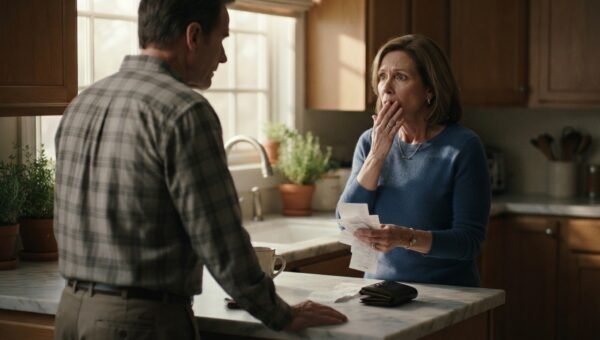
“What is that?” Sarah asked, her brow furrowing in instant irritation. “Brian, why did you put that filthy thing on the counter? Did my dad dump his trash on you?”
“Come here, Sarah,” I said quietly.
“I told you I don’t want to hear about him,” she said, her voice rising as the old anger flared back up. “I don’t care if he wants his oil changed, or if his roof is leaking. He humiliated our children. He gave Hunter a railroad watch and gave Claire nothing. I won’t have his garbage in this house.”
“Sarah,” I said, my voice firmer this time. “Sit down. Read this.”
I held out the yellow sheet of paper.
She looked at me, suspicious and defensive, but the look on my face stopped her. She set the grocery bag on the edge of the island, pulled out the stool next to mine, and took the letter.
I watched her eyes move across Frank’s heavy, slanting script.
By the end of the second paragraph, her mouth had parted slightly. By the time she reached the part about the railroad watch and Kevin’s debts, her hand started to shake. When she read what Frank had written about me—about watching me sit in the rain with Tyler, about watching me work sixty hours a week in the winter without ever asking him for a dime—a single, heavy sob broke out of her chest.
She dropped the paper on the counter, covered her face with both hands, and wept.
“He never said any of that,” she choked out through her fingers. “Not once. He never told me you were a good man. He never told me he saw any of it.”
“He didn’t want to talk about it, Sarah,” I said gently. “He’s a concrete man. He only believes in what carries the load.”
I slid the blue legal folder toward her and opened it to the trust agreement. She looked at the numbers, the parcel maps, the notary stamps, and the educational trust balances with our children’s names printed in bold black type.
“He made you the trustee?” she whispered, looking up at me with red, swollen eyes. “Not Kevin?”
“Kevin isn’t getting the land,” I said. “None of it. Frank tied it up completely. If Kevin wants money to cover his stock margins, he has to ask me, and the answer is going to be no.”
She stared at the open toolbox, reaching out slowly to touch the scarred, red metal where her father’s hand had rested for forty years. The anger that had lived in her shoulders for a week—and really, for twenty years—seemed to drain out of her all at once, leaving behind something quiet, hollow, and profoundly humbled.
The next evening, I drove back out to Mill Creek Road alone.
The sun was low behind the tree line, throwing long orange shadows across the gravel yard. Frank was sitting on his front porch in a green plastic chair, drinking a glass of water from the tap.
I walked up the porch steps and leaned against the wooden rail. We didn’t shake hands. We didn’t hug.
“Sarah read it,” I said.
Frank took a sip of his water and stared out at the forty-two acres of open hayfield across the road.
“She cry?” he asked.
“Yeah. She cried.”
“Good,” Frank said, his voice flat and steady. “Do her good to know her husband isn’t a pushover.”
“Nathan’s tuition bill is due in August,” I said. “I’ll handle the draw from the trust account at First Commonwealth on Monday.”
Frank nodded once. A slow, slight nod that barely moved his chin.
“The mower deck on the John Deere has a bad spindle,” Frank said, looking back down at his work boots. “I can’t get down on the gravel to pull the cotter pin out. If you’ve got twenty minutes, the grease gun is hanging by the bench.”
“I’ve got twenty minutes,” I said.
I walked down the porch steps toward the barn, stepped inside the cool dark of the shop, and reached for the tools. For the first time in twenty-two years, I didn’t feel like a guest on borrowed ground. I was standing on the foundation, and the man who poured it finally knew it was going to hold.