PART 1
We had been at the cabin near Blue Ridge for less than twenty-four hours when the shouting started. It was supposed to be a quiet weekend to close up the place before winter set in. My sister Brenda had driven up from Charlotte with her teenage daughter, Clara. My wife, Megan, and I came up from Atlanta on Friday afternoon.
Megan took off her wedding ring on Saturday morning before helping Brenda wash down the screened porch and wipe away spiderwebs.
The ring was a distinctive platinum band with three old European-cut diamonds set in heavy filigree. Megan had worn it every single day of our seven years of marriage. She always told people her late father, David, had bought it for her mother at an estate auction in Savannah back in the late 1980s, and David had passed it down to Megan just before he died.
She set it on the small wooden windowsill right above the kitchen sink.
By two in the afternoon, Megan went back to the sink to get a glass of water and put the ring back on. It was gone.
The next three hours were pure chaos. We pulled all the kitchen rugs up. I took apart the U-bend trap under the sink with a pipe wrench from the shed, dumping dirty water into a plastic tub while Megan sat on the floor looking through the gunk.
Clara crawled around on her hands and knees with a flashlight, checking under the refrigerator and behind the baseboards. Brenda leaned against the counter with a mug of coffee, watching us tear the cabin apart.
Around five o’clock, Megan was sobbing in the hallway. That was when Brenda took a slow sip of her coffee and said, loud enough for everyone to hear, “Well, maybe you took it off on purpose, Megan. People lose things when they want attention, or when they don’t want to be tied down anymore.”
It was an ugly, uncalled-for remark. Megan snapped. She stood right in front of Brenda and said my family had spent seven years treating her like an outsider who was never good enough, and that Brenda had been making petty digs at her since the day of our rehearsal dinner. Brenda rolled her eyes, turned her back, and walked out onto the porch.
Megan told me we were leaving immediately. She packed our bags in twenty minutes. I tried to calm the room down, but Brenda refused to apologize, claiming she had only made a harmless joke. Clara sat on the front steps looking miserable and frightened by all the screaming.
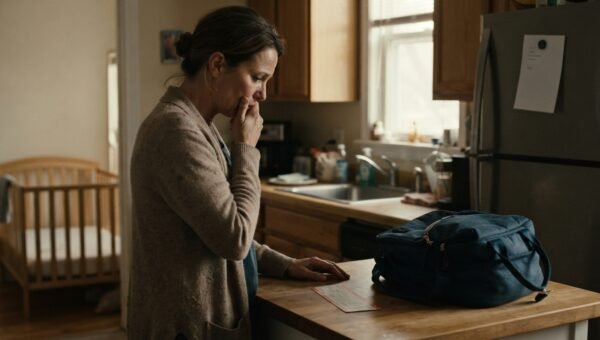
We drove the three hours back to Atlanta in heavy rain and total silence. For three weeks, the house felt like a tomb. Megan barely spoke. She took a couple of days off from her job at the dental clinic and spent her evenings staring at her empty ring finger. I felt torn in two. Brenda had always been sharp-tongued and territorial about family, but I couldn’t understand why she would turn a lost piece of jewelry into a full-scale war.
Then, on a Tuesday evening while Megan was at a late clinic meeting, my phone buzzed. It was Clara.
When I answered, my sixteen-year-old niece was hyperventilating so hard I could barely understand her words.
“Uncle Tom, you have to come,” Clara whispered, her voice shaking through tears. “Mom is at her book club.
I was looking for safety pins in her closet, inside her locked velvet jewelry armoire. The key was in her top drawer.”
“Clara, slow down. What happened?”
“Megan’s ring,” Clara choked out. “It’s in here. It’s sitting in the bottom drawer of Mom’s jewelry case, wrapped in a paper towel. Mom took it from the cabin. She had it the whole time.”
PART 2
I didn’t call Brenda. I didn’t text my wife. I grabbed my car keys, backed down our driveway, and hit Interstate 85 North toward Charlotte.
The two-and-a-half-hour drive felt like twenty minutes of blind fury. Blood was pounding in my ears. I kept picturing Megan crying on the dirty cabin floor, digging her bare fingers through pipe sludge while Brenda stood there drinking coffee. It was sick. It was cruel. To steal from your own sister-in-law, let her take the blame, and watch our marriage shake under the stress, all over some twisted sibling jealousy.
By the time I pulled into Brenda’s neighborhood in south Charlotte, it was just after nine at night. Brenda’s silver crossover was parked in the driveway. Her book club had ended. Clara’s bedroom light was on upstairs.
I walked up the front walk without knocking, turned the knob, and pushed the door open.
Brenda was sitting at her dining room table under the warm chandelier. She wasn’t surprised. In front of her sat a clear plastic zip-top bag containing Megan’s ring, a thick cream-colored folder, and a small stack of glossy photographs. Clara was nowhere in sight; she had clearly stayed in her room after calling me.
“You took it,” I said, my voice shaking so hard it cracked. “You let Megan cry for three weeks. You let her believe it went down the drain or got lost in the woods. You sat there and watched her tear the cabin apart, you sociopath.”
Brenda didn’t flinch. She didn’t raise her voice, and she didn’t offer a single excuse.
“Keep your voice down,” she said calmly, folding her hands over the cream folder. “Clara is upset enough as it is. Sit down, Tom.”
“I am not sitting down in your house. Give me the ring, or I swear to God I will call the police from your front yard.”
“Go ahead and call them,” Brenda replied, looking me dead in the eye. “Tell them to bring an officer who handles grand larceny and probate fraud. Because I didn’t take this ring to keep it. I needed to have it tested.”
“Tested for what?” I yelled. “It’s Megan’s ring! It belonged to her mother!”
Brenda pushed the cream folder and the photographs across the polished mahogany table toward my side.
“Look at them,” she said quietly.
I looked down. The top photograph was a black-and-white print from the summer of 1961, curled at the edges. It showed our grandmother, Evelyn Vance, sitting on a porch swing in Hendersonville with our grandfather. On her left hand, catching the afternoon sunlight, was a platinum ring.
I picked up the picture. The filigree work was unusual, shaped like four folded dogwood petals holding a high-set center stone, flanked by two smaller European-cut diamonds. It was identical to the ring sitting in the plastic bag on the table. Exactly identical, down to the notch on the side bezel.
“Grandmother Evelyn gave that ring to our mother in 1974,” Brenda said, her voice dropping lower. “Mother kept it in her bank safety deposit box in Asheville. When Mother got sick in 1983, before you were even born, our family fell apart financially. Uncle Richard was handling her affairs. That ring, along with four other heirlooms, vanished from her safe deposit box right before she went into the nursing home.”
“What does this have to do with Megan?” I demanded, though a cold knot was forming in my stomach. “Megan’s father bought this in Savannah in the late eighties.”
“Her father didn’t buy it at any estate auction,” Brenda said, tapping the folder. “I took that ring to Masterson Jewelers on Monday. Old Mr. Masterson did work for our family forty years ago. When he opened the band under thirty-power magnification, he found the jeweler’s mark inside the shank: ‘H.V. 1928’ for Henry Vance, our great-grandfather. He also pulled the 1983 police report our father filed in Buncombe County when Mother’s safety deposit box was cleaned out.”
Brenda leaned forward, her eyes hard and clear.
“The man who emptied that box using Uncle Richard’s forged power of attorney was an estate liquidator named David Keller. Megan’s father.”
PART 3
The room went completely silent except for the hum of the refrigerator.
I pulled out the paper inside the folder. It was a yellowed photocopy of a police report filed in Asheville, North Carolina, dated November 14, 1983. My father’s handwriting was unmistakable at the bottom. Attached to it was an inventory list. Item three was listed as: *Platinum ladies ring, 3 Old European cut diamonds approx 2.4ctw, custom dogwood motif, inscribed H.V. 1928.*
Next to it was an affidavit from the Buncombe County Sheriff’s Department. David Keller had been questioned in the spring of 1984 regarding missing estate items from two families whose parents had entered state-run memory care facilities. The charges had been dropped due to lack of physical evidence and Uncle Richard’s declining mental state, but Keller had abruptly closed his liquidation business in North Carolina six months later and relocated to Savannah, Georgia.
“The day Megan and you got engaged, I saw the pictures on your phone,” Brenda said. “I felt sick to my stomach. I asked you where she got it, and you said her father gave it to her. I knew the moment I saw it at the cabin that I was right. I couldn’t just accuse her without proof, Tom. If I asked to inspect it, she would have locked it in a safe and you would have called me paranoid. So I took it, and I drove it straight to Masterson’s.”
“Megan didn’t know,” I whispered, holding onto the edge of the dining chair. “She was a little girl in the eighties. She loved her dad. She genuinely believes he bought it legally.”
“Maybe she knows, maybe she doesn’t,” Brenda said flatly. “That doesn’t change what it is. That is our grandmother’s ring. It was stolen from our mother while she was dying of cancer. Keller kept the best piece for his own family while our father had to take out a second mortgage to pay Mother’s final hospital bills.”
“You should have told me,” I said, anger flaring back up through the shock. “You didn’t have to humiliate her at the cabin. You made her feel like dirt.”
“And what would you have done, Tom?” Brenda challenged me, standing up. “You would have protected her. You would have told her what I suspected, she would have told you some sweet story about her daddy, and that ring would have stayed on her finger forever while our grandmother’s legacy stayed stolen.”
Brenda pushed the plastic bag across the table.
“Take it,” Brenda said. “I am not a thief. I didn’t keep it. The appraisal, the provenance, and the police records are in that folder. You take that ring and you show your wife what her father actually was. And then you decide what kind of man you are.”
I picked up the bag and the folder. Clara came halfway down the stairs, looking down at us with red, puffy eyes.
“I’m sorry, Uncle Tom,” she whispered.
“Don’t apologize, Clara,” I told her, my chest aching. “You did the right thing.”
I walked out to my car. It was past ten o’clock. The rain had cleared, leaving the interstate dark, slick, and empty. I kept the ring on the passenger seat next to the folder. Every mile back to Atlanta felt like a nail being driven into my marriage.
If Megan had known the truth, our entire marriage was built on a deliberate lie. If she didn’t know, I was about to dismantle the memory of the father she idolized, while demanding she give up the most precious object she owned to the sister-in-law she hated.
ENDING
I walked through our front door in Atlanta at one-thirty in the morning.
The living room lamp was on. Megan was sitting on the sofa in her bathrobe, holding an unread magazine, her face pale and exhausted. When she saw me walk in with Brenda’s folder in my hand, she stood up immediately.
“Where were you?” she asked, her voice tight with panic. “You weren’t answering your phone. Your car was gone.”
I didn’t say a word. I set the plastic bag with the diamond ring on the coffee table between us.
Megan gasped. She reached out with both hands and picked it up, pressing the cold platinum against her chest. “Where did you find it? Oh my God, Tom, where was it?”
“Brenda took it,” I said flatly.
Megan’s face twisted into immediate rage. “I knew it. I knew she was sick. We are calling the police right now. She stole my mother’s ring out of pure spite—”
“Open the folder, Megan.”
She stopped. She looked at me, seeing my expression for the first time. The anger drained out of her face, replaced by confusion.
She sat down and pulled out the 1983 police report, the old black-and-white photograph of my grandmother on the Hendersonville porch, and the Masterson Jeweler appraisal showing the ‘H.V. 1928’ inscription inside the band.
She read the papers slowly. I watched her eyes move across her father’s name on the Buncombe County sheriff’s inquiry. She read the date: November 1983. She had been four years old.
“This is a lie,” she whispered, her voice cracking. “My father was an honest man. He bought this at an auction on Broughton Street in Savannah. He told me that my whole life.”
“Look inside the band with the magnifying glass from my desk,” I told her gently. “Look at the initials. Henry Vance. My great-grandfather. Look at the date.”
She didn’t move to get the glass. She didn’t need to. The photograph of my grandmother wearing the exact same dogwood filigree setting was right in front of her. The truth was staring at her from forty-three years in the past.
Megan covered her face with both hands and began to sob. It wasn’t the angry crying from the cabin. It was the heavy, broken weeping of someone watching their entire childhood crumble. Her father had died eight years ago, leaving her with memories of a gentle, generous antique dealer who always brought her pretty trinkets from work. She had worshipped him. Now she was looking at documented evidence that he had stripped an elderly, ailing woman’s safe deposit box and kept the prize piece for his own family.
“I didn’t know,” she choked out, looking up at me with tears streaming down her neck. “Tom, I swear on my life, I didn’t know. If I had known, I never would have worn it. I never would have let you put it on my finger.”
I sat beside her and pulled her into my arms. “I know you didn’t know. I never believed you did.”
We stayed awake until the sun came up, sitting on the living room floor talking through the ruins of forty years of secrets. There was no victory for anyone. Brenda had been right about the crime, but her cruelty in executing the reveal had left scars that would never fully heal. Clara had been forced to spy on her own mother. And Megan had lost both her wedding ring and the pristine memory of her father in a single night.
Two days later, Megan placed the ring back inside the small velvet box it had lived in for years. We drove up to Charlotte together on Sunday afternoon.
Megan didn’t go inside Brenda’s house. She waited in the car. I walked up the front steps, knocked on the door, and handed the box to Brenda.
Brenda looked down at it, her jaw tight. For the first time, she looked somewhat subdued.
“She didn’t know, Brenda,” I told my sister firmly. “Not a single word of it. You were right about the history, but you were wrong about her. And because of the way you handled this, you and I are going to need a very long break.”
Brenda opened the box, looked at her grandmother’s ring for a few seconds, and nodded once. “Thank you for bringing it home, Tom.”
I turned around and walked back to the car where my wife was waiting.
The following month, Megan and I went to a local jeweler in Decatur. We bought a plain gold band with no history, no inherited stories, and no ghosts attached to it. It was modest, clean, and paid for with money we had earned ourselves. When I slipped it onto Megan’s finger, she cried again, but this time she was smiling through the tears. We couldn’t rewrite what had happened forty years ago, but the ring on her hand was finally ours, and ours alone.