PART 1
My husband’s father called me Clara for the first time on a Sunday evening in late October.
We were sitting around his kitchen table eating roast chicken. Clara was his first wife, who died in 1968, four years before my husband, Paul, was even born. When Arthur said, “Clara, pass the salt, please,” everybody at the table laughed. Arthur was eighty-two, his cardigan had a missing button, and he had been forgetting where he set his reading glasses all autumn.
Paul smiled, patted his father’s shoulder, and said, “Dad, that’s Karen. Clara’s been gone a long time.” Arthur blinked, took the salt cellar from me, and muttered an apology into his napkin.
I brushed it off. I was fifty-four, Paul was fifty-two, and we had been married twenty-three years. We had seen older relatives slow down before.
The following Sunday, Paul stayed home to clean out our gutters, so I drove out to Arthur’s house by myself to bring him two containers of vegetable soup and sort his mail.
Arthur was sitting by the front window with a cold cup of black tea. When I walked in through the back porch, he set the mug down so hard tea sloshed onto his knuckles. He stood up, walked straight over to me, and grabbed my right wrist. His grip was surprisingly tight for an old man with thin forearms.
“Clara,” he whispered, his eyes wide and watery. “Listen to me. Don’t let Paul take the red folder.”
“Arthur,” I said, trying to pull back gently without hurting him. “It’s Karen. Paul isn’t even here.”
“Don’t let him have it,” Arthur said again. His breath smelled like peppermint and stale tobacco. “He thinks he can fix it, but he can’t. It’s behind the drawer.”
“What drawer, Arthur?”
He let go of my wrist, looked down at his shoes, and rubbed his face with both hands. Just like that, the frantic look vanished. He gave me a tired, apologetic smile and said, “I’m sorry, Karen. I get muddled when the sun goes down behind the pine trees. Thank you for the soup.”
That night in bed, I told Paul about it. I said Arthur was getting confused and maybe we needed to talk to Dr. Evans about screening him for early dementia. Paul turned his back to me, adjusted his pillow, and said, “He’s just eighty-two, Karen. Stop diagnosing my dad. He probably had an odd dream.”
On Wednesday, I called Dr. Evans’s office myself. Dr. Evans had been Arthur’s physician for nearly twenty years and had known my own family just as long. I asked if Arthur had shown any cognitive decline during his checkup the month prior.
“Karen, Arthur’s blood pressure is high, but his mental status was completely normal,” Dr. Evans told me. “He did his memory recall without missing a word. He’s sharp as a tack. If he’s confusing names, it’s grief or distraction, not his brain failing.”
Three days later, on Saturday morning, the neighbor who shoveled Arthur’s walk found him in bed. Arthur had died quietly in his sleep.
The shock hit hard, but what happened two hours later shook me worse.
We drove over to Arthur’s small brick bungalow while the county van was still parked out front. As soon as the coroner finished and left, Paul walked past his father’s empty bedroom, marched straight into the study, and began yanking hardcovers off the walnut bookshelves. He threw them onto the rug, one by one.
I stood in the doorway with my coat still buttoned. “Paul, what on earth are you doing?”
“Nothing,” he said. He said it too fast, without looking back at me, his fingers tearing through a stack of old magazines on the desk. “Just looking for Dad’s estate paperwork. Insurance policy, the deed. Basic stuff.”
“In the encyclopedia volumes?” I asked.
“I need to find it before my sister calls,” he snapped.
That was when Arthur’s voice came back to me, loud and clear: *Don’t let Paul take the red folder. It’s behind the drawer.*
I backed out of the study quietly. I walked into the dining room where Arthur kept an antique oak sideboard. Nothing there. Then I remembered the small roll-top desk in the corner of the guest bedroom down the hall. Arthur had used that desk for fifty years.
I knelt on the floor, pulled the bottom left drawer all the way out, and reached my arm into the hollow space behind the tracks. My knuckles scraped against coarse cardboard and tape.
A heavy red expanding folder had been taped firmly to the back panel of the desk frame.
I pulled it free, peeling off the brittle masking tape. Inside was a single white legal envelope and an official certificate.
I unfolded the document under the weak ceiling light. It was a certified marriage license from Campbell County, Tennessee. The groom was Arthur Vance, age twenty-four. The bride was listed as Evelyn Mae Harris, age twenty-one.
Evelyn Mae Harris was my mother. The date at the bottom was June 14, 1947, twenty-five years before Paul was ever born.
PART 2
I stood by the guest bed, holding the paper with two hands because my thumbs would not stay steady.
My mother’s maiden name was Evelyn Mae Harris. She grew up in Lafollette, Tennessee, before her family moved north to Ohio in the late 1940s. She married my father, Thomas Miller, in 1952. All my life, I believed my parents had been each other’s only spouses until my father died of lung cancer in 1994, and my mother passed five years later. My mother had never mentioned Tennessee to me except to say her people were farmers who lost their land. She had certainly never mentioned Arthur Vance.
I heard Paul’s heavy footsteps coming down the hall from the study.
I shoved the red folder under the quilt on the lower rack of the guest bed, folded the marriage certificate into my coat pocket, and turned around just as Paul appeared in the doorway.
His face was red, and his shirt collar was damp with sweat. “Did you find anything in here?” he asked.
“Just Dad’s extra blankets,” I said, keeping my voice level. “Paul, what exactly are you hunting for? The lawyer will have his will on Monday. We don’t need to ransack his house today.”
“You don’t understand how Dad did things,” Paul said. He rubbed his forehead with his sleeve. “He hid things. He didn’t trust banks or lawyers. He kept cash, old deeds, letters. If we don’t find them, the state takes what it wants.”
“Did he keep a red folder?” I asked.
Paul stopped breathing for a second. His eyes narrowed, looking at my face, then down at my empty hands. “Why would you ask that?”
“He told me about one last Sunday,” I said. “He said you were looking for it.”
Paul gave a short, bitter bark of a laugh that sounded completely hollow. “He was losing his mind, Karen. You said it yourself. The man was eighty-two and called you his dead wife.”
He walked back toward the kitchen, muttering about making a pot of coffee.
As soon as he was in the kitchen, I went back to the bed, took the red folder, slipped it under my coat, and carried it out to my car in the driveway. I locked it in the spare tire compartment beneath the trunk floorboard.
We stayed at the house until dusk, meeting with the funeral director and boxing up Arthur’s perishable food. Paul searched the study twice more, tapping on baseboards and lifting the corners of the area rug. He looked desperate, almost frantic, in a way I had never seen in twenty-three years of marriage.
That evening, Paul took two sleeping pills and went to bed early.
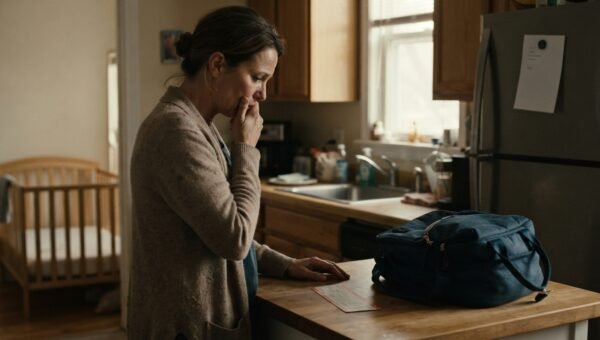
I waited until I heard his steady snoring through the bedroom door. Then I went out to the garage in my winter coat, opened the trunk of my sedan, and brought the red folder to the kitchen table.
Inside the legal envelope behind the marriage certificate were three items: a handwritten letter on yellow legal pad paper dated August 1971, a carbon copy of a bank transfer receipt from 1972 for $12,500, and an official divorce decree issued by an Ohio county court in November 1951.
The divorce decree listed Arthur Vance and Evelyn Mae Vance.
They had been married for four years. They had lived in Akron while Arthur worked at the rubber plant. There were no children listed on the decree.
Then I unfolded the yellow handwritten letter. The handwriting was unmistakably my mother’s, slanted and sharp.
“Arthur,” the letter began. “You promised twenty years ago you would stay in Michigan and never come back to this county. Now you buy a farm five miles from where Thomas and I built our lives. Thomas doesn’t know about Akron. He never knew, and he can never know. If you tell him, or if you bring this shame to my door, I swear to God I will take Karen and leave this state. Take the money you asked for and leave us in peace.”
Attached to that letter was the 1972 bank receipt showing $12,500 transferred from my mother’s personal inheritance account directly into Arthur Vance’s savings account.
I sat at my kitchen counter until three in the morning, reading those pages over and over.
Arthur had been married to my mother before either of my parents ever met. Arthur had taken money from her in 1972 to keep quiet about their past. And twenty-five years later, in 1999, when my mother died, Arthur had attended her funeral. That was the day I had first met his son, Paul.
Paul had been thirty years old then, standing beside his father in the back row of the church. Within eight months, Paul had asked me out for coffee. Within two years, we were married.
My chest tightened as a sickening thought took hold.
Paul had pursued me. Paul had been the one who insisted on buying a house only ten minutes from his father’s farm.
Had our entire marriage been an accident of geography, or had Paul known all along?
PART 3
On Monday morning, after the funeral home arrangements were completed, Paul told me he had to go into his office at the municipal water department for a few hours to sign off on payroll.
The moment his truck pulled out of the driveway, I took the red folder, got into my car, and drove to Arthur’s house.
I didn’t go to look for money. I went back to Arthur’s study to find his old journals. Arthur had kept daily five-year pocket diaries his entire adult life; I had seen them lined up on his desk shelves for years.
When I reached the study, the shelves were empty. Paul had boxed them up and put them in the trunk of his truck before leaving for work that morning.
Except Paul had missed one thing. On the floor behind the desk wastebasket was a small black notebook with a broken spine. It was Arthur’s personal ledger from 1999, the year my mother died.
I opened it to October 1999, the month of my mother’s funeral.
Arthur’s cramped handwriting filled the pages:
*Oct 14: Evelyn passed away on Tuesday. Heart.*
*Oct 17: Service at St. Jude’s. Took Paul with me. Told him the truth on the drive home about the $12,500 and the farm down payment. He was furious. He said Evelyn stole his inheritance by forcing me to sign the quiet agreement.*
*Nov 2: Paul found Evelyn’s daughter’s address. Karen Miller. He says he’s going to get back what her mother took from this family.*
I sat on the dusty floor of the study, holding that black ledger against my knees.
The room was dead quiet except for the hum of the old refrigerator down the hall.
My husband had not fallen in love with me at a church reception. He had not crossed paths with me by chance. He had targeted me because he believed my mother had blackmailed his father, taking money that should have been his.
I took the ledger, walked out to my car, and drove directly to Paul’s office.
I didn’t call ahead. I walked through the side doors of the public works building, showed my ID to the receptionist, and walked straight into Paul’s small corner office.
He was sitting behind his metal desk, eating a sandwich from a brown paper sack. When he saw me walk in with the red folder and the black ledger under my arm, he froze with his sandwich halfway to his mouth.
I closed his office door behind me and turned the lock.
“Karen,” he said, setting the food down slowly. “What’s wrong? Did the funeral director call?”
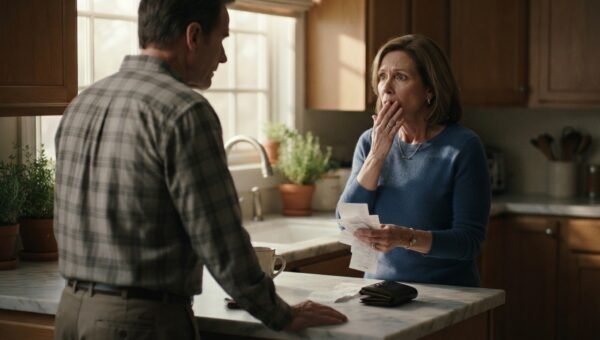
I laid the red folder flat on his desk. I opened it so the certified marriage license and my mother’s 1971 letter were visible under the fluorescent lights. Then I placed Arthur’s 1999 ledger right beside them.
Paul stared at the red cardboard. His jaw tightened. He didn’t look surprised. He looked cornered.
“He told me not to let you have it,” I said. My voice was low and steady. “He knew what you were doing, Paul. Even at the end, he knew.”
Paul looked up at me. He didn’t deny it. He didn’t apologize.
“Your mother ruined my father’s business,” Paul said, his voice hard and bitter. “Did you know that? She took twelve thousand dollars from him in 1972. That was half of his working capital. He had to sell thirty acres of prime timber just to keep the farm afloat.”
“My mother gave him twelve thousand dollars,” I said, pointing at the bank receipt. “Read the paper, Paul. It was a transfer from her account to his. She paid him to stay away from our family. He was extorting her.”
“That’s a lie,” Paul snapped, leaning forward. “She owed him. She abandoned him in Akron and took everything they had in the joint account.”
“Look at the divorce decree, Paul! November 1951. Arthur signed it. No alimony. No property dispute. She moved on. Twenty years later, your father showed up on our doorstep threatening to tell my father about her first marriage unless she paid him off. Arthur was a blackmailer.”
Paul grabbed the yellow letter and scanned the lines. His eyes darted back and forth across the page. As he read his own father’s handwritten ledger from 1999, his face lost all its color.
“He told me she stole it,” Paul whispered. “He told me on the drive back from her funeral that she had taken his life savings.”
“And you believed him,” I said. “So you hunted down her daughter. You came to my church. You married me.”
“No,” Paul stammered, standing up from his chair. “Karen, that was just how it started. I swear to you. I was angry at first, but then I got to know you. We’ve been married twenty-three years! You think I faked twenty-three years?”
“I think you spent twenty-three years keeping a grievance alive,” I said. “I think you spent twenty-three years convincing yourself that you were entitled to my life, my home, and my family because of a grudge your father invented.”
“Karen, please,” he said, reaching across the desk.
I stepped back, picked up the folder and the ledger, and tucked them firmly under my arm.
“Don’t come back to our house tonight,” I told him. “Stay at your father’s place. You wanted his things so badly. Now you can have all of them.”
ENDING
Arthur’s funeral was held on Wednesday morning.
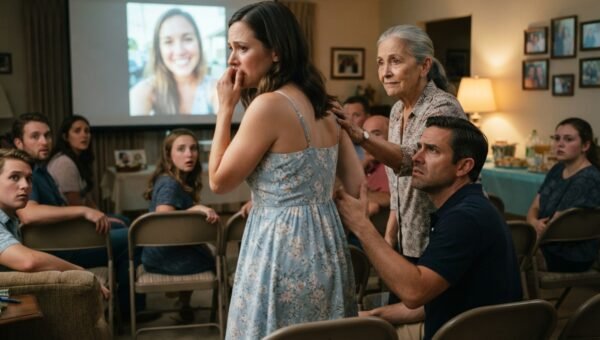
Sixteen people came to the chapel. Paul and I sat on opposite ends of the front pew. We did not hold hands, and we did not speak. When neighbors came up to offer condolences, I thanked them politely and stepped aside so Paul could receive them alone. He looked hollowed out, wearing the same dark suit he had worn to my mother’s funeral twenty-seven years earlier.
That afternoon, I met with an attorney in town.
I showed her the records. Our house was in both our names, but the original down payment had come from the money my parents left me when my father’s estate settled in 1995. The lawyer assured me that while Ohio is an equitable distribution state, the documentation I had would make a clean separation straightforward.
Paul stayed at Arthur’s farmhouse for three weeks.
He called me every evening around seven. At first, he pleaded with me, leaving long, rambling voicemails about how much he loved me, how his father had poisoned his mind, and how none of the past mattered now that Arthur was dead.
By the third week, the calls grew shorter.
“I’m sorry,” he said on the last voicemail he left before the papers were served. “I don’t even know who he was anymore. And I don’t know who I was trying to be.”
We sold our house six months later. We split the equity, but Paul agreed in writing to reimburse the initial $35,000 down payment my father had provided decades ago. He didn’t fight me in court. He gave up his share of the joint savings without argument, packed his belongings into a rented truck, and moved two states away to Indiana, where his sister lived.
I bought a small, one-story home with a wide front porch and an apple tree in the backyard, thirty miles north, near the lake.
Before I left our old house for the last time, I sat down at the kitchen table with the red folder.
I took out my mother’s 1971 letter and the yellowed marriage license from 1947. I didn’t destroy them. They were part of her life, a painful secret she had carried alone for thirty years to protect her marriage to my father and to give me an ordinary, safe childhood. She had paid Arthur Vance twelve thousand five hundred dollars to buy my family peace.
I slipped the papers into a manila envelope and placed them in my cedar chest, underneath my mother’s hand-stitched quilts.
Arthur Vance had spent the last week of his life confused, but right at the edge of the end, his conscience had finally worked. He hadn’t called me Clara because he was senile. He had called me Clara because he was an old man dying with a debt on his chest, terrified of what his son would do with the truth.
I locked the cedar chest, set the brass key on my nightstand, and let the house go quiet.