PART 1
When you tell your own child no, you brace yourself for anger. You do not expect to be completely erased.
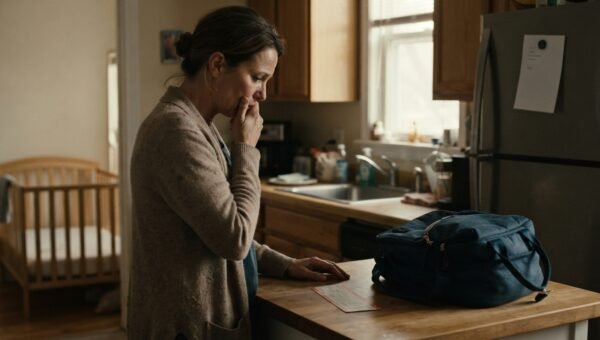
My daughter, Megan, stopped answering my calls on a Tuesday afternoon in October. Two days earlier, she had sat at my kitchen table, pushed her cold cup of tea aside, and asked me for twenty-five thousand dollars. She gave me a story about refinancing her car loans, paying off some medical bills from when the kids had RSV, and getting ahead on property taxes before the penalties hit. She spoke fast, her fingers tapping rhythmically on the laminate tabletop.
“It will give us breathing room, Mom,” she told me. “Just six months to get our feet under us.”
I looked at her face, which looked so much like mine when I was in my thirties, and I felt that familiar, heavy sinking in my stomach. It was the exact same pitch she gave me four years ago for a culinary business idea that folded within five months. It was the same tone she used two years ago when she said the bank was threatening foreclosure, only for me to find out later she had taken out high-interest personal loans to furnish her guest room with designer furniture. Then there was the twelve thousand dollars last summer, which she swore was for a sewer line repair, though no plumber ever touched her lawn.
Each time, I wrote the check. Each time, she swore it was the last time, and each time, my late husband’s life insurance policy shrank a little more.
When Tom passed, he left me enough to live carefully in this small three-bedroom house, provided I never did anything reckless. I am sixty-one years old, and I work twenty-four hours a week filing records at an orthopedic clinic. I do not have a company pension. I do not have a safety net.
“I can’t do it, Megan,” I said quietly.
She stopped tapping. “What do you mean you can’t? You have Dad’s accounts.”
“Those accounts have to carry me through the rest of my life,” I told her. “I have helped three times. You haven’t paid back a dime of the first loan, let alone the last one. If Greg is struggling with the mortgage, you two need to sit down and figure out a real budget together.”
Megan stood up so fast her wooden chair scraped hard against the floor. “Greg works sixty hours a week. He doesn’t need to be stressed with this.
You’re sitting in this paid-off house with money in the bank while your grandchildren suffer. You care more about your money than you do about your own family.”
She walked out and slammed my back door.
Over the next four months, the punishment was absolute. I was cut off from my grandchildren. Leo was seven, and Chloe was fourteen. Megan did not answer my phone calls. My texts went unanswered. When I dropped off Christmas presents on their front porch in December, nobody opened the door, even though I could hear the television running in the living room and saw Chloe’s silhouette in the upstairs window. Two hours later, Megan texted me a single sentence: “Do not come onto our property uninvited.”
That text broke something inside me. I spent January and February walking through my quiet house, wondering if I had been too hard on her. Every time I passed the framed photos of the kids on my hallway wall, I asked myself if twenty-five thousand dollars was worth losing my flesh and blood. I was lonely, and the silence in my house felt unbearable.
Then, on a rainy Thursday in early March, my cell phone rang while I was folding laundry.
The caller ID showed Chloe’s name. My heart jumped straight into my throat.
“Grandma?” she whispered. Her voice was thin, and there was a loud hum of traffic in the background.
“Chloe? Honey, are you okay?”
“Can I come over? Just for an hour? I told Mom I had to stay late in the school library for an American history project, but I took the city bus to your neighborhood.”
“Where are you right now?”
“At the bus stop by the corner pharmacy. It’s raining really hard.”
“Stay right under the awning,” I said, grabbing my car keys off the counter. “I’m coming right now.”
I drove the four blocks to the pharmacy with both hands gripping the steering wheel. When I pulled up to the curb, there she stood, holding a damp canvas backpack over her chest, wearing an oversized hoodie that belonged to her father. She scrambled into the passenger seat, shivering, her sneakers tracking wet leaves onto the rubber floor mat.
“Thank you, Grandma,” she said, looking straight ahead.
“Oh, sweetheart, let me look at you,” I reached out and tucked her wet hair behind her ear. “You’re freezing. Let’s get you home.”
We drove back to my house in silence. Inside the kitchen, I made her hot cocoa and gave her a dry sweatshirt from my closet. She sat in the exact chair her mother had occupied four months earlier. She wouldn’t look directly at me. Instead, she unzipped her backpack and pulled out an old cardboard shoebox wrapped with two heavy rubber bands.
“What is that, honey?” I asked, sitting down across from her.
“I found it in the back of Mom’s closet under the winter coats,” Chloe said, her voice barely louder than the hum of the refrigerator. “I was looking for my winter boots two weeks ago, and it was shoved behind an old suitcase. I started looking through it, and I got scared.”
She snapped off the rubber bands and slid the box across the table toward me.
Inside were dozens of unopened envelopes, past-due notices, and certified mail receipts. But the name printed on them caught my breath. They were all addressed to Megan, but the address was not the house on Maple Street where she lived with Greg and the kids.
It was an address on Westland Avenue, across town in an industrial district by the railway yards.
“Chloe, what is this address?” I asked.
“Mom told us never to tell Dad,” Chloe whispered, her eyes filling with tears.
“Tell Dad what?”
“Mom leaves every Tuesday night and tells Dad she’s taking evening classes for a medical coding certificate at the community college. But she isn’t at school, Grandma. She goes over there. Last month she made me ride with her because she said she needed help carrying boxes, and she told me if I told Dad, it would ruin our whole family.”
My hands were shaking as I picked up the top envelope. It had a bright red “FINAL NOTICE” stamp across the front. I slipped my finger under the flap and pulled out the statement.
It was not a college tuition bill. It was not rent for a second apartment, either.
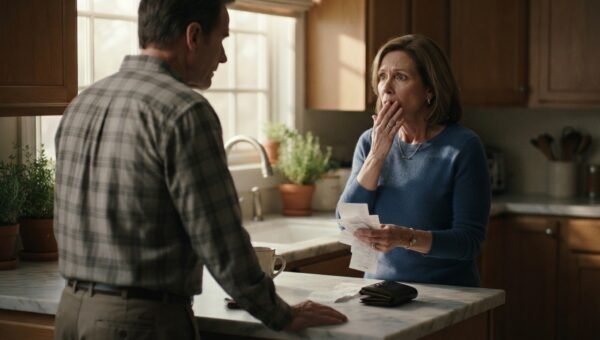
It was a bill from a commercial storage facility called Northgate Secured Storage. The invoice was for a 12-by-30-foot climate-controlled bay, an industrial unit large enough to fit the entire contents of a four-bedroom home. And the balance due was over four thousand dollars.
PART 2
The invoice in my hand showed that the unit had been rented sixteen months ago. The monthly fee was nearly five hundred dollars, and it had not been paid since November.
“Chloe,” I said, trying to keep my voice completely level. “What was inside that unit when you went with her?”
Chloe rubbed her eyes with the sleeve of my oversized sweatshirt. “It was packed to the ceiling, Grandma. Plastic bins, garment racks, moving boxes taped shut. She had me help her carry three big plastic tubs out to her trunk. When we got to the parking lot of a diner on Route 4, a woman in a silver SUV was waiting for us. Mom traded the tubs for a thick white envelope of cash.”
The room seemed to tilt. “Did you see what was inside the tubs?”
“Clothes. Purses. Shoes. Brand new stuff with the tags still hanging on them. Mom told me she was running an online boutique and that Dad didn’t understand how businesses worked. She said Dad would just take the money and put it toward boring bills instead of letting her grow her company.” Chloe wiped a tear off her cheek. “Then last week, two men in an unmarked truck came by our house while Dad was at work. They tried to take Mom’s car. She screamed at them and gave them three hundred dollars from her purse to make them leave, but she told me if I said a word to my father, he would divorce her and it would be my fault.”
I reached across the table and took both of my granddaughter’s cold hands in mine. “Look at me, Chloe. Look at my eyes.”
She lifted her head.
“None of this is your fault. Do you hear me? Not one single bit of it. You are fourteen years old. You are a child, and you should never have been asked to carry this secret.”
“I was so scared, Grandma,” she choked out, leaning forward as I pulled her into an embrace. “Mom isn’t paying our health insurance. I saw that letter in the box, too. It says our coverage was canceled in January because the premium check bounced.”
I held my granddaughter while she cried, but my mind was moving with cold, clear urgency.
Megan had not come to me for twenty-five thousand dollars to fix her family’s finances. She had come to me to bail out a secret, out-of-control spiral. She had used my money in the past to plug leaks in a ship that was sinking under the weight of her own deception. And Greg, who worked twelve-hour shifts at a diesel repair shop to provide for his family, was completely in the dark while his children’s safety net was being quietly incinerated.
I checked the kitchen clock. It was nearly five.
“Chloe, your dad gets home around six, doesn’t he?”
She nodded against my shoulder.
“We are not going to sneak around,” I said, standing up and closing the shoebox. “We are going to do this the right way. I am taking you home, and I am sitting down with your father.”
“Mom will be furious,” Chloe whispered.
“Let her be furious with me,” I answered. “That is my job as her mother. Your only job is to be a kid.”
I drove Chloe home in the fading afternoon light. The rain had turned into a steady, gray mist. When we pulled into their driveway, Megan’s sedan was not there. Chloe told me she was probably running an errand before her supposed evening class. But Greg’s work truck was parked by the garage.
I walked Chloe up the front steps, carrying the shoebox under my arm. When I knocked on the front door, I heard heavy footsteps, and Greg opened it, still wearing his navy blue work uniform with grease stains on the knees.
When he saw me standing there with Chloe, his eyes went wide with confusion. “Evelyn? Chloe? What’s going on? Megan said you were in the library until six.”
“Can I come in, Greg?” I asked. “We need to talk. Right now.”
PART 3
Greg led us into the living room. Little Leo was sitting on the carpet playing with plastic building blocks. When he saw me, he yelled, “Grandma!” and ran toward me, wrapping his small arms around my legs. The ache that had lived in my chest for four months instantly gave way to a fierce, protective anger.
I knelt down, hugged Leo tightly, and kissed his forehead. “Hey, buddy. Go play in your room for a little bit, okay? Grandma needs to talk to your dad and Chloe.”
Once the boy ran upstairs, Greg looked between me and his daughter, his expression shifting from confusion to deep concern. “What happened? Chloe, are you hurt?”
“I’m not hurt, Dad,” Chloe said quietly. “Grandma, show him.”
I set the shoebox down on the coffee table. I didn’t say a word. I simply opened the lid, pulled out the stack of past-due notices, and laid them out in a neat row across the glass.
Greg stared at the paperwork. He reached down with calloused, oil-stained hands and picked up the cancellation notice from the health insurance company. Then he picked up the final notice for the storage facility on Westland Avenue. Then he found a collection notice for an eight-thousand-dollar personal loan taken out in his name through an online lender, accompanied by an electronic signature that clearly wasn’t his handwriting.
His face lost all its color. He dropped onto the sofa, holding the papers as if they were burning his skin.
“What… what is this?” he asked, his voice shaking. “Our insurance is through my union, but Megan handles the direct deductions from our checking account. Why is this showing non-payment since January?”
“Because Megan hasn’t been paying the bills, Greg,” I said gently. “She’s been moving money into private accounts to buy designer inventory for an unauthorized resale operation. She rents a massive storage locker across town. Chloe went with her to a drop-off last month.”
Greg looked up at his daughter, his eyes rimmed with red. “Chloe? You knew about this?”
“Mom made me swear not to tell you,” Chloe sobbed, covering her face. “She said you’d leave us. She said if I opened my mouth, the repo men would come and take everything.”
Greg stood up immediately and pulled Chloe into his arms. “No. No, baby, look at me. I would never leave you and Leo. Ever. You didn’t do anything wrong.” He held her tight, but over her shoulder, his eyes met mine, filled with complete devastation. “Evelyn, she told me four months ago that you cut us off because you were being selfish. She said you refused to help us with a minor tax bill.”
“She asked me for twenty-five thousand dollars, Greg,” I told him plainly. “She told me you were drowning. I had already given her tens of thousands over the last four years, and I told her no because I realized my checks weren’t fixing whatever hole she was digging.”
Before Greg could answer, the front door rattled and swung open.
Megan walked in, carrying a takeout bag and her purse, talking on her cell phone with her shoulder propping it against her ear. “Yeah, I’ll have the inventory by Thursday, just make sure the wire clears—”
She stopped dead in the hallway.
Her eyes scanned the room: me standing by the fireplace, Chloe sitting on the couch with red, swollen eyes, Greg holding the opened letters in his hand, and the shoebox resting wide open on the coffee table.
The phone slipped right out of her hand and clattered onto the hardwood floor.
“What is this?” Megan shrieked, her voice pitching high and sharp. She pointed a finger directly at me. “What are you doing in my house? I told you to stay away from my family!”
“Your family is in crisis, Megan,” I said, keeping my voice utterly steady. “And the lying is over.”
“You went through my things?” Megan turned violently on Chloe. “You stole from my closet? How dare you! After everything I do to keep this family afloat—”
“Stop it, Megan!” Greg’s roar shook the walls of the house. I had never heard my son-in-law raise his voice like that in the ten years he had been married to my daughter.
Megan froze. The room fell into absolute silence.
Greg walked over to her and held the papers right in front of her face. “You forged my name on an eight-thousand-dollar loan. You let our children’s health insurance lapse. You’ve been lying to me about evening classes while you hoard inventory in an industrial storage unit. And you tried to extort twenty-five thousand dollars from your widowed mother while blaming her for our problems.”
“It’s a business, Greg!” she cried, tears instantly springing to her eyes, shifting immediately into the posture of a victim. “I was trying to build something for us! The margins were good at first, but then shipping rates went up, and the platform banned my seller account, and I got stuck with the inventory. I was trying to fix it myself so you wouldn’t worry!”
“You didn’t try to fix it, Megan,” Greg said, his voice dropping to a low, trembling tone that sounded far more dangerous than his yell. “You gambled with our children’s lives. You made our fourteen-year-old daughter carry your criminal secrets. You used your mother’s grief and guilt to bleed her dry.”
“Mom,” Megan turned to me, reaching out her hands, her face pleading. “You know how hard it is. You know I just wanted us to have nice things. Please tell him. Tell him we can sort this out.”
“No, Megan,” I said, looking at her without an ounce of the guilt that had haunted me all winter. “I am not shielding you anymore. The only reason I am in this house tonight is because Chloe was brave enough to tell the truth. Your husband and your children deserve reality, not your manufactured stories.”
ENDING
The aftermath was not swift, and it was not neat.
That night, Greg packed Megan a suitcase and told her she needed to stay with a friend from her old job. He did not yell, and he did not negotiate. He changed the locks the following morning.
Over the next two weeks, the full scope of Megan’s secret life surfaced. With the help of an accountant Greg hired through his union’s legal aid program, they discovered over fifty-two thousand dollars in hidden consumer debt, three maxed-out credit cards opened under retail store names, and the lease on the storage unit. The unit was packed with hundreds of wholesale designer knockoffs and liquidation pallets that she had been trying to resell under the table.
Greg took three days off work. Together, he and I went to the storage facility on Westland Avenue. We spent forty-eight hours sorting through the boxes. We liquidated what legitimate goods could be returned for store credit, held a massive two-day garage sale to clear the rest, and used every single dollar raised to settle the storage balance before it went to public auction, which avoided further legal action.
Greg went directly to his union representative and got the family’s health insurance reinstated by paying the back premiums out of his emergency savings account. He also filed fraud reports regarding the unauthorized loans.
Megan is currently living in a rented studio apartment twenty miles away. She works forty hours a week as a receptionist at a dental office, and a significant portion of her wages is being garnished to satisfy the debts she accumulated. She is in mandatory counseling as part of the legal separation agreement Greg filed last month. Greg has sole physical custody of Chloe and Leo.
My relationship with my daughter is broken, and I do not know if it will ever be fully repaired. She still sends me occasional emails blaming me for turning her family against her, claiming that if I had just written the check for twenty-five thousand dollars, none of this exposure would have happened. I don’t reply to those emails. I save them, but I do not engage with her delusions anymore.
What matters is what happened inside that house on Maple Street.
Every Tuesday and Thursday afternoon now, I pick Leo up from elementary school. Chloe walks to my house after her classes let out, and we do homework at the kitchen table. On Sundays, Greg brings the kids over for roast chicken dinner, just like we used to do when Tom was alive.
Last Sunday, as Chloe was clearing the dinner plates from the table, she stopped by my chair, leaned down, and kissed the top of my head.
“Thanks for believing me, Grandma,” she said softly.
I took her hand and squeezed it. Telling your child no is one of the hardest things a mother can ever do. But sometimes, holding your ground is the only thing that keeps the rest of the family from being pulled under.