PART 1
My father called three days before the ceremony to tell me he was not coming.
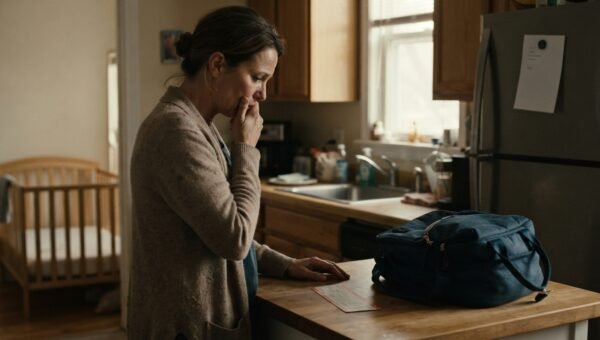
He was seventy-eight, living alone in the brick ranch style house in Canton where my mother had died seven years earlier. When I answered the phone, I was sitting on the floor of my living room with twenty-four small organza bags full of sugared almonds, trying to tie the satin ribbons with stiff fingers.
“Ruthie, I can’t do it,” he said. His voice sounded thin, like dry paper. “The headlights on Highway 62 blind me now. I can’t drive after sundown.”
I dropped the ribbon. “Dad, the ceremony is at four in the afternoon. The sun will not go down until eight. And even if it did, I already told you I would drive down and get you myself. It is forty minutes. Mark can drive your car back, or you can sleep in the guest room at my place.”
“No,” he said, too fast. “No, I don’t want to be a bother. And my hip is acting up. I would just be sitting in the corner like an old coat. You do not need to worry about an old man when Katie is getting married. Tell her I love her.”
“Dad, don’t do this,” I said. “She has four grandparents on paper, and you are the only one left alive.
She picked out a boutonniere with the little blue thistle because she remembered you grew them by the garage.”
“Tell her I love her,” he repeated, and then he hung up.
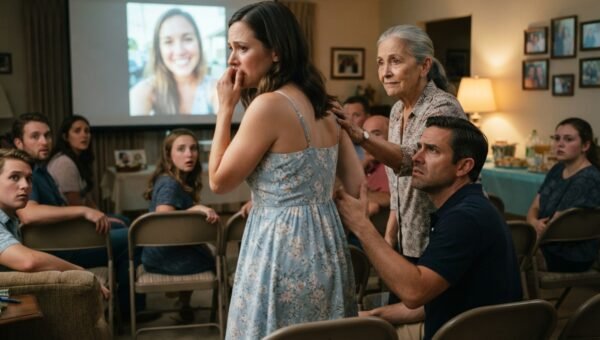
When I told Katie that evening, she did not scream or throw anything. She just stood by the refrigerator with a bottle of water in her hand, her eyes going red around the rims. She nodded twice, set the bottle down on the counter, and walked into the downstairs half-bath. I heard the lock click. She stayed in there for twenty minutes while the water ran in the sink so I would not hear her crying.
When she came out, her nose was pink, but her face was set like concrete.
“It’s fine,” she said. “We have eighty people coming from out of town. The caterer needs the final head count by eight tonight anyway. Take him off the table chart.”
“Katie, he is your grandfather. Maybe I should go down there tomorrow and—”
“Mom, stop,” she snapped. It was the first time she had raised her voice in six months of planning. “He does this. Whenever things matter, he hides in that house. I am not going to spend my wedding day begging a grown man to care about me.”
The next day was a blur of dry-cleaning bags, florist delivery vans, and rehearsal dinners. My ex-husband, Greg, arrived from Atlanta on Friday afternoon. He had not lived in Ohio for twelve years. He left when Katie was fourteen, walking away with sixty percent of our joint savings after a messy divorce that dragged through Stark County court for two bitter years. He had married a woman ten years younger than him named Brenda, bought a boat, and sent Katie three hundred dollars every Christmas inside a printed card.
When Katie got engaged to David, Greg had suddenly resurfaced. He called her three times a week.
He wired four thousand dollars toward the photographer without being asked. He showed up at the rehearsal in a sharp charcoal suit with silver hair at his temples and paid for everyone’s prime rib at the steakhouse downtown.
Katie sat next to him at the rehearsal table, laughing at his old stories from when she was five years old. Watching them made my stomach turn, but I kept my mouth shut. It was her wedding. If she wanted to believe her father was finally the man she needed him to be, I was not going to poison that weekend for her.
The ceremony on Saturday was held at the Millstone Conservatory, an old brick textile mill that had been converted into an event hall with glass skylights and exposed timber beams. The light was perfect. When the music started, Greg took Katie’s arm at the double doors. He looked proud, standing tall, his hand resting over hers on his forearm. Katie looked radiant in her ivory lace gown, smiling through tears as David watched her from the altar.
Nobody mentioned my father. Not once during the ceremony, not during the toasts, and not while the band played until midnight.
At eight on Sunday morning, my phone buzzed on the nightstand of my hotel room. The screen showed Dad’s landline.
I picked it up, my throat raspy from the noise of the reception. “Hello, Dad.”
“Ruthie,” he said. He sounded wide awake, but his voice had a strange, strained tremble in it. “Did it go well? Was she beautiful?”
The anger that had been simmering under my ribs for four days boiled over. “She was gorgeous, Dad. No thanks to you. She stood in the back room before the doors opened and asked me if you had called to leave a message. I had to tell her no. You couldn’t even manage a five-dollar card from the drugstore.”
There was a long silence on the line. I thought he was going to hang up on me again.
Instead, he took a slow, rattling breath. “Ruthie, go home and check your mailbox before you decide you hate me.”
“What are you talking about?”
“Just go look,” he whispered. “I put it in there early this morning. I didn’t want to ring the bell.”
“Dad, if this is a check, I don’t want it. Katie doesn’t want your guilt money.”
“It’s not money,” he said. His voice cracked slightly. “Look in the box. Then call me.”
He clicked off.
I sat on the edge of the bed for five minutes, staring at the muted morning news on the hotel television. Then I woke up my husband, Mark, packed our overnight bags, and told him we were driving straight to our house instead of meeting the newlyweds for the farewell brunch at the hotel café.
PART 2
The drive from the hotel to our colonial on Maple Street took twenty minutes. The morning sun was pale and cool, reflecting off the damp suburban asphalt.
I did not even take my purse out of the passenger seat. I stepped out of the car while the engine was still ticking, walked down the driveway, and pulled open the black metal mailbox by the curb.
Inside lay a small, padded manila envelope with no postage stamps. My name, *Ruth*, was written across the front in my father’s cramped, left-handed scrawl using a black felt-tip pen. The ink was fresh enough that it had not faded under the paper.
I tore the glued flap open with my thumb.
Three things fell into my palm: a plastic electronic hotel key card with the blue logo of the Hampton Inn printed across the front, a folded white paper receipt from the municipal parking garage on Market Avenue, and a sheet of lined yellow legal paper folded into quarters.
I looked at the parking receipt first.
It was stamped Saturday at 3:18 PM on the entrance line. The exit time was stamped Saturday at 11:42 PM. The total charge was fourteen dollars, paid in cash.
The Market Avenue garage sat directly across the street from the Millstone Conservatory. Its fourth-floor open-air deck had a clear, unobstructed line of sight into the conservatory’s glass-walled courtyard and the double glass entry doors.
My hands began to shake. I unfolded the yellow legal pad sheet.
My father’s handwriting was shakier than usual, wandering off the blue lines near the bottom:
*Ruthie,*
*I drove up Saturday morning at ten o’clock. I got a room at the Hampton two miles away so I could iron my good suit. I had the blue flower pin in a wet paper towel in the bathroom cup. I bought the ticket for the parking deck at three. I sat in my Buick on the fourth level with my binoculars, right where the brick wall has that open concrete railing. I came to tell her the truth before she took those vows. I sat there with the folder on my lap. But at quarter to four, I saw who walked her down the aisle. I saw Greg holding her arm by the doors, laughing with her like he had never left. I saw the way she looked up at him. If I had walked through those doors with what I have in my trunk, I would have burned her whole world down while she was standing in her white dress. I couldn’t do it to her. Call me when you read this.*
I read the note twice. The words made no sense, yet the physical reality of the parking receipt in my hand was undeniable. He had not been sitting at home in Canton afraid of headlights. He had been seventy yards away, sitting alone in a parked Buick for eight hours in the September heat, watching his granddaughter through a set of hunting binoculars.
Mark came up behind me on the driveway, holding our garment bags. “Ruth? What is that?”
“Get back in the car,” I said. My voice was completely flat.
“What?”
“Get back in the car, Mark. We are driving to Canton right now.”
The forty-minute drive down Route 8 felt like ten minutes and ten hours at the same time. I did not turn on the radio. I sat with the yellow paper pressed flat against my knee, my eyes fixed on the white lines of the highway.
When we pulled into Dad’s concrete driveway on Elm Street, his maroon 2011 Buick LeSabre was parked in its usual spot under the metal carport. The hood was cold when I touched it as I walked past.
I did not knock. I used my key on the side kitchen door and pushed it open.
The house smelled like stale black coffee and the peppermint hard candies Dad always kept in a glass dish by the telephone. Dad was sitting at the laminate kitchen table. He was still wearing his Sunday trousers and a pale blue button-down shirt that looked two sizes too big for his collarbones. In the center of the kitchen table sat an old green accordion file folder tied shut with a frayed cloth string.
He looked up when the screen door slammed. His eyes were bloodshot, surrounded by dark, hollow rings of purple skin.
“You didn’t go to the brunch,” he said.
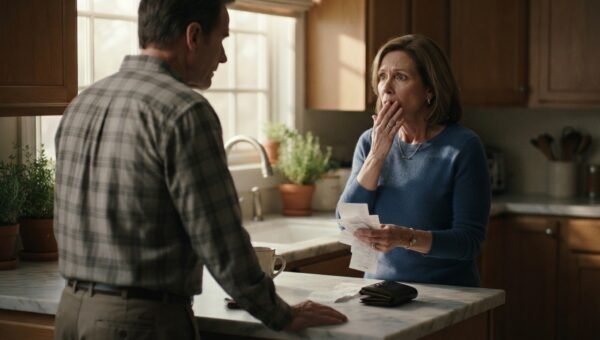
“What is this, Dad?” I threw the manila envelope, the hotel card, and the parking ticket onto the table. They scattered across the yellow floral vinyl. “You sat across the street? You let Katie think you didn’t love her enough to drive forty minutes? Do you have any idea how she cried in that bathroom on Friday night?”
Dad closed his eyes for three long seconds. His chin trembled, but he did not look away when he opened them.
“I know,” he whispered. “I know what I did to her. But if I had walked in there, she would have had no father and no grandfather by six o’clock.”
“Stop talking in riddles,” I shouted. Mark stepped into the kitchen behind me and put a steady hand on my shoulder, but I shook it off. “What is in that green folder?”
Dad rested his palm on the worn cardboard. His knuckles were swollen with arthritis.
“Greg didn’t come back to Ohio because he missed Katie,” Dad said, his voice dropping so low I had to lean forward over the table to hear him. “He came back because your mother’s brother died in January.”
I stared at him, my mind scrambling to connect the names. “Uncle Frank? What does Uncle Frank have to do with Greg? Uncle Frank lived in Sarasota. We haven’t seen him in ten years.”
“Frank died without a will, Ruthie,” Dad said. “He had no children. He had sixty acres of timberland in Columbiana County that had been in your mother’s family since 1934. And three years ago, a gas company put two horizontal shale wells on the northern border.”
PART 3
I pulled out a kitchen chair and sat down because my knees suddenly felt hollow.
“Uncle Frank’s estate,” Dad continued, untying the cloth string on the accordion folder with patient, trembling fingers, “was supposed to pass equally to his surviving siblings. Since your mother died in 2019, her fifty percent share of that mineral estate legally passed to you. Did you know that?”
“No,” I said. “Nobody told me anything about Uncle Frank’s estate. The lawyer in Florida just sent a notification that his personal checking account was used to pay his nursing home bills.”
“That is because the estate lawyer in Florida was dealing with the probate petition filed by your ex-husband,” Dad said.
He pulled a stack of legal documents from the folder and slid them across the table toward me. The top document was a certified copy of a land transfer deed recorded in the Columbiana County recorder’s office eighteen months earlier.
I looked at the signatures at the bottom of the second page.
There was Greg’s bold, looping signature. Beside it, on the line marked *Grantor / Lawful Heir*, was my name: *Ruth Ann Miller*.
I stared at the black ink. The *R* had a high loop. The cross on the *t* was slanted slightly downward. It looked like my handwriting. It looked like the signature I used on my mortgage and my driver’s license.
“I never signed this,” I whispered. “Dad, I swear to God, I never saw this paper in my life.”
“I know you didn’t,” Dad said. “He used the notary from his old logistics company in Akron. A woman named Cheryl who used to do his payroll before the business closed. Look at the date on the notary stamp.”
I looked. The date was October 14th of the previous year.
“I was in Chicago that week,” I said, my heart hammering against my ribs. “Mark and I were at his sister’s fifty-fifth birthday party. I have the airline tickets on my phone.”
“Greg sold the mineral rights to an energy holding group out of Pittsburgh for two hundred and eighty thousand dollars in November,” Dad said. His voice was steady now, deadly quiet. “He took the money and paid off the tax liens on his house in Atlanta. But the land itself—the sixty surface acres—couldn’t be transferred without the probate court issuing a final distribution order.”
Dad tapped the next document in the pile. It was a formal legal notice from the probate court in Lisbon, Ohio.
“Two weeks ago, the title company discovered the defect,” Dad explained. “The mineral rights buyers realized the power of attorney Greg used to execute the original lease was dated six months after your mother died. They froze the escrow funds. They told Greg that unless you signed a quitclaim ratification deed by the end of this month, they were referring the file to the county prosecutor for grand theft and forgery.”
The room seemed to tilt. The memory of the rehearsal dinner rushed back into my head: Greg sitting at the head of the table, laughing, generously waving his credit card to pay for thirty people’s expensive dinners, leaning over to kiss Katie’s forehead and telling her she was the most important thing in his life.
“He didn’t come for her wedding,” I breathed, the nausea rising in my throat. “He came to get me to sign the paper.”
“He was going to do it this morning,” Dad said. “He had an appointment with a mobile notary scheduled for ten o’clock at the hotel. He told Katie he had a special financial gift for her—a trust fund setup that required your signature as the primary beneficiary. He was going to put the quitclaim deed inside the trust packet while you were still happy and crying over the weekend.”
“How do you have these?” Mark asked from the doorway, his voice thick with fury. “Howard, how did you get these court records?”
Dad looked up at Mark. “Frank’s neighbor in Florida called me six months ago when he saw land surveyors on the Columbiana property. I spent the last three months hiring an investigator in Lisbon. I got the certified records on Thursday afternoon. I had them in my car. I was going to walk into the Millstone Conservatory before the wedding, hand these to Greg in front of his brothers, and tell him to get out of the state before I called the sheriff.”
“Why didn’t you?” I cried out, the tears finally breaking through. “Why did you let him walk her down that aisle, Dad? Why did you let her hold his arm?”
Dad reached across the table and took my hand. His skin was dry and paper-thin, but his grip was fiercely strong.
“Because I stood on that fourth-floor parking deck with my glasses on, Ruthie,” he said, tears finally spilling over his wrinkled cheeks. “I saw her through the glass. She was wearing her veil. She had her head on his shoulder, and she was smiling the way she used to smile when she was seven years old, waiting for him to come home from work. She thought her father had finally come back to love her.”
He paused, swallowing hard.
“If I had walked in there with the police, Ruthie, there would have been no wedding. David’s family was there. Eighty people were sitting in those pews. Katie would have spent the rest of her life remembering that her wedding day was the day her father was arrested for stealing from her mother. I couldn’t do that to my girl. I loved her too much to ruin the only day she felt whole.”
He looked down at the table. “So I sat in the car. I watched the music start. I watched him walk her down to the preacher. And then I waited until the music stopped and they turned off the lights.”
I sat in the quiet kitchen, staring at my father. The anger that had choked me for days melted away, replaced by an ache so deep it took my breath away. He had swallowed his own pride, let his daughter call him selfish, and let his granddaughter think he was callous, all to protect a few hours of pure, unblemished happiness for a girl who deserved it.
“He’s still at the hotel,” Mark said quietly, looking at his watch. “It’s barely ten o’clock.”
“Yes,” I said, wiping my face with the back of my hand. “He is.”
ENDING
We did not call the police to the hotel lobby.
Instead, Mark and I drove back to the Hampton Inn, leaving Dad resting in his recliner with a glass of water. I carried the green accordion folder under my arm.
We found Greg sitting at a low table in the corner of the hotel lobby, sipping an iced coffee. A woman with a notary stamp bag was sitting next to him, reviewing a blue folder of papers. When Greg saw me walk through the automatic doors, his face lit up with that rehearsed, charismatic smile he had used on people his entire life.
“Ruthie!” he said, standing up and smoothing his linen shirt. “I was just about to text you. I told Katie I wanted to set up a little surprise for her and David—a family trust for a down payment on a house. We just need your signature on the family land release to finalize the asset transfer.”
I didn’t say a word. I set the green folder down on top of his open documents, right in front of the mobile notary.
The notary glanced down, saw the county prosecutor’s stamp on the top fraud affidavit, and immediately closed her stamp pad.
“Greg,” I said, keeping my voice perfectly calm and low so the hotel desk clerk wouldn’t hear. “The notary in Akron, Cheryl, gave a sworn statement to the Stark County investigator on Friday morning. She admitted she notarized my forged signature without me present.”
The color drained from Greg’s face in three seconds flat. The polished, confident man vanished, replaced by an aging, frightened cheat whose hands began to shake over his iced coffee.
“Ruth,” he stammered, his eyes darting toward the hotel doors. “Let’s—let’s go outside and talk. You don’t understand how the taxes worked out on Frank’s land.”
“You are going to sign a full confession and a complete transfer of all mineral rights and remaining escrow funds directly into an irrevocable trust for Katie and David,” I told him. “You will do it right now, with this notary witnessing it. And then you are going to get into your rental car, drive to the airport, and fly back to Atlanta.”
“Ruthie, please,” he whispered. “Don’t tell Katie. Please. If she finds out, she’ll never speak to me again.”
“She will find out the truth when she is ready,” I said. “And it will not be because you were dragged out of her reception in handcuffs. That was a gift from my father. A man you aren’t fit to name.”
He signed every document without reading them. His hand was shaking so badly the notary had to point twice to the signature lines. When he finished, Mark took the folder, and we watched Greg walk out the sliding doors into the morning parking lot with his suitcase, alone.
Two weeks later, Katie and David returned from their honeymoon in St. Lucia.
The first place Katie went was not her own apartment. She drove straight down to Canton on a Tuesday afternoon.
I was sitting on Dad’s back porch, helping him snap fresh green beans into a metal colander, when her little silver car pulled into the driveway. Dad froze, his hands hovering over the colander, looking terrified that she was coming to demand an explanation.
Katie walked up the wooden porch steps. She was tanned from the island sun, her hair tied back in a loose ponytail. In her hand, she carried a small white florist box.
She didn’t ask why he had missed the ceremony.
She walked over to his chair, knelt down on the wooden boards so she was at eye level with him, and opened the box. Inside was the little blue thistle boutonniere from the wedding, perfectly dried and preserved in clear resin on a small wooden stand.
“Mom told me you were across the street,” Katie said softly. Her eyes were bright with tears, but her voice was steady and full of grace. “She told me you sat on the parking deck because you loved me too much to let a storm hit my wedding day.”
Dad looked down at the resin flower. His chest hitched, and he put his hands over his face, weeping like a child.
Katie leaned forward, wrapped her arms around his neck, and rested her forehead against his shoulder.
“You’re my real dad, Grandpa,” she whispered into his shirt. “You’ve been the only real father I ever had. And that’s all that matters to me.”
My father didn’t say anything. He just held on to her with both arms, his weathered hands gripping the back of her sweater, finally letting the weight of the last twenty years go in the quiet afternoon sun.