PART 1
When my daughter Sarah knocked on my door in late September with two battered suitcases and three cardboard boxes in the trunk of her rusted Honda, she could barely look me in the eye. Her marriage was over. She was thirty-two, utterly broke, and humiliated to be sleeping in the same twin bed she had left when she was eighteen.
On her second morning at the house, she stood in my small Ohio kitchen with a notebook and a yellow legal pad.
She told me right away that she was not there to be a burden. She insisted she did not want a single dime of my money. She found work within ten days as a receptionist at a dental clinic down on Maple Street, earning sixteen dollars an hour. Every Friday when her paycheck cleared, she handed me cash for the groceries, took over cooking dinner every night, and spent her weekends scrubbing the baseboards and repainting the hallway trim.
I was so proud of her I could hardly stand it. After all the chaos of her separation, I thought we were finally getting our quiet lives back. My husband David had passed away six years earlier from a sudden heart attack, and the silence in that house had felt heavy for a very long time. Having Sarah home felt like a second chance for both of us.
Then came the Tuesday before Thanksgiving.
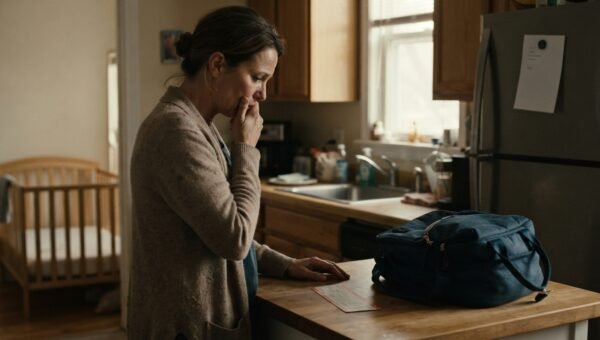
Sarah was working a late shift at the clinic. I was wiping down the kitchen counter, trying to find space for a tray of dinner rolls, when I slid the old countertop microwave out from the wall to clean behind it.
Tucked neatly into the narrow gap between the back of the microwave and the tile backsplash was a small stack of thick white envelopes.
I picked them up, thinking they were old recipe clippings or coupons Sarah had saved.
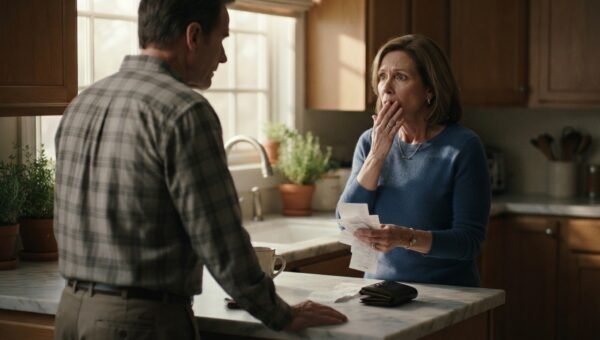
They were three final collection notices. Every single one was addressed to me, Martha Jenkins, at my home address.
My hands started shaking before I even unfolded the papers. The first notice was from a major bank demanding an immediate payment on a credit card I had never applied for, let alone possessed, with a balance of $8,400. The second was for an unsecured personal loan through an online lender for $11,200, already marked as sixty days delinquent. The third was a secondary retail line of credit for $5,000 that had been charged off to a collection agency in Chicago.
The balances totaled $24,600.
I stood in the center of my kitchen with the sink faucet still running, staring at the numbers.
My chest felt so tight I could barely draw breath. My first thought went straight to Sarah. She was the only person living in the house. She was the only one who sorted through the mail in the afternoons when the carrier came down the gravel drive. She had been desperate, carrying attorney fees from her split, and I had been foolish enough to believe her pride was genuine.
The betrayal hit me like physical blow. I thought she had stood in front of me smiling every evening while systematically forging my signature and ruining my name.
When her car pulled into the driveway at six o’clock, I was sitting at the kitchen table with the three opened letters laid out side by side under the overhead light.
Sarah walked through the door carrying her lunch tote and a bag of apples. She saw my face, stopped dead, and the smile dropped off her face.
“Mom? What happened? Are you sick?”
“You tell me,” I said, my voice shaking with a cold fury I had never once directed at my children. “Take a look at what I found tucked behind the microwave, Sarah. You told me you didn’t want my money. You looked me in the eye and swore you were paying your own way.”
Sarah set the bag of apples down on the counter and walked over to the table. She picked up the first letter, then the second, her brow furrowing deeply as she scanned the account numbers. She did not look guilty. She looked completely lost.
“Mom, what are you talking about?” she whispered. “I didn’t open these.”
“Don’t lie to me!” I snapped, slamming my palm against the table. “They were hidden behind the microwave. They are in my name. The balances add up to nearly twenty-five thousand dollars! Who else could have done this?”
Sarah stared at the papers, her lips trembling, and then she looked at me with wide, horrified eyes.
“Mom,” she said softly, “I didn’t hide them to protect myself. I found them in the mailbox three weeks ago. I recognized the collection agency names from old medical disputes years back. Mom, I thought these were Dad’s.”
The room went completely dead.
“What?” I managed to ask.
“Dad handled the household accounts before he passed,” Sarah said, tears springing into her eyes. “You remember how complicated his medical bills got at the end with the hospital. When these arrived, I panicked. I didn’t want you having another panic attack right before the holidays, so I put them back there until I could figure out how to call the agencies and show them his death certificate. I swear to you on my life, Mom, I thought an old debt of Dad’s had resurfaced.”
I stared at her, my heart thumping against my ribs. “Your father died six years ago, Sarah. Creditors cannot open brand-new lines of credit years after someone is buried.”
Sarah pulled her laptop out of her work bag right there at the table. She opened up the major credit bureau websites, sat down next to me, and walked me through pulling my full credit disclosure report for the first time in my life. We paid the extra fee to see the complete application history and linked verification records.
When the file loaded on the bright screen, the truth laid itself bare.
The accounts had not been opened six years ago. The personal loan had been granted fourteen months ago. The credit cards had been activated eight months ago.
And right there in the digital application profile, listed under the primary contact info for Martha Jenkins, was a recovery phone number with a local area code and an email address I knew by heart: brent.jenkins88@gmail.com.
It was my thirty-four-year-old son, Brent.
PART 2
The screen seemed to blur in front of me. I had to grip the edge of the kitchen table to keep the room from spinning.
Sarah just sat there beside me, staring at the glow of the monitor with her hand over her mouth. “Brent?” she whispered, like she could hardly say the name aloud. “Mom, why would Brent have his email on your credit profile?”
Brent was my oldest. He lived forty minutes away in an upscale subdivision outside Dayton, worked as an account manager for an industrial supply company, and drove a clean, late-model truck. He was the child who always seemed to have everything under control. When his father died, Brent was the one who had stepped in to help me go through David’s desk drawers. He had spent three whole weekends going through dusty file boxes in the spare bedroom, helping me roll over David’s modest life insurance policy and organizing my house deed and social security paperwork.
He had kissed my forehead before leaving with a cardboard box of old tax returns, telling me, “Don’t worry about any of the complicated financial paperwork, Mom. I’ve got your back.”
He had my back, all right. He had held onto my Social Security card, my date of birth, and my spotless credit score for five years, waiting until he needed a personal bailout.
“We need to call him,” I said. My voice sounded thin and hollow, like it belonged to a stranger.
“No, Mom, wait,” Sarah said, her eyes scanning the detailed records on the screen. “Look at the payment history. Someone has been making the minimum payments on these cards up until about three months ago. That is why no calls came to your house phone. They were set to paperless billing under his email address. The notices only got sent to your physical mailbox because the payments stopped completely in August and the accounts went into default.”
I leaned in closer. The personal loan for $11,200 had been deposited straight into an online checking account. The credit cards had cash advance charges dating back to the previous spring.
“I am not waiting,” I said.
I stood up, took my cordless phone off the base, and dialed Brent’s cell. It rang four times before he picked up. In the background, I could hear a television playing a football game and the sound of his dog barking.
“Hey, Mom,” he said, his voice easy and bright. “Everything okay? Sarah being good over there?”
“Brent, are you at home?” I asked.
There was a slight pause on the line. “Yeah. Just watching the pre-game show. Why? What’s going on?”
“Sarah and I are looking at my credit report,” I told him plainly. “And we are looking at three collection letters that were sent to this house totaling twenty-four thousand six hundred dollars. Your personal email address is listed on every single application.”
The background noise on the other end seemed to vanish as he muted the television. The silence stretched out so long I could hear the static on the line.
“Mom,” he began, his tone instantly shifting from cheerful to defensive. “Look, you don’t understand how that happened. Don’t go jumping to conclusions.”
“I am not jumping to anything, Brent,” I said, struggling to keep my voice steady. “I am reading the account numbers directly off the bureau file. Did you open a loan and two credit cards using my Social Security number?”
“It wasn’t like that!” he said, his voice rising sharply. “I got into a bind last year with some business investments that fell through, okay? My credit took a hit when the commercial loan collapsed, and the bank wouldn’t let me borrow to bridge the gap. I had bills coming due that would have ruined me. I was going to pay every single cent back before you ever found out. I made the payments for over a year!”
“You used my name without asking me,” I said, a wave of heat rising in my neck. “You took out debt against a sixty-eight-year-old widow living on fixed Social Security and a small pension. What happened in August, Brent? Why did you stop paying?”
“Because the company cut my quarterly commissions in July!” he shouted, dropping any pretense of remorse. “I couldn’t swing the twelve hundred a month anymore! I was trying to find a refinance option to move the balances over to my name, but the interest rates spiked. You don’t need to make a federal case out of this, Mom. It’s family. We can work it out without panicking.”
“A federal case?” I repeated, my breath catching in my throat. “Brent, the collection agencies are threatening to garnish my accounts or place a lien on this house. This house is all your father left me.”
“Nobody is taking the house, Mom, stop being dramatic,” he snapped. “Just give me until after the first of the year. I have a bonus coming in January. I will start paying the minimums again and clear it up. Just do not call the banks. If you call them and tell them you didn’t authorize it, you’re going to put me in serious legal trouble. You wouldn’t do that to your own son, would you?”
I looked down at the paper in my hand. In the bold black print at the bottom of the letter from the state collection agency, it read: *Failure to respond within thirty days may result in formal civil judgment and attachment of personal property.*
“I have to go, Brent,” I said quietly, and hung up the phone before he could answer.
PART 3
That night, I did not sleep a single wink. Every time I closed my eyes, I saw David sitting at the kitchen table with his reading glasses on, carefully balancing our checkbook at the end of every month. He had worked thirty-two years at the packaging plant so this modest three-bedroom ranch would be paid off before he retired. He had spent his entire life making sure I would have a safe roof over my head if he went first.
And our son had treated that safety like an emergency credit line.
At eight in the morning, Sarah was already sitting at the kitchen counter with two mugs of black coffee and a fresh notebook. The anger that had fueled me the night before had settled into a cold, grim resolve.
“What do you want to do, Mom?” Sarah asked gently. “He’s my brother, but what he did is a crime. If you try to absorb this debt on your pension, you will lose the house. You only have seven hundred dollars left over each month after utilities and medicine. The minimums alone will eat every penny of that.”
“I know,” I said.
I called our family attorney, Howard Vance. Howard had been David’s friend since high school and had handled David’s probate six years ago. He told me to come down to his office on Main Street at eleven o’clock and to bring every piece of paper I had found.
Sarah drove. We sat in Howard’s wood-paneled office while he put on his bifocals and read through the three notices, the printed credit report, and the digital account documentation Sarah had saved to a thumb drive.
When he finished, he took off his glasses, rubbed the bridge of his nose, and looked across the desk at me.
“Martha, I am going to give you the legal reality here, straight and without sugarcoating,” Howard said. “You have two paths. The first path is that you accept these accounts as your own. If you do that, you are legally responsible for the twenty-four thousand six hundred dollars plus all the accumulated penalties and interest. If Brent fails to pay, they will sue you. They will get a judgment, and they will freeze your bank accounts.”
“And the second path?” I asked.
“The second path is that you treat this as what it actually is: criminal identity theft,” Howard replied. “You go down to the county sheriff’s department, you file a formal police report for identity fraud, and you name Brent as the suspect with this email evidence. Then, we submit that police report along with a sworn Affidavit of Identity Theft to the three credit bureaus and the lenders. Under federal law, the lenders must wipe the accounts from your credit file and cease all collection actions against you.”
My stomach churned. “What happens to Brent if I file that report?”
“The lenders will charge off the fraud losses and turn the investigation over to their corporate security departments,” Howard said bluntly. “Because the total amount exceeds five thousand dollars, it crosses into felony territory in this state. The prosecutor will likely file charges against him for identity fraud and grand theft. He could face prison time, Martha. At the very least, he will have a felony record, lose his professional licensing, and be ordered to pay full restitution to the lenders.”
The silence in Howard’s office was suffocating.
“Can’t he just sign a document transferring the debt into his own name?” I asked, grasping at any straw I could find.
“No bank on earth is going to transfer unsecured, delinquent bad debt from a clean name to someone with a ruined credit score who obtained the funds through fraud,” Howard said gently. “The bank does not care that he is your son. They only care about who signed the contract, or who committed the crime. You have to choose, Martha. You protect yourself, or you protect him.”
We walked out of Howard’s office into the sharp November wind. Sarah didn’t say a word as she opened the car door for me. She knew that whatever choice I made would tear our family apart.
When we got back to the house, Brent’s truck was parked in my driveway.
He was leaning against the front fender, wearing his work jacket, smoking a cigarette. When he saw my car pull in, he stubbed the cigarette out on the gravel and walked over to my window.
“Where have you two been?” he demanded, looking back and forth between me and Sarah. “I called your house four times. Mom, you need to talk to me.”
“Come inside, Brent,” I said, keeping my voice low and flat.
We walked into the living room. Brent didn’t take off his coat. He stood near the television, his hands shoved deep into his pockets, pacing back and forth on the braided rug.
“I called a buddy of mine this morning who does personal loans,” Brent said quickly, his words tumbling out fast and nervous. “He says if you co-sign a consolidation loan with me, we can roll all three of those accounts into one single note at five percent interest. I can afford the monthly payment on that, Mom. It will lower the payment to about four hundred bucks. We can keep it out of the credit bureaus, and nobody gets in trouble.”
I looked at him. Really looked at him.
He didn’t look like a man who had realized the terrible thing he had done to his mother. He looked like an addict trying to secure his next fix, looking for another way to use my signature to keep his own comfortable life from collapsing.
“You want me to co-sign another loan for you?” I asked.
“It’s the only way, Mom!” he insisted, taking a step toward me. “If you don’t do this, what are you going to do? Are you going to call the cops on your own boy? Over money? Dad would roll over in his grave if he knew you were even considering turning me over to the police.”
That was the moment the last shred of my hesitation broke.
“Do not you dare bring your father’s name into this house,” I said. My voice was completely quiet, but it hit him hard enough that he stopped pacing. “Your father gave thirty-two years of his life to make sure I would be safe here. He worked overtime with bad knees and a bad back so I wouldn’t have to worry when he was gone. And the second he was in the ground, you went through his desk drawers, took my personal information, and used it like pocket money.”
“Mom, I was drowning!” he yelled.
“And you decided to pull me under water with you so you could keep your truck and your nice house!” I yelled back, standing straight up out of my chair. “You let collection agencies send letters to this house. You let me believe your sister was a thief. You sat there on the phone last night and told me not to be dramatic while my retirement was on the line!”
“If you file a report, I will lose my job!” he shouted, his face turning bright red. “Do you understand that? My company does background checks on finance managers! If I get charged with a felony, I am done! You will ruin my entire life!”
“No, Brent,” I said, pointing a steady finger toward the front door. “You ruined your life the day you typed my name into that computer. I am just refusing to let you ruin mine.”
“Mom, please,” he said, his voice cracking as the reality finally cracked through his arrogance. “Please don’t do this.”
“Get out of my house,” I told him. “Get in your truck, drive back to Dayton, and get out of my house.”
He stood there for five long seconds, looking at me like he was waiting for me to back down like I had done when he was a teenager. When I didn’t blink, he turned on his heel, slammed the front door so hard the glass pane rattled in the frame, and sped down the gravel driveway, slinging stones against the mailbox.
ENDING
An hour later, Sarah drove me to the county sheriff’s department on the square.
Sitting across from a deputy named Miller, I placed the three letters, the credit reports, and the printed email verification on his desk. My hands did not shake as I signed the sworn Affidavit of Identity Theft. It was the hardest signature I had ever put to paper, harder even than signing David’s death certificate six years ago, because this was choosing to let the law take my own flesh and blood.
The legal process that followed was slow, agonizing, and completely unyielding.
Howard Vance submitted the police report and the fraud affidavits to the three major credit bureaus and the two lending institutions. Under federal law, because there was an active criminal investigation, the collections were frozen immediately. Within sixty days, all three fraudulent accounts were permanently purged from my credit report, and my credit score was restored to the clean, perfect standing it had held for fifty years.
The fallout for Brent was immediate and severe.
The online lending company did not simply write off the $11,200 loss; their corporate fraud division forwarded their electronic transaction records to the county prosecutor. In February, Brent was formally indicted on two counts of fourth-degree felony identity fraud.
When the indictment was handed down, his employer fired him from his sales management position within forty-eight hours.
The family split apart like rotten timber. My sister in Florida called me twice a week for a month, crying into the phone, begging me to withdraw the police report, telling me that family forgives family no matter what. Brent’s wife refused to let me speak to my eight-year-old grandson, sending me a vicious text message blaming me for destroying their family stability before blocking my number completely.
For three months, the shame and the silence in my house felt unbearable. There were nights I sat alone in the living room, looking at the family portrait over the mantel, wondering if I should have just taken out a reverse mortgage and paid the twenty-four thousand dollars myself just to keep the peace.
Every time those thoughts started to poison my mind, Sarah would walk into the kitchen, sit down across from me, and put her warm hands over mine.
“You didn’t do this, Mom,” she would remind me every single day. “He did this to himself. If you had paid it, he would have done it again the next time he got in trouble.”
In May, Brent took a plea agreement arranged by a public defender. In exchange for pleading guilty to a single count of felony identity fraud, the prosecutor agreed to suspend his prison sentence. He was placed on four years of intensive criminal probation, ordered to perform two hundred hours of community service, and ordered to pay full restitution to the lenders on a strict monthly court schedule.
He had to sell his house in the Dayton subdivision to pay his legal fees, and he and his wife ended up moving into an apartment on the far side of town. He now works as an hourly warehouse supervisor, making half of what he used to earn.
He has not spoken a single word to me since the afternoon he slammed my front door.
Last week, Sarah received a promotion at the dental clinic. She is now the head office administrator, earning twenty-two dollars an hour with full benefits. She came home with a small chocolate cake, placed it on the kitchen table, and told me she has saved enough money to put a deposit on an apartment closer to the clinic.
I looked across the kitchen at her, at the quiet, steady life we had managed to hold onto despite everything that had been thrown at us.
“Sarah,” I told her, reaching across the table to squeeze her hand. “You stay right here as long as you need. This house is fully paid for, nobody can ever touch it, and for the first time in six years, the mail that comes to that box only belongs to the people who actually live here.”
She smiled, cut us two large slices of cake, and we ate our dinner together in the quiet house that still belonged to me.