PART 1
After twenty-seven years of sharing every dime, Martha sat me down at the kitchen table on a Tuesday night and told me she wanted her own checking account.
We had been through two mortgages, three used cars, and raising two kids on a middle-class budget where every single receipt went into an old shoe box until tax season. I was fifty-four, working maintenance for the township school district, and she was fifty-two, running the billing desk at an orthopedic clinic.
We did not have secrets about money. We never had reason to.
“It is not about divorce, Tom,” she said, looking straight at her coffee mug instead of my face. “I just feel like I have never had anything in my own name since I was twenty-five. I want to build a little savings of my own. Just a few thousand dollars from my own paychecks.”
I felt an ache in my chest, but I swallowed it down. My own father had controlled every nickel my mother spent, down to making her hand over the grocery store change, and I swore when I married Martha in 1999 that I would never turn into that kind of man. So I nodded. I told her that if having an account at the credit union down the road gave her peace of mind, she should go do it.
Three weeks later, she adjusted her direct deposit so six hundred dollars a month went into that new account.
The household bills were still covered, and she still helped pay for groceries. Everything seemed completely normal on the surface. She made pot roast on Sundays, we watched the evening news together, and our youngest, Kevin, came over on Saturdays to do his laundry.
Then the certified package arrived on a Thursday afternoon in late October.
I had come home early because the boiler at the middle school was behaving itself for once. The mail truck was just pulling away from our rural box at the end of the gravel drive. I walked down in my work boots and pulled out the mail. Among the flyers and the electric bill was a heavy, manila envelope with a return address from the county clerk of court two counties north.
It was addressed to Martha Jean Miller. That was her maiden name. Nobody had called her that since our wedding day.
I carried it inside and set it flat on the kitchen island right next to the cutting board.
I did not open it. I did not even shake it. In twenty-seven years, we had an unspoken rule that mail addressed to the other person stayed sealed until they opened it themselves.
At five-fifteen, the side door clicked open. Martha walked in, carrying her purse and a plastic grocery sack with lettuce and tomatoes. She took two steps into the kitchen, kicked off her white nursing clogs, and set her keys down.
Then her eyes hit that manila envelope.
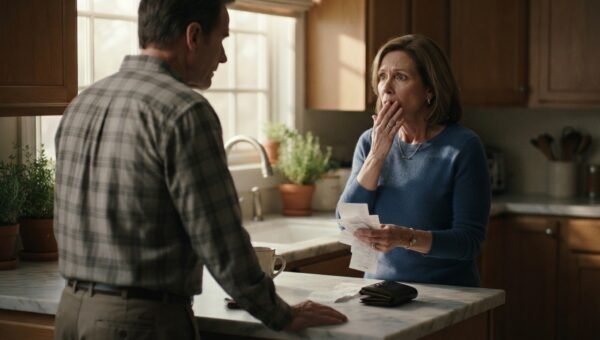
Her face drained of every drop of color. She dropped the grocery bag right onto the linoleum floor. The tomatoes rolled out, but neither of us moved to pick them up. Her lower lip began to tremble, and before she even touched the paper, tears were spilling down her cheeks.
“I was going to tell you,” she whispered, her voice cracking so hard it barely sounded like her. “Tom, please. I swear to God I was going to tell you.”
My stomach dropped into my feet. I thought about the separate bank account. I thought about her maiden name on the label. My first, terrible instinct was that she had been living a double life or preparing to leave me after nearly three decades.
“What is that, Martha?” I asked, keeping my voice as level as I could while my hands shook in my pockets. “Are those divorce papers?”
“No,” she choked out. She pulled a paper towel from the roll to wipe her eyes, stepped over the loose tomatoes, and picked up the envelope with shaking hands. “No, Tom. It is not divorce. It has nothing to do with us breaking up.”
She took a butter knife from the drawer, slit the top open, and pulled out a thick sheaf of legal paper stamped with official raised seals. She flipped through the first three pages, her breathing shallow and ragged, until she reached a certified record from an adoption registry.
We had two grown children: Kevin, who was twenty-four, and Sarah, who was twenty-six. Both were born at the community hospital twenty miles south, and I had been in the delivery room holding Martha’s hand for every contraction. We had never adopted anyone.
“Why do you have adoption records from Mercer County?” I asked, pulling out a chair and sitting down because my knees were suddenly weak.
Martha did not sit. She stood across the island from me, pulled out one single page, and slid it across the quartz counter toward my hands.
“Look at the birth mother’s name,” she said softly.
I looked down. Across the middle of the document, printed in faded typewriter ink on an official certificate of relinquishment, was the full legal name of my mother: Evelyn Mae Lawson.
My mother had passed away nine years earlier from lung complications. She had been a quiet, deeply private woman who taught Sunday school and kept a spotless kitchen.
I stared at the name, my mind refusing to assemble the pieces. I looked down at the date of birth listed for the child.
The baby had been born in a small Catholic maternity home on November 14, 1971.
I was born on May 28, 1972.
Six months. There were exactly six months between that baby’s birth and my own birth date.
PART 2
The math did not make sense. A woman cannot give birth to a child in mid-November and then give birth to another child six months later at the end of May. It was biologically impossible.
I sat there staring at the paper until the typewritten letters blurred together. My breath felt trapped behind my ribs.
“Where did you get this?” I asked, looking up at Martha. My voice sounded flat, almost hollow. “Why were you looking for my mother’s records under your maiden name?”
Martha pulled out the chair opposite me and sat down slowly. She had stopped crying, but her eyes were red-rimmed and filled with a kind of deep, exhausted dread.
“About four months ago, I got an email at work through the genealogy website I use for my family tree,” she said quietly. “A woman sent a message saying she had matched as a first-degree relative to someone who shared DNA with me through our kids’ profiles. She was looking for a woman named Evelyn Lawson who lived in Mercer County in the early seventies.”
“Why did she contact you?” I asked.
“Because Sarah and Kevin both did those spit kits two Christmases ago,” Martha said. “You remember that. You laughed at them and said it was a waste of fifty bucks, but they did it. And my name was attached as their mother on the public profile. This woman reached out to me because she didn’t want to shock you. She wanted to know if Evelyn was still alive.”
I pressed my thumbs against my temples. The kitchen was dead quiet except for the hum of the refrigerator.
“The separate account,” I said, looking across at her. “The six hundred dollars a month. That wasn’t for independence at all.”
“No,” Martha whispered, looking down at her hands. “In this state, sealed adoption records from before 1980 require a court petition and an independent intermediary. A lawyer in Mercer County told me it would cost about two thousand dollars in filing fees, search retainers, and document retrieval. I knew if I took that money out of our joint savings, you would see the withdrawal. You would ask questions before I had any proof. I didn’t want to break your heart over a rumor, Tom. I wanted the legal file in my hands so I could see if it was real.”
“So who was the baby?” I asked, my finger trembling as I pointed at the certificate. “Who was born in November of seventy-one?”
Martha reached into the envelope and pulled out the legal petition summary signed by the county probate judge. She folded it open and placed it right on top of the birth record.
“The baby was a girl,” Martha said. “Her name was registered as Baby Girl Lawson. She was adopted at three days old by a couple from Ohio. Her adoptive name is Brenda Collins. She is fifty-four years old, Tom. She is an accountant in Columbus.”
I shook my head, feeling a surge of stubborn anger pushing against the confusion. “Then my birth certificate is wrong. Or the state made a clerical mistake. My mother was thirty years old when she had me. I have my birth certificate in the lockbox in the closet. It says Evelyn Lawson, mother. Arthur Lawson, father. It has the seal on it.”
Martha reached across the counter and gently laid her hand over mine. Her skin was warm, but her fingers were trembling.
“Tom,” she said, her voice barely above a whisper. “Look at the mother’s signature on that relinquishment form. Look at the handwriting.”
I pulled the yellowed page closer. At the bottom was a thin, elegant script, slanting sharply to the right. It was the exact same hand that had written birthday cards to me every year of my life. It was the handwriting that filled the recipe cards still sitting in the tin box next to the stove.
My mother had signed that paper.
“If she had a baby in November,” I said, the words catching in my throat, “then who am I?”
PART 3
I could not sleep that night. Around two in the morning, while Martha was sleeping restlessly down the hall, I went into our bedroom closet, reached up to the top shelf behind my winter coats, and pulled down the gray fireproof lockbox.
I took out the small brass key from my keychain, clicked it open, and lifted out the folded papers. My high school diploma. The deed to our house. Our wedding certificate. And my original birth certificate from 1972.
I held it under the desk lamp in the spare room.
It looked completely authentic. It had the county seal pressed into the paper, the signature of the attending physician, Dr. H. R. Vance, and the names of Arthur and Evelyn Lawson. But when I looked closely at the top right corner, I saw what I had never paid attention to in my entire life. There was a small, hand-stamped code in faded purple ink: *AM-72-904*.
The next morning, I called in sick to the township office for the first time in six years.
Martha stayed home too. We drove together in my pickup truck, heading north toward the Mercer County Courthouse. We did not listen to the radio. The ninety-minute drive felt like it took ten hours.
When we got to the vital statistics office in the basement of the old stone courthouse, I stood at the counter with my driver’s license and my birth certificate in my hand. The clerk was a woman in her sixties with reading glasses hanging from a chain around her neck. She looked at the certificate, tapped the paper with her pen, and typed the registration number into her terminal.
She stopped typing. She looked at the screen, then looked up at me over her glasses.
“Mr. Lawson, this is an amended certificate,” she said plainly. “That is what the ‘AM’ stands for in the file number. This record was issued in August of 1972, three months after the birth.”
The floor felt like it dropped out beneath my work boots.
“What does amended mean?” I asked.
“It means the original vital record was modified after legal proceedings,” she explained, her voice professional but not unkind. “Usually, that indicates a legal adoption or an adjudication of parentage. When an adoption is finalized, the state issues an amended certificate showing the adoptive parents as the birth parents, and the original record is permanently sealed.”
I stood there frozen. Martha stepped up beside me and placed her arm through mine, leaning her weight against me so I wouldn’t stumble.
We went to the office of the attorney Martha had hired, a man named Henderson whose office was located in a converted brick house across the street from the town square. He had the rest of the unsealed court file waiting on his conference table.
Mr. Henderson closed the door, offered us water that neither of us touched, and laid out the facts like he was reading a balance sheet.
In the autumn of 1971, my mother, Evelyn, had been unmarried and thirty years old, working as a seamstress in town. She became pregnant by a man whose name was never entered into the court record. In those days, in a tiny farming community, an unwed pregnancy was treated like a scandal to be hidden away. Her family sent her to St. Jude’s Home for Unwed Mothers in the next county.
On November 14, 1971, she gave birth to a daughter. She signed the surrender papers three days later, believing she had no way to raise a child alone without money or family support.
She returned home in December of 1971, devastated. In January, she reconnected with my father, Arthur Lawson, an older widower who owned a local machine repair shop. Arthur had loved Evelyn for years. When he learned what had happened, he told her he wanted to marry her and give her a family.
They married at the justice of the peace in February of 1972.
Three months later, a young girl from the same rural township, sixteen years old and completely without resources, gave birth to a baby boy at the local clinic. The doctor who delivered that baby was Dr. H. R. Vance, the family physician who had known Arthur Lawson for twenty years.
Arthur and Evelyn took that baby home from the clinic when he was two days old. They arranged a private placement, filed the paperwork in August of 1972, and sealed the file forever.
The boy was me.
Evelyn was not my biological mother. Arthur was not my biological father. And the woman in Columbus, Brenda, was not my biological sister.
She was Evelyn’s daughter, searching for the mother who had given her up, while I was the child Evelyn had raised to replace the baby she had been forced to give away.
ENDING
We sat in the attorney’s office for a long time after he finished talking.
The room was quiet except for the muffled sound of cars passing on the street outside. I looked at the black-and-white photocopy of the private placement order from 1972. My real birth mother was listed only by her initials, C. M., sixteen years old, with no forwarding address. The file noted that she had left the state shortly after the hearing.
My entire foundation, everything I thought I knew about where I came from, had collapsed in the span of twenty-four hours.
We drove home in the late afternoon sun. Martha kept glancing over at me from the passenger seat, her hands clasped tightly in her lap. When we pulled into our driveway, she finally spoke.
“I am so sorry, Tom,” she whispered, her voice thick with guilt. “If I had known what was in those files, if I had known what it would do to you, I would have stopped right at that first email. I swear I would have.”
I turned off the ignition and looked at our house. It was a simple three-bedroom ranch, painted gray with white trim. My dad, Arthur, had helped me build the back deck in the summer of 1995, just before he passed. He had taught me how to measure joists, how to change a tire, and how to treat a woman with respect.
And my mother, Evelyn, had sat by my bed every single night when I had pneumonia at age seven, wiping my forehead with cool washcloths until the fever broke.
I looked at Martha.
“You spent your own money because you were trying to protect me,” I said. “You didn’t do anything wrong.”
That evening, we sat at the kitchen table again. Martha brought out her laptop and opened the message thread from Brenda in Columbus. There was a photograph attached.
I leaned in and looked at the screen.
Brenda had Evelyn’s exact chin. She had the same slight cleft in the center and the same thin, straight nose that I had looked at across the dinner table for the first thirty years of my life. Brenda had spent fifty-four years wondering what her mother looked like, while I had spent fifty-four years living with the woman who had cried for her in secret.
“Do you want to write to her?” Martha asked gently.
I sat there for several minutes, looking at the picture of a sister who was not my blood, but who was tied to me by the grief and love of the same woman.
“Yes,” I said. “I do.”
Two weeks later, Brenda drove over from Columbus. We met at a quiet diner halfway between our towns. She brought a small notebook full of medical questions, and I brought our family photo albums.
We sat in a corner booth for nearly four hours. I showed her pictures of Evelyn baking pies at Thanksgiving, Evelyn laughing on our front porch, and Evelyn holding our daughter Sarah when she was just a newborn. I gave Brenda Evelyn’s sterling silver locket that I had kept in my dresser drawer since the funeral.
Brenda cried when she snapped it open and saw the picture of Evelyn inside.
“She kept a photograph of a baby in her Bible,” I told Brenda, remembering something I had never understood as a boy. “There was no name on the back, just a date: November 14. She never let anyone touch it.”
Brenda closed her eyes and held the locket against her chest. “She didn’t forget me.”
“No,” I said. “She never forgot you.”
I never did find out who C. M. was, and after talking it over with Martha, I decided not to look. The teenage girl who gave birth to me in that clinic gave me to two people who loved me with everything they had. Arthur and Evelyn Lawson were my parents. Blood did not build that deck in the backyard, and blood did not wipe my forehead when I was sick.
The next Monday, Martha went down to the credit union. She didn’t close the account, but she had my name added to the signature card.
We don’t keep secrets in our house. We never did. Sometimes the past just has a way of waiting until you are strong enough to carry it.