PART 1
My son’s wife announced she was pregnant at my husband’s funeral.
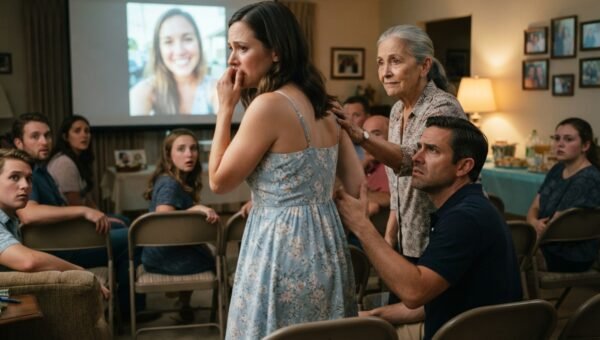
We were still standing beside the grave under the cemetery tent when she did it. The service had just ended, and an honor guard sergeant had handed me the folded burial flag for Frank’s service in the Navy. The brass casing from the three-volley salute was still tucked into the blue velvet bag in my lap. While my fingers were still gripping the coarse wool of that flag, Chloe stepped out in front of twenty relatives, cleared her throat, and said she had a gift to bring light into our dark day.
Then she smiled, pulled a sonogram printout from her black purse, and held it up for everyone to see.
My son, David, stood half a step behind her. He didn’t look happy. He looked drained and pale, his suit hanging a little loose on his shoulders. People handle grief differently, but the timing felt strange to me. It felt like someone cutting the ribbon on a new porch while the rest of the house was still on fire. Relatives immediately turned away from me and rushed toward Chloe. They hugged her, took photos, and patted her belly. I stayed in the folding chair, holding Frank’s flag against my ribs, watching my thirty-two-year-old daughter-in-law accept congratulations while my husband of forty-one years was being lowered into the ground.
Frank had been sixty-eight. He fought leukemia for fourteen months, and during those fourteen months, Chloe rarely came to our house. Whenever David drove over on Saturday mornings to help me lift Frank out of bed or change the oxygen tanks, Chloe stayed home in their townhome twenty minutes north.
She told David the smell of rubbing alcohol and sickness made her nauseous. I never held that against her. Some people cannot handle sickrooms.
Three months after the funeral, David called me on a Tuesday evening.
“Mom,” he said, and his voice had a thin, unsteady pitch to it. “We just got back from the clinic. The doctor moved Chloe’s due date.”
I set down the dishtowel I was holding. “Moved it which way, David?”
“Earlier,” he said. He took a short, rough breath. “By nearly seven weeks. The technician did a full ultrasound today. She told us the femur length and skull measurements put her at twenty-one weeks, not fourteen. David sounded completely lost. He kept repeating, ‘She told me she was barely six weeks at Dad’s service, Mom. But the screen showed a full baby. The doctor said there is no way she got pregnant in late May.'”
I stood in my kitchen, staring at the empty wooden chair where Frank used to drink his black coffee every morning. I did the math silently.
If Chloe was twenty-one weeks along in late August, she conceived in early April.
In early April, Frank was still in the hospital receiving high-dose chemotherapy at the university center. David was working out of town four days a week as a field technician for a regional telecom company. He stayed in motels near the state border from Tuesday morning until Friday afternoon.
I didn’t say any of that out loud. A mother learns early on that accusing an adult son’s wife without hard proof only makes the son build a wall between you and him.
“What did Chloe say?” I asked quietly.
“She said doctors make mistakes on early ultrasounds all the time,” David muttered. “She said first-trimester measurements are notoriously inaccurate.”
He sounded like he was reading words someone had fed him.
Two days later, Chloe called me directly. She had not called my cell phone once since the funeral.
“Helen,” she said, her voice unusually bright and sweet. “I hope you’re having a gentle afternoon. I was looking over the paperwork the obstetrician gave us, and there’s a big section on family genetic history. Heart conditions, early cancers, hereditary markers. Since Frank had such an aggressive illness, the clinic wants his full medical portfolio. Discharge summaries, pathology reports, and the genetic panel from his oncology workup. Could you pull his records from the medical records office and let me borrow them?”
It sounded completely reasonable on the surface. Frank had several genetic markers tested when the leukemia first turned resistant to targeted therapy. I wanted to protect my grandchild, whatever the truth turned out to be.
“I can sign the release and pick up the packet on Friday,” I told her.
“Thank you, Helen. You’re wonderful,” she said, and hung up.
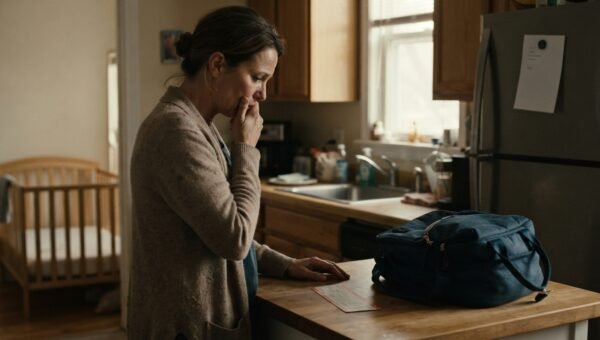
On Friday morning, I went down to the oncology records department at Saint Jude Memorial, paid the twelve-dollar processing fee, and carried a thick brown envelope to David and Chloe’s house. David was at work. Chloe answered the door in a maternity dress, took the packet from my hands with both of hers, kissed my cheek, and promised she would drop it off at her maternal care clinic that afternoon.
Seven days went by.
The following Thursday at ten in the morning, my home phone rang. The caller ID showed Saint Jude Memorial Hospital, but it wasn’t the regular oncology desk.
“Is this Helen Vance?” a woman asked. She identified herself as an administrative supervisor in the hospital’s pathology and laboratory compliance division.
“Yes, it is,” I said.
“Mrs. Vance, I’m calling regarding a supplemental release form that arrived at our laboratory desk this morning from an independent diagnostics group. The paperwork requested a chain-of-custody transfer of your late husband Frank Vance’s frozen peripheral blood and bone marrow biopsy samples.”
The room seemed to shrink. “What would they need his tissue samples for?”
“The documentation submitted by the patient’s representative, a Chloe Vance, indicates an intent to conduct comparative DNA marker testing for fetal paternity verification,” the administrator said evenly. “Because Mr. Vance is deceased, the hospital requires the surviving spouse’s direct, notarized authorization before any stored biological material can be released to a third-party laboratory. Did you sign this authorization, Mrs. Vance?”
My hand clamped tight around the plastic receiver. “No. I did not.”
“Then we will place an immediate administrative hold on the file,” the woman said. “No materials will leave this facility.”
I hung up the phone. My heart was not racing; it felt frozen solid in my chest.
Frank had been sixty-eight years old when he passed away. He spent the last four months of his life so weak from radiation and transfusions that he couldn’t walk from the bed to the bathroom without leaning his entire weight on my shoulder. Chloe was thirty-two.
I dialed my son’s cell phone immediately. It rang four times before he picked up. The background noise sounded like a truck cab or a gravel road.
“David,” I said, barely keeping my voice steady. “Did you know Chloe tried to get Dad’s biopsy samples released from the hospital lab for a paternity test?”
A heavy, dead silence stretched over the line. For five seconds, I could hear only the rumble of his truck engine and the sound of his breath catching in his throat.
Then he whispered, “Mom, please don’t hang up.”
PART 2
“I’m not hanging up, David,” I said. “Talk to me right now.”
I could hear him pulling his service truck onto the shoulder of whatever country road he was driving. The gravel crunched under his tires, the engine shut off, and then came the click of his seatbelt releasing.
“She told me she was doing it,” David said. His voice cracked right in the middle of the sentence. “She told me on Tuesday night after we got into a fight about the dates. She said if I didn’t trust her, she would prove it once and for all.”
“Prove what, David? That your father was involved with her? Do you have any idea what you are saying?”
“No, Mom! Not Dad!” David broke out, his voice rising in panic. “Not Dad like that! She said… she told me the clinic can use a direct paternal relative’s blood to confirm fatherhood through lineage markers if the father is unavailable. She told me she was testing it against me!”
I gripped the kitchen counter until the skin over my knuckles turned white.
“Why would she test against your father instead of taking a cheek swab from you?” I asked. The question hung in the air like poison.
David didn’t answer right away. When he spoke again, the shame in his voice was so heavy it made him sound like a frightened child. “Because she wouldn’t let me do the swab, Mom. She told me home cheek swabs get contaminated. She said the hospital’s sealed oncology samples were certified by a lab and couldn’t be disputed. She swore to God that once the results came back showing a ninety-nine percent family match, I’d have to stop asking questions and apologize to her.”
I stood there listening to my thirty-four-year-old son, and the whole picture began to turn inside out.
Chloe wasn’t trying to prove Frank had fathered her child. She was trying to exploit the fact that a grandfather’s DNA shares roughly twenty-five percent of a child’s markers. If she could get a private lab to run a partial family lineage test and show a biological link to Frank’s DNA, she could wave the paper in front of David and claim it proved he was the father.
She was using a dead man’s cancer records to cover up an affair.
“David,” I said as calmly as my shaking throat would allow. “Where were you the first week of April? Think carefully.”
He went quiet for a long moment. “The first week of April? That was the big fiber-optic expansion down in Hardin County. I was staying at the Comfort Inn off Highway 65 from Monday morning until Friday night. I didn’t come home once that week because we had eighteen-hour splice shifts after the ice storm.”
“And who else was in town that week?” I asked.
“Mom, I don’t know,” he whispered. “Chloe said she worked late at the real estate office every night.”
“You need to come over here, David. Leave your route early if you have to. Come to the house.”
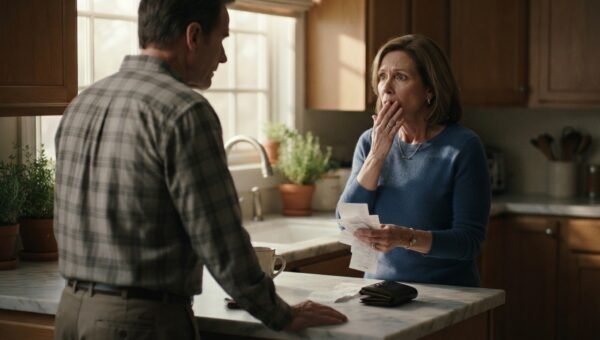
He arrived an hour and a half later. His eyes were red, and he hadn’t shaved in two days. He sat at the kitchen table, in the exact chair where he had sat as a teenager doing his algebra homework. I poured him a glass of water, sat across from him, and placed the phone on the table.
“Here is what happened this morning,” I told him. I walked him through every word the hospital compliance supervisor had said. I explained how the laboratory chain of custody worked. Chloe had taken the oncology papers I gave her, forged my name as the surviving executor on a third-party lab release form, and faxed it to Saint Jude Memorial.
The only reason the lab called me was because Frank’s oncology file had a specific biohazard flag on it. His samples were tied to an experimental clinical trial that required direct verbal confirmation from the surviving proxy before any tissue could be transferred. Chloe didn’t know that. She thought she could slip a forged paper past a medical clerk.
David put his face in his hands. His broad shoulders hitched once, twice, and then he began to weep.
“I wanted to believe her, Mom,” he said through his fingers. “When Dad died, everything felt so empty. When she held up that sonogram at the cemetery, I felt sick inside because of the timing, but a part of me thought… maybe God was giving us something to look forward to. I wanted it to be mine so bad that I let myself ignore the calendar.”
“What did she say when the doctor moved the date to twenty-one weeks?” I asked.
“She cried,” David said. “She screamed at the doctor in the parking lot. She said ultrasound technicians are idiots who guess based on head size. But when we got home, she started acting frantic. She stayed up until three in the morning searching on her laptop. The next day she asked you for Dad’s records.”
“She’s scared, David,” I said. “Because she knows a standard paternity test between you and that baby will show zero percent. But if she used your dad’s blood in some mail-order lineage kit, she could confuse you with technical jargon.”
David lifted his head. The sorrow in his face was beginning to give way to something harder. “She didn’t know you had to sign for it.”
“No,” I said. “She thought I was just a grieving widow who handed over paperwork without reading the fine print.”
I picked up the phone. “We are going to find out whose baby that is. And we are going to do it today.”
PART 3
We didn’t call Chloe first.
Instead, David pulled his truck keys out of his pocket and drove us directly to their townhome. On the drive over, David’s phone lit up three times on the console. Chloe’s name flashed across the screen each time. He didn’t touch it.
When David unlocked the front door, Chloe was standing in the kitchen. She was wearing leggings and an oversized sweater, chopping celery at the granite island. The radio was playing softly in the background. She looked up, startled to see both of us walk through the door in the middle of a Thursday afternoon.
“David?” she said, setting the knife down slowly. “Why aren’t you on your shift? Helen… what’s going on?”
David didn’t yell. He walked up to the island, took his wedding band off his finger, and set it down on the cutting board right next to the celery.
“The compliance desk at Saint Jude called Mom this morning,” David said.
Chloe didn’t gasp. She didn’t drop anything. But her eyes darted to the side, toward the hallway where their home office was, and her breathing turned shallow.
“I don’t know what you’re talking about,” she said, though her voice had lost all of its brightness. “I asked Helen for family medical history for the baby’s chart.”
“You forged my signature on an outside laboratory transfer request,” I said, stepping up beside my son. “You submitted a requisition to take my husband’s frozen blood samples to run a prenatal lineage panel. You wanted to generate a report with the Vance family DNA on it so you could tell David the baby was his.”
“That is ridiculous!” Chloe snapped, her face flushing red from her throat to her hairline. “I was trying to protect our family! David has been treating me like a criminal ever since the ultrasound! He’s been questioning me, staring at me, acting like I cheated on him! I wanted an independent lab to confirm the biological family line so he would finally shut up and let me have a peaceful pregnancy!”
“Then why didn’t you swab David?” David asked. His voice was lower now, steady in a way I hadn’t heard since his father passed away. “Why did you try to steal my dead father’s blood from an oncology freezer?”
Chloe took a step back, hitting the edge of the kitchen counter.
“Because you were acting crazy!” she yelled. “You wouldn’t have believed me anyway!”
“Who is he, Chloe?” David asked.
“Nobody! There is nobody!”
“The first week of April,” David said, cutting right through her words. “I was in Hardin County from Monday through Friday. I have the hotel receipts and the company GPS logs. You told me you were working late at the realty office. Who were you with?”
Chloe crossed her arms over her stomach, clutching herself tightly. She looked at me, her eyes full of venom. “You’ve hated me since the day we got married, Helen. You turned him against me from the start.”
“Do not look at my mother,” David said, his voice cracking like a whip. “Look at me. Who is the father of that baby?”
The silence that followed stretched out until the ticking of the kitchen wall clock sounded like a hammer striking an anvil.
“It was Marcus,” she whispered finally.
Marcus was thirty-four. He was the managing broker at the commercial real estate firm where Chloe worked as a leasing coordinator. Two years earlier, David and I had attended their firm’s Christmas dinner; Marcus had shaken Frank’s hand, smiled at us, and bought our table a bottle of wine.
“It happened twice,” Chloe said, the words spilling out of her now in a hurried, desperate stream. “Just twice, David. During the spring retreat. I was drunk, and we were stressed about your dad dying, and you were always gone working overtime. It didn’t mean anything! I swear to God it didn’t mean anything! When I missed my period, I thought the dates lined up with when you came home that weekend. I honestly thought it was yours! It wasn’t until the twenty-week scan that the measurements came back so big… and I panicked. I knew if you took a test, you’d leave me.”
“So you decided to drag my father’s corpse into it,” David said.
“I thought… I read online that grandfather markers could establish paternal probability,” she sobbed, burying her face in her hands. “I thought if the paper came back saying Vance DNA was present, it would say seventy or eighty percent, and you wouldn’t look any deeper. I was trying to save our marriage!”
“You didn’t try to save our marriage,” David said quietly. “You tried to make me raise Marcus’s kid while spitting on my dad’s grave.”
He turned on his heel and walked straight down the hallway into their bedroom. Five minutes later, he came back out carrying a duffel bag stuffed with work shirts, jeans, and his steel-toed boots. He didn’t look at her again.
“Let’s go, Mom,” he said.
I looked at Chloe one last time. She was slumped against the counter, crying into a paper towel, but I didn’t feel angry anymore. I just felt a deep, profound weariness.
“The hospital has placed a fraud flag on Frank’s records,” I told her quietly. “If you contact that records department again, I will file a police report for identity forgery before the sun goes down.”
She didn’t answer. We walked out the front door and let it click shut behind us.
ENDING
David moved back into his old childhood bedroom that night.
The next morning, we sat down with a family law attorney in town named Robert Miller. David filed for divorce that afternoon on grounds of adultery and fraud. Under our state’s laws, because the child was conceived during the marriage, David would have been legally presumed to be the father on the birth certificate unless formal legal action was taken before delivery.
Mr. Miller filed an emergency motion to disestablish paternity, requesting a court-ordered prenatal non-invasive paternity test through an accredited forensic laboratory. Chloe’s attorney didn’t fight the motion. Two weeks later, David gave a blood sample at a certified lab downtown. Chloe gave hers the following day.
The results arrived in the middle of October. The probability of David being the biological father was zero point zero percent. Marcus was formally named in the supplemental filings. According to David’s lawyer, Marcus hired his own representation the following week after his wife discovered the paperwork.
Chloe gave birth to a baby boy in late December. David didn’t go to the hospital. He didn’t sign the birth certificate. Marcus’s name was entered as the legal father after the court finalized the paternity disestablishment in January.
The divorce was completed in March. David gave up his claim to the townhome equity in exchange for complete release from any financial obligations, and Chloe sold the place two months later to move back to her parents’ house near the state line.
David stayed in my guest room through the spring and summer. On weekends, he helped me clean out Frank’s workshop in the garage, sorting through forty years of socket wrenches, fishing tackle, and sawdust. Some days we didn’t talk much at all. We just worked until our hands were dirty and the sun went down behind the pine trees in the backyard.
Yesterday was the one-year anniversary of Frank’s funeral.
David and I drove out to the cemetery together in the morning. The grass had grown in thick over the plot, completely covering the raw red dirt where the tent had stood a year ago. It was quiet out there, just the wind moving through the cedar branches and the sound of distant highway traffic.
David knelt down and wiped a dusting of pollen off the bronze military plaque set into the stone.
“I’m sorry, Dad,” he whispered.
I put my hand on my son’s shoulder. “Your father knew who you were, David. And he knew who he was. Nothing that happened changes that.”
We stood there for a few minutes in the September air. Then we walked back to David’s truck, got in, and drove home to make lunch. Frank’s folded burial flag still sits in the glass triangle case on our mantle, clean and untouched, right where it belongs.