PART 1
The holiday season had barely faded into the bitter chill of January when the argument about the Bible happened. My mother in law, Clara, is a woman who measures devotion in heavy, gilt edged heirlooms. For Christmas, she had handed our sixteen year old daughter, Chloe, a thick, dark leather bound family Bible that had supposedly survived half a century of moves and quiet Sunday devotions. Chloe had unwrap it with a polite, stiff smile, her teenage boredom hanging heavy in the air.
As soon as Clara turned her back to chat with my wife, Sarah, Chloe rolled her eyes, tossed the heavy book onto the bookshelf next to a row of old yearbooks, and didn’t touch it again for months.
It stayed there collecting dust until mid March. Chloe came running down the stairs frantic one Tuesday evening because she needed a pressed flower or a vintage page for a high school biology project due the next morning. She remembered the old Bible, grabbed it off the shelf, and carried it to the kitchen island. As she flipped the stiff, yellowed pages searching for a flat leaf, something small and stiff slipped out from the binding near the middle chapters and fluttered down onto the linoleum floor.
Chloe bent down, picked it up, and frowned. It wasn’t a leaf. It was an old, curled rectangular photograph with white borders, the kind of glossy square print they developed in photo labs decades ago.
She flipped it over, then showed it to Sarah and me while we were cleaning up dinner dishes.
“What is this?” Chloe asked, handing it across the counter.
I took the photograph. My thumb brushed the glossy surface. It showed two newborn infants lying side by side in a hospital bassinet, wrapped in identical coarse cotton blankets stamped with the local county hospital logo. They looked tiny, squished, and fiercely red, typical newborns fresh from the delivery room. But what caught my eye immediately was the handwriting on the back. Written in faded blue ballpoint ink was a date from thirty eight years ago, matching the year Sarah was born. Beneath the date were two distinct names. One name was Sarah Elizabeth. The second name, right beside it, had been aggressively crossed out with thick, overlapping loops of blue ink so that the letters were completely illegible beneath the dark scrawl.
Sarah walked over, wiping her hands on a dish towel, and peered over my shoulder. Her face went very still. She took the photo from my hand, staring at the crossed out name with a look of sudden, profound confusion.
“That’s my birth date,” Sarah whispered, her voice dropping an octave. “And that’s definitely the old county hospital where Mom always said I was born. But why is there another baby? And whose name is scribbled out like that?”
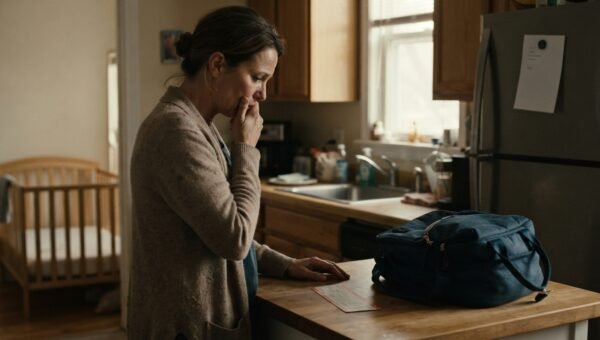
We didn’t have an answer. Sarah tried calling her mother right then, but Clara didn’t pick up her landline, which wasn’t unusual for a Tuesday night when she usually attended her local garden club committee meeting. The photograph sat on the kitchen counter like a small unexploded bomb for the rest of the night. Sarah stared at it on and off while she loaded the dishwasher, running her fingers over the scratched out ink as if she could magically peel away the blue barrier to reveal whatever secret her mother had hidden inside a religious heirloom for nearly four decades.
PART 2
By Wednesday afternoon, the weight of the photograph had become unbearable. Sarah took a half day off from her job at the local credit union, and I drove us out to Clara’s house on the edge of town. Clara lived alone in the modest ranch house where Sarah had grown up, a place smelling permanently of lemon polish, old paper, and brewed black tea. When we knocked, Clara answered the door wearing her usual neat cardigan and sensible slacks, looking every bit the retired school administrator she was.
“Well, this is a surprise,” Clara said, stepping back to let us into the entryway. “Is everything all right with Chloe?”
“Chloe is fine, Mom,” Sarah said, her voice tight and clipped as she walked past her mother straight into the living room. She pulled the square photograph out of her handbag and laid it flat on the coffee table right beside a small porcelain figurine. “We found this inside the family Bible you gave Chloe for Christmas. It fell out when she was looking for a page for a school project.”
Clara stopped moving. She didn’t look down at the table immediately. Instead, her gaze snapped up to Sarah’s face, and all the color seemed to drain out of her cheeks, leaving her skin a pale, papery gray. Her hands, which had been loosely clasped in front of her, suddenly clenched together so hard her knuckles turned white.
For a long, agonizing moment, the house was completely silent except for the rhythmic ticking of the grandfather clock in the hallway.
Clara let out a long, shuddering breath that sounded like air leaking out of a punctured tire. She walked slowly to her armchair, sat down with stiff deliberation, and stared at the photograph on the table.
“I hoped that picture was gone,” Clara murmured, her voice barely louder than a whisper. “I thought I burned it back when we cleared out the old storage unit ten years ago.”
Sarah took a step forward, her hands shaking slightly. “Mom, what is this? Who is the other baby in the bassinet with me? Why is there a second name crossed out on the back? Did I have a twin?”
Clara shook her head slowly, her eyes fixed on the floral pattern of the rug. “Not exactly.”
I stood beside Sarah, watching her mother closely. There was no defiance left in Clara, only a heavy, crushing exhaustion that had been buried under thirty eight years of silence.
“What do you mean, not exactly?” I asked, keeping my voice steady. “Tell us what happened at the hospital, Clara.”
Clara looked up, her eyes swimming with a sudden, bitter moisture. She looked at Sarah with a mixture of immense sorrow and deep, lingering fear.
“The hospital called three days after I brought you home,” Clara began, her voice cracking slightly as she started to untangle the lie she had lived with for almost four decades.
PART 3
Clara clasped her hands tightly in her lap, her gaze drifting back to the past as she explained the reality of that week thirty eight years ago.
“I had a difficult delivery at the old county hospital,” Clara said, speaking into the quiet room. “The nurses brought me a baby girl on the second day, wrapped her up, and told me everything was fine. On the fourth day, they discharged me. But three days after I brought you back to this very house, the hospital billing and records department called my landline. A frantic administrator told me there had been a terrible administrative mixup in the newborn nursery during a shift change. They said the crib tags had been swapped for a few hours, and they needed me to bring you back immediately so they could sort out DNA samples and verify identities with another couple who had given birth on the exact same morning.”
Sarah gasped, bringing a hand up to cover her mouth. “A baby mixup? They called you and told you I might not be yours?”
“Worse than that,” Clara whispered, a tear finally spilling over her eyelid and tracking down her cheek. “When I drove back down there with you in the back seat, terrified out of my mind, the head nurse and a hospital administrator sat me in a bleak little room. They brought in the other baby. They showed me the paperwork. But before they could even finish explaining the mess, the other family had already arrived. It was a young, chaotic scene. Tempers flared. There were accusations thrown around about clerical incompetence. But then the head administrator pulled me aside privately. He told me that official records were already logged, that a court battle over infant custody could take months or even years in our local district court, and that the emotional trauma for both families would be devastating. He suggested, in no uncertain terms, that since the babies were already settled in our homes, perhaps it was better to let sleeping dogs lie.”
“You let them switch us back?” Sarah demanded, her voice rising in sudden, sharp disbelief. “Or you let them keep the wrong baby? Which one was I, Mom?”
“That’s just it,” Clara said, her voice breaking entirely. “The names on the back of that photo represent the two infants matching your birth weight and time. When I looked at the two of you side by side in that back room, I didn’t know which one was the flesh and blood I had labored over for twenty hours. The hospital records were already a tangled web of crossed out entries and missing charts. The administrator practically begged me to take you and go home, promising that the other family was being persuaded to do the same with the other child to avoid a public scandal. I was twenty four, newly single after your father walked out, and terrified of losing the only piece of family I thought I had left. So I took you, walked out that heavy glass door, and threw the paperwork in a dumpster down the block. I kept that single polaroid because I couldn’t bear to throw away the face I had stared at for three days, but I crossed out the other name so I wouldn’t have to look at the what if every time I opened the album.”
The silence that settled over the living room was suffocating. Sarah stood frozen, staring at her mother as thirty eight years of identity dissolved into a complicated blur of hospital bureaucracy and a frightened young mother’s desperate choice.
ENDING
The drive back to our house was entirely silent. Sarah stared out the passenger window, watching the gray suburban landscape blur past as dusk began to settle over the telephone poles and fading storefronts. She didn’t cry anymore; she had moved past tears into a strange, hollow quietness that I didn’t know how to reach.
That evening, after we sat through a quiet dinner where Chloe barely touched her food because she sensed the heavy tension in the air, Sarah and I sat at the kitchen island with the old photograph between us. We searched online registries and historical birth logs for the county hospital from that specific week thirty eight years ago. The records were sparse, digitized decades late with missing indices and corrupted scans, but we found a public archive reference to a class action settlement involving misplaced maternity records at that facility during the mid nineteen eighties.
Sarah picked up the photo, her thumb tracing the thick blue ink that hid the second name.
“I don’t even know who I am anymore,” Sarah said softly, her voice barely carrying across the counter. “For thirty eight years, I thought I was Clara’s daughter through and through. Now I look in the mirror and wonder whose features I actually carry. Was I the baby meant for another family across town? Did someone else grow up wondering why they didn’t quite fit in with the people who raised them?”
“We find out,” I told her, reaching across the wood to cover her cold fingers with mine. “Clara survived by burying it, but we don’t have to. We can contact the hospital archive board, file the records request, and see if anyone else has been looking for answers from that spring.”
Sarah looked down at the photograph one last time, her expression hardening with quiet resolve. She slid the small piece of glossy paper back into its old leather home inside the Bible, closed the heavy cover with a firm thud, and pushed it to the center of the table. We had opened a door that could never be shut again, and whatever truth lay on the other side of that crossed out name, we were going to face it together.