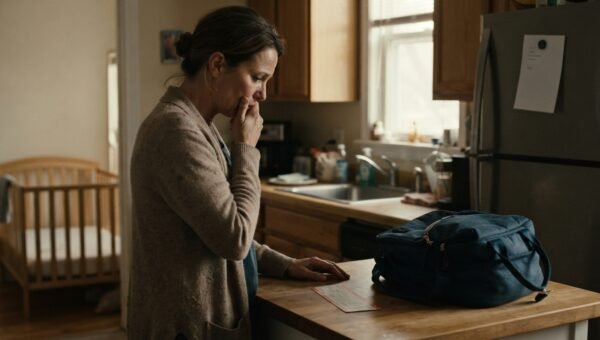
The livestream buffer circle spun in the center of my old laptop screen for twelve seconds before the audio kicked in. It was a dull, tinny sound, mostly the rustling of programs and the low murmur of three thousand people sitting in folding chairs under an aluminium pavilion six miles away. I had a cup of black coffee sitting on the counter next to me that I had poured at 8:00 in the morning, and now the surface had that thin, iridescent film floating on top of it from sitting too long in the quiet kitchen.
Chloe had called me two nights before from her apartment across town. Her voice had that tight, brittle sound she got whenever she was trying to deliver news she knew would tear a hole in things. She told me her biological mother had tracked her down through an alumni directory or a mutual acquaintance, I did not even ask which. Then came the part that made my chest tighten until I could not get a full breath. She asked if I would stay home from the ceremony.
“It would just be easier if you weren’t there, Martha,” she had said, and she did not call me Mom in that sentence, she used my name like I was a landlord or an aunt she saw once a year at Thanksgiving. “She wants to see me walk, and she said it would be too much tension with you in the same row. I am sorry.”
I did not yell. I never yelled at Chloe, not once in the sixteen years since her father dropped her off on my front porch with a canvas duffel bag and a plastic sack of clothes when she was six years old. I just told her that her happiness was what mattered most and that I would watch the feed from home. I cleaned the kitchen counters twice. I wiped down the laminate until it squeaked under the sponge, and then I sat down at the small wooden table by the window with my cold coffee and waited for her name to be called.
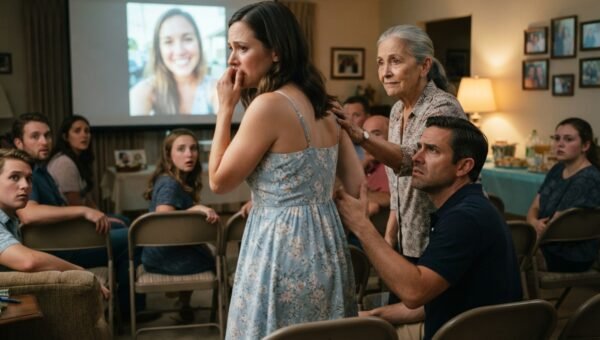
The announcer had a booming, professional voice that echoed off the metal rafters of the colocation center. He rattled through the economics degrees at a clip that made every name blur into the next one. I kept my eyes fixed on the small rectangle of light on my screen, watching the line of black gowns shuffle across the stage, waiting for the dark curls and the sharp profile I had braided for proms and dried tears over after bad breakups.
Then the announcer stopped midsyllable. The papers in his hands made a sharp, dry rustle against the microphone. He leaned down and whispered something to the dean sitting behind him, and the audio picked up the low murmur of confusion rolling through the front rows.
“We are experiencing a brief pause in the program,” the announcer said, his voice losing its polished edge and sounding like a man reading an announcement about a delayed flight. “There has been an unexpected family situation. We will resume shortly.”
The camera panned away from the stage immediately, cutting to a wide shot of the balcony where families were fanning themselves with graduation programs. I did not move. My hands were flat on either side of my laptop, my fingers dug into the grain of the old table. I knew before the knock came that the ceremony was over for Chloe. You do not halt a university graduation for a minor delay.
Something had broken, and it had broken right where she was standing.
The knock on my front door came at 10:14 in the morning. It was not the sharp, hurried rat-a-tat of a delivery driver or a neighbor needing a cup of sugar. It was two heavy, deliberate raps, followed by the sound of someone shifting weight on the wooden porch boards.
I stood up so fast my knees popped, the kitchen chair scraping back against the linoleum with a loud screech. I walked down the narrow hallway past the framed photographs of Chloe at ten winning a ribbons at the county fair, Chloe at fourteen with her braces and her science fair project, Chloe at sixteen learning how to parallel park my old Ford pickup by the grain elevator.
When I pulled the door open, the morning light hit me square in the eyes. Chloe stood right on the welcome mat, still wearing her heavy black graduation gown with the red stole draped unevenly over one shoulder. Her mortarboard was slightly crooked, and her face was wet with tears that had smeared her mascara into gray smudges under both eyes. But it was not just Chloe standing there.
Three feet behind her, standing near the edge of the hydrangea bushes, was Sarah. I had not seen Sarah’s face in sixteen years, not since the bitter afternoon she walked out of that house with a suitcase and left a six-year-old girl sitting on the living room floor playing with plastic farm animals. She looked older, of course, her hair streaked with silver around the temples and her eyes hollowed out by time, but the shape of her jaw was identical to the girl standing on my porch.
Nobody said anything for five seconds, and honestly that felt louder than the graduation speakers. Chloe looked at me with a gaze so heavy and wrecked it made my stomach drop down into my shoes.
“She told me this morning why she really left when I was six,” Chloe whispered. Her voice was shaking so hard she could barely get the words out.
She reached out with a hand that trembled violently and held out a manila envelope. It was thick, sealed across the back flap with red evidence tape and stamped with a court clerk’s purple seal near the bottom corner. It looked official and cold, the kind of paper that belongs in a municipal basement rather than a front porch on a Saturday morning in May.
“Come inside,” I said, my voice sounding flat and strange in my own ears. I did not look at Sarah. I kept my eyes on Chloe’s chin, right where she had a small scar from falling off the bicycle I taught her to ride without training wheels.
We moved into the living room, the three of us, stepping in through the front door like strangers who had been forced together by a car wreck on the highway. Sarah lingered by the entryway, her hands clasped tightly in front of her linen blouse, looking around my living room as if she expected the furniture to bite her. This was the house Chloe grew up in, the house where I stayed up until 3:00 a.m. nursing her through the flu, the house where we painted her bedroom yellow when she turned twelve. Sarah had no right to look at the framed pictures on the wall, but she did anyway, her eyes darting from frame to frame.
Chloe dropped her graduation cap onto the coffee table. It landed with a dull thud, the tassel trailing off the edge and onto the braided rug. She held the manila envelope out toward me again, refusing to let go of the other side.
“You need to read what is in here,” Chloe said. Her breathing was shallow, coming in short, ragged hitches. “She waited for me outside the girls’ restroom behind the auditorium before the procession started. She had this with her. She told me everything.”
I took the envelope from her hands. The paper was heavy, slightly damp from the morning humidity outside. I did not tear the red tape right away. I looked up at Chloe, seeing the exact moment her childhood ended, that brutal second when a person realizes the adults in their life were playing a game with rules they never agreed to.
“Your father told me she walked out because she didn’t want the responsibility,” I said quietly, repeating the lie I had lived with and repeated to myself like a prayer every time things got hard. “He said she packed her car while you were at kindergarten and just drove away.”
Sarah took half a step forward from the doorway, her mouth opening as if she wanted to defend herself, but she stopped when I turned my head toward her. There was no warmth left in me, just the cold, hard certainty of a woman who had spent sixteen years holding down the fort while someone else was a ghost.
“That was not what happened,” Sarah said. Her voice was cracked, dry like old paper. “He told everyone I abandoned her. He had the bank accounts locked down for six months before I left. He told me if I tried to take Chloe with me, he would use his brother in the county court to declare me unstable and make sure I never saw her again. He had the papers drawn up. He was a lawyer, Martha. He knew how to make people disappear on paper.”
I looked down at the file in my hands. The red tape gave way with a sticky tear when I finally pulled it loose. Inside were court transcripts, bank statements from sixteen years ago showing zero balances, certified psychiatric evaluations stamped by a court-appointed doctor who had declared Sarah perfectly sound of mind despite what her ex-husband’s filings claimed, and a formal custody petition she had filed and refiled every three years until the statute of limitations ran out and the courts stopped answering her letters.
The paperwork told a story of a quiet, methodical domestic siege. It showed how a man could systematically isolate a young mother, lock her out of her own financial life, threaten her with the loss of her child, and then write the history books the moment she walked out the door to save herself from being institutionalized on false pretenses.
I sat down slowly on the edge of the floral couch. My legs did not feel like they belonged to me anymore. The pages felt heavy, each one an anchor pulling me back through years of missed birthdays, quiet Christmases where I wondered if Sarah even remembered what day her daughter was born, and all those nights Chloe cried into her pillow because she thought her biological mother had looked at her and decided she was not worth staying for.
“I tried,” Sarah said, her voice dropping to a low, desperate plea as she stepped closer to the couch. “I spent sixteen years trying to get back to her legally. Every time I got close, his firm blocked it or the county judge tossed the motion. When I finally tracked her down last month through the college registry, I just wanted her to know the truth before she started her life. I didn’t want her carrying that lie around like I did.”
She looked at me then, really looked at me, and I saw the exhaustion in her eyes. It was the same exhaustion I saw in the mirror every morning when I washed my face. We had both been prisoners of the same man, just in different rooms of the house. He had lied to me from the day we met, telling me Sarah was a cold, unstable woman who ran off with a truck driver, making me feel like I was the saintly savior who stepped in to rescue his motherless little girl. He had used my good heart to anchor his lie, making me the permanent caretaker of a secret I never knew existed.
“You should have fought harder,” I said. The words came out flat and hard, like stones dropped into an empty bucket. I did not shout, but the room went completely still. “You should have stood on this porch sixteen years ago and made a scene. You should have called the police. You shouldn’t have let him win by default just because it was hard.”
Sarah flinched as if I had struck her across the face. She knew I was right. No matter how rigged the deck was, no matter how much money her ex-husband had tied up in local courts, a mother does not leave her six-year-old child behind for sixteen years without a trail of blood and fire. She had protected herself, and while I understood it in the cold logic of survival, I could not forgive it. Not when I was the one who had wiped the tears, paid for the braces, sat through the parent-teacher conferences, and loved that little girl through every single dark night when she wondered why she wasn’t enough.
Chloe was standing between us now, looking back and forth from Sarah to me like a spectator at a tennis match where both players were bleeding.
“I didn’t want to go to the ceremony once she told me,” Chloe said, her voice breaking entirely as she reached out and grabbed my hand. Her fingers were ice-cold against my palm. “She sat me down in her car behind the bleachers and showed me the court stamps. I read the dates, Mom. I read what he did to her. But then I looked at my phone and saw all the texts you sent me this morning wishing me good luck and telling me you were proud of me even from home.”
She dropped to her knees right there on the living room floor, burying her face in my lap just like she used to do when she scraped her knees on the gravel driveway as a little girl. Her shoulders shook with deep, wracking sobs that seemed to pull every ounce of air out of the room.
“I’m sorry,” she whispered into my apron. “I’m so sorry I asked you to stay away. I was angry at everyone, and I thought… I thought maybe having my real mother there would fix the part of me that always felt broken.”
I put my hand on the back of her head, feeling the thick, dark curls I had brushed out every school morning for a decade and a half. I looked past her shoulder at Sarah, who stood by the entryway with her hands pressed against her mouth, watching the only real family she had ever lost hold onto each other without her.
“You aren’t broken, Chloe,” I said, and my own voice cracked for the first time. “You never were.”
Sarah stood there for another minute, a ghost who had finally found the door only to realize the house had already been built by someone else. She did not say anything else. She knew there was nothing left to claim. The court file lay open on the coffee table beside her graduation cap, the red tape curling up like a dead leaf on the wood.
Without a word, Sarah turned around, pushed open the front screen door, and walked out down the gravel drive. The screen door swung shut behind her with a soft, familiar click that sounded like the end of a long, heavy shift at the end of a very bad week.
We sat there on the living room floor for a long time after she left, the two of us, while the spring sun moved slowly across the wooden floorboards and the coffee on the counter went completely cold. Chloe reached out and picked up her graduation cap from the table, turning it over in her hands before setting it down right on top of the open court file. We didn’t talk about her father, and we didn’t talk about the ceremony she walked out of. We just sat side by side on the couch, two people who had survived the same man’s wreckage, finally looking at a future that belonged entirely to us.