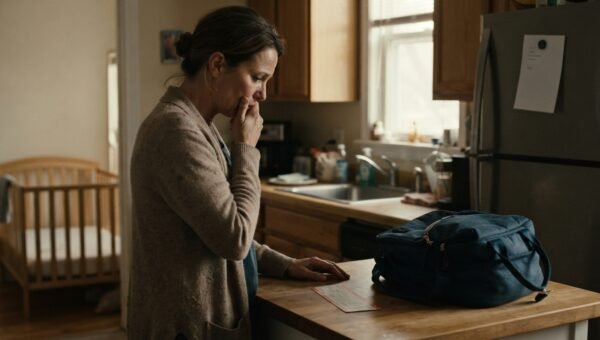
The pork chops were still warm in the cast-iron skillet when Arthur told me he wasn’t hungry. That was the first Tuesday in October.
I remember the grease popping against the gas flame, small amber sparks that left tiny dark spots on the black metal grate. I’d spent forty minutes browning them with a little garlic salt and flour the way he liked, the way his father had liked before him, back when people sat down at six o’clock and ate what was put in front of them without needing a reason.
Arthur pushed the white ceramic plate an inch to the left, his thumb rubbing the rim in that slow, rhythmic circle he only did when he was thinking about something else.
“I ate over at Clara’s,” he said. He didn’t look up from the sports section folded beside his water glass. “She made pot roast. I didn’t want to be rude.”
“You could have called,” I said, wiping my palms on the dishtowel tucked into my apron strings. My voice didn’t sound angry. It sounded thin, like tissue paper stretched too tight across a frame. “I made enough for three.”
“She just wanted some company, Bev. Her knee’s acting up again with the damp.”
That was how it started. Simple enough, and ordinary enough that I let it slide right past me into the laundry basket of everyday married life. Clara had moved into the small brick ranch on Maple Street three weeks earlier, right after her hip surgery and the sale of her house down in Portsmouth.
She was seventy-eight years old, with hair the color of tin foil and a mouth that always looked like she’d just bitten into a lemon seed. For thirty-two years of marriage, Clara had lived ninety miles away, far enough that her visits were limited to Thanksgiving and a week in July when she sat on our back deck and complained about the humidity. Ninety miles was a healthy distance. Three blocks was an address change.
By the second week of November, Arthur hadn’t eaten a single meal at our dining room table.
He’d come home at five-thirty, his gray coat smelling faintly of stale cigarettes and the damp cedar mulch Clara used around her hostas, and hang his keys by the back door with a heavy, metallic clatter. He’d loosen his tie, the maroon silk one I bought him for our anniversary, and stand by the sink staring out the window toward the alley while I chopped celery or peeled potatoes for one.
“Aren’t you having anything?” I’d ask, the knife rhythmically hitting the yellow cutting board. *Thump. Thump. Thump.*
“Already had some soup,” he’d say, his voice flat and dry as winter grass. “Clara had some cans in the pantry she wanted to get rid of.”
He was losing weight. I noticed it first in his shoulders, the way the wool of his tweed blazer started to bunch and fold around his collarbones like it was hanging from a wire hanger instead of a man. His belt went in two extra notches, leaving a long, pale tail of leather sticking out past the first loop. When he slept, he tossed until three in the morning, his breathing shallow and ragged, his heels digging into the bottom sheet as if he were trying to push himself away from the headboard.
“You need to see Dr. Miller,” I told him one night while he was sitting on the edge of the mattress pulling off his socks.
His ankles looked like white birch twigs, all knobs and blue veins. “You’re dropping pounds like a sick calf, Art. It isn’t normal.”
He stopped with his left sock half off, his heel caught in the wool. For three seconds he didn’t move a muscle, his back turned to me, the dim light from the hallway cutting across his shoulder blades.
“I’m fine,” he muttered, yanking the sock free and tossing it toward the hamper with a weak flick of his wrist. “Just stress at the lumber yard. The new inventory system is a nightmare.”
“Then let Dr. Miller look at your blood pressure. You’ve been hiding your phone calls, too. Every time I walk into the den, you turn the screen down.”
He didn’t answer. He just rolled onto his side, facing the flowered wallpaper, and pulled the quilt up to his ears. *I’m fine.* It was the only sentence he had left that didn’t sound like it was rehearsed.
Three weeks later, the snow started coming down in thin, gray needles that didn’t stick to the pavement but made everything look smeared and dull.
I was standing at the kitchen counter at four in the afternoon, scraping the skin off three carrots for a pot of barley soup, when the silence in the house finally got too heavy to breathe around. The refrigerator hummed its low, steady D-flat, and outside the window, Mrs. Gable’s Lab was barking at nothing against the chain-link fence three yards over. Arthur’s car wasn’t in the driveway, he’d said he had to stop by the hardware store for some carriage bolts, but his gray wool coat was still hanging on the peg by the basement door. He’d left without his coat. In twenty-eight degrees, Arthur never left the house without his wool coat.
I didn’t think about it. I just reached for the thermos on the top shelf, filled it with three ladles of the hot, yellow barley soup I’d salted twice, and pulled my yellow rubber boots on over my house slippers. I didn’t even grab an umbrella.
The walk to Maple Street took seven minutes through the slush. Clara’s house looked dark from the front, the porch light off, the beige venetian blinds drawn tight across the picture window like a pair of heavy eyelids. But as I came around the side drive, past the rusted metal frame of her empty clothesline, I saw it.
Arthur’s gray sedan was parked right up against the side garage door, tucked back behind the overgrown lilac bushes where nobody from the street could see it from a passing cruiser. The engine was off, but the frost on the hood had melted in a ragged oval right above the radiator, like someone had been leaning against it not ten minutes before.
I walked up the three concrete steps of the side porch, my boots making a wet, sucking sound against the ice. The screen door was unlocked. It didn’t squeak when I pushed it open; Clara always kept the hinges greased with lard.
Inside, the house smelled like cold linoleum and old wool. It didn’t smell like pot roast. It didn’t smell like soup, or coffee, or onions, or garlic, or anything that had ever seen a hot stove in this century. The kitchen sink was bone dry, the white porcelain stained with a faint ring of rust around the drain. On the counter sat a single box of saltines, the cellophane torn open at the corner, and nothing else. No dirty plates. No forks. No greasy skillet.
She hadn’t cooked in weeks. Arthur hadn’t been eating pot roast at his mother’s kitchen table because there was no food in this house to cook.
A low murmur came from somewhere under my feet. It wasn’t the hum of the furnace, the old oil burner down cellar had a heavy, rhythmic thrum that shook the floorboards in four-four time. This was voices. Muffled, overlapping, urgent voices talking in whispers that sounded like dry leaves scraping across a tombstone.
I didn’t knock. I didn’t clear my throat. I walked straight down the narrow hallway past the bathroom with the lavender bath mat, my hand trailing along the floral wallpaper until my fingers found the white wooden door that led down to the fruit cellar.
The door was unlatched, just an inch open, letting a thin wedge of yellow light spill out across the brown carpet runner.
I pushed it with the toe of my boot.
The stairs were steep, twelve wooden steps covered in gray indoor-outdoor carpeting that had worn down to the backing near the edge of the top riser. As I went down, one step at a time, the smell hit me, not old dampness, but the sharp, hot reek of men’s aftershave, stale cigarette smoke from a pack hidden away, and the sour sweat of people who had been sitting in a small, unventilated room for three hours with the door shut tight.
At the bottom, the basement opened up into the old fruit storage room Clara’s husband, Walter, had paneled in knotty pine back in nineteen-seventy-four. Six folding chairs had been dragged out from the storage alcove and arranged in a rough circle around Walter’s old workbench, the one with the wood-burning vise and the jars of rusted galvanized nails.
Arthur was sitting in the metal folding chair directly beneath the dangling sixty-watt bulb. He looked smaller than he did at home, his shoulders rounded, his hands clasped tightly between his knees as if he were holding a bird he didn’t want to crush.
To his left sat Clara, her silver hair pulled back into a tight bun that looked like a knot of steel wire, her thin lips pressed into a hard white seam. Next to her was Uncle Dale from Chillicothe, his red flannel shirt unbuttoned at the throat, and Cousin Roy, holding a black plastic clipboard against his stomach like a shield. Two cousins from the west side, the ones who hadn’t spoken to me since my mother’s funeral back in ninety-four, were leaning against the concrete foundation wall with their arms crossed over their chests, their faces flushed in the yellow glare.
On the center of the workbench, right where Walter used to clean his fishing reels, was a large, blue-backed plat map of our acreage on Rural Route Four.
My name, *Beverly Jean Miller*, was written across the top third of the paper in thick, jagged strokes of red felt-tip marker. A heavy red line had been drawn straight through my signature like a butcher’s slash through a side of beef, dividing the pasture and the barn from the main house where my grandfather had put the roof on with his own two hands.
Nobody saw me on the top landing. Nobody heard the door give. They were all looking at Arthur, who was staring down at the concrete floor between his worn leather shoes.
“She’s getting harder to manage,” Clara was saying, her voice thin and sharp as a tin whistle. “She’s lived in that house forty years. She thinks she owns the place because her name’s on the deed with yours, Artie. But the lawyer says if we file the abandonment papers while she’s visiting her sister in Mansfield over New Year’s, “
“I don’t know about Mansfield,” Arthur muttered, his voice shaking so hard the words blurred together. “She said she wasn’t going this year. Her sister’s hip is too bad for visitors.”
“Then we find another way,” Roy said, leaning forward so the light hit the bald spot on the top of his head. “We tell Dr. Miller she’s showing signs. You’ve got the logs from the last three weeks, Art. You said she’s been forgetting where she puts the car keys. You said she left the basement door wide open in November.”
“I didn’t say she left it open,” Arthur whispered, his hands tightening until his knuckles turned the color of lard. “I said she *might* have.”
“It doesn’t matter what you said,” Clara snapped, her hand coming down flat on the workbench with a sharp *thwack* that made the jar of galvanized nails rattle against the wood. “It matters what you sign. We’ve got six witnesses who can attest to her state of mind since October. Once the court appoints a conservator, the property reverts to the direct male line under Walter’s original ninety-one covenant. You get the house clear and free of encumbrances, Artie. You can sell it by March and use the equity to clear that debt with the supply yard.”
I took one step off the bottom stair and my boot heel hit the bare concrete with a hollow, ringing crack that sounded like a pistol shot in the low-ceilinged room.
The conversation didn’t taper off. It died the way a fire dies when you dump a bucket of well water straight into the coals, instantly, with a thick, choking hiss of steam.
Six heads jerked toward the stairs at the exact same second.
Clara’s jaw dropped an inch, her small, dark eyes widening until I could see the yellowed whites around her pupils. Dale shifted his boots in the sawdust, his mouth opening and closing twice like a landed carp. Roy dropped his clipboard against the edge of the workbench, the plastic corners clattering against the old grease-stained vice.
Arthur didn’t look up right away. He kept his eyes fixed on the red ink line cutting straight through my name on the map between his feet. Then, very slowly, his chin came up. His face wasn’t white. It was gray, the color of wet newsprint left out in the alley behind the print shop.
“Bev,” he said. His voice was no louder than a dry leaf brushing against a windowpane. “You shouldn’t have come down here.”
“No,” I said. My hands weren’t shaking. That was the funny part. When you’ve spent thirty-two years wondering why a man doesn’t want your cooking anymore, and you finally find out he’s been spending his evenings in a hole in the ground plotting how to throw you out like an old couch, your hands stop shaking because there’s nothing left to lose. “I think I got here right on time.”
I walked across the concrete floor, my rubber boots crunching over bits of old mortar and dried mouse droppings, until I was standing two feet from the workbench. I didn’t look at Clara. I didn’t look at Roy or Dale or the cousins from the west side who were suddenly finding the patterns in the knotty pine paneling very interesting. I looked straight at Arthur.
I reached down, picked up the blue-backed plat map with my left hand, and let the thermos of barley soup drop onto the center of the workbench. The lid popped off when it hit the wood, and a thick stream of yellow broth spilled out across the legal pads, soaking into the paper until the red ink began to run and feather out into little pink smears across the names of my pasture and my barn.
“You haven’t eaten at Clara’s once, have you, Artie?” I asked. My voice sounded like it belonged to someone else standing across the room, someone who was just watching a play they’d seen three times before.
Arthur looked down at the soup spreading across his cousin’s notes, his tongue coming out to wet his dry lower lip.
“She didn’t make pot roast,” he whispered.
“I know she didn’t,” I said.
I picked up the map, folded it twice until my name and the red line were hidden inside the crease, and tucked it into the pocket of my coat.
Clara stood up then, her small frame stiff with seventy-eight years of being the person everyone else in the county was supposed to be afraid of. She pointed a thin, liver-spotted finger toward the stairs, her voice trembling with a rage that had more vinegar in it than blood.
“You get out of my house, Beverly,” she hissed, her chin trembling. “You’ve got no business here. This is family business. You were never anything more than an extra name on a deed Artie was too soft to keep off.”
I turned and looked at her then. I looked at the gray bun, the cheap polyester cardigan with the plastic buttons, and the dry, empty sink upstairs that I could still see in my mind’s eye.
“You’re right, Clara,” I said, and my voice was so quiet she had to lean forward to catch it. “It *is* family business. And Arthur is going to need a lawyer who doesn’t charge by the hour, because he’s going to spend the next six months explaining to a judge why he’s been living in a basement with six people who don’t know the difference between a deed and a conspiracy.”
I looked back at Arthur. He was still sitting in the folding chair under the sixty-watt bulb, his hands empty, his shoulders curled inward as if he were trying to make himself small enough to fit through the drain in the floor.
“Your coat’s on the hook upstairs, Artie,” I said. “Bring it with you when you come. Or stay down here with your mother. It’s all the same to me now.”
I didn’t wait to see if he got up. I climbed the twelve wooden stairs back to the kitchen, let myself out through the unlocked screen door, and walked back down Maple Street in the dark while the first real flakes of snow finally started to stick to the frozen ground.
By midnight, the house was so quiet I could hear the refrigerator compressor click off from the other end of the hall.
I didn’t turn on the television. I didn’t call my sister in Mansfield. I walked into the kitchen, turned on the single overhead light above the sink, and took the blue-backed plat map out of my coat pocket.
I didn’t unfold it. I didn’t look for my name or the red line where Clara had tried to cross me out of forty years of mornings. I held a corner of the heavy paper over the blue flame of the gas burner until the edge caught, curling inward with a bright orange hiss and leaving a smell of burnt starch and old ink in the quiet air.
When the flame reached my fingers, I dropped it into the stainless-steel sink and watched it turn to gray ash against the metal. Then I reached into the refrigerator, pulled out the skillet with the cold pork chops from Tuesday, and set them on the counter for breakfast.