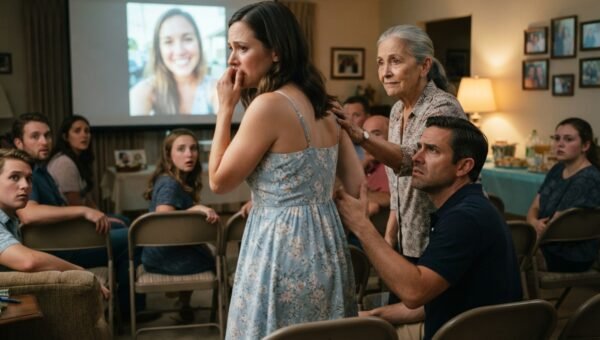
I got the math wrong for thirty-two years, mostly because I spent so much time looking at the floor whenever people asked about how our family came together.
The cardboard box sitting on my kitchen table weighed twelve pounds and four ounces, though I didn’t know the exact weight until I took it down to the post office scale last Tuesday. My neighbor Roy and I spent four days clearing out the rafters of the house where I raised Marie, hauling forty years of accumulated life down the aluminum ladder one heavy load at a time.
My knees ached in a way that felt personal, like the house itself was protesting the sale. Marie had promised she would drive over from Columbus to help with the heavy dresser in the guest room, but her phone call on Thursday morning had been brisk and distracted.
She told me she was too busy with the regional audit at her firm to make the drive down Route 23. I told her it was fine, but honestly, it hurt. Roy didn’t say anything when I hung up the phone, just handed me another roll of brown packing tape and told me to keep my chin up because the first fifty years are always the hardest.
We were working our way through the far corner of the attic behind the old cedar chest when Roy pulled out the small red suitcase. It was tucked away behind some rolled-up linoleum from the seventies, covered in gray dust that smelled of dry wood and old insulation.
Roy wiped the lid with his sleeve and handed it down to me without a word. The brass latches were tarnished green, but they popped open easily enough when I pressed them.
Inside, sitting right on top of a folded yellow sweater that looked about right for a five-year-old child, was a single train ticket dated November 14, 1994. Underneath the ticket lay a folded square of blue stationery with Arthur’s unmistakable handwriting scrawled across it in black ink.
“If Marie ever asks why she came to us, tell her the station story.”
I just stood there in the quiet of the attic because my brain kind of stopped working for a second. Marie was born in the local county hospital three miles from our front porch on a rainy Tuesday morning in 1989, or at least that was the story we had told her every year on her birthday.
Arthur had put the birth announcement in the local paper himself. I looked down at the tiny cotton dress with white embroidery along the collar, and the math in my head simply stopped adding up.
Roy cleared his throat and looked out the small gable window toward the tree line. “You want me to leave you for a minute, Clara?”
“No,” I said, though my voice sounded thin and small even to me. “No, Roy. Stay right here. I think I’m losing my mind.”
I didn’t wait for him to answer. I pulled my phone out of my apron pocket and dialed Marie’s number before I could talk myself out of it. She answered on the third ring, her voice tight with the kind of corporate exhaustion I knew too well.
“Mom, I told you, the quarterly numbers are a complete disaster right now and I can’t leave the office until, “
“Marie,” I said, cutting right through her list of spreadsheets. “Get in your car right now and drive down here.”
“Mom, stop it. I have three conference calls before five o’clock.”
“I am holding your suitcase,” I told her, and my voice cracked right on the middle of the sentence. “The one with your name stitched inside the lining in green thread. You need to be here in twenty minutes.”
The line went silent for three long seconds, save for the faint hum of office chatter in the background. Then I heard the sharp click of a keyboard being pushed aside and the rustle of papers.
“My what?” she asked.
“Just drive.”
I hung up before she could argue. Roy helped me carry the red suitcase down the steep attic stairs and set it on the kitchen table right next to the electric kettle. We didn’t talk while we waited. I made a pot of coffee that neither of us drank, and I kept running my thumb over the brass latch of the suitcase until my skin felt raw.
Exactly twenty-two minutes later, I heard the familiar crunch of gravel in the drive as Marie’s silver sedan fishtailed slightly near the mailbox. She didn’t bother turning off the ignition properly before she was out of the car and slamming the door shut. The front screen door banged against the aluminum siding, and then she was standing in the kitchen doorway with her blazer half-off her shoulders and her hair pulled back into a messy knot that looked like it had been twisted with a pen.
She took one look at the red suitcase sitting on the laminate table, and all the fight went right out of her face.
“Where did you find that?” she whispered.
“In the back of the attic,” I told her, pointing a shaking finger at the blue note resting beside the train ticket. “Behind the old linoleum. Roy pulled it out.”
Marie walked over to the table like she was afraid the floor might drop away beneath her shoes. She didn’t touch the handle. Instead, she reached out one finger and traced the embroidered letters near the zipper, letters that spelled out her own first name in a clumsy, childish script I had never seen before in my life.
“This isn’t mine,” she said, though she wasn’t asking.
“Read the note,” I told her.
She picked up the square of blue paper. Arthur’s handwriting was steady and neat, the way it always was when he was trying to explain something complicated to me without making me worry. She read the sentence once, then twice, and then her eyes snapped up to mine with a look of pure, unadulterated panic that made my stomach turn over.
“What station?” she asked. “Mom, what is he talking about? I was born at St. Jude’s. You showed me the nursery window when I was six.”
“That was what Arthur wanted you to believe,” I said, and the words tasted like dry paper in my mouth.
I walked over to the pantry and reached behind the flour canisters to pull down Arthur’s old lockbox, the heavy metal one he kept his tax papers and firearm registration in. I hadn’t opened it since the week after he passed away three years ago. The brass key was still hanging on a little hook inside the broom closet where he always left it behind the spare dish towels.
Marie watched me without moving an inch, her hands balled up into tight fists inside the pockets of her wool trousers. The kitchen was so quiet we could hear the refrigerator compressor clicking on and off down the hall.
The lockbox popped open with a heavy metallic snap. Inside sat a stack of folded bank receipts from 1994, a handful of old photographs of Arthur standing by the old brick railway depot down on Jefferson Street, and a thick, legal-sized envelope with my name written across the front in red grease pencil.
I pulled the envelope out and sat down at the table across from my daughter. My hands were shaking so badly I had to drop the papers onto the Formica just to keep from tearing them.
“He went down to the freight office on a Tuesday afternoon,” I told her, staring down at the faded ink of Arthur’s journal entry. “He told me he was going down to check on a shipment of cedar fence posts for the garden. He was gone for four hours.”
“Why didn’t you ever go with him?” Marie asked, and her voice sounded smaller than it had when she was ten years old.
“Because I trusted him,” I said, and I didn’t mean it as a defense. It was just a fact. “Arthur took care of everything. When he came home that evening, he was quiet, but he had a bundle wrapped in an old wool blanket. He told me the hospital had discharged a little girl whose mother couldn’t be found, and that the social workers were looking for a temporary placement before the state foster system took her in. He said her name was Marie. He said we were going to keep her safe for a few weeks until things got sorted out.”
Marie reached out and picked up the train ticket. The ink was faded purple, stamped by the conductor at the Junction City platform forty miles north of here.
“Weeks turned into years,” she said softly.
“The weeks turned into months, and then Arthur went to see a lawyer named Henderson over in the county seat,” I said, continuing the story because the silence felt too heavy to bear. “Henderson helped him draw up the papers, sealed the birth record through a private clerk who retired the following year, and gave us a clean slate. Arthur told me that if we treated you like our own from the very first day, you wouldn’t carry the shadow of where you came from. He wanted you to have a home that didn’t start with someone walking away.”
Marie didn’t cry right away. She just stared down at the small cotton dress inside the suitcase, running her thumb over the embroidered collar where the white thread was starting to fray with age.
“Is that why I always felt like I was running?” she asked after a long time.
The question hung in the air between us, heavy and sharp. I looked at my daughter, really looked at her, and saw the same frantic energy in her eyes that Arthur used to have whenever he was trying to fix something that was broken beyond repair. She had spent her entire adult life working seventy-hour weeks, building a fortress out of spreadsheets and retirement accounts, terrified that if she stopped moving for even one second, the ground underneath her would simply disappear.
“Nobody abandoned you, honey,” I said, and I finally reached across the table to take her hand. Her fingers were ice cold. “Your biological mother left you with a note at a ticket window because she didn’t have enough money for a bus ticket north, and she knew the stationmaster was a good man. Arthur found you sitting on a wooden bench with this exact suitcase between your feet, holding a ticket to nowhere.”
Marie let out a long, shuddering breath that sounded like air escaping from an old tire. She didn’t pull her hand away. Instead, she squeezed my fingers so hard my knuckles popped.
“He never told me,” she whispered. “Dad never said a single word.”
“He wanted to protect you,” I said. “He told me once that some truths are too heavy to carry until you’re strong enough to lift them on your own. I think he just ran out of time before he thought you were ready.”
We sat there in the kitchen as the afternoon sun shifted across the linoleum, turning the dust motes in the air into little streaks of gold. The quarterly reports and the regional audits didn’t seem to matter anymore. Marie didn’t check her phone once during the next two hours. We went through the rest of the box together, finding old Polaroids of Arthur holding a five-year-old girl with a missing front tooth outside the back porch, pictures I had somehow forgotten taking or had misremembered as being taken at the county fair.
The house was still sold. The real estate agent was still coming by on Friday morning to stick the red “Under Contract” sign into the front lawn, and forty years of our lives still had to be packed into cardboard boxes before the moving truck arrived on Monday.
When the sun finally dipped below the tree line and the kitchen grew dark, Marie stood up and walked over to the light switch by the door. She didn’t turn it on immediately. She stood there in the dim light, looking out the window toward the old gravel driveway where her car was parked.
“I’m not going back to Columbus tonight,” she said quietly.
“You have those conference calls,” I reminded her, though I felt a sudden, sharp lightness in my chest that I hadn’t felt since Arthur died.
“Let them figure it out,” she said.
She walked back to the table, closed the lid of the red suitcase with a firm *click*, and picked it up by the worn leather handle. Without saying another word, she carried it out through the screen door and placed it carefully in the trunk of her sedan, right beside her briefcase, before coming back inside to help me tape up the last boxes.