PART 1
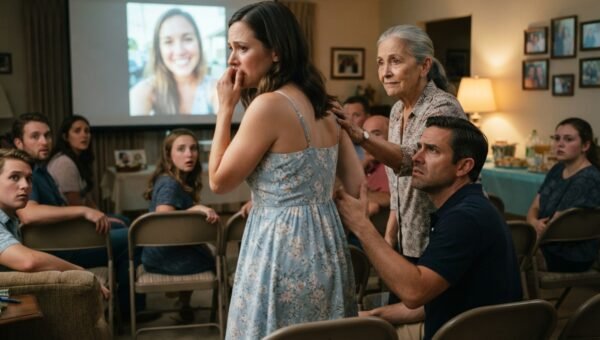
My brother David sat in the very last row of the chapel, right beside the double doors, with his coat folded over his lap like he was waiting for a bus. When Pastor Miller looked out over the pulpit and asked if anyone from the immediate family wanted to say a few words about our father, David did not stand up. He did not look at me. He stared straight ahead at the brass handles of the casket, and before the closing prayer was even finished, he slipped out into the gray afternoon.
By the time our cousins gathered in the church basement for coffee and ham sandwiches, David’s truck was already gone from the gravel lot.
Our aunt Evelyn cornered me by the urn table with a paper plate in her hand. She told me David had always been cold, that our father had spent the last fifteen years of his life trying to bridge the gap between them, and that walking out before the lunch was a slap in the face to a good man’s memory. I was too tired to defend him. In fact, I was furious.
Dad had lived a quiet, humble life in our small Ohio town. He worked thirty-two years at the county water department, went to church every Sunday, and kept a garden behind his small brick ranch. Ever since the night our mother died thirty-one years ago, Dad had carried himself like a man trying to do everything right.
I was only three when it happened. A drunk driver crossed the center line on Route 4, hit our mother’s station wagon head-on, and took her life on a rainy Tuesday in November. David was nine. He remembered her laugh, the way she tucked him in, and the sound of the state troopers walking up our front steps to give Dad the news.
Growing up, David was distant with Dad. In his late twenties, David stopped coming home for Thanksgiving altogether. Whenever Dad tried to call, David kept the conversations under two minutes. Dad used to sit at the kitchen table with his reading glasses on, looking down at his hands, and say, “Your brother carries that wreck inside him, Clara. Some wounds just don’t heal right.” Dad spent years sending David birthday checks that David never cashed. Dad offered to help him with a down payment on his house in Columbus, but David refused to take a single dollar.
To me, it looked like cruel stubbornness. Dad had given up his whole life to raise us alone, and David could not even stay to eat a sandwich in his honor.
A month after the funeral, a heavy brown cardboard mailer arrived in my mailbox. There was no card inside, just a thick manila folder taped tightly along the edges, and a single sheet of lined notebook paper torn from a spiral pad.
David had written three sentences in blue ink: “You should know why I couldn’t stand there and listen to them talk about him. You deserve to see what he actually did. Don’t throw this away until you read every page.”
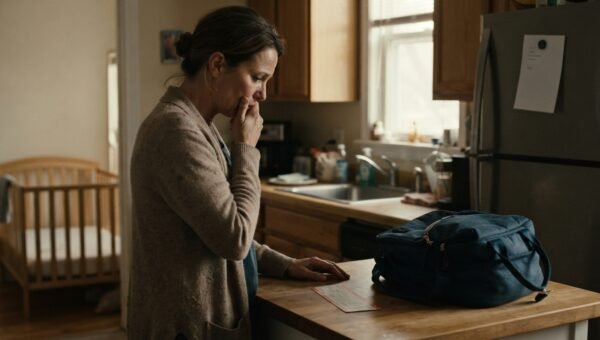
I sat at my kitchen table, cut the tape with a pair of scissors, and opened the folder. The first document was a typed letter dated fourteen years after our mother died, addressed to the Ohio Parole Board.
At the bottom of the page, written in Dad’s unmistakable left-handed cursive, was his signature. Dad had written four separate letters over six years, pleading with the state to grant early release to the man who had been behind the wheel of the car that killed our mother.
PART 2
I read those parole letters three times, trying to find some kind of mistake.
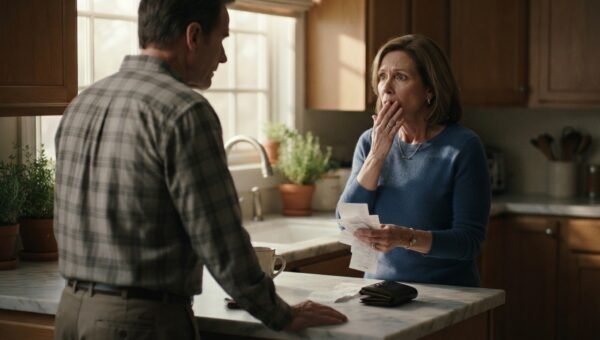
The driver’s name was Marcus Vance. According to the court records clipped behind the letters, he had been twenty-two years old that night, with two prior driving offenses. He had served nearly fourteen years of a twenty-year sentence for aggravated vehicular homicide. In the first letter, dated in the spring of 2007, Dad wrote about Christian mercy and how holding a man in prison could not bring back a mother. In the second letter, written two years later, Dad went even further. He stated that he had corresponded with Marcus regularly, that he believed Marcus was fully reformed, and that our family supported an early grant of parole.
Our family. Dad had used those words. But David and I had never been asked. We had never been told.
My hands shook so hard the papers rattled against the wooden tabletop. All those years, Dad had told the neighbors he bore no hatred in his heart. People in town thought he was practically a saint for refusing to speak ill of the man who wrecked our family. But secretly writing the parole board, petitioning the state to open the prison doors for the man who killed his wife, felt like an ugly betrayal. It felt like he had erased our mother’s life with a fountain pen.
I grabbed my phone and dialed David’s number. He answered on the second ring, his voice low and steady.
“Did you open it?” he asked.
“David, what is this?” I could barely get the words past the knot in my throat. “Why did Dad do this? Why did he write to the parole board for that man?”
“I found out ten years ago,” David said. His voice had no anger in it, just an old, flat exhaustion. “I was helping Dad clear out the file cabinet in the back room after his knee surgery. I wasn’t snooping. I was looking for his old water department pension forms. The folder was tucked behind the furnace receipts. When I asked him about it, he told me it was between him and God. He told me forgiveness was a duty.”
“You never said a word to me,” I said, tears burning my eyes. “All these years, you let me think you were just being bitter and hateful toward him.”
“I promised Dad I wouldn’t tell you,” David replied quietly. “He begged me, Clara. He said you were too little when Mom died, that you grew up happy because you didn’t carry the anger, and he didn’t want to poison your memory of him. But every time I looked at his face, all I saw was a man who traded Mom’s justice for his own self-righteous peace. I couldn’t stand in that church and listen to people say he was a martyr. I couldn’t do it.”
I leaned back against the kitchen counter, staring at the thick stack of papers. It was terrible, but in a strange way, it explained David. It explained why he never took Dad’s money, why he stayed away on holidays, and why he couldn’t bear to stand near Dad’s casket.
“I’m sorry,” I whispered. “I’m so sorry, David. I called you cold. I thought you were just selfish.”
“Don’t apologize yet,” David said. He took a slow breath on the other end of the line. “There is one more paper in that folder, Clara. You haven’t looked at the last page.”
PART 3
“What last page?” I asked.
“Turn to the back of the clip,” he said. “Past the parole board’s release notice. Read the handwritten letter on yellow legal paper.”
I pulled the thick stack toward me and flipped past the typed state forms. The final document was folded in half, yellowed at the creases, dated three months after Marcus Vance had walked out of the penitentiary in the summer of 2011. The handwriting was jagged and slanted, written with a cheap ballpoint pen.
It was addressed directly to our father’s home address.
“Dear Frank,” the letter began. “I know this letter should have come sooner, but every time I sat down to write it, I couldn’t find the words. The state gave me fifty dollars and a bus ticket, and I still don’t know why you did what you did for me. Nobody else would have looked at me like a human being after what I took from you.”
My eyes moved down to the second paragraph, and my breath stopped in my throat.
“Thank you for raising my daughter as your own,” Marcus Vance wrote. “When Linda told me she was pregnant that spring, I panicked. I was drinking every night, working odd jobs, and I had no business being anybody’s father. When she took off and brought the baby to your house, you could have put her in foster care. You could have left her at the county home and nobody would have blamed you. Instead, you gave her a name, a bed, and a life. Every day I spent in that cell, the only thing that kept me from ending it was knowing she was safe with you. I know you never want me near her, and I will honor that until the day I die. But thank you for keeping Clara safe.”
The kitchen went dead quiet except for the hum of the refrigerator.
Clara.
My name was Clara.
“David?” I spoke into the phone, but my voice sounded like it belonged to a stranger three rooms away. “What is this?”
“Mom didn’t die with an empty car, Clara,” David said gently. “That night on Route 4, Mom was driving home from the grocery store. She was alone. Marcus Vance was driving drunk, and his girlfriend, Linda, was in the passenger seat with an eight-month-old baby girl in a car seat. When the crash happened, Mom was killed instantly. Linda died at the hospital four hours later. Marcus was arrested on the scene. But the baby was pulled from the wreckage without a single broken bone.”
I looked down at my own hands resting on the counter. The skin, the shape of the knuckles, the narrow wrists. None of it looked like Dad’s hands. None of it looked like the photos of the smiling woman on the mantle who had been buried in the churchyard.
“Dad didn’t raise you out of some random coincidence,” David continued, his voice cracking slightly. “The state was going to place you in foster care because Marcus was going to prison for twenty years and Linda had no family left. Dad went to the hospital that night. He saw you in the nursery. And two days later, he hired an attorney and petitioned the court for emergency custody. He took the baby from the car that killed his wife, brought you into his home, and raised you as his daughter. He legally adopted you before you turned one.”
The truth did not come like a violent storm. It settled into the room like a heavy stone dropping into deep water.
Dad had not helped Marcus Vance out of pride or easy forgiveness. Dad had watched over Marcus for fourteen years because Marcus was the biological father of the child Dad loved more than his own grief. Dad had written those parole letters because he believed a man who had paid for his crime deserved a chance to live, but Dad had demanded one strict condition: Marcus had to stay away so I could grow up believing I was entirely, completely, and undeniably Frank’s daughter.
“When I found out ten years ago,” David said, “I thought Dad was insane. I hated him for bringing that wreck into our house. I looked at you, and every time I saw your face, I remembered the night Mom didn’t come home. That was why I couldn’t look at you, Clara. It wasn’t your fault. But I was angry at Dad for loving you more than he loved his own pain.”
ENDING
I sat at my kitchen table until the afternoon sun slid below the treeline, leaving the kitchen in long blue shadows. I held Marcus Vance’s yellow legal paper in my left hand and Dad’s parole letter in my right.
Two men had shaped my life. One had destroyed a family on a wet two-lane road, spent fourteen years behind bars, and kept his promise to stay a ghost. The other had stood in a hospital nursery thirty-one years ago, looked at the baby of the man who took his wife, and chose to take me home.
All those years, Aunt Evelyn and our cousins thought Dad was a saint because he was quiet. They didn’t know the half of it. He had carried a secret so heavy it cost him his relationship with his only biological son, just so I would never spend a single night wondering who I belonged to.
I cleared my throat and spoke into the phone. “David?”
“I’m here,” he said.
“Are you still in town?”
“I’m at a motel near the highway,” he answered quietly. “I didn’t want to drive back to Columbus until I knew you got the envelope.”
“Come over,” I told him. “I’m making coffee. We need to talk, and you don’t need to sit in that room alone.”
There was a long silence on the line, the kind of silence that usually meant David was getting ready to hang up and retreat back into his shell. But then he took a breath.
“Give me twenty minutes,” he said.
After I hung up, I walked into the hallway and stood in front of the framed photograph on the wall. It was taken the day I graduated from high school. Dad was standing beside me in his Sunday suit, wearing that faded blue tie he wore to every wedding and funeral, with his arm wrapped tightly around my shoulders. He was looking at the camera with the proudest, most stubborn smile a man could have.
I reached up and touched the wooden frame. I didn’t change the picture. I didn’t take it down. I left it right where it had hung for twenty years, turned off the hall light, and went to the kitchen to put the kettle on for my brother.