PART 1
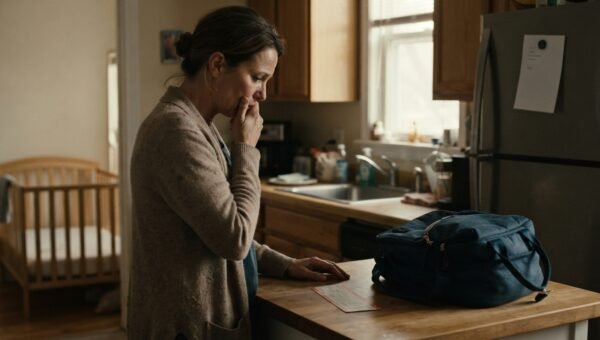
My mother sat at my kitchen table on a Tuesday morning in late March, pushed a paper napkin back and forth with her thumb, and told me she was selling her wedding ring.
She was seventy-six, living on her monthly Social Security check, and her bottom molar had cracked down into the root. The dentist had told her the tooth had to come out, bone grafting had to be done, and an implant bridge would run nearly four thousand dollars.
“I don’t want your sister knowing,” Mom said. Her voice was quiet, almost flat. “You know how Brenda gets. If she thinks I’m letting that ring go, she’ll make it into a three-act play about family legacy. And I don’t want your money either, Claire.”
“Mom, I have savings,” I told her. “Let me just write the check for the oral surgeon.”
“No,” she said, looking right at me. “Your father gave me that ring forty-eight years ago. It sat in a velvet box in my dresser drawer for ten years after he died because my knuckles swelled up from arthritis. If a band of gold can fix my jaw so I can chew my dinner without crying, your father would have driven me to the shop himself. I’m handling it.”
She made me swear I would keep quiet. I hated it, but Mom had spent her whole life guarding her dignity, especially when it came to Brenda.
Brenda was four years younger than me, lived thirty minutes away in an expensive subdivision with two leased luxury cars in the driveway, and treated our mother like an unpaid babysitter or an antique collection waiting to be inventoried. Whenever Brenda visited Mom’s small duplex, her eyes tracked across the mantel, the silver-plated tea set, and the cedar chest, constantly asking, “What are you going to do with this someday?”
Three days later, Mom took the city bus downtown to Miller & Sons Jewelers on Oak Street. When she came home, she told me the owner had taken the ring on consignment, given her a partial advance receipt, and promised to call when the transaction cleared. Her dental surgery was scheduled for the second week of April. I drove her there, sat in the waiting room with her coat on my lap, and drove her home with a bag of ice packs and soft pudding cups.
For three weeks, I felt like a good daughter who had respected an old woman’s boundaries.
Then came Easter Sunday dinner at my house.
Brenda walked through my front door carrying a store-bought lemon pie in one hand and holding her left hand awkwardly high, fingers splayed across the front of her designer sweater. The center diamond caught the hall chandelier.
It was Mom’s ring.
The square halo, the engraved platinum filigree along the shoulders, the slightly worn prong on the lower left corner where my father had bumped his hand against the car door the night he proposed in 1968.
“Look what Mom gave me,” Brenda announced before she even set the pie on the counter. She pushed her hand toward my face. “She called me over to her place on Thursday. She said she finally decided who should inherit it. She told me it belonged with someone who would actually wear it out in public instead of leaving it in a sock drawer.”
Mom was sitting on the living room sofa, her cane resting against her knee, staring down at her lap. She didn’t look up. She didn’t say a word.
I looked from Brenda’s smug grin to our mother’s quiet, bowed head, and my chest seized up with a cold, sickening burn. I had sat in an oral surgery clinic watching Mom bleed into gauze, believing she had parted with the last piece of Dad she owned just to pay for her teeth, while she had turned around behind my back and handed it to the daughter who hadn’t even offered to bring her a cup of soup.
PART 2
I didn’t cause a scene at Easter dinner. I poured iced tea, I passed the ham, and I watched Brenda twist that ring around her finger every time she reached for the salt.
Every single time Brenda flashed her hand, she had a comment ready. “It’s about understanding what things mean, Claire. You’ve always been so practical. You don’t really care about heirlooms.”
Mom ate less than half a roll and asked me to drive her home before coffee was even brewed.
In the car on the way to her duplex, the silence was suffocating. I kept both hands on the wheel, my jaw aching from how hard I was clenching my teeth.
“You told me you sold it,” I said finally, keeping my eyes fixed on the taillights ahead of us. “You sat in my kitchen, told me you needed dental work, and refused my money so you could keep your pride. And then you gave it to Brenda?”
Mom kept looking out the passenger window at the strip malls passing by. “Claire, leave it alone.”
“Leave it alone? I took off work twice to sit with you in that dental chair, Mom. Brenda didn’t even call you that week. Why did you lie to me?”
“I didn’t lie to you,” she said softly. “You just don’t know the whole story. Now drop me at my door. My jaw aches.”
She got out, shut the car door, and walked up her front walk with her head down. I drove home feeling foolish and discarded. It felt like every childhood pattern had repeated itself in one single afternoon: Brenda demanded, Mom caved, and I was left paying the emotional bill.
For the next four weeks, Brenda wore that ring everywhere. She posted pictures of her hand holding coffee mugs on Facebook. She wore it to her daughter’s soccer games. She called our cousins in Ohio to tell them Mom had chosen her as the family steward. Mom stayed quiet, barely left her house, and changed the subject whenever I tried to ask about it.
I stopped offering extra help. If Mom wanted Brenda to have the treasures, Brenda could drive her to the grocery store on Tuesday mornings.
Then, on a rainy Thursday in mid-May, my phone rang while I was folding laundry. The caller ID showed a local landline: Miller & Sons Jewelers.
I answered, expecting a misdial.
“Claire Henderson?” a man’s voice asked. It was elderly, measured, and formal.
“Yes, speaking.”
“This is Thomas Miller down at Miller Jewelers on Oak Street. I’m calling regarding repair ticket number 4082, left in our care by your mother, Evelyn.”
My heart gave a hard, confused thump against my ribs. “Mr. Miller, my mother sold that ring to you back in late March. There wasn’t any repair.”
There was a short pause on the line, followed by the rustle of heavy paper.
“Mrs. Henderson, your mother did not sell a ring to me,” Mr. Miller said plainly. “She paid me. She also left your name and phone number on the claim envelope, with explicit instructions that I was to contact you personally sixty days after the work was completed. The sixty days were up on Tuesday. You need to come down to the shop.”
PART 3
I was downtown within forty minutes.
Miller & Sons was an old-school jewelry store with green carpet, heavy glass display cases, and dark wood paneling that smelled like brass polish and velvet. Mr. Miller was a silver-haired man in his seventies wearing magnifying loupes pushed up onto his forehead.
When I introduced myself, he nodded, unlocked a heavy metal drawer beneath the counter, and brought out a small gray velvet box and a sealed manila envelope.
“Your mother came in here the third week of March,” Mr. Miller said, resting his weathered hands on the glass. “She had a piece of yellow legal pad paper with her and three thousand dollars in cash she had withdrawn from her emergency savings. She knew exactly what she wanted.”
He opened the velvet box.
Resting inside on the black fabric was my father’s ring. The real ring. The unmistakable vintage platinum setting, the warm fire of the old European-cut diamond, and the familiar worn prong.
“I don’t understand,” I whispered, reaching out to touch the cold metal with the tip of my finger. “Brenda is wearing this right now. I saw it on Easter. I’ve seen it every week since.”
Mr. Miller allowed himself a dry, knowing smile.
“Your sister is wearing a high-grade cubic zirconia replica set in silver alloy, electroplated with white rhodium,” he said. “Your mother brought in her original ring, paid me four hundred and eighty dollars to have an exact duplicate cast and set with synthetic stone, and left the original here in my safe. She told me she needed sixty days of quiet to let the dust settle before I handed this over to you.”
He pushed the sealed manila envelope across the glass counter toward me. My mother’s handwriting was on the front: *For Claire.*
My hands shook as I slit open the envelope. Inside was a cashier’s check for four thousand dollars—the exact amount of the oral surgery Mom had paid for herself—and a single page torn from her floral stationery.
The note was short, written in Mom’s spidery, precise cursive:
*Claire,*
*When my tooth broke, Brenda came over to my house. I told her I was in terrible pain and needed an oral surgeon. The first words out of your sister’s mouth were, ‘If you have to sell things to pay for it, you can’t sell Dad’s ring. That has to go to me.’ She didn’t ask if I had eaten. She didn’t offer me ten dollars. She spent twenty minutes walking around my bedroom looking for where I hid the box.*
*That same evening, you came over with vegetable broth, sat on my couch, and offered to empty your own savings account to pay my doctor without me even asking.*
*Brenda has spent ten years badgering me about what my things are worth. She wanted Dad’s ring because she thought it was worth six thousand dollars and made her look important. So I gave her exactly what she values: a pretty piece of glass with no soul in it.*
*The copy is for the daughter who asks what things are worth. The real one is for the daughter who asks if I’m okay.*
*Keep Dad’s ring. Wear it, or keep it safe. And don’t you dare say a word to your sister until after I’m gone. Let her show off her glass.*
ENDING
I sat in my car in the rain outside the jewelry store for twenty minutes with the velvet box open on my lap.
The anger that had been poisoning my chest for nearly two months vanished, replaced by an ache so deep it brought tears to my eyes. My mother hadn’t been weak. She hadn’t been bullied into submission. She had simply lived long enough to know that arguing with greed is a waste of breath, but protecting what is precious requires quiet spine.
When I walked into Mom’s kitchen that afternoon, she was sitting by the window with a cup of chamomile tea, a magazine open on the table.
I didn’t say a word. I just walked over, pulled the velvet box from my purse, and set it next to her teacup.
Mom looked down at the box, then looked up at me. Her dark brown eyes were steady, but a tiny, mischievous smile pulled at the corner of her mouth—the first real smile I had seen on her face since her tooth had cracked.
“Mr. Miller called on time, I see,” she said.
“You’re terrible,” I told her, my voice cracking as I pulled out the chair across from her.
“No, I’m practical,” she replied, taking a slow sip of tea. “Your father worked fifty hours a week at the foundry to buy that diamond. He gave it to me out of love and protection. Giving it to Brenda would have made it a trophy for selfishness. It belongs on the hand of the daughter who has his heart.”
She reached across the table and pushed the box back into my hands.
“Put it on,” she said.
I slipped it onto my ring finger. It fit perfectly, cold and solid against my skin, carrying forty-eight years of a marriage built on quiet endurance.
Two days later, Brenda called me to brag about a compliment she had received on the ring at a country club luncheon. “Someone told me the vintage setting looked priceless,” Brenda said over the speakerphone, her voice full of satisfaction.
“I’m sure it did, Brenda,” I answered softly, looking down at my own hand where Dad’s true stone caught the afternoon sun through my kitchen window. “I’m sure it looked exactly like what you wanted.”