PART 1
My husband’s son from his first marriage, Greg, had barely spoken ten words to him in nearly ten years. He did not call on Thanksgiving. He did not send a card on Christmas. When my husband, David, had his first stroke three years ago, Greg sent a single text asking if the insurance covered rehab, and then we heard nothing for sixteen months.
Then last November, Greg suddenly started showing up every Sunday at noon.
He brought plastic containers of store-bought potato salad and bags of sweet rolls from the grocery store by the highway.
He would pull a kitchen chair right up to David’s recliner, lean in close, and talk about football scores or old high school track meets. David’s eyes would light up, his pale face flushing with that quick, grateful color old sick men get when they think an estranged child has finally forgiven them.
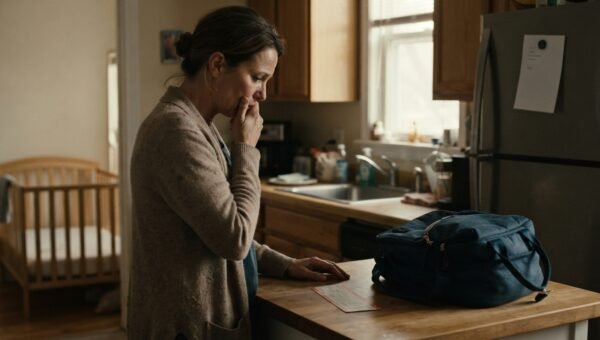
I was glad for David. I really was. Even though the timing felt strange with David’s heart failing and his kidneys declining by the week, I told myself not to be cynical. A dying man deserves peace with his boy. If Greg wanted to sit by that chair and listen to his father wheeze through old stories, I was not going to stand in the doorway looking sideways at it. I made fresh coffee. I stepped out to the porch or ran errands to the grocery store so they could have their private talks.
David passed away on a rainy Tuesday in late March.
Two weeks after the burial, Greg drove over in a clean truck, sat at my kitchen table without taking his jacket off, and handed me a copy of a new will.
It was dated December 18th. It left David’s truck, his workshop tools, his brokerage account, and our house to Greg.
It left me with a small ten-thousand-dollar cash stipend from the checking account.
“Dad wanted things handled right,” Greg said, staring down at his coffee mug. He did not look me in the eye. “He felt bad about all those lost years. He told me the house was his family property from before you two got together, and it ought to stay in the family line.”
The house had indeed belonged to David’s mother originally. David and I had lived in it for twenty-four years, painted every wall, replaced the roof twice out of our joint savings, and paid off the remaining twelve years of the mortgage together. But I didn’t scream, and I didn’t throw him out.
I was sixty-two years old, exhausted from eighteen months of heavy caregiving, and I had my own separate retirement account from thirty years of working in county payroll. I had enough to buy myself a quiet two-bedroom townhouse near town.
I loved David, but I was too tired to spend three years in probate court trading insults with a man who only visited when death was in the room.
“If that’s what your father signed,” I told Greg quietly, “you take it to probate. I’m not going to fight you.”
Greg looked relieved. He gathered his papers, thanked me with a stiff little nod, and left within five minutes.
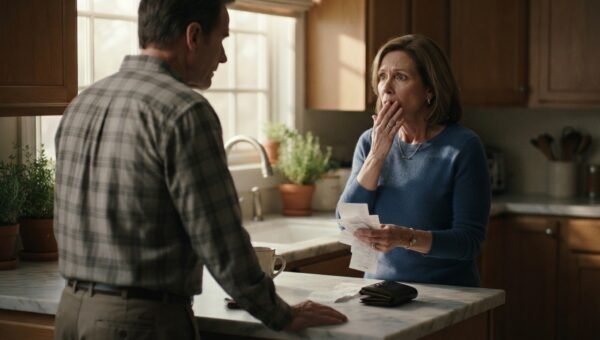
Ten days later, my phone rang. It was Arthur Vance. Arthur was seventy-four, had handled David’s taxes and legal papers since the 1980s, and had drafted David’s original mutual will back in 2012, which had left everything to each other.
“Martha,” Arthur said, his voice unusually clipped and quiet. “Greg filed a new testamentary document with the county clerk on Monday. Along with a letter of intent.”
“I know, Arthur,” I said, leaning against the kitchen counter. “Greg showed me the copy.
I told him I wasn’t contesting it. I just want to pack my things and move on.”
There was a long pause on the line. I could hear Arthur shifting heavy papers on his desk.
“Martha, I’m not calling you as Greg’s lawyer. I’m calling you as David’s executor from the prior estate file,” Arthur said carefully. “I need to ask you a direct medical question, and I need you to be completely honest with me. Could David write his name last December?”
The question caught me off guard. “What do you mean?”
“I mean, could he hold a pen? Could he write a full cursive signature and five lines of text on December 18th?”
“No,” I answered immediately. “He couldn’t. Arthur, his rheumatoid arthritis flared so bad last October that his right index and middle fingers were locked into his palm. By Thanksgiving he couldn’t even sign his Social Security checks. I had to use the bank power of attorney stamp for everything.”
Arthur let out a slow breath over the receiver.
“Then you need to come down to my office this afternoon,” he said. “Greg didn’t just file a typed form with two witness stamps from a pack-and-ship store. He filed a handwritten codicil attached to the back. A note explaining why David was cutting you out and leaving the estate to Greg.”
“A note?”
“Yes,” Arthur said. “And Martha, whoever wrote it had a steady, elegant hand.”
PART 2
Arthur’s office was in an old brick building two blocks from the county courthouse. The blinds were drawn against the afternoon glare, and the room smelled of old paper and stale coffee.
When I sat down in the leather chair across from him, Arthur didn’t offer small talk. He slid a clear plastic sleeve across the blotter. Inside was a single sheet of cream-colored stationery with three small embossed lines at the top.
Beneath the header was five sentences written in dark blue fountain-pen ink:
*To Whom It May Concern: It is my clear and sound wish that my ancestral home and all personal property revert entirely to my blood son, Gregory, upon my death. My wife Martha has her own pensions and does not require my family estate. This corrects the neglect of past years.*
At the bottom was a signature: *David E. Miller.*
I didn’t look at the signature first. My eyes locked onto the capital letters in the body of the note.
The capital *T* in *To* had a high, looped flourish that curled back over the crossbar like an umbrella handle. The capital *M* in *Martha* had three perfectly balanced arches, with the final tail dipping low below the baseline and ending in a precise, round dot.
It was neat. It was steady. It was unmistakable.
I had seen that exact handwriting every single December for twenty-four years.
It was on the birthday cards tucked into my mailbox every August. It was on the Christmas envelopes containing twenty-dollar bills that arrived for our nieces and nephews. It was on the recipe cards for lemon pound cake and spiced pot roast sitting in the wooden box in my pantry right now.
The handwriting did not belong to my husband.
It belonged to David’s eighty-four-year-old mother, Evelyn.
I sat there with my hands resting on my purse, unable to look away from that curling *T*. Evelyn lived in an assisted living apartment four miles down the road. She was sharp as a tack, drove herself to church every Sunday morning in her beige sedan, and guarded her family name like it was crown jewelry.
“Martha?” Arthur asked gently. “Do you recognize that hand?”
“It’s Evelyn’s,” I whispered.
Arthur took his glasses off and rubbed the bridge of his nose. “Are you certain?”
“Arthur, look at the capital letters. Look at how she finishes the word *estate*. David wrote like an eighth-grade boy who had his knuckles rapped by nuns. He printed in block letters, and after his stroke, he couldn’t manage more than a wavy line. Evelyn went to a girls’ academy in Richmond in the 1950s. She takes pride in penmanship. She writes notes to the church council every single month in this exact script.”
“The witnesses on the typed will are two clerks from the shipping store on Oak Street,” Arthur said, tapping the second sheet. “Greg brought an elderly man in a wheelchair to the counter on December 18th, had him produce an old state ID of David’s, and had the clerks notarize the signature page. But this handwritten codicil was submitted as evidence of testamentary intent to override the 2012 will I hold.”
My stomach turned over. “Did David even know about this?”
“I don’t believe David ever saw this paper,” Arthur said flatly. “And if Greg took an infirm man to a public notary under David’s name, or if he used an old driver’s license while David sat home sick, that is not merely an estate challenge, Martha. That is criminal fraud.”
Arthur leaned forward, folding his hands over the plastic sleeve.
“I can file an emergency petition to halt probate right now. I can depose Greg under oath next week, and I can subpoena Evelyn. But you need to tell me what you want to do. If I file this, the county prosecutor will likely take an interest. Evelyn is eighty-four. Greg is her only grandson.”
I looked out Arthur’s window at the traffic passing on Main Street.
I remembered David sitting in that recliner in December, smiling weakly while Greg talked about old football games. David had genuinely believed his boy loved him again. He had died believing that the estrangement was healed, that his son had returned out of genuine affection, not because of a calculated scheme cooked up over Sunday dinners.
“Don’t file anything yet,” I told Arthur, standing up. “Give me until tomorrow afternoon.”
“Martha, don’t go confronting Greg alone,” Arthur warned.
“I’m not going to see Greg,” I said. “I’m going to see Evelyn.”
PART 3
The halls of Meadowbrook Living were quiet and smelled of floor wax and lavender spray. I walked past the common room where three women were working on a jigsaw puzzle and stopped at apartment 114.
I didn’t knock softly. I knocked three firm times.
When Evelyn opened the door, she was wearing a pale blue cardigan, her silver hair neatly pinned back. She smiled when she saw me, stepping back to let me in.
“Martha, dear,” she said, her voice smooth and composed. “What a nice surprise. I was just boiling water for peppermint tea. Have you started sorting through David’s clothes yet? Greg mentioned he might come by this weekend to help clear the garage.”
“I’m not clearing the garage, Evelyn,” I said.
I didn’t sit on the floral sofa. I stood right in the center of her small living room, reached into my tote bag, and laid Arthur’s photocopy of the handwritten note on her glass coffee table.
Evelyn stopped midway to the kitchen. Her eyes dropped to the paper.
She didn’t gasp. She didn’t drop her teacup. She just stood very still, her chin lifting slightly.
“What is this?” she asked.
“You know exactly what it is,” I said, keeping my voice down so it wouldn’t shake. “You wrote it. In your own hand, on your own stationery from your desk right over there.”
Evelyn walked slowly to the armchair, smoothed her skirt, and sat down. She folded her hands in her lap, looking up at me without an ounce of shame.
“That house was built by my father in 1948, Martha,” she said evenly. “David was my son, and I loved him dearly. But you have no children. When you die, who does that house go to? Your sister in Ohio? Her kids, who never set foot in this county?”
“I lived in that house for twenty-four years, Evelyn,” I said. “I took care of your son while he choked on his own saliva. I changed his sheets. I paid half the mortgage, and I paid for his supplemental insurance out of my own pension while your grandson didn’t pick up the phone for a decade.”
“Greg is blood,” Evelyn said coldly. “He made mistakes when he was younger, but he carries the Miller name. That property belongs to a Miller. When David got so sick in the fall, Greg came to me. He told me you were planning to sell the place the minute David was in the ground and move away. He told me David wanted him to have it, but that David was too intimidated by you to change his papers.”
“And you believed that?” I asked. “Did you ever bother to ask David yourself?”
“David was weak toward the end, Martha. You know he was. His mind was wandering.”
“His mind was completely clear, Evelyn. It was his hands that didn’t work. His hands were crippled with arthritis. He couldn’t hold a pen to sign a grocery slip, let alone five lines of flawless script.”
A tiny flicker of uncertainty crossed her eyes, but she pressed her lips tight. “Greg said he would have David confirm it with the notary.”
“Greg hired a stranger or dragged someone else in,” I said. “Arthur Vance has the file. Arthur knows David couldn’t write. The notary clerks will be questioned, Greg will be deposed under oath by Friday, and the court will refer the whole packet to the county sheriff for forgery and fraud. Both of you.”
The word *sheriff* finally cracked her composure. Her fingers tightened on her cardigan until her knuckles went pale.
“I didn’t commit a crime,” she said, her voice dropping into a sharp whisper. “I wrote down what Greg told me David wanted. Greg said it was just a statement of family wishes to attach to the paperwork.”
“You wrote it because you wanted to cut me out,” I said. “And Greg used you to steal an estate worth three hundred and forty thousand dollars. If you think the district attorney won’t prosecute an eighty-four-year-old woman who writes a fake will codicil to disinherit a caregiver wife, you can explain that to Arthur Vance in court.”
Evelyn looked down at the photocopy on the table. For the first time, her hands began to tremble.
“What do you want, Martha?” she asked. The proud, aristocratic tone was gone. She just sounded like an old woman trapped in a corner.
“I want the truth in writing,” I said. “And I want Greg off my property by tonight.”
ENDING
We sat at her small dining table for forty-five minutes.
I didn’t let her call Greg. I called Arthur Vance directly from my cell phone, put him on speaker, and had Arthur dictate a formal, sworn affidavit of retraction.
In that statement, written under penalty of perjury, Evelyn admitted that she had written the note herself at Greg’s request, that David had never dictated or authorized a single word of it, and that she had no knowledge of how David’s supposed signature had been affixed to the probate petition.
Arthur sent a junior associate from his firm over with a mobile notary stamp within half an hour. Evelyn signed it with the very same blue fountain pen she had used to write the forgery. Her signature was shaky this time.
At five o’clock, Arthur called Greg.
I was sitting in Arthur’s office when the call went through on speaker. Arthur didn’t raise his voice. He simply informed Greg that an affidavit of fraud and forgery had been executed by Evelyn Miller, that the December will was being formally withdrawn from probate, and that if Greg set foot on the property or contacted me again, Arthur would hand the complete file directly to the Commonwealth’s Attorney for immediate criminal indictment.
There was complete silence on the other end of the line for ten seconds.
“She told you?” Greg finally choked out. His voice sounded thin, stripped of all that easy Sunday confidence.
“Your grandmother told the truth,” Arthur said. “You have twenty-four hours to sign the withdrawal of the petition and deliver the keys to my office. If they are not on my desk by noon tomorrow, the police will serve you at your job.”
The line clicked dead.
Greg delivered the keys the next morning at eight-thirty. He did not ask to see Arthur, and he did not leave a message for me.
Three weeks later, the probate court reinstated David’s original 2012 will. The house, the truck, the workshop tools, and the bank accounts passed to me, clean and clear.
I didn’t stay in the house.
I spent May sorting through David’s things, packing his clothes for the veterans’ shelter and giving his woodworking tools to a young carpenter David had mentored years ago at church. I sold the house in June to a young couple with two small boys who fell in love with the big backyard and the apple trees David had planted along the fence.
I bought a quiet, sunlit townhouse three miles away, with a small stone patio and a garden bed just big enough for tomatoes and hydrangeas.
I haven’t spoken to Greg since the day he brought that paper to my kitchen. I hear through town acquaintances that he moved two counties over and rarely visits his grandmother.
Evelyn still lives at Meadowbrook. Last month, when my birthday came around in August, I walked down to my new mailbox by the curb. Inside was a stack of flyers and a single white envelope.
Inside was a simple store-bought card with a printed greeting.
There was no personal note written inside. No curling *T*, no three-arched *M*, no delicate blue fountain-pen ink. Just her name signed at the bottom, stiff and brief, without love or apology.
I didn’t keep it. I dropped it into the recycling bin by the garage, walked inside to my quiet kitchen, and made my own coffee in the peace I had worked twenty-four years to earn.