PART 1
My daughter-in-law, Corinne, told me in the second week of April that I needed to stop coming to my nine-year-old grandson’s baseball games. We were standing in her driveway while Leo was still inside getting his cleats on. She did not raise her voice. She just crossed her arms, looked past my shoulder at the garden bed, and said my presence made her uncomfortable.
I asked her what I had done. I had never argued with her in the bleachers, never coached Leo from the sidelines, and never criticized the way she or my son, Mark, raised him.
During the games I had attended that spring, I sat four rows back by myself near the fence, drinking black coffee from a thermos and clapping when the boys ran off the field.
“It is just a feeling, Evelyn,” she said. “You take up too much room energetically. I need space to enjoy Leo’s childhood without your eyes on us.”
When I called Mark that evening from my kitchen table, hoping he would tell me it was a misunderstanding, he sounded tired. He told me to just respect Corinne’s boundary. He said marriage was hard enough without his mother making waves over little league.
“She is under a lot of stress with her salon, Mom,” Mark said. “Just give it a rest. Do not turn this into a war.”
So I stepped back. It felt like someone had shut a heavy door right on my fingers, but I stayed home.
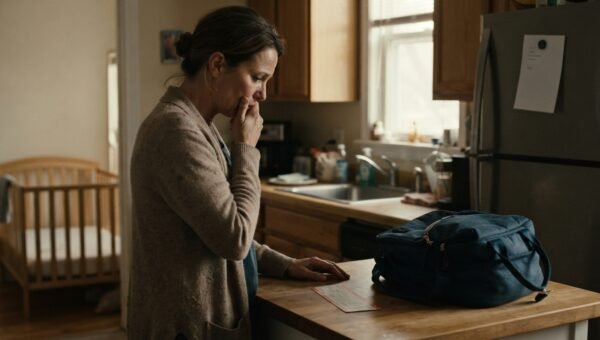
Leo was my only grandchild. I had watched him three afternoons a week when he was a toddler while Mark worked overtime at the freight terminal and Corinne was building her client list. Now, on Tuesday and Friday nights, I sat in my living room and waited for other parents to upload photos to the league’s Facebook group. I would zoom in on Leo’s small shoulders in his navy jersey, trying to see if he looked happy, trying to guess if he was hitting the ball.
Then came the second Friday in May. It was nearly seven o’clock, and the sun was just starting to dip behind the pines. The game had ended at six-thirty. My phone rang with a number I did not recognize, and when I answered, a man spoke with the steady, slightly hurried tone of someone trying to manage a parking lot full of departing cars.
“Evelyn Miller? This is Coach Davis from the Dodgers. Leo’s team.”
“Yes,” I said, standing up immediately. “Is Leo hurt?”
“No, ma’am, he is fine physically,” the coach said. “His emergency card still lists you as the secondary contact. Practice ended half an hour ago and everyone has gone home. Nobody else is answering the primary numbers. His mom’s phone goes straight to voicemail, and Mark’s work line says he is off site until tomorrow. Can you come get him?”
I left my tea on the counter and grabbed my purse. The park was seven miles away down Route 4. When I pulled into the gravel lot, the big floodlights over field two were already dark. Leo was sitting alone on the bottom wooden rail of the bleachers, his canvas equipment bag resting between his sneakers, picking dried clay off the toe of his right shoe. Coach Davis was standing twenty feet off by his pickup truck, checking his watch.
Leo ran over the minute my car stopped. He climbed into the front seat, tossed his cap onto the floorboard, and stared straight ahead at the dashboard.
“Did Mom forget?” he asked quietly.
“She probably got held up at work, honey,” I said, putting the car in gear. I thanked the coach, rolled up the window, and turned on the heater because the evening had turned chilly. “Your dad is working the late run out in Canton.”
We drove about a mile in silence before Leo reached into his pocket and pulled out a folded piece of glossy paper. He smoothed it against his denim knee. It was the roster sheet they handed out to parents at the start of every season, with the schedule on the back and tiny headshots of the coaching staff along the margin.
“Mom was not at the salon,” Leo said, his voice flat in the dim car. “She was here for the first two innings. Then she left with Ben.”
“Coach Ben?” I asked. I remembered there was an assistant coach, a man with a beard who worked the third-base line, but I had only seen him from forty yards away through chain-link wire.
“Mom doesn’t want you at games because she thinks you’ll notice Coach Ben,” Leo said.
I slowed down at the blinking yellow light on Main Street. “What am I supposed to notice about Coach Ben, Leo?”
Leo turned the paper toward me and tapped his small thumb against the small, black-and-white picture of the assistant coach.
“He looks like Uncle Gary,” Leo said.
My hand tightened on the steering wheel until my knuckles ached. The man staring back at me from the team roster was not a stranger. The last time I had seen that face, thirty-one years ago, his name was not Ben Davis. His name was Bernard Gary Vance, and he had vanished from our town three months before my son was born.
PART 2
I pulled the car into the gravel driveway behind my small house and turned off the ignition. Leo was already unbuckling, his mind on the frozen waffles I had promised him. I took the folded roster from his hand, tucked it into my jacket pocket, and walked him inside.
While Leo ate at the counter, I tried calling Mark again. It rang five times before his generic voicemail picked up. Then I called Corinne. This time it did not go straight to voicemail. It rang twice, clicked, and Corinne spoke before I could say a word.
“Mark told you to stop checking in on game nights, Evelyn,” she said. She was breathing fast, and behind her voice I could hear the hum of highway tires and low music. “We are handling Leo. We are having dinner.”
“Leo is sitting at my kitchen island eating frozen waffles,” I said.
The line went dead silent. The background road noise seemed to vanish as she pulled the phone closer to her mouth.
“What are you talking about?” she asked.
“Coach Davis called me from the field forty minutes ago,” I said, keeping my voice very even so Leo would not hear any tremor. “Leo was sitting on the bleachers alone in the dark. Your phone was off. Mark was on the road. The coach used the emergency card you never updated.”
“I… my battery died,” Corinne stammered, her voice suddenly high and thin. “I had an emergency errand. Mark’s friend was helping me move some salon equipment into storage. I was on my way back.”
“You left a nine-year-old child in an empty park, Corinne.”
“Do not lecture me,” she snapped, trying to find her anger again, but it was hollow. “I am ten minutes away. Do not put things in his head. Keep him there.”
She hung up. I stood by the refrigerator, took the roster out of my pocket, and smoothed it flat under the overhead light.
Bernard Gary Vance. In the summer of 1994, everyone called him Gary. He was twenty-two, worked at the lumber yard, and had rented the small apartment above my late husband Tom’s automotive garage. Tom had treated Gary like a younger brother, lending him tools, inviting him to Sunday suppers, helping him keep an old Chevrolet running. Then, in November of that year, Tom’s safe in the garage office was pried open. Four thousand dollars in cash was gone, along with Tom’s hunting rifle and Gary himself.
Three months later, in February of 1995, Mark was born. Tom spent the next ten years paying off the debts that theft created, never speaking Gary’s name again until the day Tom died of a stroke in 2012.
Now, this photograph showed the same man, older, with gray in his trimmed beard and thicker around the neck, listed under the name Ben Davis. And Corinne had told me I took up too much room. She had told me my presence made her uncomfortable.
Headlights swept across my living room curtains. A car door slammed, followed by heavy footsteps on my porch. Corinne did not knock. She pushed the front door open, her purse slung over her forearm, her face flushed red from the cold air.
“Leo, get your bag,” she ordered, barely looking at me. “Your father is going to be home soon.”
Leo looked at me, then looked down, slid off the stool, and grabbed his equipment. He walked out to her car without saying another word.
Corinne turned to follow him, but I caught the wooden frame of the storm door and held it open.
“How long has Gary Vance been coaching that team, Corinne?” I asked.
She stopped on the top step. Her back stiffened. She did not turn around immediately, and when she did, her eyes were wide and guarded.
“His name is Ben,” she whispered, glancing nervously toward the car where Leo was climbing into the back seat. “He is just an assistant coach. His nephew plays for the league.”
“He stole four thousand dollars from my husband,” I said. “He ruined Tom’s business credit when we were thirty days away from bringing Mark home from the hospital. Why are you driving around with him while your son sits in a dark dugout?”
Corinne took a half-step back down the porch stairs. “You do not know what you are talking about. You are paranoid. This is exactly why Mark does not want you around. You invent drama because your own life is empty.”
“Then why did you ban me from the field?” I asked.
She glared at me, her mouth set in a hard, ugly line. “Because he recognized you first, Evelyn. The very first practice back in March. He saw you sitting on the bleachers and asked me if you were Tom Miller’s widow. He told me if you stayed around, you would make a scene and ruin everything he has built here. He has a landscaping business now. He has a family. He did not need your old grudges dragging him down.”
“So you protected a thief instead of your son’s grandmother?”
“He loaned us nine thousand dollars for my salon expansion last fall, Evelyn!” she hissed, stepping closer, her face twisted with a mixture of panic and resentment. “Mark’s credit was shot from his truck loan. Nobody else would touch us. Ben gave us the cash at zero percent interest because he said he owed Tom’s family a debt. He is helping us. You just sit in that house and judge everyone.”
She turned, ran down the steps, and drove away so fast the gravel sprayed against my mailbox.
PART 3
I did not sleep that night. I sat at the kitchen table with Tom’s old metal filing box that I kept on the top shelf of the hall closet. In the back, behind the house deed and our life insurance policies, was the faded carbon copy of the police report Tom filed on November 14, 1994. It listed the serial number of the stolen Remington rifle and the missing cash. It listed Bernard Gary Vance as the suspect who had fled town.
At seven o’clock Saturday morning, Mark’s truck pulled into my driveway. He came through the back door without knocking, looking exhausted, his work jacket unzipped. He had driven three hours from Canton after Corinne called him in the middle of the night.
“Mom,” he said, rubbing his eyes with both hands. “Corinne is hysterical. She says you ambushed her, that you are accusing her of having an affair with the coach.”
“I never said a word about an affair,” I answered. I pointed to the table. “Sit down, Mark.”
He hesitated, then sat. I laid the 1994 police report in front of him, right next to the little league roster with Ben Davis’s face circled in red pen.
Mark stared at the yellowed paper. “What is this?”
“That is the man who robbed your father thirty-one years ago,” I said. “Your father worked eighty hours a week through that whole winter to keep that garage from going under before you were born. Tom never bought himself a new coat for five years because of Gary Vance.”
Mark picked up the police report. His fingers traced the faded typewriter text. “Corinne told me Ben was an old friend of Dad’s. She said he ran into her at the bank last year, heard about our debt, and wanted to help out of respect for Dad’s memory. She said he wanted to keep it private because he was embarrassed about falling out of touch.”
“Did you sign a note for that nine thousand dollars?” I asked.
Mark looked down at his boots. “No. Corinne handled the paperwork. She said it was an informal family loan. Mom, Ben has been around the house. He helped me fix the transmission on the mower last month. He was nice to Leo. He seemed… I don’t know, he seemed like a regular guy.”
“He is using you to buy clean air in this county, Mark,” I said. “He came back under a different first name, found Tom’s son, and gave Corinne money to keep his conscience quiet and his past buried. And the minute he saw me sitting in those bleachers, he knew I would recognize the tattoo on his left forearm and that broken nose Tom gave him when he caught him drinking in the shop. So he told your wife to get rid of me. And she did.”
Mark’s face went completely blank. He looked from the police report to the baseball roster, then back again.
“She left Leo,” Mark said quietly. His voice was different now. The defensiveness was gone, replaced by a cold, heavy realization. “The coach didn’t call me because my battery was charged the whole time, Mom. I was on the loading dock. I had three bars. Corinne had my number blocked on her phone so she could make that run to storage.”
He stood up, picked up both papers, and folded them into his breast pocket.
“Where are you going?” I asked.
“To the ball field,” Mark said. “There is a nine o’clock coaches’ meeting before the double-header.”
I grabbed my coat. “I am coming with you.”
We took my car. When we arrived at the park, three coaches were standing near the equipment shed, drinking coffee from paper cups. Gary Vance was leaning against the chain-link fence, wearing a blue Dodgers cap, laughing at something the head coach said.
Mark did not run. He walked with long, deliberate strides across the grass. I stayed five paces behind him.
Gary looked up as we approached. His smile vanished the second his eyes moved from Mark to me. He did not speak. He just slowly lowered his coffee cup.
Mark pulled the police report out of his pocket and held it out.
“You remember my mother, Gary?” Mark asked. The other two coaches stopped talking and looked over.
Gary took a shallow breath. He looked older under the morning sunlight, the lines around his eyes deep and tired. “Mark, look. That was thirty years ago. I was a kid. I made a terrible mistake. I tried to make it right with your wife. I gave you guys the cash—”
“You didn’t give us anything,” Mark said, his voice carrying clearly across the quiet diamond. “You used my wife to hide from an old woman because you were terrified of being seen for what you are. You don’t owe my father nine thousand dollars. You owed him four thousand in 1994, which would be over eight thousand today with interest.”
Mark reached into his wallet, pulled out a folded cashier’s check he had drawn against our joint family farm savings account that morning, and shoved it against Gary’s chest. It was for nine thousand dollars.
“That pays off my wife’s salon,” Mark said. “You take your name off this roster today, or I hand this report to the league board and the county sheriff by noon. My father let you run thirty years ago because he didn’t want the town talking while my mother was pregnant. I am not my father.”
Gary looked at the check, then looked at me. For a second, he looked like he wanted to apologize, to say something that would smooth the rough edges off thirty years of cowardice.
“I’m sorry, Evelyn,” he muttered.
“No, you aren’t,” I said. “You were just comfortable until yesterday.”
ENDING
Gary resigned from the coaching staff that afternoon, telling the league president that his landscaping contracts required him to travel on weekends. Nobody asked questions, though Coach Davis gave me a quiet nod when I saw him at the grocery store the following Tuesday.
Mark did not leave Corinne, but things between them changed completely. He took over the salon’s books, closed the private account she had opened for the expansion, and set up a strict repayment plan to rebuild the savings we had used to clear the debt. Corinne spent two weeks avoiding my eyes, but by June, she had to face reality. She needed someone to watch Leo while she worked the late shifts to make up for the salon’s lost margin, and she knew she had burned every other bridge.
She came to my house on a Sunday afternoon, standing in the same kitchen where she had once acted so superior. She brought Leo’s clean uniform on a hanger and set it on the back of a chair.
“I was scared about the money, Evelyn,” she said, looking down at her hands. “We were so far behind on the mortgage, and Ben made it sound so easy. He said you were bitter and that you would ruin the business if you found out.”
“I am not bitter, Corinne,” I said, pouring hot water into two mugs. “I am just old enough to know that free money always costs more than you can afford.”
She didn’t argue. She just took the tea and drank it.
The district playoffs started in mid-July. On a bright, warm Saturday morning, I walked through the main gate of the park carrying my folding aluminum chair and a cold bottle of water. I did not sit four rows back by myself near the fence. I walked right down to the front row, directly behind the home dugout, and set my chair on the grass next to Mark.
Corinne was sitting two seats down, holding a scorebook, keeping track of the balls and strikes. When Leo stepped into the batter’s box, he tapped the plate with his bat, looked up into the stands, and caught my eye.
He didn’t wave, because nine-year-old boys don’t wave during an at-bat. But he touched the brim of his blue cap, dug his back cleat into the dirt, and waited for the pitch. I took a sip of my water, leaned back in the sunshine, and watched my grandson play.