PART 1
My husband’s brother, Thomas, asked to borrow our Silverado on a Tuesday morning. He said he needed it for three or four hours just to move some boxed tools and garden supplies from a rental locker across town.
My husband, Mark, has always had a hard time saying no to his family. Thomas was forty-six, worked sporadically at an auto body shop, and constantly carried an air of someone who had just missed an easy fortune through no fault of his own.
Mark gave him the keys around noon with a simple request to have it back before dark because Mark needed the truck for his early shift at the county water department the next morning.
Thomas didn’t bring it back before dark. He didn’t answer his phone at nine, and he didn’t answer at eleven. When headlights finally swept across our front gravel driveway at twenty minutes past midnight, Mark went straight to the porch in his socks.
The truck smelled like burnt clutch and damp cardboard. The fuel light was glowing orange on the dash, and the passenger side bed panel had a deep, creased scrape down to the primer. Thomas climbed out, smelling heavily of convenience-store coffee and cheap cigarillos. He tossed the keys onto the hood instead of handing them over.
“Ran into some bad luck,” Thomas said, not looking Mark in the eye. “Buddy of mine had an emergency eviction.
Had to load up furniture, three runs back and forth across the county line. I was doing a good deed, Mark. Don’t look at me like that. I’ll throw you twenty bucks for gas on Friday.”
Mark was exhausted. He looked at the scraped panel, let out a heavy breath, and just rubbed his face. “Go home, Thomas. We will talk about the fender tomorrow.”
Thomas had walked down the gravel road toward his apartment before I even got outside. Mark wanted to go straight to bed. He wanted to drop it because pushing Thomas on anything always turned into four days of sulking, angry phone calls from their mother, and zero reimbursement anyway.
I told Mark to go inside and get some sleep. I took my flashlight out to the driveway to make sure the doors were locked and to check how bad the scratch actually was.
While checking the passenger seat for any leftover trash Thomas might have left behind, my foot bumped something against the runner track.
I reached down into the dark gap between the center console and the floor mat. My fingers closed around a tiny, hard piece of plastic.
I pulled it up into the beam of the flashlight. It was a child’s pediatric hearing aid. It had a bright pink silicone mold shaped for a small ear canal and a tiny silver clip on a braided nylon lanyard meant to keep it attached to a child’s shirt collar.
Mark and I raised two boys who are now in their thirties. We don’t have young grandchildren. We haven’t had a young child in that truck since we bought it six years ago.
I walked inside, sat down at the kitchen table, and called Thomas. It rang five times before he picked up.
“Thomas, whose hearing aid is in the floorboard of our truck?” I asked.
There was a five-second pause. The background noise on his end was dead quiet.
“I don’t know what you’re talking about,” he said. His voice sounded defensive right away. “Must have been in there for years.”
“It’s brand new, Thomas. It’s pink. It’s fitted for an eight-year-old girl. Whose is it?”
“I told you, I was helping a guy from the shop move his tools and some old furniture,” Thomas snapped. “Maybe one of his kids dropped something in the cab while we were loading. I don’t keep track of other people’s junk, Sarah. Leave me alone, I’m trying to sleep.”
He hung up on me.
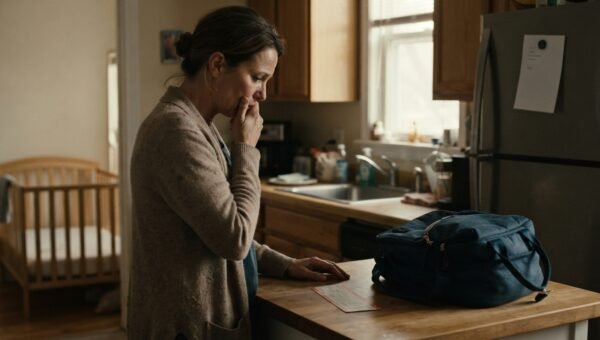
I set the pink device on the kitchen counter next to the truck keys. Something about the way his voice had tightened made my stomach feel uneasy.
At seven the next morning, while Mark was already at work, I opened our town’s community social media page to see if anyone had mentioned an accident or a sideswipe on the road Thomas would have taken home.
Instead, the very first post at the top of the local feed stopped me completely.
A woman named Claire Miller had posted three pictures less than an hour earlier. One was of a teal nylon medical backpack. The second was an eight-year-old girl with dark curly hair sitting in a pediatric clinic chair. The third was a clear, close-up photograph of the exact custom ear mold sitting on my kitchen counter: hot pink, with a tiny clip attached to a braided string.
The post read:
“Ugent: During an emergency move from our duplex on Elm Street late last night, my daughter Mia’s medical travel bag went missing from our porch, along with two tubs of her daily equipment. Her backup hearing aid was inside the bag. We cannot afford to replace it out of pocket, and she cannot attend school without it. If anyone saw a gray Chevy truck loading items near Elm Street around 10:30 PM, please call me. No questions asked. We just need the aid back.”
A phone number was listed at the bottom.
I picked up my phone with a trembling hand and dialed. A woman answered on the second ring, her voice raspy and choked with exhaustion.
“Hello?”
“Claire?” I asked quietly. “My name is Sarah Miller. I think I have your daughter’s hearing aid.”
There was a sudden, sharp intake of air on the line. Then she paused, catching the last name.
“Miller?” she asked slowly. Her tone shifted from relief to sudden wariness. “Wait. Are you related to Thomas Miller? Because he told me his entire family was dead.”
PART 2
The silence on the line felt heavy. I sat at my kitchen table, looking at the small pink device next to my coffee mug.
“Thomas is my brother-in-law,” I told her. “He’s my husband’s younger brother. His family is very much alive. What happened last night, Claire?”
Claire let out a ragged sob. She told me she was twenty-nine and had been renting a small duplex on Elm Street for two years. Two weeks ago, the landlord informed the tenants that the property had been sold to a commercial developer and everyone had until the end of the month to clear out. Claire worked double shifts as a certified nursing assistant at the county care center, had no family nearby, and had been desperately packing boxes between twelve-hour shifts.
Four days ago, Thomas had stopped by her duplex while she was loading trash bags into her sedan. He told her he ran an independent hauling service. He told her his parents had died years ago, that he had no siblings, and that he lived alone on odd jobs. He offered to move her entire duplex to a small apartment across the river for one hundred and fifty dollars, cash upfront, as a personal favor because he knew how hard it was to raise a child alone.
Claire had paid him the one hundred and fifty dollars from her emergency grocery money on Monday afternoon.
“He showed up at nine o’clock last night with a silver Silverado,” Claire said, her voice shaking with anger now. “He was supposed to be there at two in the afternoon. My neighbor helped me stage everything on the covered porch because of the rain. Thomas loaded three dressers, two boxes of kitchen things, and Mia’s plastic storage totes. Then he told me he had to make the first run to the new unit and would come right back for the rest.”
“Did he come back?” I asked.
“No,” Claire said. “He never answered his phone. At midnight, my landlord told me anything left on the porch at dawn was going into the commercial dumpster. I had to pay my neighbor another eighty dollars to throw what was left into his van. When we got to the new apartment, the items Thomas was supposed to deliver were just dumped on the curb in the grass. One of the dressers was smashed. And Mia’s medical tote was completely gone. Her primary hearing aid is at the clinic getting repaired. The one in that tote was the only backup we had.”
I felt a sickening flush of heat rise up the back of my neck.
Thomas hadn’t helped a buddy move tools. He had taken cash from a desperate single mother, used our truck to haul her belongings, dumped her furniture in a wet yard when he got tired of the job, and scraped our fender in the process.
“Claire,” I said, my voice steady. “Where are you right now?”
She gave me the address of her new rental on Tenth Street. I told her I would be there in twenty minutes.
I wrapped the pink hearing aid in a clean cloth napkin, grabbed my purse, and drove our small sedan across town. The neighborhood was tired, filled with narrow gravel driveways and weathered siding. When I pulled up, I saw the wet grass near the road. A white painted dresser lay on its back, one drawer cracked open to the mud.
Claire was standing by the chain-link fence. Her face was pale, with dark purple shadows under her eyes, and she had an eight-year-old girl holding tightly to the fabric of her scrub pants.
I got out of the car. I walked straight up to her, opened the cloth napkin, and held out the hearing aid.
The little girl looked up, saw the bright pink plastic, and made a quiet, excited sound. Claire took it with both hands, her knuckles white, and dropped to her knees to hug her daughter.
“Where was it?” Claire whispered, looking up at me.
“Under the passenger seat,” I said. “He dropped it when he parked at our house after midnight.”
Claire stood up, wiping her cheek with the back of her wrist. “The tote it was in had her prescription ear drops, two clinic binders, and an emergency supply kit. It was a clear plastic container with blue handles. If he didn’t leave it in the truck, where is it?”
I thought about the smell of our truck cab the night before. I thought about the four-mile stretch of dirt road between Elm Street and the river crossing, and I thought about the storage yard behind the body shop where Thomas spent his afternoons.
“Give me two hours,” I told Claire. “I’m going to find out.”
I got back in my car and called Mark. When he answered on his break, I didn’t soft-pedal it. I told him every single word Claire Miller had just spoken. I told him about the hundred and fifty dollars, the fake dead family story, the smashed dresser in the mud, and the missing medical tote.
Mark went completely quiet. The background noise of the water plant hummed through the receiver.
“Meet me at his apartment,” Mark said. His voice was unusually flat. “I’m clocking out for an early lunch.”
PART 3
Thomas lived in a converted basement unit behind a four-plex off Division Street. His rusty sedan was parked in the alley.
When Mark and I walked down the concrete exterior steps, Mark didn’t knock politely. He hit the wood panel three times with the flat of his hand.
The door cracked open after a minute. Thomas was wearing gym shorts and an undershirt, his eyes bloodshot from lack of sleep. When he saw Mark standing there in his work boots, his face tightened.
“What are you doing here?” Thomas asked. “I told you I’d pay for the gas on Friday.”
“Open the door, Thomas,” Mark said.
“Look, I worked late last night. I’m exhausted.”
“Open the door or I call the county sheriff right from this landing,” Mark said. He didn’t raise his voice, but the tone made Thomas step back from the threshold.
We walked into the dim front room. It smelled stale, like fried food and damp carpet. In the corner by his kitchen counter sat three large plastic storage bins.
Two of them were gray utility totes with yellow lids. But the third one, sitting right on top of a folding chair, was a clear plastic tote with bright blue handles.
Through the clear plastic, I could see two spiral notebooks, three boxes of medical tubing, and a pediatric first-aid pouch.
Beside the tote sat an open black toolbox with brand-new chrome ratchets that hadn’t been there when I helped Mark move some old furniture into this apartment three months ago.
Thomas saw me looking at the blue handles. He crossed his arms immediately.
“That was left on the truck bed,” Thomas said quickly. “I meant to drop it off later today. It was dark, Sarah. Things got mixed up.”
“You told her your family was dead,” I said.
Thomas blinked. A sudden flicker of panic crossed his features, quickly replaced by defensive anger. “I tell people whatever keeps them from asking personal questions. She was paying me peanuts to haul three rooms of heavy junk up two flights of stairs. You have no idea what that work is like.”
“You took her grocery money,” Mark said, stepping closer to his brother. “You took our truck, you put a six-hundred-dollar scrape in the panel, you emptied my fuel tank, and you stole a sick kid’s medical supplies so you could root through them to see if there was anything worth selling.”
“I didn’t steal anything!” Thomas shouted. “I forgot to unload one bin! You’re treating me like a criminal over an honest mistake!”
“Then why is her box inside your locked apartment instead of on her porch?” Mark asked.
Thomas didn’t answer. He looked at the floor, his jaw set, refusing to give an inch. He had used that same stubborn silence for twenty years whenever he was caught lying, knowing Mark would eventually tire of the fight and walk away.
Mark didn’t walk away.
Mark walked past him, picked up the clear plastic tote with the blue handles, and set it against his chest. Then Mark looked down at the coffee table where Thomas’s leather wallet was sitting next to his car keys.
“Pick up the wallet, Thomas,” Mark said.
“What?”
“Pick it up.”
Thomas hesitated, then picked up the worn leather bifold.
“Take out one hundred and fifty dollars,” Mark said. “Right now.”
“That’s my food money for the week, Mark!”
“Then you can eat ramen,” Mark said. “Give me the cash, or Sarah calls Deputy Vance right now and tells him you used our registered vehicle to steal private property from an eviction site.”
Thomas stared at Mark. For years, Thomas had relied on Mark’s quiet nature, his patience, and his fear of family drama. But there was no patience left in the room. Mark’s face was cold, set like stone.
Thomas cursed under his breath. With trembling, angry fingers, he flipped the bifold open, pulled out two fifty-dollar bills and two twenties, and slapped them down on the laminate counter. It was one hundred and forty dollars. He dug into his shorts pocket and threw a crumpled ten-dollar bill on top of it.
“There,” Thomas spat. “Take it. You’re siding with some stranger over your own brother. Mom would be sick if she saw this.”
“Don’t you ever mention Mom to me again,” Mark said quietly. “If you ever come near our property, our truck, or our driveway again, I will sign the police report myself. We are finished carrying your messes.”
Mark turned and walked out the door with the tote. I followed him up the concrete steps into the gray daylight.
We drove straight back to Tenth Street.
When Claire opened the door, Mark carried the tote inside and set it gently on her kitchen table. I took the one hundred and fifty dollars from my pocket and laid it beside the container.
Claire looked at the money, then at the box, and then at Mark.
“He won’t bother you again,” Mark told her. He looked embarrassed, his shoulders curved slightly, carrying the shame that his brother had been incapable of feeling. “I’m sorry it was our truck he was driving when he did this to you.”
Claire didn’t take the money right away. She looked at Mark’s face, recognizing the pain of a decent man who had just severed a long-standing tie.
“Thank you,” she said softly. “You didn’t have to do any of this.”
“Yes, we did,” Mark said.
ENDING
We stopped at the body shop on the way home to get an estimate on the passenger panel. The repair came out to six hundred and eighty dollars to pull the crease and blend the paint. Mark wrote a personal check from our savings account without saying a word.
When we got home, the house was quiet.
Around five that evening, Mark’s phone rang. It was his mother. He let it ring through to voicemail. A minute later, she left a three-minute message, weeping, saying Thomas had called her from a gas station pay phone claiming Mark had broken into his home, threatened him, and stolen his rent money. She wanted Mark to come over immediately and apologize to his brother so the family could heal.
Mark listened to the message once while standing at the kitchen window, looking out over our quiet backyard.
When the recording ended, he didn’t call her back. He set the phone facedown on the counter and deleted the message.
“Are you going to answer her?” I asked gently.
“Not today,” Mark said. “And not tomorrow. If she wants to believe Thomas, that’s her choice. But my truck isn’t a weapon for him anymore, and neither are we.”
Two days later, on Saturday afternoon, a small knock sounded at our front door.
I opened it to find Claire standing on the porch. She was holding a brown paper bag, and Mia was standing beside her, wearing her pink hearing aid clipped neatly to her faded yellow sweater.
“We were on our way to the grocery store,” Claire said, looking a little shy. “Mia wanted to give you this.”
She handed me the bag. Inside was a small loaf of banana bread wrapped in tin foil and a sheet of construction paper folded in half. On the paper, Mia had drawn a picture with crayons: a big gray truck with four giant wheels, a girl with two pink ears, and the words *THANK YOU* written in uneven, blocky purple letters across the top.
I looked down at the little girl. She looked up at me, touched her ear where the pink mold was securely fitted, and smiled.
“You’re very welcome, honey,” I told her.
Mark came to the door, wiping grease from his hands with an old shop rag. He saw Mia standing there, saw the drawing in my hands, and for the first time in four days, the tension in his shoulders seemed to drop away.
After they walked back down the driveway to their car, Mark took the drawing from the table. He didn’t put it in a drawer or throw it out with the junk mail. He walked over to the refrigerator, took down an old magnet from a local hardware store, and pinned the paper right at eye level on the door.
Thomas never paid for the gas, and he never offered a single dollar for the dent in the fender. His side of the family stopped inviting us to Sunday dinners, and the silence from them was long and cold.
Every morning when Mark gets his coffee before work, he walks past that purple crayon drawing on the fridge. The dent is still on the truck, but the door to our home is finally shut to the lies.