PART 1
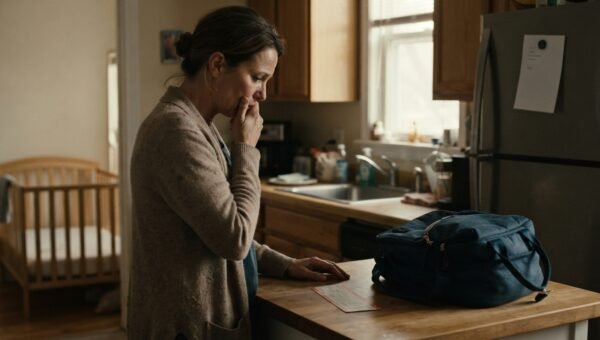
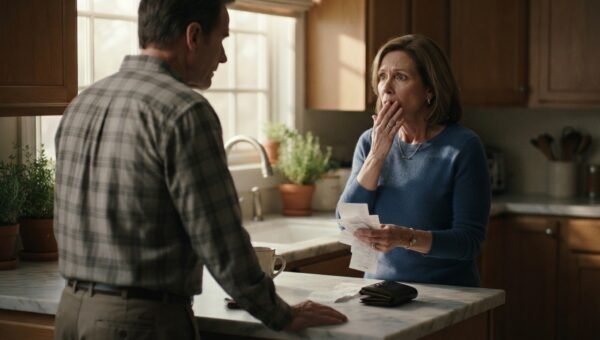
My husband promised his mother we would pay for her new kitchen without asking me. The estimate sat on our kitchen counter for three days, printed on heavy cream cardstock from a high-end design firm in town: $36,000.
I told him no. I said it plainly, twice, while drying dinner plates. We were fifty-four, our youngest daughter had just started nursing school, and our savings account had finally recovered from my knee surgery the previous spring.
We did not have thirty-six thousand dollars to give away for custom walnut cabinets and quartz countertops.
His mother, Evelyn, called me selfish the following Sunday over cold pot roast. She told her two daughters that I kept my husband, David, on an allowance. David did not defend me. He looked down at his green beans, let the silence sit, and then slept on our basement sofa for seven straight nights. He barely spoke to me unless it was about the grocery list or taking out the trash.
Then on Thursday morning, a contractor named Mark sent an email directly to my personal address. He had attached an updated work order for Evelyn’s home on Maple Lane, listing me as the primary client and property owner.
I assumed it was an administrative mix-up. People make clerical errors all the time, especially with surnames. I replied within ten minutes, explaining that I was merely the daughter-in-law, that we had not approved the project, and that I held no title to the Maple Lane house.
Mark replied an hour later with a screenshot from the county recorder’s public portal.
My full name was there. My social security number was truncated to the last four digits, but they matched mine. According to the county records, the deed to Evelyn’s two-story colonial had been transferred directly to me eighteen months earlier through a quitclaim document.
I printed the PDF right at my kitchen table. My signature sat at the bottom of the second page. It looked like my handwriting at a quick glance, but the slant was stiff, the loop on the capital letter was rounder than the way I write, and the date beside it fell on a Tuesday when I had been three hundred miles away visiting my sister in Ohio. I had never signed that form. I had never seen it before in my life.
I stared at the notary stamp in the lower right corner. The name was Brenda Cole, with a commission expiration date and an office address two miles from David’s auto body shop.
I called the number listed on the seal. Brenda answered on the second ring. When I gave her the document number and the address, she paused, and I heard the rustle of a physical ledger flipping open.
“I remember that appointment,” she said, her voice dropping into something cautious. “It was eighteen months ago, late afternoon. But you weren’t there. A woman came in with your husband and presented an official driver’s license with your name on it.”
“What did she look like?” I asked. My hands were completely cold.
Brenda described a woman in her late seventies, petite, with silver-white cropped hair, wire-rimmed reading glasses, and a persistent cough.
It was an exact description of my mother-in-law.
PART 2
I stayed on the phone with Brenda Cole for nearly twenty minutes. She pulled her notary log from the locked cabinet in her office and read the entry to me word for word.
David had paid the ten-dollar fee in cash. The woman with him had presented an expired state ID card with my name, address, and date of birth. Brenda admitted she had noticed the photograph looked noticeably younger than the woman standing before her, but David had laughed it off, claiming his wife had just gone through a rough year of health issues.
“I should have looked closer,” Brenda said, her voice shaking slightly. “If this wasn’t you, ma’am, that’s document fraud. I have to report this to my bond agency.”
“Don’t call anyone yet,” I told her. “Give me until tomorrow morning.”
I drove straight to the county clerk’s office downtown. I paid twelve dollars for a certified copy of the recorded quitclaim deed and sat in my car in the municipal parking garage, studying every line. Eighteen months ago, Evelyn had ostensibly given me her entire home for ten dollars and love and affection.
It made zero sense. Evelyn hated me. From the day David brought me home twenty-eight years ago, she had treated me like an outsider who had stolen her favorite boy. She never gave me so much as a birthday card without a subtle insult inside it. Why would a woman like that sign over her biggest financial asset to a daughter-in-law she openly resented?
I drove to David’s auto repair shop instead of heading home.
His truck was parked in the bay. When I walked through the side door, he was wiping grease from his knuckles with a blue shop rag. He looked annoyed to see me, assuming I had come to fight more about the kitchen remodel.
“If you’re here to argue about Mom’s cabinets, Martha, I don’t have the energy,” he said, turning toward his workbench. “She’s eighty-one. She deserves to have her house the way she wants it.”
I laid the certified deed down on the metal table between a set of wrenches and a stack of invoices.
“Why is Evelyn’s house in my name, David?”
The color washed out of his neck first, then his cheeks. He reached for the paper, but his hand stopped an inch above it, trembling just enough for the rag to drop.
“Where did you get that?” he asked.
“Mark sent me the estimate because I’m listed as the owner,” I said. “Then I spoke with Brenda Cole. She remembers your mother sitting in her chair, pretending to be me with my old expired driver’s license from the junk drawer.”
David swallowed hard. He didn’t deny it. He didn’t yell. He sank onto his rolling stool and put his face in his grease-stained hands.
“Mom had a lien,” he whispered.
“What kind of lien?”
“Back taxes and a line of credit she took out five years ago,” he said, staring at the concrete floor. “She owed ninety-four thousand dollars to a private lender, and they were threatening foreclosure. If the house went to auction, she would have ended up with nothing, and the state would have taken whatever equity remained for her Medicaid lookback. Her lawyer told her that if she didn’t own the property, the private lien would have a harder time attaching to her future benefits. But she couldn’t transfer it to me because my business credit was already tapped.”
“So you stole my identity,” I said. “You and your mother forged my name on a legal deed to hide her debt.”
“We weren’t hiding it to hurt you,” he pleaded, reaching for my arm. I stepped back out of his reach. “The plan was for her to live there until she passed, then we’d sell it and clear everything. You were supposed to get the house anyway.”
“Then why the thirty-six thousand dollar kitchen?” I demanded. “Why push for a luxury remodel when the house has a six-figure debt hanging over its neck?”
David closed his eyes. “Because the contractor isn’t just doing the kitchen, Martha. The estimate was structured so Mark could pull equity out as a home improvement loan under the owner’s name. Under your name.”
PART 3
The full scale of what they had planned hit me like cold water.
They weren’t just asking for thirty-six thousand dollars from our savings. That was only the down payment Mark required to initiate the project paperwork. Once the permit was filed in my name as the confirmed deed holder, David and his mother had arranged for a secondary property loan against Evelyn’s house to pay off her ninety-four thousand dollar private debt, using my clean credit profile to secure the financing.
They were going to saddle me with a massive second mortgage on a house I never asked for, to rescue Evelyn from her own reckless financial history.
I didn’t scream. When you realize the person you have shared a bed with for nearly three decades sees you as disposable collateral, anger comes second. Survival comes first.
“Pack your clothes tonight,” I told David.
“Martha, please. We can fix this. We can transfer it back.”
“You can’t transfer a deed back without clearing the title defects,” I said. “You know that. And your mother doesn’t get to commit a felony and pretend it was just family business.”
I drove directly to Evelyn’s house on Maple Lane.
She was sitting in her sunroom, drinking tea from the porcelain cup my children had bought her for Christmas years ago. When she saw me walk in without knocking, her mouth tightened into that familiar, dismissive purse.
“David told you to apologize, I assume,” she said, setting the saucer down.
I set the certified deed and Brenda Cole’s written statement on the glass table between us. Brenda had emailed it to me an hour earlier after consulting her supervisor.
“The notary identified you, Evelyn,” I said quietly. “She kept the photocopy of my old license that you handed her. She kept the signature page where you wrote my name.”
Evelyn didn’t blink. She looked down at the paper, then back up at me with cold, defiant eyes.
“David agreed to it,” she said, her voice entirely devoid of remorse. “He is my son. Everything I have belongs to him anyway. You married into this family, Martha, and you’ve held the purse strings like a warden for twenty-eight years. That house was supposed to be his inheritance. I did what was necessary to protect what is ours.”
“It isn’t yours anymore,” I said. “And it isn’t his. By law, right now, this property belongs to me.”
“You wouldn’t dare,” she sneered. “David would never let you.”
“David is packing his bags,” I told her. “And if you ever sign my name to a scrap of paper again, I will hand these files to the county prosecutor before the sun sets.”
I gave her two choices. She could cooperate with a formal real estate attorney to sign a rescission of the fraudulent transfer and arrange an immediate private sale of the house to settle her debts on her own, or I would report the forgery to the county sheriff’s department and let the courts handle the deed.
Her face lost every trace of its smug certainty. For the first time in twenty-eight years, she had nothing cruel to say.
PART 4
ENDING
It took four months and twenty-two hundred dollars in legal fees to untangle the title without filing criminal charges against the father of my children.
My attorney made it very clear: if we went through the police, both Evelyn and David were at risk of felony indictments for document forgery and identity theft. I chose not to put my daughters through the public humiliation of watching their father go to prison, but I refused to carry the burden of their deceit for another hour.
The Maple Lane house was put on the market in late October. It sold for less than Evelyn wanted, just enough to pay off the private lender, clear the back property taxes, and cover the real estate commissions. Evelyn had to move into a one-bedroom subsidized senior apartment on the south side of town. Her new kitchen has laminate counters, a two-burner electric range, and an apartment-sized white refrigerator. She does not call me selfish anymore. In fact, she does not speak to me at all, which is the greatest peace I have had in three decades.
David moved into an apartment above a transmission repair shop across town. He called me twice a week at first, asking if we could go to marriage counseling, swearing he had only gone along with the scheme because his mother had threatened to cut him out of her life completely.
I listened to him, but I did not invite him back. A man who will hand his wife’s name and credit over to be sacrificed to his mother’s demands is not a partner; he is an accomplice.
Our divorce was finalized on a rainy Tuesday in May. We divided our modest retirement accounts evenly, and I kept our home, buying out his small portion of the equity with a modest refinancing loan that I applied for with my own clean hands.
Yesterday, an envelope arrived from the county recorder’s office with the finalized discharge of the Maple Lane quitclaim deed. My name is completely gone from that property. It belongs to a young couple who planted marigolds along the front walkway last weekend.
I took the certified copy I had kept in my kitchen drawer, walked it out to the fire pit in our backyard, and dropped it onto the dry pine needles. I watched the stiff paper curl and turn to ash, until there was nothing left of my forged signature except smoke drifting over the grass.