PART 1
The night Sandra took Leo back, my husband David sat on our front porch steps until two in the morning, staring at the gravel where the boy had gotten sick.
Leo was nine years old. He had lived under our roof in Michigan since he was five, ever since Sandra walked away into a court-ordered inpatient facility two counties over. In those four years, David and I had put together his Lego bins, taken him to get his ear tubes checked, taught him how to ride a bicycle without training wheels, and signed every single permission slip for field trips.
We had a temporary guardianship order through the county probate court, but we had never moved to terminate her parental rights. David loved his sister, and he honestly believed people could get clean and stay clean if you gave them enough grace.
That grace cost us our boy.
Sandra showed up on a Tuesday afternoon in early October. She did not call ahead. She arrived in a dark gray sedan with a man we had never seen sitting in the passenger seat, engine running. She held a manila folder against her chest and walked right past the mums I had planted on the front steps. She had completed her eighteen-month probation, finished her outpatient aftercare, and held a certificate of compliance from the state. The county judge had dissolved our temporary guardianship two days prior, signed on a Friday afternoon without a formal hearing because we had never filed an objection to her petition for reunification.
“Get his things,” Sandra told David. She did not step across our threshold. Her eyes were hard and guarded, her arms folded tight over a denim jacket. “He is my son. You two have played house with him long enough, but you are not stealing my child.”
David had tried to speak to her like a brother. “Sandra, let him finish the week at school. Let us pack him up properly. You can stay for dinner, let him get used to the idea.”
“No,” she said. “Right now. If you don’t bring him out to this porch in ten minutes, I’m calling the sheriff’s department. He belongs with me.”
Leo had been sitting in the dining room doing long division at the oak table. When he heard her voice, his pencil rolled off the paper and hit the floorboards. When David walked him down the driveway toward that idling sedan, Leo clung to David’s belt loops with both hands.
He cried so violently that his knees buckled by the rear bumper, and he threw up his lunch right onto the gravel. Sandra pulled him by the wrist, shoved his small red duffel bag onto the floorboard, and locked the passenger door before backing down our lane so fast her tires sprayed stones against our mailbox.
For six months after that day, David and I lived in total silence. Sandra changed her phone number within forty-eight hours. She took Leo out of his elementary school without leaving a forwarding address for his records. When David drove the forty miles out to her old apartment building, the super told him she had moved out weeks earlier. Every letter David mailed to her last known address came back stamped return to sender.
We kept his bedroom exactly as he left it. His blue quilt was smoothed out, his unfinished model airplane rested on his nightstand, and his baseball glove sat on the closet shelf.
David aged ten years in those six months. Every time the landline rang during dinner, he lunged for the receiver, only to hear a telemarketer or an automated pharmacy reminder.
Then came an unseasonably warm April night. It was eleven o’clock on a Thursday, and David was in the bathroom brushing his teeth while I turned off the living room lamps.
Headlights swept across our front curtains. A white patrol cruiser with county markings pulled into our driveway, gravel crunching slow and deliberate beneath heavy tires.
My stomach dropped straight into my shoes. I called David’s name, my voice cracking before the sound even left my throat. I thought Leo was dead. I thought Sandra had relapsed behind the wheel of that gray car and wrapped it around a telephone pole with our boy in the backseat.
David came down the hall still holding his toothbrush, bare feet on the hardwood.
I opened the front door with the chain still latched, peering through the three-inch gap. A tall county deputy with graying temples stood on the porch under our yellow bug light. His hat was in his hand.
“Are you David and Nora Miller?” he asked.
“Yes,” David said, pushing past me to unhook the chain. “What happened? Is it Leo?”
“The boy is safe,” the deputy said immediately. His voice was level, the practiced tone of a man who knew how people reacted to uniforms late at night. “He’s sitting at the sheriff’s substation in Coldwater right now with a female officer, eating a grilled cheese sandwich. He asked me to bring this to you first.”
The deputy reached down and lifted a faded canvas backpack. It was navy blue with an orange zipper pull, the same backpack David had bought Leo at Walmart for the third grade.
The fabric was dusty around the seams, and one of the shoulder straps had been mended with black electrical tape.
“I need you both to come down to the station with me,” the deputy said, handing the heavy pack across the threshold into David’s hands. “Child Protective Services has already been dispatched, but Leo refused to say a single word to anyone until he knew Uncle David had this bag.”
PART 2
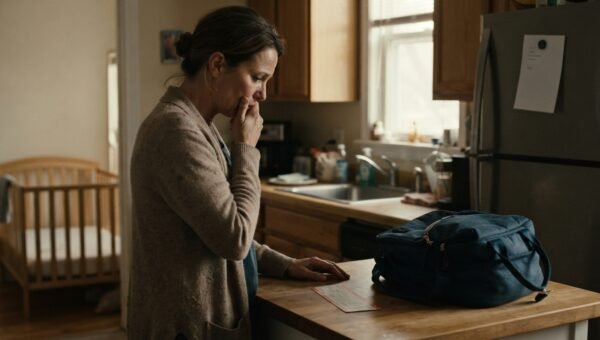
David carried the backpack into the kitchen and set it under the overhead fluorescent light like it was made of thin glass.
His hands were shaking so hard he could barely manage the zipper. Inside were three mismatched socks, an action figure with a missing arm, half a sleeve of stale saltine crackers wrapped in plastic wrap, and a black-and-white marble composition notebook. The edges of the cardboard cover were frayed down to gray fuzz, swollen around the corners from moisture.
David opened the front cover.
Leo’s third-grade handwriting was small and cramped, written in blue ballpoint ink. The first page started in November, just three weeks after Sandra had dragged him down our gravel driveway.
There were dates running down the left-hand margin: *Nov 14, Nov 22, Dec 3.* Next to each date, Leo had written street names, house numbers, and license plate tags. He had recorded car colors and makes in simple, blunt sentences: *Green truck, noisy pipe, dent on side. White van, loud music, stayed 10 minutes.* Under several entries, he had written names of towns forty miles away from where Sandra was supposed to be living.
He had turned himself into a nine-year-old clerk, sitting in back rooms and documenting everything.
David turned the pages slowly. The entries got closer together in January and February. *Mom sleeping on floor. Man with eagle tattoo took my tablet. No heat, used oven door open.* Leo had kept track of every adult who walked through whatever rooms Sandra had dragged him into, noting the times they arrived and the times they left.
On the very last lined page, dated just two days before this late-night knock on our door, the ink was smudged where water or tears had hit the paper. The handwriting was uneven, the letters slanting sharply downward:
*If Mom leaves me there again, call Uncle David. He knows the way home.*
Below that sentence, Leo had written our home landline number, David’s cell phone number, and our full street address, complete with our five-digit zip code. He had memorized them during the four years he lived with us, and he had written them down so he would not forget.
The deputy, whose name tag read Miller—no relation to us—stood near our kitchen doorway with his thumbs hooked in his duty belt. He had watched us read without interrupting.
“Where was he found?” David asked, his voice raw.
“A motel parking lot off the interstate near the county line,” Deputy Miller said. “Around eight o’clock tonight. A clerk called dispatch because a boy had been sitting behind the dumpster on an upturned milk crate for three hours in the dark. Sandra was inside room 114 with two individuals known to our narcotics unit. She was not in a condition to know what time it was, let alone where her son had gone.”
The deputy took a breath and looked down at his boots. “The state worker tried to take that bag from him when they loaded him in my squad car. Leo held onto it with both hands and bit her sleeve. He told me his uncle was the only person who was allowed to open it.”
David looked at me, then down at the mended strap on the backpack. All the hesitation he had carried for years, all that cautious family guilt that had made him step aside for Sandra six months earlier, vanished from his face.
“We’re going to the station,” David said.
We followed the patrol car through the dark country roads into Coldwater. The county substation was a flat brick building with bright institutional lighting that smelled of floor wax and stale coffee. When we walked into the side conference room, a social worker with tired eyes was sitting at a folding table with a clipboard, and Leo was sitting in the corner in an oversized vinyl chair, his legs tucked up under his chin.
His face was thinner than it had been in October. His hair had grown out past his collar, jagged and uneven where someone had tried to cut it with dull kitchen scissors. When the door opened and he saw David, he didn’t run. He just uncurled his legs, stood up on his socks, and buried his face directly into David’s belt buckle, grabbing the stiff leather with both fists just like he had on our driveway.
David dropped to his knees on the linoleum and wrapped his arms around the boy’s back. He didn’t say anything fancy. He just kept repeating, “I’ve got you, buddy. You’re alright. I’ve got you.”
The social worker, whose name was Mrs. Alvarez, pulled me aside while David stayed on the floor with Leo. She had two thick folders open on the table.
“He won’t be going back to her,” Mrs. Alvarez said quietly. “Sandra was arrested tonight on felony possession and child endangerment charges. But because you two did not have permanent legal custody, the state has to place him in emergency shelter care tonight unless we can clear an immediate kinship diversion.”
“We raised him for four years,” I said, my voice shaking with an anger I couldn’t swallow down. “You have his records right in front of you. He lived in our house from five to nine. We never should have let her take him.”
“I understand that, Mrs. Miller,” she said calmly. “The problem is Sandra’s legal status. Even from a holding cell, she has already told the intake officer that she explicitly refuses to consent to him staying with you. She claims David is hostile toward her and that you are trying to alienate her child. Without a court order granting emergency temporary custody to a non-parent over the mother’s direct objection, the statute requires us to use a licensed foster home until the preliminary hearing on Monday.”
It was Thursday night. That meant three days in a stranger’s house for a boy who had spent six months counting license plates behind closed doors.
PART 3
David stood up from the floor. He still had his hand resting on Leo’s narrow shoulder. He reached into his coat pocket, pulled out the black-and-white composition notebook, and laid it flat on the table directly between Mrs. Alvarez and the deputy.
“Read this before you make any phone calls for a foster bed,” David said.
Mrs. Alvarez looked at David, then pulled the notebook toward her. She turned the pages slowly. For ten minutes, the only sound in that small room was the hum of the vending machine in the hallway and the dry scrape of paper turning under her thumb.
Leo’s notebook wasn’t just a child’s diary. It was a chronological ledger of neglect and illegal transactions. Leo had recorded dates, specific locations, and details that no child should have known. On page twelve, he had written down the address of a storage facility in Branch County where Sandra had been keeping boxes for her boyfriend. On page fourteen, he had recorded the license plate of a sedan that had visited the motel three times in one week, along with the exact times the driver entered and exited.
Deputy Miller leaned over the social worker’s shoulder, his eyes scanning the license plates. He pulled a small notepad from his breast pocket and tapped one of the numbers Leo had written down.
“That’s a plate our task force has been looking for since February,” the deputy said to Mrs. Alvarez. “This kid just gave us the operational timeline for a distribution ring out of Angola. He was sitting in those rooms while it happened.”
Mrs. Alvarez closed the notebook. Her demeanor had changed completely. She wasn’t looking at family drama anymore; she was looking at a severe, documented pattern of endangerment that directly contradicted the mother’s claims of parental fitness.
“Sandra’s attorney will argue the boy was coached,” Mrs. Alvarez said, testing the ground.
“Look at the handwriting,” David said, his voice dropping low and steady. “Look at the dates. That starts in November, three weeks after she took him from our porch. We didn’t know where he was. We haven’t spoken to him in six months because she blocked our numbers and moved four times. That boy wrote down those numbers because he knew he was in danger, and he knew we were the only ones who would look for him.”
Leo stepped forward from David’s side. His voice was quiet, raspy from crying, but clear enough for everyone in that room to hear.
“Mom said Uncle David hated me,” the boy said, looking straight at the table. “She said if I tried to call, the police would put me in a cage because I wasn’t hers anymore. So I wrote down where we went. In case I had to walk.”
Mrs. Alvarez closed her eyes for three long seconds. When she opened them, she picked up her desk phone and dialed the on-call county prosecutor.
“I need an emergency ex parte placement order for an endangered minor,” she said into the receiver. “We have substantial corroborating physical evidence of ongoing felony endangerment provided directly by the child. Kinship placement with the paternal uncle is available immediately. I am not putting this boy in shelter care tonight.”
It took an hour and twenty minutes. A county magistrate signed the emergency order electronically at 1:40 a.m., placing Leo in our temporary physical and legal custody pending a full dependency hearing.
Sandra remained in the county jail without bond. When the deputies processed her property from the motel room, they found our old family photos cut up into pieces in her purse, but none of Leo’s schoolwork. She had stripped away every reminder of his life with us, but she hadn’t known about the notebook he had kept tucked between the lining and the bottom cardboard of his school backpack.
ENDING
We got back to our house just as the sky was turning from black to deep gray along the tree line.
Leo walked up the gravel driveway holding David’s hand. He stopped right at the spot where he had been sick six months earlier, looked down at the stones for a second, and then looked up at the porch. The mums I had planted in October were long dead, replaced by a pot of yellow pansies David had brought home from the hardware store two weeks ago.
“My room still got my planes?” Leo asked.
“Every single one of them,” David told him.
I took Leo into the kitchen and made him three pieces of cinnamon toast with real butter, the way he liked it when he was seven. He ate every bite, sitting up straight in his old chair, watching the sun come up through the maple trees outside the window. He didn’t ask about his mother. He didn’t ask about the motel.
After he ate, I ran a warm bath. He soaked until the water went cool, scrubbing three months of motel grime and road dust off his elbows and knees. I washed his hair with the apple-scented shampoo we had kept under the sink since the day he left.
David went to the basement and brought up his old barber clippers, the ones he used on his own hair every Sunday morning. He set a wooden kitchen chair on the back porch and wrapped an old bath towel around Leo’s neck, pinning it with a wooden clothespin. For twenty minutes, David worked carefully, leveling out the jagged edges Sandra had left, taking the hair down short and clean around his ears. Leo sat perfectly still, his eyes closed, listening to the steady hum of the motor against the back of his neck.
The legal battle didn’t end that morning, but the uncertainty did.
Over the next fourteen months, the county prosecutor used the dates and license plates from Leo’s marble notebook to secure convictions against two of the men Sandra had been traveling with. Sandra eventually accepted a plea agreement that included a five-year prison sentence and a voluntary relinquishment of her parental rights.
On a rainy Tuesday in July of the following year, David and I stood before a family court judge in the county courthouse, dressed in our Sunday clothes. When the judge signed the final decree of adoption, Leo didn’t cry. He just reached out, took the pen the judge offered him as a souvenir, and slipped it into his front pocket.
The navy blue backpack is still in our front hall closet, hanging from the brass hook behind David’s winter coat.
The electrical tape on the right shoulder strap has started to peel at the corner, showing the gray thread underneath. Inside the small front pouch, the marble composition notebook sits completely full, every page covered in pencil and blue ink. Leo hasn’t written in it since that night at the substation.
Now, when he comes home from middle school, he drops that heavy bag by the back door, kicks off his muddy sneakers onto the mat, and yells across the kitchen to ask what David is cooking for dinner. He doesn’t look over his shoulder anymore. He knows exactly where he lives.