PART 1
My daughter-in-law told my grandson I wasn’t his “real grandma” because I’m his father’s stepmother.
I had been in that boy’s life since the day he was born. When my stepson, David, was twelve, his mother walked away from their family to start over in Arizona, and I stepped into a house filled with dirty laundry, takeout boxes, and a quiet, wounded boy who barely spoke above a whisper.
I raised David through braces, high school graduations, broken collarbones, and his first apartment. When he married Brenda seven years ago, I paid for the catering, stepped back politely to let Brenda’s mother take the front pew, and never asked for credit.
When little Leo came along five years ago, I took two weeks of unpaid leave from my county clerk job to stay on their living room sofa. I changed diapers at three in the morning so Brenda could sleep. Over the next five years, I was the one who kept extra juice boxes in my lower fridge drawer, watched him every Tuesday afternoon so Brenda could run errands, and bandaged his scraped knees with the dinosaur adhesive bandages he loved.
Then, three months ago, Brenda organized a family picnic at the park for her side of the family. I brought two pans of baked macaroni and a cooler of lemonade.
When Leo tumbled off the low swing and skinned his palm, he started crying and ran straight toward me, arms outstretched.
Brenda caught him by the shoulder before he reached my knees. She didn’t whisper it. She said it loudly enough for her sister and her mother to hear over the portable radio.
“Go to your actual grandmother, Leo. Jo is just your dad’s stepmom. She’s not your real grandma.”
Leo stopped in the grass. His small face went completely blank, the way young children look when the ground under their feet suddenly doesn’t hold. He looked at Brenda, then up at me. His arms slowly dropped to his sides. He didn’t run to Brenda’s mother. He just wiped his dirty hand against his shorts and walked over to sit alone by the picnic bench.
I could have made a scene right there in front of Brenda’s relatives, but I looked at David.
He was standing by the grill with a spatula in his hand, looking down at the coals, pretending he hadn’t heard a word. That hurt worse than what Brenda had said.
“I think I’ll head home,” I said quietly. I left the food, got into my Buick, and drove back to my empty house.
Over the next month, I backed away. When Tuesday came, I didn’t call to offer babysitting. When Brenda texted asking if I could pick Leo up from preschool because she had an appointment, I told her I had errands of my own. It felt like tearing off a piece of my own skin, but I refused to force myself into a home where I was treated like an intruder who had overstayed her welcome.
The two times David brought Leo over to drop off my garden tools, Leo hung back by the truck. When I knelt down and opened my arms, he shuffled his sneakers in the gravel and looked at his shoes.
He wouldn’t hug me. He wouldn’t look me in the eye. He was five years old, and his mother had told him our love was fake. I didn’t blame him, but the quiet ache in my chest never really left.
Then, on a rainy Thursday afternoon a month later, David’s pickup pulled into my driveway.
He didn’t bring Leo. He came up my front porch steps alone, his work jacket soaked through at the shoulders. When I opened the screen door, he looked exhausted, with dark shadows under his eyes.
“Mom,” he said. He hadn’t called me that in two months. “Do you have a minute?”
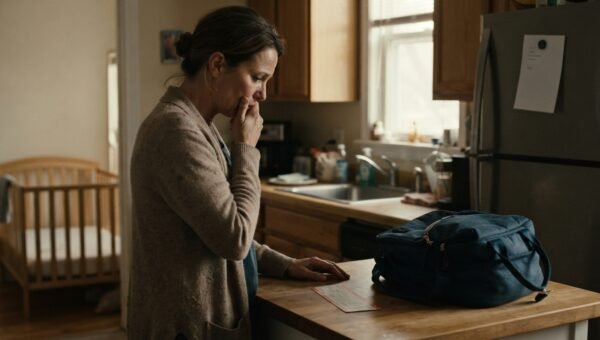
He sat at my kitchen table, keeping his wet hands between his knees. He reached into his inner jacket pocket and pulled out a folded piece of construction paper, damp around the corners, and smoothed it flat on the tabletop.
It was a school assignment titled “My Family Tree.”
Leo had drawn everyone in thick crayon. There was David with stick legs, Brenda with yellow hair, Brenda’s parents, and their dog. But right next to his father’s branch, Leo had drawn a small figure with curly brown hair, gray eyeglasses, and an oversized smile. Beside it, in shaky, uneven preschool letters, he had written “Grandma Jo.”
He had taken a bright red crayon and circled my name three times.
My throat tightened. “David, what is this?”
“Look at the back,” David said, his voice cracking.
I turned the heavy paper over. In neat blue ballpoint ink, Leo’s preschool teacher, Mrs. Albright, had written a note:
“David and Brenda, please contact me as soon as possible. Leo has been very withdrawn during free play this week. Today he became inconsolable during nap time. He keeps telling us that his mother told him Grandma Jo is going away forever and that he isn’t allowed to love her anymore.”
I stared at that handwriting until the blue ink blurred.
I looked up at David. “Going away forever? Why would Brenda tell a five-year-old child that I was going away forever?”
David swallowed hard. He looked down at the linoleum floor, his jaw working, unable to meet my eyes.
“Because she told him we were moving,” David whispered. “And she told him you were the reason why.”
PART 2
The kitchen clock ticked against the wall, loud and steady.
“Moving where, David?” I asked. My voice came out flat and dry.
“Brenda wants us to move to Raleigh,” he said, staring at his coffee mug. “Her sister lives there. She says the schools are better. She’s been looking at subdivisions for six months.”
“And why would you tell your son that I’m the reason you have to leave?”
David rubbed his face with both hands. “I didn’t tell him that, Mom. Brenda did. When I came home from work yesterday, Leo was hiding in his closet with his stuffed bear. He asked me if Grandma Jo was mad at him. He asked me if you were leaving the state because he was bad.”
The anger that rose in me wasn’t loud or reckless. It was the cold, clear anger of a woman who has spent thirty years keeping her mouth shut to keep other people comfortable.
“Brenda didn’t just decide you’re moving because of schools,” I said, leaning across the table. “You have a stable job with the county water department here. You’ve got ten years in your pension. Your mortgage here is manageable. You don’t pick up and move four states away just because your sister-in-law likes North Carolina. What is really going on, David?”
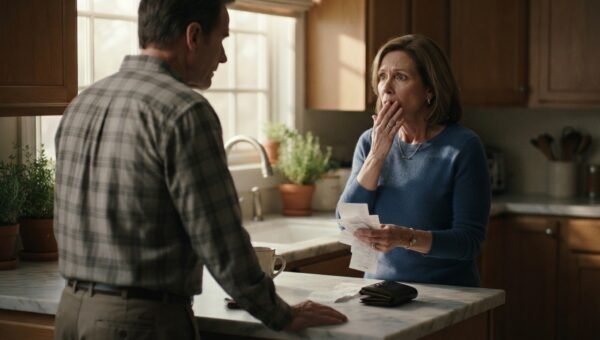
He didn’t answer right away. He reached into his pocket again and pulled out an envelope. It was an official letter from First Heritage Bank, addressed to David and Brenda Miller.
“Brenda applied for a bridge loan two weeks ago,” David said, his voice barely audible. “She wanted $45,000 for a down payment on a house outside Raleigh. She put our current house up as collateral.”
“Did she get it?”
“No,” David said. “The bank denied it yesterday. That’s why I found out. The rejection letter came to my email because my name is on our checking account. When I confronted her last night, she broke down. She told me she owes $38,000 on private credit cards that I never knew about.”
I looked at the boy I had raised from a terrified twelve-year-old. “How did she run up $38,000 without you noticing?”
“Shopping, online boutique clothes, furniture we couldn’t afford for our living room, trips with her sister,” David said, his voice thick with shame. “She was hiding the paper bills at her mother’s house. She thought if we moved to Raleigh, she could roll her secret debt into a larger mortgage on a new build, start clean, and nobody here would ever know. But she needed cash to secure the lot. When I told her six months ago that we didn’t have that kind of money, she told me we could ask you.”
The puzzle pieces snapped together with a harsh, ugly click.
“She asked me six months ago,” I remembered aloud. “She came over on a Sunday, talking about how old my kitchen cabinets were and how much equity I must have built up in this house since your father passed. She casually asked if I’d ever thought about taking out a reverse mortgage to help you two get ahead.”
“And you told her no,” David said.
“I told her this house was paid off by your father’s hard work, and that my retirement depends on having zero debt,” I replied. “I told her that my will leaves the property to you when I die, but while I am alive, I need a roof over my head that no bank can touch.”
David nodded slowly. “That was the day she changed. She came home furious. She told me your money was sitting there doing nothing while we were struggling. She said you were selfish. And when you wouldn’t give her the equity, she decided she wanted you out of our lives completely. She started telling her family that you favored your own nieces over Leo. Then she started telling Leo that you weren’t real family, hoping that if Leo pulled away from you, I’d stop visiting you, too.”
“She poisoned a five-year-old child’s heart,” I said, “just because an old woman wouldn’t hand over the deed to her house.”
David picked up the teacher’s note again. “Mrs. Albright called me directly this morning on my cell phone. She didn’t call Brenda. She said, ‘Mr. Miller, Leo spent his entire recess sitting by the fence today. When I asked him why, he told me that if he’s a good boy, maybe his real grandma won’t disappear.’ Mom, when she said that, I felt like someone had kicked the air out of my lungs.”
David stood up from the table. For the first time since he had arrived, he looked directly at me. His eyes were red, but the indecisive, passive look he usually wore around Brenda was gone.
“I’m not moving to Raleigh,” David said. “I called a lawyer during my lunch break. And I told Brenda she needs to pack a bag and stay at her mother’s house until we figure out what custody and our marriage look like. But before I deal with any of that, there’s one thing I have to fix right now.”
He grabbed his keys off the counter. “Leo is at the school’s after-care program until five. Put your coat on, Mom.”
PART 3
The rain had tapered off to a cold, steady mist by the time we pulled up outside Oak Creek Elementary.
The brick building smelled of damp floor wax, paper paste, and wet wool jackets, the exact same smell I remembered from when David was in the sixth grade. We checked in at the front desk and walked down the wide green hallway to the after-care room.
Through the safety glass in the door, I saw a dozen children gathered on the rug around a teacher reading a picture book. But over in the reading corner, tucked between two low plastic bookshelves, Leo was sitting alone on an oversized beanbag chair. He had his knees pulled up to his chest, his chin resting on his kneecaps, staring down at a pair of green plastic dinosaurs he wasn’t even playing with.
My heart tightened so hard it felt like a physical ache.
David pushed the door open. The after-care supervisor looked up, smiled, and waved David over to sign the attendance binder. David pointed toward the reading corner, touched my arm gently, and stepped to the desk.
I walked slowly across the tiled floor. My boots made a soft squeak on the wax.
When I reached the edge of the low bookshelf, I didn’t say a word. I just knelt down on the hard linoleum. My knees popped, the way they always do these days, and I sat right on the floor beside his beanbag.
Leo turned his head. His eyes went wide.
“Grandma Jo?” he whispered. His voice was so small it barely carried across the bookshelf.
“Hey there, buddy,” I said softly.
He looked at my face, then down at my hands, then quickly toward the classroom door, as if he expected someone to come through it and yell at him.
“Are you real?” he asked.
That simple question from a five-year-old boy nearly broke my composure, but I kept my voice calm and steady.
“I am as real as this floor, Leo. Feel my hand.”
I held out my right hand, palm up. Leo hesitated. He looked at his plastic dinosaurs, then slowly reached out his small, cold fingers and touched my palm. I closed my fingers gently around his.
“Your mom got confused about some grown-up things, Leo,” I told him, looking straight into his wide, dark eyes. “Being a family doesn’t come from a paper, and it doesn’t come from a doctor’s office. When your daddy was a boy, I chose to love him and take care of him every single day. And the minute you were born, I chose to love you. Nobody on this earth has the power to undo that.”
Leo’s lower lip began to tremble. A single tear spilled over his eyelid and ran down his freckled cheek.
“Mommy said you were going away forever because I’m not your real grandson.”
“I am not going anywhere,” I said, putting my other hand on his small shoulder. “I live six minutes from your school. My lower fridge drawer is still full of apple juice boxes. Your dinosaur bandages are still in my bathroom cabinet. And there is not a single place in this world I would rather be than right here sitting on this floor with you.”
Leo let go of his plastic toys. He lunged forward, throwing his small arms around my neck so hard his chin knocked against my collarbone. He buried his wet face into the crook of my neck, sobbing with the deep, shuddering relief that only a terrified child can feel.
I wrapped both arms around his back and held him against my chest. I buried my face in his soft hair, which smelled like rain and baby shampoo, and rocked him right there between the bookshelves.
Behind us, David walked over. He knelt down beside us on the linoleum, reached his long arms around both of us, and put his forehead against mine. For five full minutes, none of us said a single word. We just stayed there on the floor, holding each other while the other children laughed at their book across the room.
When Leo finally pulled back, he wiped his nose on his sleeve and looked down at his shoes.
“Can we get chicken nuggets?” he asked quietly.
David laughed, a rough, wet sound, and ruffled Leo’s hair. “Yeah, buddy. We can get whatever you want.”
ENDING
That afternoon was eight months ago.
Brenda did not move to Raleigh. When David confronted her with the bank rejection and the teacher’s note, she tried to scream, tried to blame his family, and tried to claim that I had manipulated the situation. But David stood completely firm. He told her that her debt was her own responsibility, and that until she got into counseling and addressed her spending, she could not live under the same roof as him and Leo.
She spent four months living in her mother’s spare bedroom. In the end, faced with the reality of an actual divorce and the possibility of losing primary custody because of her financial concealment, Brenda agreed to terms.
They are in marriage counseling now. She took a full-time administrative job at an insurance office to pay down her $38,000 in credit card balances out of her own paycheck. David took over all the household finances; every bank account requires his signature, and their mail comes to a secure post office box.
Brenda and I do not have long conversations. When she drops Leo off at my house now, she stays in the driveway. She says “Hello, Jo” through the rolled-down car window, and I say “Hello, Brenda.” There is no warmth between us, and there probably never will be. But there is a boundary now made of poured concrete, and she knows better than to ever touch it again.
David has grown up. It took thirty-two years and a near-disaster with his own child, but he stopped looking down at his shoes when hard things needed to be said. He comes by on Sunday mornings to change the oil in my Buick, prune the hydrangeas along my front porch, and drink black coffee while we talk about his work.
As for Leo, Tuesdays belong to us again.
Yesterday afternoon, the weather turned warm enough to sit outside. Leo sat at my kitchen table with a fresh box of sixty-four crayons while I sliced up crisp honeycrisp apples.
Without saying anything, he slid a piece of white printer paper across the table toward me.
On it, he had drawn two figures holding hands under a big yellow sun. One was small with blue sneakers, and the other was taller, wearing gray eyeglasses and a bright purple sweater like the one I wear on cool mornings.
Underneath the tall figure, he had carefully printed four letters in dark green crayon:
REAL.
He didn’t ask me to grade it, and he didn’t ask for a compliment. He just grabbed a slice of apple, dipped it in peanut butter, and asked if we could go outside to check the bird feeder.
I folded the drawing in half, walked into the hallway, and pinned it right to the center of my refrigerator door, directly at eye level.
It is still there this morning.