PART 1
I told my husband David no three times, but he still put the invitation in the mailbox. His father, Frank, had walked out on the family when David was twelve years old, leaving his mother, Evelyn, to raise two children alone in a drafty two-bedroom rental outside Dayton. For thirty-two years, the story in David’s family never changed by a single word: Frank had packed his bags on a Tuesday morning, disappeared across the state line, and never paid a solitary penny of child support.
David grew up working paper routes at dawn and bagging groceries until midnight while his younger sister, Claire, got whatever Evelyn could scrape together. When David and I started planning our daughter Megan’s wedding, David sat at our kitchen table with a pen between his fingers and his shoulders hunched. He looked worn out in a way that had nothing to do with work. He told me he needed closure. He said Megan was his only daughter, he was fifty-four years old, and he did not want to carry a grudge into his own old age without looking his father in the eye just once.
I hated the idea. Evelyn was seated at Table 1 with her sister, wearing a dusty rose dress we had spent three weeks tracking down. I told David that inviting Frank was an insult to his mother, who had worked double shifts as a billing clerk to put food on their plates.
But David looked at me with that quiet, stubborn ache he only gets when his childhood comes up, and I gave in.
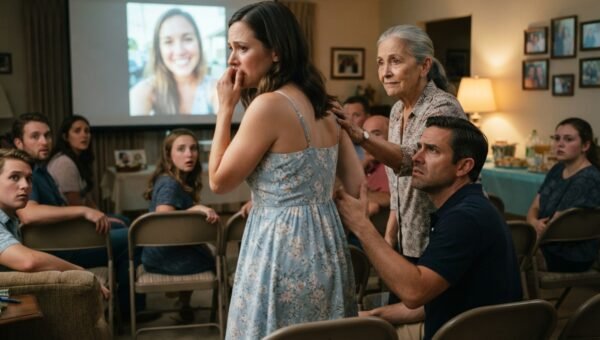
Frank showed up near the end of the cocktail hour, just before the reception dinner was served. He looked smaller than the angry, shadowy figure David had described over our twenty-eight years of marriage. He was seventy-six, wearing an off-the-rack gray suit that hung loose on his frame, carrying an ordinary brown coat over his arm. He did not bring a wrapped box, an envelope with a card, or a guest. He carried only a small, cream-colored business envelope tucked against his chest.
He stayed less than ten minutes. He did not try to sit down. He did not go near Table 1, where Evelyn was busy fixing her granddaughter’s veil and complaining about the temperature of the soup. Frank waited by the double doors near the coat check until David spotted him and walked over.
I watched from twenty feet away, my hands tight around my champagne glass, ready to pull David away if things turned ugly. But nothing loud happened. Frank spoke a few words that I could not hear over the band tuning up. He handed the small cream envelope to David, pressed both hands against David’s shoulders, and pulled him into a brief, awkward hug. David did not hug him back right away, but he did not pull away either. By the time David stepped back, Frank was already turning toward the exit. He walked out into the parking lot under the drizzle, got into a ten-year-old Buick, and drove off into the dark.
David slid the envelope into the inside pocket of his tuxedo jacket. His face was completely flat. When I asked him what his father had said, David only shook his head and said, “He told me not to open it until tonight was over.”
We got through the speeches, the cake cutting, and the last dance with Megan and her new husband. We loaded the gifts into our trunk, tipped the banquet captain, and drove back to our quiet house around midnight. The house was dead quiet. The heels of my shoes felt like lead against the linoleum.
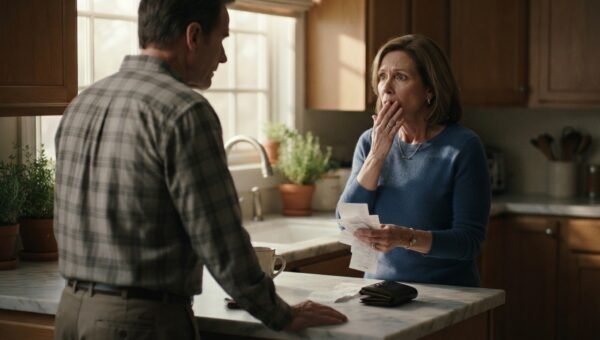
David sat down at the kitchen table without taking off his jacket. The tie was undone, dangling loose around his collar. He pulled the cream envelope from his pocket, took a small paring knife from the drying rack, and sliced the top seam.
Inside was a faded, stapled ledger packet from the Montgomery County Child Support Enforcement Agency, along with several carbon-copy receipt slips that smelled faintly of old basement dust. Every single page was dated. Every month from October 1984 through August 1998 had an official county cashier stamp next to it, marked “RECEIVED – FULL PAYMENT.”
Every single payment. Fourteen straight years without a missed month.
David’s hands began to shake as he flipped through the staples. Evelyn had sworn on her own parents’ graves for three decades that Frank had vanished into thin air and left them penniless.
At the bottom of the last summary page, below a bank endorsement stamp, there was a handwritten note in faded black ballpoint ink: “Deposited to account ending 4412.”
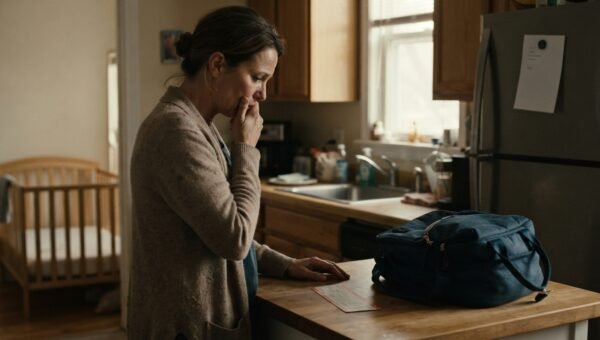
David stared at the four digits for nearly two minutes without blinking. His breathing went shallow, the way it does when someone takes a heavy blow to the chest. He looked up at me across the laminate table, his eyes bloodshot and glassy under the yellow kitchen fixture.
“That wasn’t child support,” David said, his voice cracking down the middle. “That was Mom’s college fund account for Claire.”
PART 2
The house stayed completely silent except for the refrigerator humming in the corner. I pulled a chair out and sat down next to David, pulling the papers toward myself to read the fine print.
The receipts were county-certified carbons, pink and yellow slips with perforated edges. Frank had paid $425 a month starting the month he left in the fall of 1984, which increased to $550 a month by 1990 after a court review. It was all there: court case numbers, docket stamps, the signature of the Montgomery County clerk, and deposit transfer memos from the old Third National Bank, which had been bought out by National City decades ago.
“Look at the account name,” I said softly, pointing to the bottom carbon slip.
The primary name on account 4412 was Evelyn M. Vance. The secondary designation was listed clearly as “Claire E. Vance – Uniform Gifts to Minors Act.”
David’s name was nowhere on that account.
David had dropped out of his second semester at community college in 1988 because Evelyn told him there was no money for his tuition books or his car insurance. He had taken a graveyard shift at a distribution warehouse in Dayton, lifting crates until his back gave out at thirty, while Evelyn told him that a good son helps his mother carry the burden of an absent, deadbeat father. Meanwhile, his younger sister Claire had gone to Ohio State for four full years without working a single summer job. Claire lived in an off-campus apartment that Evelyn always claimed had been paid for by a private scholarship from her church and Evelyn’s own overtime savings.
“He paid,” David whispered. He ran his thumb over the county cashier’s purple ink. “He paid every dime. He paid over seventy thousand dollars.”
“David, look at the date on the last slip,” I said.
The final payment slip was dated August 14, 1998, the exact month Claire turned eighteen. Tucked behind the county ledger was one single sheet of lined legal pad paper, folded in thirds. The handwriting was cramped, written with an old-fashioned fountain pen that had bled slightly into the fibers of the paper.
“David,” the note began. “I know you think I threw you away. That’s what your mother told you, and that’s what you had to believe to survive in that house. In 1984, your mother filed a court order saying if I contested the custody arrangement or came within five hundred feet of the property, she would drag Claire through court and claim abandonment. The judge ordered child support through the county clerk. I paid it directly so she couldn’t say I defaulted. In 1989, when you were seventeen, I went to your high school track meet to watch you run the hurdles. Evelyn saw my truck in the lot, called the police, and told the officer I was harassing the family. She told me right there in the parking lot behind the bleachers that if I ever tried to contact you directly, she would tell you and Claire that I had another family in Indiana.
I didn’t have another family. I lived in an eight-hundred-square-foot duplex in Springfield and worked sixty hours a week at the machine shop. When you turned eighteen, I went to your apartment, but your mother had already told you I was garbage, and I saw the look on your face when you answered the door. You slammed it. I realized then that if I pushed, I would only ruin whatever peace you had left. I am giving you this now not because I want you to hate your mother. I am giving it to you because you have a daughter of your own tonight, and a man should not go to his grave having his son believe he was a coward who didn’t care whether his boy ate or starved.”
David did not cry. He just sat there, reading the letter three times through, his mouth pressed into a thin, bloodless seam.
At 1:30 in the morning, David stood up, walked into our bedroom, and took off his tuxedo. He hung the jacket over the back of the dining chair with the cream envelope sticking out of the breast pocket. He lay on top of the bed with his clothes on, staring at the ceiling until the sun started coming through the blinds.
The next morning was the post-wedding family brunch at our house. It had been planned for six months. Evelyn was scheduled to arrive at eleven with Claire and Claire’s husband.
By ten, the coffee maker was running and the breakfast casseroles were in the oven, but neither David nor I had spoken more than ten words. David went outside, swept the porch, arranged the patio chairs, and checked the driveway twice. When Evelyn’s blue sedan pulled up at twenty past eleven, David stopped on the walkway and watched her step out.
Evelyn was seventy-eight, perfectly coiffed, carrying a box of bakery rolls and her small leather purse. She stepped onto the porch, smiled at David, and said, “The wedding was lovely, David, but you shouldn’t have let your father near the hall. It was completely inappropriate after what he put us through.”
David didn’t answer. He held the screen door open for her, stepped inside behind her, and locked the latch.
PART 3
Claire walked in two minutes later, talking loudly on her phone about the traffic on Interstate 75. Her husband trailed behind with a case of sparkling cider.
“Sit down, Mom,” David said. His voice was not loud, but it had a strange, flat edge that made Claire stop mid-sentence and hang up her call.
“What’s the matter with you?” Evelyn asked, setting the bakery box on the kitchen island. “You look like you didn’t sleep a wink. You always did let big events get to your nerves.”
David walked over to the dining room chair, picked up the cream envelope, and laid the Montgomery County child support ledger flat on the island, right next to the white bakery box.
Evelyn glanced down at the papers. She saw the purple Montgomery County stamp, and her hand froze on the handle of her purse. Her jaw tightened, but she did not back up.
“Where did you get that?” she asked.
“Frank,” David said. “He stayed ten minutes last night. Just long enough to put this in my hands.”
Claire stepped closer, leaning over the counter with a confused frown. “What is that? Old tax forms?”
“It’s child support,” David said, looking directly at his mother. “Fourteen years of it. Certified by the county. Paid every single month from the week he walked out until Claire’s eighteenth birthday.”
Claire looked from the papers to Evelyn. “Mom? I thought Dad never paid anything. You told us he left state to dodge the court orders.”
“He was an abusive, neglectful man,” Evelyn snapped, her voice rising an octave, sharp and defensive. “He broke this family in half, Claire! He abandoned us in that ratty rental while he lived his own life. If he sent a few scraps of money to clear his conscience with the state, that doesn’t make him a father.”
“Seventy-one thousand four hundred dollars isn’t a few scraps, Mom,” David said evenly. “Not in 1985. Not in 1992.”
He flipped the top three ledger sheets over and pointed his finger at the bottom transfer memo.
“Account ending in 4412,” David said. “Third National Bank. That was your savings account, wasn’t it?”
Evelyn’s mouth opened, but no sound came out right away. She gripped her purse tighter against her side. “I had to manage the household, David. You don’t know what it took to keep shoes on your feet. You were a child.”
“No,” David said. “Account 4412 wasn’t the household checking account. The household account was at KeyBank, ending in 0891. I know that because I used to write out your utility checks for you when your arthritis flared up. 4412 was the custodial college fund for Claire. You had Frank’s child support direct-deposited straight into an account that only had Claire’s name on it.”
Claire gasped, her face flushing bright red. “Wait. Mom, that account was my college money? You told me that was from Nana’s life insurance policy!”
“It was family money!” Evelyn shouted, her voice shaking with sudden, ugly fury. “It was money for our family! David was already working! He had a job at the store, he was strong, he could take care of himself! You needed an education, Claire! You were a girl, you needed security! If I had told David his father was sending checks, he would have run right back to that man, and after what Frank did to my pride, I wasn’t going to let him have my son!”
The room went dead.
There it was. She didn’t say Frank had beaten her. She didn’t say Frank had stolen from them. She said: *after what Frank did to my pride.*
David took a slow breath. He didn’t yell. He didn’t sweep the bakery box off the island or slam his fist on the counter. That was the part that made my throat ache the most; David had carried that heavy, self-blaming burden for thirty-two years, believing his father had looked at him and decided he wasn’t worth four hundred dollars a month.
“I dropped out of school, Mom,” David said, his voice dropping so low Evelyn had to lean forward to hear it. “I gave you six hundred dollars a month from my warehouse checks between 1988 and 1993 because you sat at that kitchen table with unpaid electric bills and cried that Dad had ruined us. I paid for Claire’s braces. I paid for the transmission on your Buick. I did that because I thought we were drowning.”
“You were helping your family!” Evelyn insisted, tears finally spilling down her powdered cheeks, though they looked more like anger than grief. “That’s what a good son does! You have a good life now, David! You have a nice house, you have a wife, you have Megan married off! Why are you letting that bitter old man poison you against your own mother?”
“He didn’t poison me,” David said. “He just brought the receipts.”
David picked up the papers, squared the edges neatly against the countertop, and slipped them back into the cream envelope. Then he looked at his mother, not with hatred, but with a cold, clear distance that I had never seen in him before.
“I want you to leave, Mom,” David said. “Take the rolls, take your purse, and go home.”
ENDING
Claire started crying right there in the kitchen. She tried to touch David’s arm, saying she had never known, that she would never have touched a cent of that money if she had known it was paid on David’s back. David gently took her hand off his sleeve and told her he didn’t blame her. He knew Claire was only six years old when Frank left. She had only known the version of reality Evelyn had fed her with a silver spoon.
Evelyn didn’t apologize. When she realized David wasn’t going to back down, her tears stopped instantly. She picked up her leather purse, pulled her coat tight around her shoulders, and walked out to her car without looking at me or David again. Claire’s husband drove Evelyn home in her Buick, while Claire stayed on our back patio for two hours, sitting on an iron chair with her head in her hands, trying to put together thirty years of family lies.
Two days later, on Tuesday afternoon, David took a half-day from work. He didn’t tell me where he was going, but when he came back to the house around five, I saw grease on the cuff of his blue work shirt and a white paper coffee cup from a diner in Springfield sitting in his cup holder.
He walked into the kitchen, washed his hands at the sink, and dried them on the dish towel.
“Did you find him?” I asked.
David nodded. “He works part-time at an auto parts warehouse off Route 40. Mostly inventory and sorting gaskets.”
“Did you talk to him?”
“A little,” David said. He leaned back against the counter, looking out the kitchen window at our backyard garden. “We sat in his truck behind the loading dock. I didn’t know what to say to him at first. I told him I got the papers. He told me he didn’t expect me to call him Dad. He said he just wanted me to know that when he was standing in the rain behind those bleachers at my track meet in 1989, he was proud of the way I cleared the hurdles.”
David’s voice caught on that last word, but he cleared his throat and looked down at his wedding ring.
“We’re going to get coffee next Saturday,” David said. “Just the two of us. At a Bob Evans halfway between here and Springfield.”
Things with Evelyn changed permanently. David didn’t cut her off completely; he still makes sure her lawn gets mowed and her prescription medicines are delivered to her door, but he stopped going over for Sunday dinners. He stopped calling her every evening on his drive home from the shop. The blind, devoted loyalty he had carried since he was twelve years old simply evaporated, replaced by a quiet, civil boundary that Evelyn could never cross again.
Last night, David went into our basement and brought up an old cardboard shoebox filled with his high school ribbons and newspaper clippings. He found the faded blue ribbon from that 1989 district track meet, smoothed out the wrinkled satin with his thumb, and set it on the nightstand next to his watch.
He didn’t say a word about it, and neither did I. But for the first time in all the years I have known my husband, he fell asleep without grinding his teeth.