PART 1
When you grow up with almost nothing, you learn early how to hide the sound of your own stomach.
I was thirteen years old that fall, living in a narrow two-room rental behind a radiator shop in south Columbus. My mother worked six days a week cleaning linens at an industrial dry cleaner, and our supper was usually whatever was left in the cupboard: white toast with margarine, cabbage boiled with bacon grease, or generic tomato soup stretched thin with tap water.
I owned two pairs of pants that hit above my ankles and a brown winter jacket with a broken plastic zipper I held shut with a safety pin.
One Thursday in October, my classmate David asked me to walk over to his house after eighth-period gym to work on an eighth-grade science poster. David’s father was an insurance appraiser, and their home sat on a quiet street lined with tall maple trees and neat sidewalks. To me, that house felt like a museum. The rugs were thick enough to muffle footsteps, and the air smelled like roasting meat and cinnamon.
Around six o’clock, David’s mother, Mrs. Miller, called us downstairs.
“Dinner is on the table, boys,” she said.
I tried to make an excuse to go home, but David pulled my sleeve. “Stay,” he said. “Mom made a whole roast chicken.”
I sat down at their long dining table between David and his older sister.
There were china plates with blue floral edges, cloth napkins folded beside real silverware, a bowl of buttered egg noodles, green beans, and a platter piled high with carved chicken.
David’s father bowed his head and said a short grace. When he said amen, they passed the platter.
I took one small piece of white meat and a spoonful of noodles. I ate as carefully as I knew how, holding my fork with two fingers the way I had seen teachers do in the cafeteria, keeping my elbows off the wood, chewing with my mouth closed until the food was completely gone.
Halfway through the meal, the conversation stopped.
I glanced up from my plate. David’s father had lowered his fork. His sister was looking down at my hands. Mrs. Miller was leaning forward, her gaze fixed entirely on me, not blinking, her mouth pressed into a tight, hard line.
Nobody passed another bowl. Nobody asked me about school. Every single person at that table was staring directly at me in complete silence.
A hot prickle of shame rose up the back of my neck. I looked down at my hands. My fingernails were scrubbed clean. I hadn’t spilled anything. I hadn’t made a sound. But their eyes remained on me, cold and steady, until I set my fork down on the rim of the plate.
“Thank you for dinner,” I whispered, barely able to get the words past my throat. “I need to get home before dark.”
Mrs. Miller didn’t say, “You’re welcome.” She just watched me stand up, push my wooden chair in, and walk out into their front hallway. I grabbed my coat with the pinned zipper and ran the mile and a half back to our rental in the chilly dusk, my chest burning the whole way.
The next afternoon, Friday, I walked up our cracked front steps after school and pushed open the screen door.
I stopped dead in the doorway.
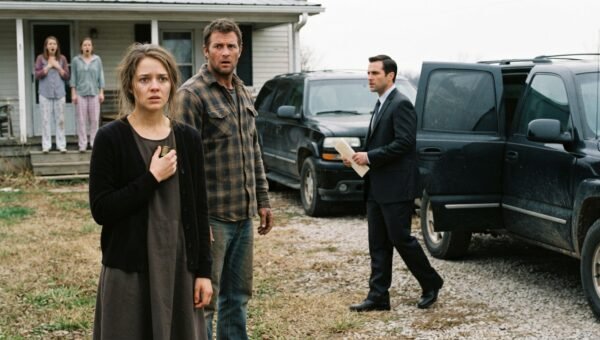
Sitting at our small chrome kitchen table, her beige handbag perched on the cracked yellow vinyl beside her, was Mrs. Miller.
My mother was standing by the stove, clutching a damp dishcloth in both hands. Her knuckles were white, and her face was flushed dark red from her neck to her forehead.
She turned around, saw me standing in the doorway with my backpack, and said in a tight, trembling voice, “Take your shoes off and go in the bedroom right now.”
PART 2
I didn’t move fast enough.
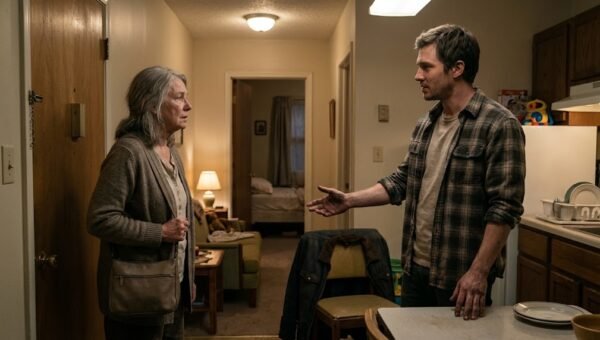
“Wait,” Mrs. Miller said. She stood up from our wobbly chrome chair. Her coat was camel hair, soft and expensive, hanging past her knees, completely out of place against our peeling wallpaper. “I came here because of what happened last night, young man.”
My mother’s breath came out fast and shallow. She stepped between Mrs. Miller and where I was standing by the threshold.
“He didn’t steal anything from your home,” my mother said. Her voice shook, but it had a dangerous edge I had never heard before. “I searched his pockets myself the minute you walked in here. He has never taken a single nickel from anyone. If you think my boy is a thief, you can call the police to this door right now.”
“I never accused him of stealing, Mrs. Ward,” Mrs. Miller replied calmly. She reached into her coat pocket and pulled out a small, pale blue card. “I came because of how he ate.”
The shame from Thursday night flooded back into my throat, thicker and hotter than before.
“I watched him,” Mrs. Miller continued, looking straight at my mother. “He ate like a boy who hadn’t seen solid protein in three days. He took tiny bites, his hands were trembling, and when my husband offered him seconds, he wouldn’t look up because he was terrified we would notice he was still hungry.”
My mother’s face stayed crimson, but her shoulders dropped an inch. Her chin jerked up. “We manage. We don’t ask for charity.”
“This isn’t charity,” Mrs. Miller said. She held out the blue card. “Our church runs the auxiliary food program for the county hospital. My husband is the treasurer on the board. We have two paid after-school sorting jobs open at the food pantry warehouse on Sullivant Avenue, starting next week. Three afternoons a week, four hours a day, ten dollars an hour. We also provide dinner for every worker on the shift.”
She looked over my mother’s shoulder, directly at me.
“David told me you’re the top student in eighth-grade algebra,” Mrs. Miller said quietly. “We need someone to log inventory on the ledger and help unpack the delivery trucks. But the state labor board requires a parent’s signature for a fourteen-year-old worker, and you turn fourteen next month, don’t you?”
I nodded once, unable to speak.
“My family wasn’t staring at you last night to be cruel,” Mrs. Miller said, her voice softer now. “My husband recognized you. His father worked twenty-five years at the old rail yard with your grandfather before the yard shut down. He knew who you were the minute you sat down at our table. He looked at you, and then he looked at me, because we both knew what pride does to people in this town. You were starving yourself so you wouldn’t impose, and your mother was working herself into the grave trying to keep this roof over your heads.”
PART 3
My mother looked down at the pale blue card on the table.
She didn’t reach for it. For thirty seconds, the only sound in the kitchen was the faint hum of our old refrigerator rattling in the corner.
“I work forty-eight hours a week at the laundry,” my mother said, her voice dropping to a harsh whisper. “I buy what I can. I pay thirty-two dollars a week for this room, and I buy milk and oats. We don’t take handouts from church committees. We never have.”
“It’s not a handout,” Mrs. Miller repeated firmly. “It is honest work. Your son will earn every dollar he takes home. He will be doing actual bookkeeping for forty-five families who depend on those crates every Saturday morning.”
She set a small manila envelope beside the blue card.
“Inside is the application and the permit forms. You sign them, or you don’t. But if you let your pride starve your boy’s future, Mrs. Ward, that isn’t dignity. That’s just stubbornness.”
Mrs. Miller walked past me toward the screen door. She paused on the top step, looked back into the kitchen, and said, “David expects you at three o’clock on Monday to finish that science poster, Arthur. Don’t be late.”
The screen door clicked shut behind her.
My mother stood staring at the manila envelope for a long time. Her face was still flushed, but the anger was gone, replaced by a deep, weary grayness around her eyes. She pulled a chair out, sat down at the table, and buried her face in her rough, red hands.
I didn’t know what to do. I set my backpack on the linoleum floor, walked over to the table, and put my hand on her shoulder.
“Mom,” I said. “I can work. I want to work.”
She didn’t look up, but she reached out and pulled the manila envelope toward herself. She picked up a stubby pencil from the windowsill, unfolded the county work permit, and signed her name on the bottom line.
Her signature was shaky, but the pencil pressed hard enough into the paper to leave a deep groove.
ENDING
The following Tuesday afternoon, I walked through the double metal doors of the warehouse on Sullivant Avenue for my first shift.
David’s father was there, wearing gray work pants and heavy boots. He didn’t say anything about the dinner at his house. He just handed me a yellow legal pad, a blue ballpoint pen, and a clip-on badge with my name written in block letters.
“Two boxes of dry beans per crate, four cans of stew, one sack of flour,” Mr. Miller said, clapping a heavy hand on my shoulder. “Write down the lot numbers from every skid before you break down the pallets. At five o’clock, we eat.”
For four years, all through high school, I worked at that warehouse three afternoons a week. I made $120 every two weeks, cash in a brown envelope, and every dollar went straight onto our kitchen table to pay for real meat, fresh eggs, and winter boots that actually fit. At the end of every shift, Mrs. Miller would pack a brown paper bag with four roast beef sandwiches and two pieces of fruit for me to take home to my mother.
My mother never met Mrs. Miller again for coffee or pleasant conversation. They came from different worlds, and the shame of that Friday afternoon never fully left my mother’s eyes whenever church was mentioned. But my mother never tore up the work permit, either.
Thirty years later, after my mother passed away in a warm, paid-for nursing home in northern Ohio, I had to clean out her bedroom dresser.
In the bottom drawer, tucked beneath her Sunday gloves and an old silver pocket watch that had belonged to my grandfather, was that same pale blue card Mrs. Miller had left on our yellow vinyl table in 1982.
The corners were dog-eared, and the blue paper had faded almost white. On the back, in my mother’s faint pencil handwriting, were three words she had written on the night she signed my work permit:
Arthur’s clean start.
I didn’t throw it away. I folded it into my wallet, right behind my driver’s license, where it sits to this day.