PART 1
The moving truck was already backed halfway up Mom’s gravel driveway when Brenda walked out the screen door, carrying a cracked plastic laundry basket full of cleaning rags.
It was twenty-eight days after we buried our mother, Martha Vance, in the churchyard cemetery out on Route 9. Mom had fought vascular dementia for nearly two years, but during the final six months, her memory slipped away completely. She did not know what year it was, she could not remember what she had eaten for breakfast, and half the time she called me by her younger sister’s name.
I was fifty-six, working four days a week as an intake clerk at the county health department. For eighteen months, I was the one who drove over every evening after work to crush Mom’s medication into applesauce, wash her bedsheets, and pay her heating oil bills from her small checking account.
Brenda lived in a gated subdivision twenty miles north in Strongsville. She drove a leased white Lexus, wore designer sunglasses, and managed an upscale commercial salon. During those eighteen months of hospice and hospital beds, Brenda visited our mother exactly four times. Each time, she stayed less than twenty minutes, complaining about the smell of disinfectant before kissing Mom on the forehead and rushing back to her appointments.
Then, three weeks before Mom died, Brenda showed up on a Tuesday morning while I was at my desk at the clinic.
She brought a mobile notary public whom she knew from her salon network.
When I arrived at four-thirty to start dinner, Brenda was standing in the foyer, zipping an expandable leather portfolio. She gave me a tight, triumphant smile and told me she had taken legal charge so I would not be burdened.
Mom passed away on a rainy Sunday morning. Four days after the funeral, Brenda served me with a certified eviction notice via the county sheriff.
Brenda had executed a quitclaim deed transferring Mom’s three-hundred-and-ten-thousand-dollar brick split-level directly into her own private LLC, using a durable power of attorney Mom supposedly signed on that Tuesday morning. She claimed that under the document, she was granted absolute authority to liquidate real estate to settle family affairs. The probate court clerk informed me that because the deed had been recorded before Mom’s death, the house bypassed probate entirely.
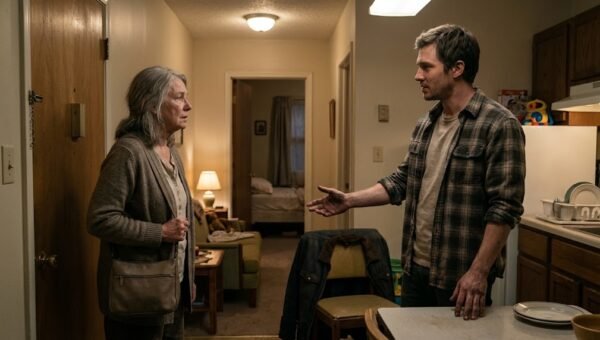
When I arrived that Saturday morning to pack my old childhood books and the sewing machine my grandmother gave me, Brenda had already changed the deadbolts.
Two men from a clean-out crew were tossing Mom’s porch furniture into the back of a dumpster.
I stood on the front lawn, clutching my purse against the cold October wind. “Brenda, please,” I said, trying to keep my voice from breaking. “Let me go through the upstairs cedar chest. Mom promised me her photo albums and the kitchen dishes we used for Sunday dinners.”
Brenda leaned against the brick pillar of the front porch, arms crossed over her wool coat. Her eyes were cold, completely devoid of grief.
“The personal property belongs to the estate, Sarah, and the estate belongs to me,” Brenda said loudly, loud enough for the moving crew to hear. “You lived off Mom’s goodwill for years while I handled the real financial pressure. Everything inside is being staged for the estate sale on Friday.”
She reached down behind the porch railing, picked up an old rectangular wooden recipe box with faded painted daisies on the hinged lid, and tossed it into the damp grass at my feet.
The lid popped open, scattering several handwritten index cards onto the lawn.
“Take that kitchen junk and go,” Brenda sneered, checking her watch. “If your car is still parked on this curb in ten minutes, I am calling the township police for criminal trespass.”
I knelt on the wet grass, my knees soaking through my trousers. I gathered the scattered cards with trembling hands, closed the little wooden latch, and carried the box to my car.
For four years, that recipe box sat on the high shelf above my stove in my two-bedroom rental duplex. I could not bear to open it. Every time I looked at those painted daisies, I heard Brenda’s cruel laugh and felt the humiliating burn of standing on Mom’s lawn while strangers hauled our family history to the dump.
Brenda renovated Mom’s house, lived in it for two years to avoid capital gains taxes, and then put it up for lease as an executive rental for twenty-six hundred dollars a month. She cut all contact with me. If we crossed paths in the grocery store aisle, she turned her cart around and walked in the opposite direction.
Then came a Saturday afternoon four years later, in early November.
I was standing on a wooden stepstool, wiping down the greasy cabinet faces above my stove before the Thanksgiving holidays. My elbow caught the corner of the wooden recipe box. It tumbled off the shelf, bounced hard off the laminate countertop, and hit the kitchen floor with a heavy crack.
The painted box did not just pop its latch. The impact split the bottom panel completely, loosening a false floor made of thin cedar veneer that had been nailed into the base with tiny brass brads.
I crouched on the floor to pick up the loose recipe cards. That was when I saw the thick parchment paper wrapped inside dark brown oilcloth, tucked neatly into a hidden cavity beneath the recipe dividers.
Beside the folded paper lay three original certificates of stock in ExxonMobil, issued in my mother’s name, totaling nine hundred and fifty shares. With stock splits and dividends over thirty years, the certificates were worth over ninety-five thousand dollars.
Folded around the stock certificates was an official legal document dated August 12, 1994.
It was an unrecorded warranty deed for the three-hundred-and-ten-thousand-dollar house, signed by my mother, conveying full title of the property solely to me.
Pinned to the front of the deed was an index card written in Mom’s steady, unmistakable cursive, dated fifteen years before her mind began to fade. The note read:
“Sarah, my sweet girl. If you are reading this, it means Brenda has shown her true nature after I am gone. Do not let her frighten you. Take this original deed and the stock directly to Judge Arthur Miller at the county courthouse. Tell him Martha sent you. He holds the sealed master docket from 1994, and he knows what Brenda did.”
PART 2
I sat on the kitchen floor for nearly twenty minutes, surrounded by spilled recipe cards for sugar cookies and pot roast, staring at the faded ink of my mother’s signature.
The name Judge Arthur Miller was familiar, but I had not thought about him in years. In 1994, Arthur Miller was not a probate judge. He was our family attorney, the man who had handled my father’s small business filings and settled my grandfather’s estate. When my father died unexpectedly in the spring of 1993, Mr. Miller had spent hours in our living room, helping Mom sort through debts, insurance policies, and property taxes. He had been elected to the county court of common pleas in the late nineties and served as the administrative judge of the probate division until his retirement three years ago.
The date on the deed, August 12, 1994, struck me with the force of a physical blow.
That was the summer Brenda was twenty-four and working as an assistant manager at a savings and loan branch in Medina. I remembered a terrible night that August when Brenda had come home past midnight, crying hysterically, while Mom shut the kitchen doors and spoke in hushed, urgent tones with someone on the phone until sunrise. Two days later, Mom withdrew eighteen thousand dollars from her emergency savings, and Brenda abruptly moved to an apartment across the county line. Mom had refused to speak a single word about what happened, telling me only that family matters stayed under our roof.
Now, looking down at the deed, the legal language was clear and formal.
The document conveyed Mom’s house on Oak Creek Road directly to me, Sarah Vance, reserving a life estate for Martha Vance until the day of her death. It had been signed by my mother before a licensed notary public, witnessed by two independent parties, and marked with a raised corporate seal from Arthur Miller’s private law office.
Beneath the signature line was a typed notation: *Executed in duplicate; Master counterpart retained in escrow pending grantor’s demise or notice of adverse claim.*
Mom had not merely given me the house. She had transferred the legal remainder interest to me thirty years ago, long before Brenda ever drafted her power of attorney.
On Monday morning, I took a personal day from my job at the clinic.
I dressed in my Sunday slates, placed the oilcloth bundle inside a protective leather binder, and drove down to the county justice center in Medina. Judge Arthur Miller had retired from the bench, but according to the court directory, he still maintained senior judicial status and held an office on the fourth floor as an estate mediator twice a week.
When I gave my name to the clerk outside his chambers, the older woman looked at me with curiosity. She picked up her desk phone, spoke for a few seconds, and then opened the heavy oak door.
“Judge Miller will see you right now, Ms. Vance,” she said.
The room smelled of old leather books and coffee. Arthur Miller sat behind a broad mahogany desk, looking remarkably sharp at seventy-eight years old, his silver hair neatly combed above a tweed jacket. When he saw me step through the doorway, his eyes widened slightly, and he stood up from his chair.
“Sarah,” he said, extending a warm, firm hand across the desk. “You look so much like your mother. Please, sit down. When my clerk said Martha Vance’s daughter was outside, I wondered which of you had finally found the box.”
My breath caught in my throat. “You knew about the recipe box?”
Judge Miller opened a center drawer, pulled out a pair of gold-rimmed reading glasses, and gestured toward my binder. “Martha came to my office thirty years ago this summer. She was brokenhearted, but she was one of the most clear-headed women I ever represented. Lay out what you found, Sarah.”
I opened the binder and placed the 1994 warranty deed, the ninety-five thousand dollars in stock certificates, and Mom’s handwritten index card onto his green desk blotter.
Judge Miller picked up the note first. He read it in silence, a faint, sad smile touching the corners of his mouth. Then he picked up the deed, inspected the notary stamp, and held the parchment up to the daylight coming through the tall windows.
“Brenda took the house, didn’t she?” Judge Miller asked, setting the document down. “She used an eleventh-hour power of attorney while your mother was incapacitated.”
“Yes,” I answered, my throat tight. “Three weeks before Mom passed. She transferred the property into an LLC and evicted me. She told me the house bypassed probate entirely.”
Judge Miller leaned back in his leather chair and shook his head with quiet disgust.
“Brenda always believed she was the cleverest person in the room,” he said softly. “In July of 1994, Brenda was caught embezzling funds from the customer teller drawers at First Federal. She had stolen sixteen thousand dollars to pay off credit card debts and cover retail sprees in Cleveland. The bank president was a personal acquaintance of your late father. He agreed not to refer the matter for criminal prosecution on one condition: full restitution within seventy-two hours.”
The mystery of that terrible summer suddenly dissolved into crystal clarity.
“Mom paid it,” I whispered.
“Martha paid every dime from your father’s life insurance proceeds,” Judge Miller confirmed. “She emptied her emergency reserves to keep Brenda out of state prison. But that night, Martha sat in this very office and told me something I have never forgotten. She said, ‘Arthur, Brenda has no conscience. If she would steal from strangers who trusted her with their savings, she will strip Sarah of everything the moment I am in the ground.'”
Judge Miller pulled a set of brass keys from his vest pocket, walked over to a heavy steel safe in the corner of his chambers, and turned the dial. He pulled out a thick, faded legal envelope labeled *Vance Estate – Escrow Trust 1994*.
“Under Ohio real property law, a power of attorney only grants an agent the authority to act on behalf of the principal,” Judge Miller explained, returning to his desk. “An agent cannot execute a deed to themselves without explicit gifting authority written into the instrument, and any transfer made while the grantor lacks mental capacity is completely void from inception. But more importantly, Sarah, your mother did not own the underlying remainder title to that house when Brenda signed that paper.”
He opened the escrow envelope and placed a certified duplicate deed on the desk beside mine.
“In August 1994, your mother executed this valid, irrevocable conveyance to you. She retained only a life estate for her own occupancy. The moment your mother drew her last breath four years ago, her life estate terminated automatically by operation of law. Absolute, unencumbered fee-simple ownership vested directly in you. Brenda’s quitclaim deed transferred absolutely nothing, because Brenda’s power of attorney had zero title to convey.”
PART 3
Judge Miller did not waste an hour.
He made two phone calls: one to the county recorder’s office to place an immediate administrative lien on the property parcel, and a second to an estate litigation specialist named Katherine Ross, whose firm was located two blocks from the courthouse.
“Katherine,” Judge Miller told her over the speakerphone, “I am sending you Sarah Vance. We have an unrecorded 1994 conveyance with an executed duplicate held in judicial escrow, combined with an unauthorized self-dealing quitclaim deed executed under an invalid power of attorney. I want an action to quiet title filed by four o’clock, and I want an emergency freeze placed on the LLC’s rental receipts.”
By two o’clock that afternoon, I was sitting in Katherine Ross’s office, reviewing the paperwork.
The numbers were staggering. For four years, Brenda had collected twenty-six hundred dollars a month in rental income from the family home, totaling one hundred and twenty-four thousand eight hundred dollars. Furthermore, the ninety-five thousand dollars in ExxonMobil stock certificates had accrued nearly eighteen thousand dollars in unpaid dividend distributions, which had been held in the state unclaimed funds treasury because Brenda had failed to produce the physical certificates.
“We aren’t just taking your house back, Sarah,” Katherine Ross told me, her voice crisp and steady. “Brenda committed self-dealing under a fiduciary instrument. We are filing a quiet-title complaint, an emergency motion for declaratory judgment, and a petition for full financial accounting. She will have to disgorge every single dollar of rental income she pocketed, plus interest.”
On Wednesday afternoon, the process server delivered the summons and complaint to Brenda’s salon in Strongsville.
My phone rang at six-fifteen that evening.
I picked it up. Brenda’s voice was sharp, fast, and trembling with rage.
“What kind of pathetic stunt is this, Sarah?” she hissed into the line. “A thirty-year-old unrecorded deed? You think you can walk into court with a piece of paper from 1994 and undo four years of legal ownership? My attorney told me an unrecorded deed is worthless against a recorded instrument!”
“Your attorney should check the law regarding self-dealing under a power of attorney, Brenda,” I replied, my voice calm, without a single tremor. “And you might want to call Judge Arthur Miller. He holds the escrow duplicate from the day Mom protected the house after your little incident at First Federal.”
The line went completely dead for five seconds. When Brenda spoke again, the arrogant sneer had vanished, replaced by a raw, hollow panic.
“You brought Arthur Miller into this?” she stammered. “He was retired. He has nothing to do with this.”
“Arthur Miller held Mom’s trust,” I said. “He knows why Mom wrote that deed, and he knows what you did to her emergency savings thirty years ago. I spent four years living in a rental while you rented out our family home. The lawsuit is filed, Brenda. Do not call my phone again.”
I disconnected the call before she could scream.
The legal battle lasted less than three months.
When Katherine Ross presented the certified escrow counterpart from Judge Miller’s vault alongside Mom’s medical records proving advanced cognitive decline at the time Brenda’s notary signed the power of attorney, Brenda’s legal counsel knew they were facing total defeat. In Ohio, a self-dealing conveyance by a fiduciary without explicit written authority is considered void ab initio, invalid from the moment of signature.
Worse for Brenda, the notary public who stamped the power of attorney admitted under deposition that our mother had been completely non-responsive during the signing, simply nodding her head while Brenda guided her pen. Faced with potential criminal referrals for filing a false instrument and elder exploitation, Brenda’s attorney approached Katherine with a surrender offer.
In late January, we met in a neutral conference room at the county justice center.
Brenda sat across the table, dressed in a muted gray pantsuit, with dark circles under her eyes. She refused to look at me. Her hands shook as her attorney laid out the agreed settlement entry.
Under the terms of the court order, Brenda surrendered all legal claims to the property on Oak Creek Road. The county recorder was directed to cancel the fraudulent quitclaim deed and register the 1994 deed, placing the title solely in my name.
Furthermore, to avoid criminal proceedings and a formal judgment for conversion, Brenda agreed to transfer a lump sum of eighty-five thousand dollars from her personal investment accounts to reimburse the net rental income she had collected, while signing a promissory note for the remaining thirty-nine thousand dollars, secured by a second mortgage on her own salon building.
When the final signature was inked, Brenda pushed her chair back and stood up.
She leaned across the table, her face pale, her lips trembling with bitter fury. “You destroyed my life over a house Mom never meant for you to have alone,” she whispered. “You used an old man’s grudge to ruin our family.”
I looked up at her, feeling neither hatred nor pity, only a vast, clean emptiness.
“Mom meant for me to have a safe home, Brenda,” I told her quietly. “And you were the one who gave me the deed. You threw it right at my feet and told me to take the kitchen junk.”
ENDING
Two weeks later, the tenant who had been leasing the house moved out following the expiration of his commercial lease.
On a bright, cold Saturday in February, I drove down Oak Creek Road and pulled into Mom’s gravel driveway. The air was crisp, the sky a clear winter blue. I held the new brass key in my hand, walked up the front steps, and unlocked the front door.
The house was empty. Brenda had removed all the staging furniture, leaving bare hardwood floors that still carried the faint dents from my father’s old recliner in the living room.
I walked from room to room, listening to the gentle hum of the furnace in the basement. The house no longer smelled of cleaning chemicals and hostility. It smelled of cedar, old plaster, and winter sunlight.
I walked into the kitchen. The morning light poured through the bay window above the sink, illuminating the yellow laminate countertops where Mom had rolled out pie crusts every Thanksgiving of my life.
I walked out to my car, carried in a cardboard box, and set it down on the counter.
Inside was the wooden recipe box with the painted daisies. I had taken it to a furniture restorer in Medina three weeks ago. The craftsman had repaired the split cedar base, reattached the original brass latch, and hand-rubbed the faded wood with beeswax until the little daisies looked bright and fresh again.
I opened the lid. The recipe cards were neatly arranged behind their index tabs: yeast rolls, beef stew, peach cobbler, and the handwritten note from my mother that had waited thirty years to save my life.
I took the ninety-five thousand dollars in ExxonMobil stock and placed it into a secure municipal bond fund with Katherine Ross’s financial advisor, securing my retirement so I would never have to worry about my later years. The eighty-five thousand dollars Brenda reimbursed went into paying off my car, replacing the roof on the house, and planting a row of new maple trees along the driveway.
I did not sell the house.
Last night, I sat in the living room by the brick fireplace, watching the snow fall softly against the windowpanes. The room was warm, the tea was hot, and my favorite quilt was spread across my lap.
Brenda had believed that money, speed, and arrogance could overpower a lifetime of quiet decency. She thought she could take what she wanted and throw the scraps to the curb. But she had forgotten that my mother had spent her life watching everything, measuring every choice, and planning for the day when the truth would have to stand on its own feet.
I ran my fingers over the polished wood of the recipe box sitting on the small side table beside my chair.
My mother had known exactly what she was doing when she hid that deed. She had trusted that love and patience would outlast greed, and in the end, her kitchen junk had brought me all the way home.