PART 1
The honey-glazed ham was still steaming on the dining room table when Derek dropped the manila folder onto my porcelain plate.
The edge of the folder clipped my water glass, sloshing cold ice water across the linen runner my mother had embroidered forty years ago. Nobody moved. The silver fork slipped out of my fingers and hit the rim of my bowl with a sharp clink.
“Open it, Mom,” Derek said. He stayed on his feet, leaning forward with both palms flat against the mahogany table. “Just look at what you did.”
Across from me, my sister Evelyn froze with her cloth napkin halfway to her lap. She looked down immediately, smoothing the fabric over her knees, her mouth set in a thin, nervous line. Evelyn hated noise. She hated tension even more, and Derek knew how to fill a room until nobody else had air to breathe.
I looked down at the pale manila folder. My name, Clara Miller, was scrawled across the tab in black marker, alongside the previous tax year.
“Derek, we are sitting down for Easter dinner,” I said, keeping my voice level. “Your aunt drove an hour from Canton to be here. Whatever this is, put it back in your briefcase until we finish.”
“No,” Derek said, his voice rising enough to make Evelyn flinch. “We aren’t doing that today. We are not pretending everything is fine while you cost me seventy-four hundred dollars. You filed your own return on Tuesday, didn’t you? Behind my back.”
“I filed my taxes like I have done every spring since your father died,” I replied. “I walked into Arthur Vance’s office on Tuesday afternoon, signed my paperwork, and had him transmit it. That isn’t behind your back. That is my personal business.”
“It stopped being your personal business when you ruined my filing status,” Derek snapped. He yanked the folder open, pulling out several stapled forms with yellow sticky notes flagging the bottom lines. “I claimed you as a qualifying relative dependent. My accountant submitted my return three weeks ago. Then this morning, I get a formal notification from the IRS rejecting my electronic submission because your Social Security number was already processed on an independent return.”
I sat back against the wooden chair. At sixty-eight years old, I live alone in a two-bedroom brick ranch that my late husband, Thomas, and I paid off twelve years before cancer took him.
I pay my property taxes in two installments every June and December. I pay my gas, electric, water, and car insurance from my monthly pension and Thomas’s survivor benefit.
“Why on earth would you claim me as a dependent?” I asked. The confusion was real, but beneath it, a sharp knot of dread began to tighten in my stomach. “I am an independent adult. I maintain my own home.”
“Because I carry you,” Derek said, his face flushing red above his collar. He looked over at Evelyn, looking for an ally, but she kept her eyes fixed on the butter dish. “You act like you do everything yourself, Mom, but who covered you when your plumbing went out? Who paid the emergency restoration crew when the subfloor rotted out under your master bathroom last October? Eight thousand two hundred dollars. Straight out of my business account. That is more than half your support for the entire year, and that gives me the legal right under IRS rules to claim the head-of-household deduction and the family tax credits.”
He tapped a printed receipt stapled to the inside cover of the folder. It was an invoice from Miller Premier Plumbing for eight thousand two hundred dollars, marked paid by credit card.
“You know that wasn’t a gift, and you know you didn’t carry me,” I said, my voice dropping an octave.
“You couldn’t afford it,” Derek threw back at me. “You were panicked in your hallway crying about mold, and I stepped in and wrote the check. Now you go and file a separate ten-forty, your system flags mine as fraudulent, and my refund is frozen. I had that money earmarked for payroll taxes at the shop on the fifteenth. You need to call your CPA right now, tell him you made an error, and submit an amended return withdrawing your independent filing.”
The room fell so quiet I could hear the hum of the refrigerator in the kitchen.
I looked at my son. He was thirty-eight, running a small auto parts franchise that always seemed to be one good quarter away from breaking even. I had spent his entire twenties and thirties helping him out of jams, co-signing small equipment notes, and listening to him talk about how close he was to making it big. But this was different. He was standing in my dining room, in front of my sister, rewriting reality to cover his own margins.
I reached for my handbag hanging from the back of my chair. I unzipped the inner pocket, pulled out my reading glasses, and took out the small leather check ledger I carried everywhere.
“You paid eighty-two hundred dollars to the contractor on October twelfth,” I said steadily, opening the ledger to the fall pages. “On November third, my quarterly annuity dividend cleared. I wrote you a cashier’s check from First National Bank for four thousand dollars. On January ninth, I transferred another two thousand dollars directly into your operating checking account. That is six thousand dollars repaid out of eighty-two hundred. The remaining twenty-two hundred was supposed to be paid down next month when my CD matures. You didn’t support me, Derek. You lent me temporary float for eight weeks, and I repaid over seventy percent of it before you ever touched your tax forms.”
Derek’s eyes narrowed. “That sixty-four hundred was a gift between family. You said yourself you wanted to help me with the new inventory.”
“I never said that,” I replied, staring directly into his face. “The memo line on both payments says ‘Bathroom repair reimbursement.’ I have carbon copies in the desk drawer ten feet from where you are standing.”
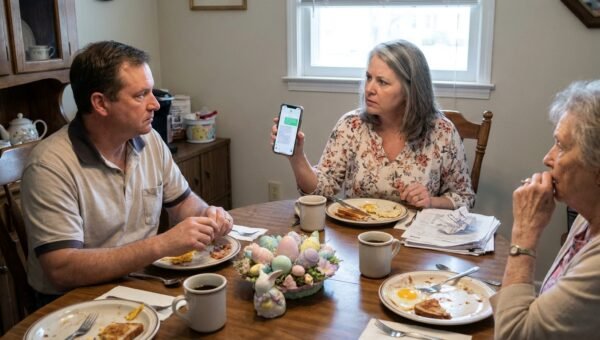
Derek opened his mouth to argue, but the screen of my phone lit up on the tablecloth.
It vibrated twice, buzzing against the wood. The screen showed an incoming text message from Arthur Vance, the CPA who had managed my and Thomas’s taxes for twenty-two years. It was Sunday afternoon, Easter Sunday. Arthur never texted me on weekends.
I picked up the phone and unlocked it.
The message read:
*Clara, I am sorry to interrupt your holiday, but I just pulled an urgent alert on your IRS account. An amended filing flag came up from an outside preparer using your identity. Did you authorize Derek to use your Social Security number and your private Vanguard 1099 details on a Schedule C dependency form last month? Please call me immediately.*
I slowly set the phone down. The screen stayed bright for a few seconds, illuminating the glass of spilled water and the papers Derek had thrown onto my plate.
I looked up at my son. His hands had stopped tapping the table. His shoulders were stiff, his jaw locked tight, his gaze fixed on my phone screen.
“Arthur just pulled my file,” I said softly, the words coming out cold and clear. “Did you take my private investment forms out of my house, Derek? Did you use my identity without my consent?”
PART 2
Derek didn’t answer right away. He reached across the table, his hand darting toward my phone, but I pulled it back and slipped it into the pocket of my cardigan.
“Arthur is an old man who doesn’t understand modern small-business write-offs,” Derek said, his voice dropping into that quick, dismissive cadence he used whenever he was caught in a corner. “He overcomplicates everything. I used an enrolled agent who handles commercial accounts. He told me that if I provided substantial living support to a parent, I had to document your outside income to prove you met the income thresholds for the credit.”
“My Vanguard paperwork was in the locked filing cabinet in Thomas’s old study,” I said. My pulse was pounding in my throat, hot and fast. “The only key is on the ring in the pantry. You used my house key while I was at physical therapy in February, didn’t you?”
Evelyn finally raised her head. “Derek, tell me you didn’t do that. Tell your mother you didn’t go through Thomas’s desk.”
“Aunt Evelyn, stay out of this,” Derek snapped without looking at her. “Nobody stole anything. I am her only child. Everything she has is going to me eventually anyway. I was trying to keep seven thousand dollars from going to the government so I could keep my store afloat through the spring slump. If Mom had just let me handle her taxes through my guy like I offered back in January, none of this would have happened. My preparer would have handled both returns together, balanced the credits, and we both would have come out ahead.”
“I would have committed tax fraud,” I said.
“It isn’t fraud if you live under the same financial umbrella!” he shouted.
“We do not live under the same umbrella,” I said. I stood up from the table. My knees were stiff, but I forced myself to stand straight, looking him dead in the eyes. “I am going into the kitchen to call Arthur. Do not touch my papers, and do not leave this house.”
I walked through the swinging door into the kitchen, letting the wood click shut behind me. My hands were shaking so hard I had to brace my wrist against the laminate counter to dial Arthur’s mobile number. He answered on the second ring.
“Clara,” Arthur said, his voice gravelly and rushed. “I hate to do this to you on Easter, but when the IRS electronic gateway rejected your independent filing this morning, I ran an inquiry through the practitioner portal. Someone didn’t just claim you as a dependent. Someone filed an auxiliary Schedule C attachment listing you as an uncompensated dependent member of an LLC, using your Social Security number and your Vanguard portfolio account number to substantiate household assets.”
I leaned heavily against the edge of the sink, looking out the window at the garden bed where Thomas used to plant beefsteak tomatoes every May. “He used my investment account? The one Thomas left me?”
“He didn’t liquidate it,” Arthur clarified quickly. “He couldn’t do that without a power of attorney on file with Vanguard. But he listed your monthly dividends as qualifying household baseline assets under his business address to meet the criteria for a commercial hardship extension and an earned-income dependent adjustment. It is completely improper. Clara, if you sign an amendment agreeing to his claim, you are legally certifying under penalty of perjury that he provided more than half your support, that your primary residence was under his management, and that your assets were co-mingled with his enterprise. You would forfeit your independent homestead credit on your property taxes, and you could be held liable for his business balance if the IRS audits his entity.”
The air in my chest felt thin. “What happens if I refuse?”
“Your independent return stands,” Arthur said. “Because your filing was accurate and backed by your bank records, the IRS will reject his claim. They will send him an audit notice requiring him to substantiate the eight-thousand-dollar claim with receipts and proof of residency. When he can’t prove you lived with him or that you didn’t reimburse him, they will assess the back taxes, tack on a failure-to-pay penalty, and reverse his refund. It is going to cost him around nine thousand dollars with penalties.”
“And if he doesn’t have it?”
“Then they put a tax lien on his business assets,” Arthur said quietly. “I am sorry, Clara. But you cannot let him submit that paperwork. You would be putting your home at risk to bail him out.”
I thanked Arthur, told him to keep my original filing active, and ended the call.
When I pushed the swinging door open, Derek was sitting in my chair. He had poured himself a glass of tea. The manila folder was closed, resting under his forearm. Evelyn was standing near the sideboard, her coat already over her arm, her purse clutched against her stomach.
“I need to get home before the weather turns, Clara,” Evelyn whispered, her eyes pleading with me not to make her choose sides. “Call me tomorrow, okay? Please just work it out.”
I walked Evelyn to the front door, hugged her tightly, and locked the deadbolt after she walked down the porch steps. When I walked back into the dining room, Derek had the folder open again, pen in hand.
“Look, Mom,” he said, his tone shifting into the sweet, reasonable voice he used when he was ten years old asking for an advance on his allowance. “I know it looks bad about the study. I shouldn’t have gone through Dad’s files without asking. I was desperate. The parts supplier in Cleveland changed their terms from net-sixty to net-fifteen, and I had ten thousand dollars in orders sitting on the dock that I couldn’t release without capital. I did what I had to do to survive.”
He slid a single sheet of paper across the table toward me. It was an IRS Form 1040X, an amended return, filled out with my personal information. The signature line was highlighted in yellow.
“Sign this,” he said. “Arthur can fax it tomorrow. It pulls your independent claim, accepts the dependent status for just this one tax year, and my refund clears by next Friday. As soon as my supplier releases the inventory, I’ll pay you back the entire twenty-two hundred you still owe on the bathroom, plus another two thousand for your trouble. We both win.”
I looked down at the yellow highlight. The print was crisp and official, a government document that would erase my legal independence with one stroke of blue ink.
“And what happens to my property tax exemption?” I asked. “The senior homestead credit requires me to be the sole head of this household with independent filing status. If I sign this, my county property taxes jump twelve hundred dollars a year.”
Derek waved his hand. “We’ll deal with that when the county bill comes.”
“No, Derek,” I said. “You will deal with your supplier, and you will deal with the IRS.”
PART 3
Derek’s smile vanished. The pen hit the polished wood of the table with a sharp crack.
“Are you serious?” he hissed, leaning forward. “You would let your own son lose his franchise over a technicality on a tax form? After everything I’ve done for you? Dad would turn over in his grave if he saw you turning your back on me over paperwork.”
Using Thomas’s name was his biggest mistake.
For seven years, whenever Derek wanted money, whenever he wanted to borrow my car, whenever he wanted me to babysit his inventory shipments in my garage, he brought up Thomas. *Dad wanted the family business to thrive. Dad told me to take care of you. Dad would have written the check.*
“Your father,” I said, every word dropping like iron, “spent thirty-five years working the night shift at the stamping plant. He kept every receipt in an empty cigar box in the closet. He never cheated on an invoice, he never took a dime that didn’t belong to him, and he would never have crept into this house while his widowed mother was at a doctor’s appointment to steal financial papers out of a locked desk.”
Derek stood up so fast his chair screeched against the hardwood floor. “I didn’t steal anything! I’m trying to save my business!”
“Then go to the bank and take out a commercial loan,” I replied.
“The bank won’t lend to me!” he shouted, his voice echoing off the high plaster ceilings. “My debt-to-income ratio is maxed out from the warehouse lease! This tax credit was the only way I could clear the books before the second quarter! If that refund doesn’t clear, the supplier cancels my contract. Do you understand that? I lose the territory!”
“Then you lose the territory,” I said.
He stared at me as if I had spoken in another language. For his entire life, whenever the consequences of his poor planning arrived at the door, someone had paid the toll. When his first truck was repossessed at twenty-two, Thomas bought him an old sedan. When his first partnership collapsed at twenty-nine, I signed over my mother’s small inheritance to keep him out of small claims court. Every time we saved him, we told ourselves we were being good parents. We told ourselves he was just finding his footing.
He wasn’t finding his footing. He was simply learning that his mother would always absorb the cost of his recklessness.
“You’re really going to do this to me,” he said, his face pale now, the anger turning into a cold, ugly contempt. “You’re going to let Arthur report my filing.”
“Arthur doesn’t have to report anything,” I said. “The system has already flagged it. The automated cross-check rejected your claim the second my return went through. The IRS will send you a deficiency notice within thirty days. If you take this form to your enrolled agent tomorrow morning and amend your return voluntarily before they open a formal audit, you will avoid the fraud penalties. You’ll owe the money, but you won’t be charged with deliberate misrepresentation.”
“I don’t have seven thousand dollars to give them, Mom!”
“Then you can set up a monthly payment plan with the IRS,” I told him. “They offer installment agreements. You will have to cut your personal spending, sell that boat sitting in your driveway that you haven’t put in the lake for three summers, and pay what you owe.”
Derek looked down at the table. He saw the ledger showing my six-thousand-dollar reimbursement. He saw the manila folder with his own clumsy paperwork. He knew he had no leverage left.
Slowly, deliberately, he gathered up his papers. He stuffed the 1040X into the folder, not bothering to fold it neatly, creasing the corners as he jammed it into his leather satchel.
“I’m not paying the rest of that plumbing bill,” he said, refusing to look at me. “The twenty-two hundred you still owe me. Keep it. Consider it my final contribution to your retirement.”
“I am not keeping it,” I said. “I will mail a cashier’s check for twenty-two hundred dollars directly to Miller Premier Plumbing tomorrow morning, made out to the company, with your invoice number on the memo line. The receipt will go into my records. When that check clears, my obligation to that repair is zero, and your claim of support is completely disproven on paper.”
He zipped his satchel with a violent jerk. “Don’t bother calling me on Mother’s Day, Mom. If my shop goes under, don’t look for me to help you rake your leaves or clear your driveway this winter. You want to be independent? You can be independent all by yourself.”
“I have been independent for a long time, Derek,” I said softly. “You just didn’t notice because you were too busy looking for what was left to take.”
He walked out through the kitchen without another word. The back door slammed shut, hard enough to rattle the copper pans hanging from the rack above the island. A few seconds later, his truck engine roared to life in the driveway, gravel spitting against the brick foundation as he backed out into the street and sped away.
ENDING
The house was completely still.
I stood in the dining room for a long time, looking at the untouched plates of ham, the bowl of scalloped potatoes with the cheese crust cooling into a dull yellow, and the water stain drying slowly into the embroidered linen runner.
My hands were no longer shaking. A strange, heavy quiet settled over the room, the kind of quiet that follows a severe summer thunderstorm after the power cuts out and the wind finally stops beating against the siding.
I walked over to the table and began clearing the dishes. I scraped the food into glass storage containers, stacked the plates in the dishwasher, and took the linen runner off the table. I carried it into the laundry room, soaked the water stain with cold water, and hung it over the utility sink to dry.
Then I walked down the short hallway to Thomas’s old study.
The room smelled faintly of cedar and the old pipe tobacco Thomas had given up fifteen years before he passed. The oak filing cabinet sat in the corner beside his heavy wooden desk. I looked at the bottom drawer. The brass lock was scratched, the wood around the keyhole slightly nicked where Derek had forced the small brass key into the tumbler.
I opened the drawer. The green hanging folders were out of alignment. Thomas had kept them organized alphabetically: Auto, Home, Insurance, Medical, Taxes, Vanguard.
The Vanguard folder was pushed toward the back, the paper tab bent down. Inside, the annual statement showing the dividend yield and the principal balance was wrinkled, creased where Derek had folded it in half to slip it into his jacket before taking it to his tax preparer.
I smoothed the paper flat with my palm.
I felt a sudden, sharp ache in the center of my chest, not of anger, but of profound grief. Thomas and I had worked so hard to give Derek a clean start. We had paid for his technical degree, helped him with his first commercial lease, and spent our lives believing that if you gave a child enough safety, they would grow up to value the people who provided it. But somewhere along the line, safety had turned into entitlement, and love had become an asset he felt entitled to borrow against.
On Monday morning, I was at the First National Bank branch when the doors opened at nine o’clock.
I withdrew twenty-two hundred dollars from my savings account and had the teller issue a cashier’s check payable directly to Miller Premier Plumbing. I walked two doors down to the post office, placed the check inside a certified envelope with signature confirmation required, and mailed it.
Next, I drove to Arthur Vance’s office.
Arthur was sitting behind a desk stacked with client files, wearing his reading glasses on the tip of his nose. He took the certified mail receipt from me, made a copy for his records, and attached it to my IRS file.
“I received an electronic notification an hour ago,” Arthur told me, looking over the top of his glasses. “Derek’s enrolled agent submitted an amended return at eight-fifteen this morning. He removed the dependent claim and dropped the Schedule C attachment. He took your advice, Clara.”
“What will happen to his business?” I asked.
“He owes the IRS about seventy-six hundred dollars between the lost credits and the revised filing fee,” Arthur said frankly. “They will put him on an installment agreement if he asks for one. It will be tight for him, but if his business has any real value, he will survive it. But he won’t be able to use your name or your assets again. I placed an identity protection pin request on your Social Security number this morning. From now on, nobody can file a federal return using your information without a six-digit electronic key that will be mailed directly to your physical address every January.”
I sat in the leather armchair across from Arthur, listening to the hum of his desktop computer and the distant clatter of the traffic out on Main Street.
“Did I do the right thing, Arthur?” I asked quietly. It was the question that had kept me awake between two and five in the morning, staring up at the plaster ceiling of my bedroom.
Arthur took off his glasses and set them on the desk. “Clara, if you had signed that 1040X, you wouldn’t have saved his business. You would have only delayed his reckoning by four months, and you would have handed him the title to your financial independence to do it. You didn’t hurt Derek yesterday. You just stopped him from hurting you.”
Three weeks later, on Mother’s Day, my phone did not ring.
There was no card in the mailbox, no bouquet of grocery-store carnations on the front porch, and no knock at the front door. Evelyn called around noon to ask how I was holding up, her voice gentle and cautious, but I told her the truth: I was fine.
That afternoon, I went out into the backyard with my garden trowel and a flat of red geraniums. The soil was damp and cool from the morning rain. I knelt on a foam pad, dug six small holes along the brick border beneath the kitchen window, and planted the flowers one by one, pressing the dark earth firmly around their roots.
Derek was angry, and he might stay angry for a very long time. He might tell his friends and his cousins that his mother turned her back on him over a few lines on a tax form. But as I washed the dirt from my hands at the garden hose, watching the clean water run over the bricks and soak into the lawn, I knew the truth.
My home was mine. My name was mine. And for the first time in twenty years, I wasn’t paying for someone else’s choices.