The envelope arrived on a Tuesday morning, sitting right on top of my doormat like an afterthought. It was a plain white square with my name written in ink that had smeared slightly at the edge of the *s*. But the top right corner where the postage stamp belonged was entirely bare. Just blank paper. I picked it up off the concrete porch, feeling the grit of the morning dust under my thumb, and brought it straight inside.
For two weeks, I had stayed away from the Maple Ridge Care Center. David had called me on a Thursday night, his voice dripping with that reasonable, exhausted authority he always used when he wanted me to fall in line. He told me Mom was struggling to adjust to her new medication schedule. He told me my sudden visits were disrupting her physical therapy routine and confusing her short-term memory.
“She asks about you, Clara, but then she gets completely disoriented for hours afterward,” David had said, pausing just long enough for me to feel guilty. “The staff really needs us to keep things steady right now. Just give her a couple of weeks to settle in without any extra noise.”
I had hated it, but I trusted him. Or maybe I was just tired of fighting with him. Then I called Mom on Sunday to check in, and her voice sounded flat, ironed out, entirely unlike herself.
She repeated almost verbatim what David had told me, as if someone had written it on a dry-erase board just out of her line of sight. “David says you shouldn’t come for a bit, honey. My routine is all mixed up.” I had hung up the phone with a knot in my stomach that wouldn’t dissolve.
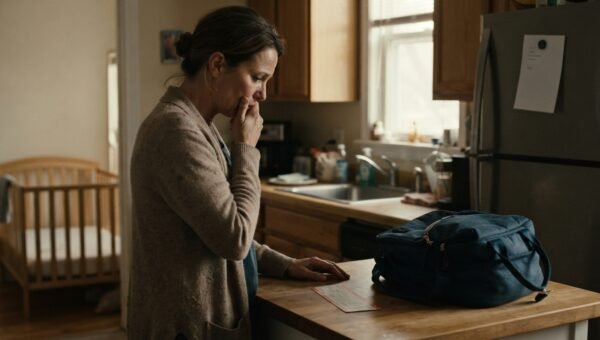
Now, standing in my kitchen with the blank corner of that envelope staring back at me, I slid my finger under the flap. Inside was a generic birthday card with a cheerful yellow daffodil on the front. But the message scrawled across the left-hand panel wasn’t printed. It was Mom’s shaky, familiar handwriting, crammed into the bottom margin because she had run out of space.
“Please come when David is not here,” it read.
That was it. No birthday wishes. Just a silent, desperate SOS smuggled out through someone willing to risk their job.
I didn’t call David. I didn’t call the facility to announce myself. I checked the wall clock in my hallway, 10:14 in the morning. David worked out of his downtown office on Tuesdays until at least two o’clock, managing commercial real estate accounts that kept him chained to a dual-monitor desk setup. I grabbed my car keys off the hook, locked the front door behind me, and drove straight to Maple Ridge.
The drive took twenty-two minutes, and every single red light felt like a personal insult. My hands gripped the steering wheel so hard my knuckles ached by the time I pulled into the gravel lot behind the brick building. I walked through the automatic sliding glass doors of the lobby, nodding at the receptionist who was busy staring down at her phone, and headed straight down the stale-smelling hallway toward Room 214.
Mom was sitting in her armchair by the window, wearing a faded floral cardigan that looked too big for her shoulders.
When the door clicked open, she jumped so hard her knitting needles clattered onto the linoleum floor.
“Clara?” she whispered, her eyes darting toward the hallway. “You shouldn’t be here. David said, “
“David is at his office,” I said, closing the door behind me and latching it. I walked across the room and knelt beside her chair, taking her cold, thin hands in mine. “I got the card, Mom. The one with no stamp.”
Mom let out a long, ragged breath that seemed to deflate her whole chest. She didn’t cry. Mom wasn’t a crier; she was a woman who survived forty years of bookkeeping and a stroke by keeping her head down and her wits sharp. But her fingers squeezed mine back with a desperate, trembling strength.
“He’s been coming in every evening after work,” she said, her voice barely louder than the hum of the wall heater. “He brings these papers. He tells me they’re just updates for my care plan. He says my signature is required to keep my room paid for.”
“What papers, Mom?”
She tilted her head toward the narrow twin bed pushed against the far wall. “Under the mattress. At the head of the bed. He leaves a manila folder there sometimes when he thinks I’m asleep, or he tucks it under my pillow before he helps me into bed.”
I stood up immediately, walked over to the bed, and jammed my hand between the heavy innerspring mattress and the metal frame. My fingertips brushed against slick cardboard. I pulled out a standard beige manila folder, its tab marked with a handwritten label that wasn’t Mom’s neat cursive.
I carried it back to the armchair, sitting down on the edge of the small footstool so I could catch the light from the window. Mom watched me, her chest rising and falling in shallow jerks.
“Open it,” she whispered.
I opened the clasp. The folder was stuffed with official-looking financial documents, bank letterheads, pension transfer requests, and life insurance policy amendments. I flipped through the first few pages, my breath catching in my throat as I read the bold headings. Change of primary beneficiary. Complete assignment of death benefits. Transfer of durable power of financial decision-making.
And everywhere I looked, right beside Mom’s name, was a new signature scrawled in an unsteady hand that didn’t quite match hers. David had added his own name as the sole beneficiary on her pension, her supplemental life policy, and the remaining equity from the sale of our childhood home. He hadn’t just inserted himself into her care plan; he was draining everything she had left before she even left the facility.
“I didn’t sign these,” Mom said, her voice cracking for the first time. “I told him I wanted everything split between us like your father’s will said. But he brought those forms in last month when my head was spinning from the new pills. He guided my hand. He told me it was just a receipt for the pharmacy.”
I flipped to the back page of the primary insurance transfer document, looking for the mandatory witness verification section. Every legal document required two independent signatures or a registered notary to be valid. My eyes scanned down the lines until they hit the bottom right corner.
The witness signature was neat, practiced, and belonged to a woman named Chloe Vance.
I knew that name. Chloe Vance was the twenty-four-year-old administrative assistant to the executive director of Maple Ridge. More importantly, she was the girl David had brought to Easter dinner three months ago, the one he introduced as his “serious partner” while she sat at our dining table and smiled politely into her napkin.
The room seemed to tilt slightly on its axis. It wasn’t just a greedy son taking advantage of an aging parent. It was an inside job, coordinated with administrative access and executed right under the nose of the facility management.
“He told me Chloe was just doing her job as a witness for the facility,” Mom murmured, watching my face darken. “He said everyone signs things like this when they move into long-term care. I trusted him, Clara. He’s my boy.”
“He’s a thief,” I said, the words slipping out of my mouth before I could catch them.
I stood up, sliding the folder back into its protective cover and pressing it flat against my ribs under my jacket. Mom reached out, her fingers catching my sleeve.
“What are you going to do?” she asked, fear flickering in her eyes. “If you make a fuss, he’ll just move me somewhere else. He has the paperwork saying he’s my proxy.”
“He doesn’t have valid paperwork,” I said, my voice dropping into a cold, steady register that surprised even me. “Forged signatures witnessed by an undisclosed romantic partner in a care facility constitute commercial fraud and elder exploitation. That’s not a family disagreement, Mom. That’s a felony.”
I didn’t wait for her to answer. I kissed the top of her head, told her I would be back before dinner with reinforcements, and walked out of Room 214 with my jaw clenched so tight my teeth ached.
I bypassed the front desk and walked straight down the administrative corridor to the executive director’s office. The frosted glass door bore a brass plaque reading *Director Sarah H. Sterling*. The door was half-open, and I could see Chloe Vance sitting at her outer desk, tapping away at a dual-screen computer while sipping from a branded ceramic mug.
She looked up as my boots clicked on the linoleum.
“Can I help you?” she asked, her professional smile slipping just a fraction when she saw my face. “Visiting hours for Room 214 are restricted this week per family request, “
“I’m Clara,” I said, stopping right at her desk and laying the manila folder flat on her keyboard. I didn’t raise my voice. I kept it low and flat, the way my father used to talk when a deal had gone sideways. “And you’re Chloe Vance, right? David’s girlfriend.”
Chloe’s color drained instantly, her professional veneer cracking wide open. “I don’t know what you, “
“Open the folder, Chloe.” I tapped my fingernail against the corner of the cardboard. “Take a good, long look at page four. That’s your signature on the witness line for an incapacitated resident’s pension transfer, isn’t it? And let’s check the employee handbook regarding financial conflicts of interest with residents’ families. Shall we go ask Sarah Sterling how she feels about her administrative assistant notarizing fraudulent beneficiary changes for her own boyfriend?”
Chloe stood up so fast her office chair rolled backward and slammed into the filing cabinet behind her. “I was just helping David file routine updates. He told me she wanted to streamline her estate, “
“She didn’t sign it,” I said, leaning over the desk until she had nowhere else to look. “And you didn’t verify identity per facility protocol because you were sleeping with the beneficiary. That’s conspiracy to commit financial fraud in the first degree. You have about two hours before I hand this entire packet to the corporate compliance board and the local district attorney’s office.”
The office door behind her swung open instantly. Sarah Sterling stepped out, her expression sharp and questioning. “Is there a problem out here?”
“There’s a very big problem,” I said, pulling the folder open and holding up the signed pages for the director to see. “Your front office is being used as a staging ground for elder financial abuse. Let’s go into your office right now and call legal counsel, because David is going to be walking through those front doors at exactly five o’clock for his evening visit, and I want the police report filed before he sits down in my mother’s room.”
The next three hours were a blur of fluorescent lights, quiet phone calls, whispered arguments behind closed doors, and the cold, institutional smell of corporate compliance paperwork. Director Sterling didn’t hesitate once she saw Chloe’s signature paired with the resident identification numbers; liability for a care facility is a terrifying thing, and administrators protect their licenses above all else. By 4:45 PM, Chloe Vance had been escorted from the building by security, her desk cleared out into a cardboard box, and her access badge deactivated.
I was sitting in a visitor chair just outside Mom’s room when the elevators dinged at the end of the hall at 5:02 PM.
David walked out, carrying a takeout bag from the local diner and wearing that easy, confident smile he always wore when he thought he was winning. He stopped dead in his tracks when he saw me sitting by the door, blocking the entrance to Room 214.
“Clara?” he said, his smile faltering as he shifted the bag to his other hand. “What are you doing here? I thought we agreed, “
“We didn’t agree on anything, David,” I said, standing up slowly so I was looking him straight in the eye.
I didn’t yell. I didn’t throw the takeout bag at him. I just reached into my tote bag, pulled out the manila folder, and held it out toward his chest until he had no choice but to look down at it.
“Mom’s pension is staying where it belongs,” I said, my voice completely steady. “Her life insurance is untouched. And Chloe isn’t working here anymore. In fact, if you ever step foot inside this facility again, Director Sterling has instructions to call the county sheriff before you even reach the lobby.”
David’s face went completely slack, the color draining out of his skin until he looked remarkably old. He opened his mouth to say something, some excuse, some deflection, some reminder of how much he supposedly sacrificed, but no words came out. He just stared at the folder in my hand, realization crashing over him like cold water.
“You went through her things,” he whispered, his voice shaking with sudden, ugly fury. “You had no right.”
“She’s the one who mailed the letter, David,” I said, stepping past him toward the door. “You forgot to put a stamp on it.”
I went inside the room and closed the door behind me, leaving him standing alone in the hallway. Mom was sitting by the window, looking out at the parking lot as the sun began to dip below the treeline, casting long, clean shadows across the floorboards.
On her bedside table sat a properly stamped envelope, addressed to my house in her own steady, unhurried hand, ready to be mailed without fear.