Three months. That was how long it had been since Julian stood in my entryway and told me I was too old-fashioned to handle a newborn baby.
I still remember the exact way he crossed his arms over his chest, looking down at his shoes like he was reading a script someone else wrote for him. He had that tight little set to his jaw that he only ever got when he was trying to convince himself of something he knew was wrong.
I didn’t yell at him. I just handed him the box of newborn clothes I’d spent three weeks washing in mild soap and folding into little squares, and I walked him out to his car.
“It’s just that Clara’s mother has these modern schedules, Mom,” he had said, standing by the driver’s side door with his keys jingling in his palm. “Everything’s timed down to the minute. We just want consistency.”
I told him I understood. I didn’t, but I told him I did anyway because that is what you do when your only boy starts his own life and decides your fifty years of raising children doesn’t count for anything anymore. Clara’s mother, Brenda, moved into their guest room the following Tuesday. She brought her designer luggage, her printed spreadsheets, and her air of quiet superiority that made me feel like an illiterate peasant every time I dropped off a casserole on the front porch.
I didn’t push. I kept my distance, gardened until my knees ached, and waited for the phone to ring.
When it finally did ring, the clock on my nightstand glowed 12:44 in the red digits I’ve stared at for twenty years since Arthur passed away.
My phone didn’t just ring; it buzzed against the wooden table with a harsh, rattling vibration that made my heart jump right into my throat. I sat straight up in the dark, throwing the quilt off my legs before I even had my glasses on.
“Julian?” I said into the receiver, my voice scraping the silence of an empty bedroom.
“Mom,” he said. He wasn’t crying, but his breathing sounded thin and fast, like he’d just run up three flights of stairs. “Mom, you need to get over here right now. Don’t ask questions. Just put your shoes on and drive.”
“Is it the baby?” I was already swinging my feet onto the cold floorboards, my toes searching blindly for my slippers. “Is Leo breathing?”
“Leo’s fine. He’s sleeping in his crib upstairs. Clara’s asleep too,” Julian said, his voice dropping to a harsh whisper that sounded like tearing paper. “Just get in your car.
I’m looking at the doorbell camera history from the last three months, and I need you to see it. I need you to tell me I’m losing my mind.”
The drive through our sleepy Kansas neighborhood took six minutes, but it felt like wading through wet cement. The streetlights flickered against the windshield of my old sedan, casting long, sliding shadows across the empty asphalt. When I pulled into Julian’s driveway, his porch light was blazing, casting a harsh yellow glow over the neat rows of hostas Brenda had insisted on planting last spring.
Julian was waiting at the front door before I even pulled the key out of the ignition. He didn’t look like a successful thirty-four-year-old software architect anymore. He looked like the ten-year-old boy who had fallen out of the old elm tree in our backyard, pale and shaking, staring at a scrape he knew was going to require stitches.
He didn’t hug me. He just grabbed my elbow, pulled me inside, and clicked the heavy wooden front door shut behind us with a soft, final click.
“Keep your voice down,” he muttered, leading me straight past the living room and into the kitchen. “Clara takes those heavy sleeping pills on Tuesdays because of the postpartum anxiety. I don’t want to wake her until we know what we’re looking at.”
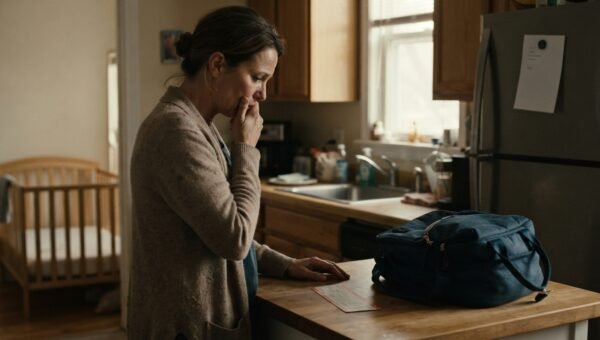
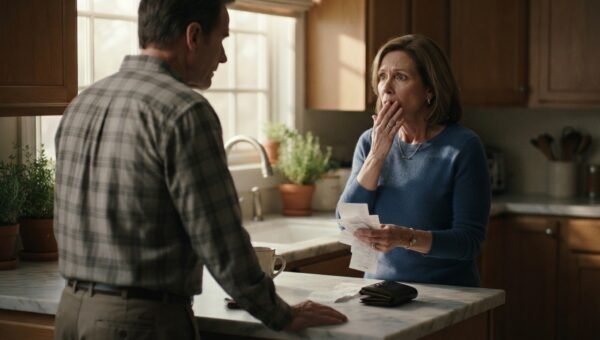
The kitchen smelled of stale coffee and the faint, sweet scent of baby formula. Right in the middle of the granite island sat a piece of cream-colored cardstock, written in Brenda’s careful, looping cursive. It was a feeding schedule.
“Look at it,” Julian said, jabbing a finger down at the paper. “Read the times for last Thursday.”
I leaned in, squinting against the overhead lights. “Thursday at 2:15 PM. Formula, four ounces. Burped at 2:25. Down for a nap at 2:30.”
“Now look at this,” Julian said, turning his laptop around so the screen faced me. He clicked a small play button on a video file titled Front_Porch_10_14.
The video opened with the timestamp in the corner: Thursday, 2:14 PM. The camera showed our front porch, bright and sunlit. For about ten seconds, nothing happened. Then the front door swung open, and Brenda stepped out into the frame. She wasn’t carrying Leo. She wasn’t carrying a diaper bag. She was wearing her tan trench coat and carrying a thick, black leather folder that I immediately recognized as belonging to the locked filing cabinet in Julian’s home office.
She walked down the steps with a quick, purposeful stride that didn’t look like a grandmother checking on a sleeping baby. She walked right out to the curb where a dark sedan was idling with its hazard lights off.
“That’s not even the worst part,” Julian whispered, his fingers hovering over the trackpad like he was afraid of touching a live wire. “Watch the next clip. I pulled the archive from every single Tuesday and Thursday for the last two months. Every time I was at the downtown office for my late meetings.”
He clicked to a different date three weeks ago. On screen, Brenda walked out of the house at precisely 1:30 PM. She carried another file, this one stuffed with papers that caught the midday light. A man stepped out from the shadow of the neighbor’s overgrown hedge to meet her at the edge of the driveway. He was wearing a faded baseball cap pulled low over his forehead, but you could see the sharp line of his jaw and the way he walked with a slight hitch in his left hip.
Brenda handed him the folder. The man took it, tucked it under his arm, and muttered something low.
And then the audio on the laptop picked up. Even through the tinny speaker of the MacBook, the woman’s voice came through clear and distinct, sharp as broken glass.
“I’ve got the client ledgers for this quarter, Arthur,” Brenda said on the recording. “Don’t lose them like you did the last batch.”
The kitchen went dead silent except for the low, rhythmic hum of the refrigerator in the corner.
I stopped breathing. The name hit the back of my throat like a swallowed bone. Arthur. That was my late husband’s name. Arthur had been dead for six years, buried under a simple granite stone twenty miles away in the churchyard. Nobody named Arthur walked around this town anymore. It wasn’t a common name for men under sixty, and it certainly wasn’t a name Brenda had any business saying to a stranger in a baseball cap outside my son’s house.
“Mom?” Julian looked at me, his eyes wide and bloodshot in the harsh light. “Who is Arthur? Why did she call that man Arthur? She looked right at him and called him by Dad’s name.”
I didn’t answer him right away. I pulled out one of the heavy counter stools and sat down because my knees had suddenly decided they didn’t want to hold my weight anymore. The coffee maker on the counter had that wet, burnt smell it gets when you leave the basket dirty overnight, and I found myself staring at a single stray coffee ground near the spout just to have something real to look at.
“Your father’s been gone six years, Julian,” I said, my voice sounding thin even to my own ears.
“I know when Dad died,” Julian said, his voice rising just a fraction before he caught himself and glanced nervously toward the stairs. “I was a pallbearer. I helped lower him into the ground. But that man on the screen, he’s not old enough to be Dad, and he doesn’t look like him from the front, but the way he holds his shoulders… Mom, the way he turned around when she gave him that folder… it made my stomach turn.”
“Show me the office,” I said, standing back up before the shock could settle into my bones. “Show me what’s missing.”
Julian led me down the short hallway toward the guest room at the back of the house that he used as a home office. He pushed the heavy oak door open. The room was dark, but when he flicked the switch, the desk lamp illuminated a scene of quiet devastation.
The door to the filing cabinet wasn’t picked or forced. It was wide open, the brass lock hanging limply from the latch like a broken tooth. Inside, rows of hanging folders sagged sideways.
“She had the spare key,” Julian said, his hand coming down hard on the edge of the mahogany desk. “Clara gave her a set of keys when she moved in so she could let the repairman in last month. I told Clara to take them back, but we got busy. We just… we got busy with the baby.”
He started pulling out empty folders, tossing them onto the blotter one by one. Each one had a red sticker on the tab. Proprietary client lists, software architecture schematics, tax documents for his firm’s biggest corporate accounts. Thousands of pages of confidential data that Julian’s partners would fire him for losing, or worse, sue him into bankruptcy over.
“She wasn’t just babysitting,” I said quietly, walking over to the window that looked out over the quiet suburban street. “She was running an errand girl service right out from under your nose while you were at work.”
“But why?” Julian’s voice cracked, the anger finally breaking through the panic. “Why would Brenda do this? She’s wealthy. She goes to the country club with Clara. She drives a brand-new Lexus.”
“People don’t steal because they’re broke, Julian,” I said, remembering things my own mother used to say about the people in our town when the grain elevator went under back in ’94. “They steal because they’re cornered. Or because someone has a hold on them they can’t break.”
We didn’t wait until morning. We sat at that kitchen island for two hours, watching every clip Julian could export from the cloud archive. We mapped out the dates. Every Tuesday and Thursday, right down to the minute. The falsified feeding charts weren’t just mistakes; they were alibis written down on paper so Clara would think the baby’s routine was being managed while Brenda was out at the curb handing over state-of-the-art corporate secrets to a man with my dead husband’s name.
At 5:15 AM, the upstairs floorboards creaked.
Julian went stiff as a board. We heard the soft shuffle of slippers coming down the stairs, followed by the light, tired sigh of a young mother getting up to check on her son.
Clara appeared at the kitchen doorway wearing an oversized flannel shirt, her hair tied back in a messy knot. She stopped dead when she saw me sitting at the island at five in the morning, and then she looked at Julian’s face.
“Julian?” she asked, her voice thick with sleep and sudden dread. “Why is your mother here? Is Leo okay?”
Julian didn’t look at her. He just turned the laptop around so the screen faced the edge of the counter, right where Clara was standing, and clicked play on the longest video file in the folder.
We didn’t have to explain anything.
By six o’clock, the guest room door upstairs was closed, and we could hear the sharp, muffled sound of Brenda’s voice through the wood, crying and shouting all at once while Clara sat on the stairs with her face buried in her hands, dry-heaving into a kitchen towel.
Julian stood by the front window with his phone pressed to his ear, talking to a corporate lawyer he woke up and then to the local police precinct. He didn’t stutter once. He spoke with a cold, hard clarity that I hadn’t heard from him since he was twenty-one years old.
By seven-thirty, a police cruiser was parked out by the hostas, its red lights turned off but its presence heavy enough to make the neighbors pull their blinds shut across the street. Brenda came down the stairs carrying her two designer suitcases, her face mottled and swollen, looking smaller than she had the day she moved in. She didn’t look at Julian. She didn’t look at me. She just walked past the kitchen island without stopping, her heels clicking against the hardwood until the front door slammed behind her with a sound that seemed to shake the foundation of the house.
Clara didn’t come down until the police car had backed out of the drive.
She walked into the kitchen looking like she had aged ten years in two hours. Her eyes were red-rimmed, and she wouldn’t meet either of our eyes as she walked to the sink to run the tap.
“I didn’t know,” she whispered to the chrome faucet. “Julian, I swear to God, I didn’t know.”
“I know you didn’t,” Julian said, his voice softer now, though the hard edge didn’t leave his jaw. He walked over and put his hand on her shoulder, but she flinched away from him, retreating into herself like a turtle pulling back into its shell. “Just… don’t talk about it right now. Go upstairs with Leo.”
She left without another word, her slippers dragging against the floor.
The house grew very quiet then. The kind of quiet that comes after a summer storm has blown through and torn half the shingles off the roof, leaving you to look around at the yard and figure out what’s left to salvage.
Julian sat down in the chair Clara had just vacated. He rubbed his hands over his face, his fingers catching in his stubble, and let out a long, ragged breath that sounded like it had been trapped in his chest for months.
“I was an idiot,” he said into the wood of the counter.
“You were protecting your family,” I told him, reaching across the space between us to pat his hand. His skin felt hot and dry.
“No,” he said, looking up at me with eyes that looked entirely too much like his father’s when the bank foreclosed on the tractor shed back in ’98. “I was proud. I didn’t want you here because you didn’t have a spreadsheet or a sleep app. I thought modern meant better.”
“Modern just means new, Julian,” I said softly. “It doesn’t mean it works.”
He managed a small, miserable smile at that, the first one I’d seen all night. He reached out and pushed the cream-colored cardstock, Brenda’s fake feeding chart, to the side, letting it slide off the edge of the counter into the recycling bin below.
On the clean granite in front of us sat a blank pad of lined paper and a ballpoint pen.
“Can you do it?” Julian asked, his voice dropping low, almost like he was afraid I’d say no. “Can you show me how you used to do it? Before all this?”
I picked up the pen. It felt balanced and steady in my hand, exactly the way it always had.
“First thing,” I said, drawing a clean line across the top of the white paper, “you don’t time a baby by a clock. You time a baby by their breathing.”
Julian didn’t say anything to that. He just leaned back against the counter, watching the morning light start to filter through the kitchen window, turning the edges of the white cabinets gold. Upstairs, through the ceiling boards, we heard the first small, sleepy cry of a little boy waking up for the new day.
I didn’t wait to be asked. I started writing down the hours in my own handwriting, small and neat and steady, right there on the clean counter where the sun was finally starting to warm the wood.