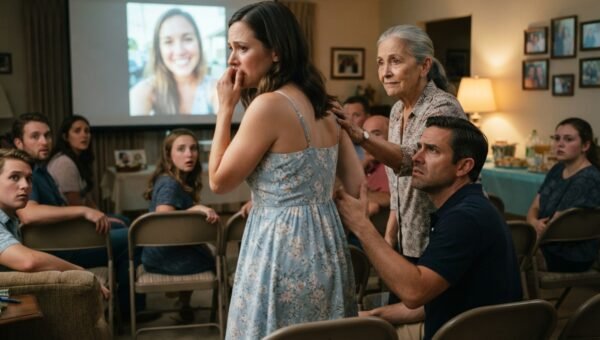
The padded envelope was waiting on my front porch when I got back from the grocery store, sitting right on top of the welcome mat like it had been dropped there with some kind of heavy purpose. It didn’t rattle when I picked it up, just felt dense and lumpy, taped shut with clear packing tape that had a few dog hairs stuck to the edges. I didn’t think much of it until I cut it open with the kitchen shears and slid the contents out onto the counter between the fruit bowl and the mail sorter.
There was a little gray digital recorder, the kind with the cheap plastic buttons that click too loud when you press them, and a folded piece of lined notebook paper. Chloe’s handwriting was small and cramped, rushed in the way she always wrote when she was trying not to cry during a math test back in high school. Please listen before you call anyone. That was all it said. No signature, no date, just those eight words crowding the blue lines at the top of the page.
My hands felt cold right away, the way they always did when the weather shifted too fast in October, but it was only late August and the kitchen was seventy-four degrees. I hadn’t heard from Chloe in fourteen days, not since she stood by my kitchen island and asked me that awful, quiet question while I was chopping celery for pot roast. She had been married to Mark for nine years, and out of nowhere she had looked up from her coffee cup and asked, Mom, did Dad ever make you feel like you were crazy?
I knew exactly what she meant. I knew the specific look in her eyes because I had seen it in my own bathroom mirror for fifteen years before I finally packed up the station wagon and took her away from a man who could turn the weather inside a room upside down with a single sigh. But I had lied to her. I told her no, of course not, your father was just high-strung. I spent twelve years biting my tongue after the divorce, working three days a week at the county clerk’s office and keeping my mouth shut about the late nights and the missing bank statements and the way my old man could convince me I’d imagined conversations we’d had an hour prior, all because I didn’t want my kid growing up hating the man who shared her eyes.
She had looked disappointed that afternoon, standing there in her sensible navy cardigan with her car keys in her hand, and then she had changed the subject to the weather and left ten minutes later.
Two weeks of silence followed. When I called her house on Tuesday, Mark answered with that smooth, unbothered baritone he used whenever he was managing an office problem. Chloe needs some space right now, he had told me, his voice as level as a spirit level. She’s just dealing with some anxiety flare-ups, Clara. You know how she gets when she’s overworked.
I picked up the little gray recorder from the counter, my thumb catching the small red record switch on the side. The battery light didn’t blink when I pushed power, but the screen lit up with a tiny number three in the corner, showing three distinct audio files saved in the memory. I pressed play and set it down next to the salt shaker.
The first recording was mostly kitchen noise, faint and muffled like the machine had been sitting inside a coat pocket or the bottom of a deep purse.
There was the heavy thud of a refrigerator door sealing shut, the high, rhythmic whine of the dishwasher running through its dry cycle, and then the sound of water running hard into a stainless steel basin. A drawer scraped open, rattling silverware around with an impatient, sharp sound that made me flinch.
Then came Chloe’s voice, small and tight in a way that didn’t sound like my thirty-two-year-old daughter who managed a dental clinic, but like the little girl who had scraped her knee on the playground behind the library. Mark, where did the rest of the savings go? The account statement came in the mail today and seven thousand dollars is just gone. We had that money for the roof repair.
The machine hissed for a second, picking up the low hum of the refrigerator motor before Mark spoke. His voice was lower than Chloe’s, perfectly calm, almost gentle in the way a doctor tells you to take a deep breath before a needle. You’re looking at the wrong quarter’s statement again, Chloe. We talked about this last month when you paid the insurance premium from that reserve.
Chloe didn’t answer right away, and on the tape I could hear the sound of her breathing, shallow and fast like she was trying to catch up to a runner who had already turned the corner. I didn’t pay it from there, Mark. I checked the ledger three times this morning before you woke up. Seven thousand dollars didn’t just evaporate.
A chair scraped back across a hardwood floor, the legs making a dry, screeching sound that rattled right through the little speaker on the counter. The audio dipped as if he had stepped closer to wherever the recorder was hidden. You are rewriting history again to suit your anxiety, Mark said, and the words hit my chest like a cold fist dropped from a second-story window.
I didn’t reach for the stop button. I just stood there in the middle of my own kitchen with the sunlight coming through the window over the sink, hitting the dust motes floating in the air, because my brain kind of stopped working for a second. That sentence wasn’t just similar. It was an exact duplicate, down to the flat, patient cadence and the heavy emphasis on the word anxiety, as if being worried about your own life was some kind of diagnosed mental defect you had invented just to bother him.
Twenty-four years ago, my ex-husband had stood by our dining room sideboard in Iowa and looked at me with those exact same cold, pitying eyes while I tried to balance a checkbook that didn’t add up. You are rewriting history again to suit your anxiety, Clara, he had told me, right before he walked out to his truck to go stay with his brother for a week, leaving me to explain to the electric company why the check bounced. I had spent two decades convincing myself that men like that were rare, that I had simply drawn a bad card from a very small deck.
I pressed the button to skip to the second file, my finger trembling against the hard plastic edge. This one was shorter, barely forty seconds long. The background was quiet, just the muffled sound of traffic outside an open window and the distant bark of a neighbor’s dog.
Chloe sounded exhausted this time, her voice cracking around the edges. I just want to call my mom, Mark. Just for an hour. I feel like I’m losing my mind and I need someone to tell me I’m not crazy.
Mark’s voice came back immediately, smooth as oil on linoleum. If you call your mother right now in this state, you’re only going to drag her into your episode, and you know how fragile she gets about your father. Let’s just focus on getting you stable. You’re doing it again, honey. Just breathe.
I let out a breath I didn’t even know I was holding, and my hand hit the counter hard enough to rattle the fruit bowl. He was using me as a weapon against her. He had taken my own silence from two weeks ago, the silence born of my own cowardice and my fear of stirring up old ghosts, and turned it into a electric fence to keep her inside his yard.
I didn’t listen to the third file. I didn’t have to. I knew what was on it, or at least I knew enough of it to make my skin crawl. Seven thousand dollars missing, an account under his sole control, and a wife who was being systematically convinced that her own memory was a liability she couldn’t trust. It was the exact same machine, running on the exact same fuel, just twenty years later in a different zip code with a different set of curtains in the living room.
I walked over to the landline on the wall by the pantry, my hand reaching automatically for the receiver before I stopped. Calling him would do nothing. Mark would answer with that same smooth, reasonable tone, telling me that Chloe was resting, that she had taken her medication, that the doctor had recommended a quiet week with no outside visitors. He would handle me the way he handled her, turning my protective anger into evidence of my own instability.
I didn’t call anyone. I grabbed my car keys off the hook by the back door, locked the screen behind me with a sharp click, and got into my sedan without even turning on the radio.
The drive out to their subdivision took twenty-two minutes through the county roads, past the old feed mill and the stretch of highway where the state troopers liked to sit behind the billboards. The houses out there all looked the same, built ten years ago during the boom with matching brick facades and little sapling maples planted in the center of every postage-stamp lawn. Number 414 had a black sedan parked in the driveway, its hood warm enough to tick in the afternoon heat.
I didn’t pull into the drive. I left my car three houses down by the empty lot where the builder had never finished the foundation, and I walked the rest of the way up the concrete sidewalk. My shoes made a dry, crunching sound on the gravel that had spilled over from the flower beds.
The front door wasn’t locked. In neighborhoods like that, people still pretended they lived in a world where neighbors didn’t steal your lawn chairs or your peace of mind, so you could just turn the brass knob and walk right into the front hall. I pushed the door open and stepped onto the hardwood of the entryway.
The house smelled of lemon furniture polish and burnt toast, that specific smell of a kitchen where someone had tried to make lunch in a hurry and given up. From down the hall toward the back of the house, I could hear voices coming through the open door of the den. Mark was talking, his voice carrying that same smooth, controlled cadence I had just heard coming out of the little gray recorder on my kitchen counter.
I just need you to sign the transfer authorization, Chloe, he was saying, and his tone had just a tiny edge of iron underneath the velvet now, like a wire pulling tight. Once the remaining funds are moved into the consolidated account, we won’t have to keep arguing about where the grocery money went every month. You’re the one who keeps misplacing the receipts.
I didn’t knock. I just walked down the short hallway and pushed the white paneled door the rest of the way open.
Chloe was sitting at the small mahogany desk in the corner of the den, her shoulders hunched forward and her hands flat on the blotter as if she were trying to hold the furniture down. She looked smaller than she had two weeks ago, her hair pulled back into a messy clip with a few strands hanging loose around her face. Mark was standing beside her, leaning over the desk with a pen in his hand, pointing down at a paper form with neat rows of blue and black boxes.
When I stepped into the room, Mark didn’t jump. He just straightened up slowly, his face smoothing out into that polite, corporate smile he wore whenever he ran into me at the grocery store or the pharmacy. Clara, he said, and his voice didn’t even miss a beat. We weren’t expecting company today. Chloe’s been having a bit of a rough afternoon with her focus, so we’re just getting some paperwork sorted out before she lies down.
Chloe didn’t look at Mark. She looked at me, and her eyes were wide and red-rimmed, fixed on my face with an expression of such raw, helpless recognition that I felt my stomach turn over.
I reached into the pocket of my cardigan, pulled out the little gray recorder, and laid it right on top of the financial form Mark was pointing at. The plastic made a sharp clack against the wood.
I listened to all three files before I left the house today, Mark, I said, and my voice didn’t shake nearly as much as I thought it would. It sounded flat and dry, like old paper being torn in half.
Mark’s smile didn’t vanish all at once, but the corners of his mouth twitched downward just enough to show the small muscle jumping in his jaw. That’s a private family matter, Clara, he said, and his voice dropped an octave, losing that helpful retail warmth and turning into something heavy and dark. You shouldn’t be interfering in things you don’t have the full picture of. Chloe was just confused about some bills.
Chloe finally moved. She looked down at the little recorder sitting on the tax form, then up at Mark, and then back at me. Her hands didn’t look like they belonged to her anymore; they were shaking so hard she had to curl them into tight fists against the edge of the desk.
You said I lost it, Chloe whispered, and her voice wasn’t high anymore. It was very quiet, the way a well sounds when you drop a stone down and wait a long time for it to hit the water. You told me three times this week that I was imagining the withdrawals.
Mark took a half-step toward her, his hand coming down on the edge of the desk with a dry thud. Chloe, don’t be ridiculous. Your mother is stirring up old anxieties because she never got over her own divorce. You know how she is.
I didn’t wait for him to finish the sentence. I walked over to the desk, put my hand on Chloe’s shoulder, and felt how cold she was right through her sweater.
Get your coat, Chloe, I said.
Mark reached out, his fingers catching the sleeve of my cardigan with a grip that was a little too tight, a little too fast. Now hold on just a minute, Clara. You are not coming in here and breaking up my marriage just because you couldn’t keep your own together twenty years ago. You’re delusional, both of you.
I looked right at him, straight into those blue eyes that looked so much like the ones I used to stare at across our kitchen table in Davenport while he told me I was losing my mind. I didn’t yell. I didn’t pull away from his hand. I just looked at him until his fingers started to slip off the wool.
The police don’t need to be called for us to audit seven thousand dollars of diverted household funds, Mark, I said, and my voice was so steady it scared me a little bit. And the recorder has your voice on it clear enough for a judge to hear every word about how my daughter’s brain is failing her. You can give her the space you’ve been talking about, starting right now.
Chloe stood up so fast her chair tipped backward, hitting the baseboard with a hollow bang that made the lamp on the side table rattle. She didn’t look back at the desk, and she didn’t look at the papers scattered across the mahogany. She just grabbed her denim jacket off the hook by the door and walked past him without a word, her boots clicking hard against the hallway floor.
Mark didn’t follow us to the door. He stayed by the desk, his face gone the color of skim milk, his mouth half-open as if he were trying to find the right sentence out of a script that had just been torn up in front of him. As I pulled the front door shut behind us, I could hear him muttering something to the empty room about how nobody was listening to reason.
We didn’t talk all the way back to my house. Chloe sat in the passenger seat with her hands jammed deep into her pockets, staring out the window at the cornfields rolling by in the late afternoon sun, her breathing coming in slow, ragged puffs that gradually started to match my own.
When we got back to my place, I didn’t ask her what she wanted to eat or what we were going to do about the bank accounts or the house. I just went straight to the cupboard and pulled down two heavy ceramic mugs with the chipped rims that my sister had given us back when we opened the hardware store.
We sat at my kitchen table side by side, the two mugs sitting there on the scarred oak surface, poured by hands that didn’t shake anymore because there was nothing left to pretend about.