The text from Arthur came after I’d left the house: “It’s too quiet here. Please come back.” I wish I hadn’t read it, though I don’t know what I expected it to say. By then, I’d already put the keys on the foyer table and driven away with Toby. To explain how I got there, I have to go back to the morning Arthur gave me his choice.
He was dressed for the train to Manhattan, checking his watch in the foyer as if the whole matter had already been settled.
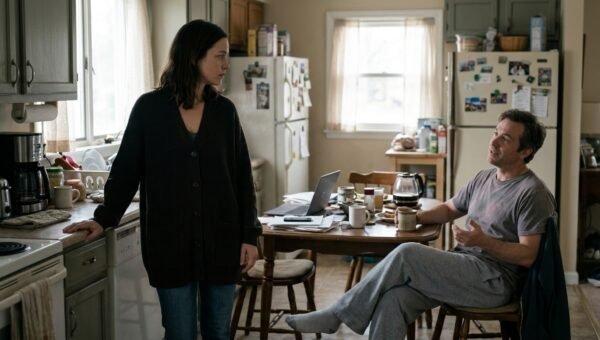
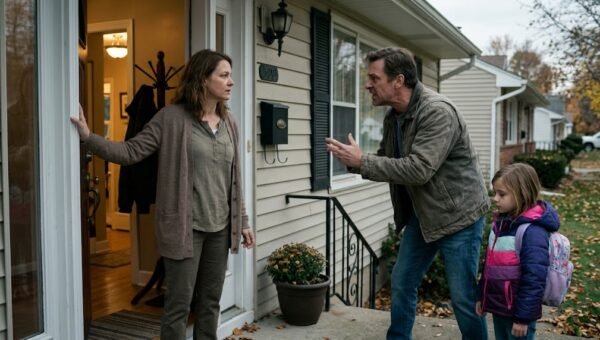
He told me Toby had become an intrusion in our marriage and that it was time to send him to boarding school. If I wouldn’t agree, Arthur said, I could leave with him.
I saw Toby’s socks on the upper stair runner. Just the toes, tucked behind the banister. Arthur didn’t notice. I knew Toby had heard us, because when I called his name, the socks disappeared.
Arthur picked up his briefcase. “I’m not discussing this again.”
I didn’t answer. I’ve spent too much of my life trying to make an argument sound gentle enough that another person might accept it. That morning, I didn’t need to work out what I thought. I saw Toby’s feet on those stairs and knew I wasn’t sending him away to keep my marriage comfortable.
Arthur left for Manhattan. The front door shut, and I went upstairs to Toby.
He was sitting on the edge of his bed, looking down at his hands.
I sat beside him and told him he wasn’t the problem. I told him he was staying with me. He asked if Arthur had said he didn’t want him in the house.
I said Arthur had said something cruel. That was the truth, but not the whole truth. I should’ve told Toby more. Instead, I put my hand over his and said, “You’re not going anywhere without me.”
He nodded once. I remember the little red thread on his sock, pulled loose at the heel. It was the sort of thing I used to fix without thinking. I kept looking at it because I didn’t yet know what else to do with my hands.
I went to the upper closet for an old duffel bag. Arthur kept his winter garment bags there, and I’d been told more than once not to move his things. I was looking for Toby’s bag, not snooping.
Still, I knew the difference between a rule and a warning, and I’d learned not to test either one.
The duffel was shoved high on the shelf. When I pulled it down, a wooden box shifted behind the garment bags and bumped the closet wall. It was worn along the edges, the kind of box that had been handled plenty before someone decided it shouldn’t be seen.
I could’ve pushed it back. Arthur was gone, but I still heard his voice in my head telling me to leave his things alone. I opened it anyway.
There was an envelope from an estate attorney in Boston, postmarked eight months earlier. Under it sat a trust document and papers for a boarding school. I read the attorney’s letter twice. It said my family had left money in trust for Toby’s care, enough to give me choices I hadn’t known I had.
Arthur had kept the letter from me. He’d also kept the correspondence that came after it.
His pencil notes were in the margins of the school paperwork. Beside tuition, he’d written about deductibles. Beside the school name, he’d noted that it was an upstate academy.
At first I tried to find a kinder explanation. Maybe he’d planned to tell me. Maybe he’d thought the trust would be easier to manage himself. I’ve always been good at patching a fence one loose board at a time, telling myself the whole thing was still standing.
Then I found the signed inquiry form tucked beneath the trust document. Arthur had asked about admission for Toby. He’d done it without telling me, and he’d hidden the money that could’ve helped me make a home of my own. This wasn’t a bad morning or one thoughtless remark. He had made a plan.
I called the estate attorney using the number on the letter. My hands were unsteady, so I wrote down what the attorney said on the back of an envelope. The trust was real. The money had been meant for Toby’s care. Arthur’s name wasn’t the only name that mattered.
“Can you help me get it under my control?” I asked.
“Yes,” the attorney said. “I’ll start today.”
I told the attorney about Arthur’s application and the missing letters. I also said I was leaving. The attorney didn’t tell me what to do about my marriage. I was grateful for that. I didn’t need someone else making decisions for me, even if they were good ones.
After the call, I packed Toby’s essentials and a bag for myself. I packed carefully, not because I was calm, but because I knew I’d forget things if I rushed. Socks, medicine, his school things, two shirts he liked. I kept the trust papers and the school form out of the box.
I called the neighbor down the lane, someone I trusted, and asked if Toby could wait there while I got the car ready. I didn’t want him standing in the foyer when Arthur came home. I’d seen enough of what a grown man’s anger could do to a child, even when no one raised a hand.
Toby looked at the packed bag by the stairs. “Are we going?”
“Yes,” I said.
“Because of me?”
“No. Because of what Arthur chose to do.”
I drove him to the neighbor’s porch and made sure he was settled before I went back. He looked small in the doorway, but he didn’t ask me to stay. I told him I’d be right back. I put the packed bag in the car and returned to the house with the box and papers.
I left the box open on the table beneath the foyer chandelier. The letter and the boarding application lay flat beside it. I wanted Arthur to see the proof before he could tell me I’d misunderstood him. My own keys stayed in my pocket.
When Arthur came home from Manhattan, he stopped as soon as he saw the papers. His eyes went from the letter to the box, then to me. He didn’t ask what I was doing. He knew.
“You went through my things,” he said.
“I found a letter addressed to me.”
He picked up the trust document and looked at the first page. “I was trying to protect the marriage.”
I’d expected something like that. I still felt the old urge to help him make his case, to turn his words into something less ugly. But he’d kept the letter for eight months. He’d asked about a school for Toby behind my back. I couldn’t soften those facts without lying to myself.
“You hid Toby’s money,” I said.
“I thought boarding school would give him structure.”
“You applied without telling me.”
“He needs discipline,” Arthur said. “This isn’t about money.”
I put my finger on the attorney’s letter. “You hid this so I couldn’t leave.”
He looked at the papers again. He didn’t answer. I told him the attorney had been notified, the trust was being redirected to an account only I controlled, and my car was packed. I’d also decided to start divorce proceedings. I was done waiting for Arthur to decide whether Toby belonged in his life.
Arthur reached for my hand. I pulled it back. He said we could talk in the morning, when we weren’t upset. That used to work on me. It meant I’d swallow the hurt tonight and sit through another talk tomorrow.
“Not this time,” I said.
I left my keys on the table beside the open box. Then I went to the car and collected Toby. We stayed in a nearby suite while I worked out permanent housing, and the attorney handled the trust transfer. I started the divorce process. None of it happened in one neat afternoon. But the choice had already been made.
When I think of Toby on the stairs, I still see that loose red thread on his sock. I’d thought I was the one who needed a place to go. I was wrong about that. I already had the one person I wasn’t willing to leave behind.
The heavy brass door clicked shut behind me. Arthur was left under the chandelier, staring at the empty wooden box and the single set of silver house keys.