PART 1
The call came in at a quarter past nine on a drizzly Tuesday night. My phone buzzed against the laminate kitchen counter while I was rinsing out a coffee pot, and when I saw my Aunt Clara’s name on the screen, my first thought was that something had happened to her heart. She was seventy-two, with mild asthma and knees that gave her fits whenever a front rolled through Ohio, but she was never the kind of woman to dial anyone past dark unless the house was on fire.
“Beth?” Her voice was so thin I could barely hear it over the sound of diesel engines roaring in the background. “Beth, honey, are you home?”
“I’m right here, Aunt Clara,” I said, setting the pot down on the drying rack. “Where are you? What is that noise?”
“I’m down at the Greyhound depot on Fourth Street,” she whispered. She sounded like she was trying to swallow down tears and failing completely. “I know it’s late, and I know it’s an awful thing to ask. But could I sleep on your sofa tonight? Just for a day or two, until I figure out what to do.”
I grabbed my car keys off the hook by the back door before I even asked another question. “Stay right inside the waiting area, Clara. Do not go out on the sidewalk. I’m ten minutes away.”
On the drive across town, my mind was racing. For the last four years, ever since my Uncle Ray passed away from pancreatic cancer, Clara had been living in their brick ranch on Maple Avenue.
It was the only home she had known for forty-two years. Two years ago, her daughter, my cousin Shannon, had moved back in after a messy second divorce. Shannon brought along two teenagers, three unruly dogs, and an endless stream of financial complaints. We all knew Shannon was loud, selfish, and ran through money like water, but Clara always made excuses for her. Clara was the gentlest soul in our family, the kind of woman who spent her Sundays baking cinnamon bread for church shut-ins and keeping Ray’s memory alive in every corner of that little house.
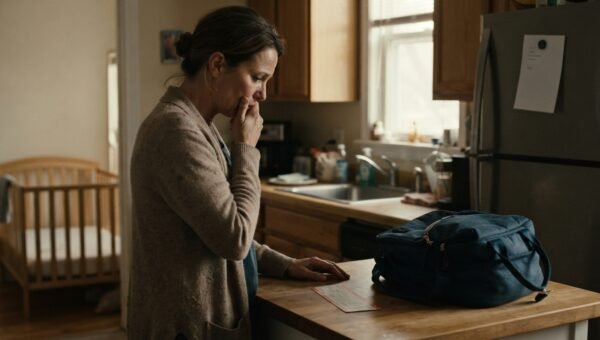
When I pulled up to the curb of the bus station, I spotted her through the glass doors. She was sitting on a yellow plastic bench under the fluorescent lights, clutching a single brown paper grocery bag in her lap. Next to it rested an eight-by-ten framed photograph of Uncle Ray in his navy veteran uniform.
She had no suitcase. She didn’t even have her wool winter coat, just a thin cardigan pulled tight around her shoulders against the October chill.
I rushed inside and wrapped my arms around her. She felt smaller than I remembered, like grief and exhaustion were physically shrinking her frame.
“What happened?” I asked, kneeling down in front of her bench. “Where are your bags? Where is your coat?”
“Shannon sold the house, Beth,” Clara said, her chin trembling. “A company came by last week with papers, and Shannon told me today that the buyers want immediate possession. She said the sale closed this afternoon. She told me she was moving the kids down to an apartment in Cincinnati, and there wasn’t room for me. She drove me to the terminal, handed me fifty dollars, and told me to take the bus out to my sister in Pennsylvania.”
“Pennsylvania?” I stared at her in disbelief. Clara’s sister Martha was eighty-one and living in an assisted living facility with severe memory loss. “Martha can’t take you in! Shannon knows that!”
“Shannon said it was time for me to stop leaning on everybody,” Clara whispered, staring down at Uncle Ray’s picture. “Please don’t yell, Beth. Please don’t make trouble. Shannon gets so angry, and I just… I don’t have the stomach for a fight. If I can just sleep on your couch tonight, I’ll call the county housing office in the morning.”
“You are not going to county housing, and you are not going to Pennsylvania,” I told her firmly.
I took the paper grocery bag and Uncle Ray’s frame in one arm, took Clara’s cold hand with the other, and led her to my car. In the grocery bag were three pairs of socks, an extra nightgown, her blood pressure pills, and her Bible. That was all Shannon had allowed her to take from forty-two years of marriage.
When we got to my place, I heated up some leftover vegetable soup, set Clara up in my spare guest bedroom with clean flannel sheets, and waited until her breathing slowed into sleep. But I couldn’t sleep a wink. I sat at my dining room table, staring into the dark hallway, burning with a cold, sharp anger. Ray and Clara had paid off that Maple Avenue house back in 2008. I remembered Ray having a little barbecue in the backyard to celebrate burning the mortgage papers. How could Shannon sell a house that belonged to Clara? Clara might be soft-spoken, but she wasn’t declared incompetent, and she certainly hadn’t signed over her life to her daughter.
First thing Wednesday morning, while Clara was still asleep, I pulled up the county property website on my computer. I typed in the address on Maple Avenue. The records were confusing, showing a document filed back in April, but the system had an alert on the page saying the deed book had an unindexed transfer.
At eight-thirty sharp, I dialed the county recorder’s office. I gave the clerk the parcel number and asked if a deed transfer had been completed the previous afternoon for Clara Miller’s property.
The clerk, a woman named Beverly whose voice sounded tired and raspy, asked me to hold while she pulled the file from the digital queue. I stood by my kitchen window, watching the rain hit the glass, expecting her to tell me that Shannon had forged Clara’s signature on a quitclaim deed.
“Ma’am?” Beverly’s voice came back on the line. “I’m looking at the record right now. Your aunt didn’t sell that property yesterday. In fact, your aunt couldn’t have sold it.”
My stomach dropped. “What do you mean? Is it still in her name?”
“No,” Beverly said flatly. “It isn’t in Clara Miller’s name, and it never belonged to Shannon Miller either. The house transferred six months ago, back in April, into an irrevocable family trust established by Raymond Miller before his death.”
I gripped the phone tighter. “A trust? Ray created a trust?”
“That’s right. The Raymond Miller Family Protection Trust,” Beverly read off the screen. “The deed was recorded by his estate attorney. And according to the recorded certificate of trust on file here, the sole trustee with exclusive legal authority to sell, lease, or transfer that property isn’t your aunt, and it certainly isn’t Shannon.”
“Then who is it?” I asked, my heart pounding in my ears.
“The sole trustee is listed as Elizabeth Ann Harper,” Beverly said. “That’s you, isn’t it?”
PART 2
The silence on the line felt like it lasted five minutes. I stood frozen in my kitchen, holding the receiver so hard the plastic creaked.
“Me?” I managed to croak out. “Beverly, are you sure? There was never any paperwork sent to me. Nobody ever told me.”
“I have the recorded memorandum right here, Ms. Harper,” Beverly replied, typing something in the background. “It was filed by an attorney named Gerald Vance. His office is downtown on High Street. It looks like the property transfer was executed under a deed executed while Mr. Miller was still living, but it had a delayed recording provision tied to the final settlement of his estate. As the trustee, you have full fiduciary authority. Nobody can sell, encumber, or convey that parcel without your physical signature. Whatever your cousin did yesterday, it wasn’t a legal sale through this county.”
I thanked Beverly, hung up the phone, and stood in my quiet kitchen while the pieces began to click into place.
Gerald Vance had been Uncle Ray’s lawyer for thirty years. Ray had worked as a machinist at the roller-bearing plant, and while he was a quiet man who rarely raised his voice, he had an iron sense of practicality. He had watched Shannon run through two husbands, three cars, and every dime of inheritance she had ever touched. Ray had loved Shannon because she was his daughter, but he never trusted her with money. He knew Clara’s soft heart would be no match for Shannon’s bullying once he was gone.
I walked down the hall and peeked into the spare bedroom. Clara was awake, sitting on the edge of the mattress with her hands folded in her lap, looking lost in a room that wasn’t hers.
“Clara,” I said gently, stepping inside and sitting on the chair beside the dresser. “Did Uncle Ray ever mention a lawyer named Gerald Vance to you before he passed?”
Clara looked up, her eyes watery. “Oh, yes. Ray went to see Mr. Vance when he got sick. He told me he was putting together some papers so I wouldn’t have to worry about the house if he went first. But after the funeral, Shannon told me Mr. Vance was too expensive. Shannon said she took care of the estate herself through the probate court.”
“Shannon lied to you, Clara,” I said, keeping my voice as calm and steady as I could. “Ray didn’t leave the house to Shannon. And he didn’t leave it in a way that Shannon could take it from you. He put it into a trust to protect you. And he named me as the person responsible for protecting it.”
Clara stared at me, her mouth parting slightly. “He… he named you?”
“I’m going down to Mr. Vance’s office right now,” I said, standing up. “I want you to eat the oatmeal I left on the stove, stay warm, and don’t answer the phone if Shannon calls. We are going to find out exactly what Shannon did yesterday.”
I drove downtown through the steady gray rain and walked straight into Gerald Vance’s office without an appointment. His secretary tried to tell me he was in a client meeting, but the moment I gave my name and mentioned Raymond Miller’s trust, Mr. Vance opened his inner office door. He was in his late sixties, with thick silver hair and wire-rimmed glasses, and he looked both surprised and immensely relieved to see me.
“Elizabeth,” he said, ushering me inside and closing the door behind us. “I have been trying to reach you for nearly five months. The contact letter we sent to your old address on Meadow Lane was returned undeliverable.”
“I moved three years ago, Mr. Vance,” I said, sitting in the heavy leather chair across from his desk. “What did Ray do?”
Mr. Vance pulled a thick manila folder from the top of his cabinet and laid it between us. “Ray came to see me two months after his diagnosis. He was clear-headed and very specific. He knew Shannon’s history with debt. He knew she had judgments against her in two neighboring counties for unpaid credit cards and personal loans. He told me, ‘Gerald, if Clara gets that house outright, Shannon will badger her until she signs it away, and they’ll both end up on the street.’ So we established an irrevocable trust.”
He flipped open the document and pointed to the second page. “The terms are simple. Clara has an absolute life estate. She has the legal right to live in the home completely rent-free, uninterrupted, for the remainder of her natural life. The trust pays the property taxes and insurance from a small maintenance annuity Ray funded with his life insurance policy. Upon Clara’s death, the house is to be divided equally between Shannon and your brother Mark. But during Clara’s life, the house cannot be sold, mortgaged, or transferred without the trustee’s consent. And Ray appointed you because he knew you wouldn’t back down from Shannon.”
“Shannon told Clara yesterday that the house was sold,” I said, my voice hardening. “She took Clara’s key, packed her clothes into a grocery bag, and left her at the Greyhound station last night with fifty dollars. She told Clara the buyers were taking possession today.”
Mr. Vance removed his glasses and rubbed the bridge of his nose. His expression turned from polite professional interest to pure, chilling disgust. “She did what?”
“Who bought it?” I asked. “Beverly at the recorder’s office said no deed had cleared.”
“Nobody bought it through legal channels,” Mr. Vance said, pulling up a search window on his computer. “Let me check the local court docket. If Shannon tried to sell that property, she either committed outright fraud or she dealt with an unlicensed wholesaler.”
He typed for three minutes in complete silence while the printer behind his desk hummed to life. When he pulled the pages from the tray, his jaw was set tight.
“Here it is,” Mr. Vance said. “Shannon signed an unrecorded land purchase contract three weeks ago with an entity called Buckeye Rapid Home Buyers LLC. It’s an off-market cash outfit. She signed an affidavit of sole heirship, claiming Clara was deceased and that Shannon was the sole surviving beneficiary of Raymond Miller’s intestate estate. They paid her a seventy-five thousand dollar cash deposit on an agreed purchase price of one hundred and ten thousand. The remainder was due upon recording the deed, which their title company was attempting to push through today.”
Seventy-five thousand dollars. Shannon had thrown her own mother out in the cold for pocket money on a house worth twice that much, lying about her own mother being dead to get cash into her hands.
“Can they take the house?” I asked, my pulse hammering in my throat.
“Not a chance,” Mr. Vance said, picking up his desk phone. “A forged heirship affidavit is void on its face. Buckeye Rapid Home Buyers has zero legal claim to the property, and their contract is a piece of worthless paper. But more importantly, Elizabeth, Shannon has committed felony grand theft, wire fraud, and falsification of official records. And if someone is at that house right now trying to change the locks, they are trespassing on trust property.”
Mr. Vance dialed the county sheriff’s civil division directly, identifying himself as counsel for the Raymond Miller Trust. “Sergeant,” he said into the receiver, “we have an active unlawful eviction and criminal trespass underway at 1412 Maple Avenue. The lawful life tenant was removed under false pretenses, and an unauthorized third party is attempting to seize the premises. The trustee is en route with legal counsel.”
He hung up, grabbed his overcoat from the coat rack, and looked at me. “Get in my car, Elizabeth. Let’s go meet your cousin.”
PART 3
When Mr. Vance and I turned the corner onto Maple Avenue, my stomach twisted into knots.
Parked along the curb in front of Uncle Ray’s house were two large white box trucks and a beat-up silver minivan with Shannon’s bumper stickers on the tailgate. Two men in work boots were carrying a wooden dresser across the front lawn, while a third man in a yellow safety vest was standing by the front porch with a clipboard and a drill in his hand.
Shannon was standing on the front porch steps, wearing an oversized sweater, clutching a tall plastic travel mug in one hand and talking animatedly on her cell phone. She was laughing. She actually stood there laughing while men carried her parents’ life out to the curb.
Before Mr. Vance even brought his sedan to a full stop behind the box trucks, a county sheriff’s cruiser pulled up on the opposite side of the street, followed immediately by a second squad car. Deputy Miller, a tall, broad-shouldered officer I recognized from town, stepped out into the rain and adjusted his duty belt.
Shannon stopped laughing the second she saw the police cars. She hung up the phone and hurried down the steps, her face pulling into an expression of theatrical annoyance.
“What is going on here?” Shannon demanded as Mr. Vance and I stepped out onto the wet asphalt. Then she saw me, and her face went completely pale. Her eyes darted from me to the cruiser, and for half a second, she looked like she wanted to run behind the garage.
“Beth?” she stammered, trying to muster a defensive sneer. “What are you doing here? Did you bring Mom? I told her she needed to go to Aunt Martha’s. I have everything under control here.”
“Put the drill down, sir,” Deputy Miller called out to the man on the porch. “Step away from the door and keep your hands visible.”
The man with the clipboard immediately backed away, holding his hands out to his sides. “Whoa, officer, we’re just the clean-out crew hired by Buckeye Rapid. We’re contracted to clear the interior and secure the locks.”
“Nobody is clearing anything,” Mr. Vance said, stepping forward and opening a black leather binder. He pulled out the certified copy of the recorded trust agreement, the deed from Ray Miller, and the original letters of trusteeship. He handed the packet directly to Deputy Miller.
“I am Gerald Vance, legal counsel for the Raymond Miller Family Protection Trust,” he announced in a calm, clear voice that carried across the lawn. “The owner of this real property is the trust. The sole lawful fiduciary is Elizabeth Harper, standing right here. The life tenant is Clara Miller, who is very much alive, despite the fraudulent affidavit Shannon Miller executed to obtain seventy-five thousand dollars from an off-market buyer.”
Deputy Miller looked over the documents, his eyes scanning the raised county seal and the recording timestamps. Then he looked at Shannon. “Is Clara Miller deceased, ma’am?”
Shannon’s face flushed an ugly, mottled red. “My mom wanted this! She couldn’t keep up the house! It’s too big for her, and the plumbing is shot, and I’m the one who’s been taking care of her for two years! I have a right to my father’s estate!”
“You have zero rights to this estate during your mother’s lifetime,” Mr. Vance said coldly. “And you swore under penalty of perjury on an affidavit of heirship filed with a title company that Clara Miller passed away on January fourteenth of this year. That is a fourth-degree felony in this state, Shannon. Along with grand theft by deception.”
The man in the yellow vest cursed under his breath, pulled out his phone, and began frantically dialing his supervisor. “We’re leaving,” he told the deputy. “We’re not getting dragged into a title scam. Guys, put that stuff back inside right now.”
“No, don’t put it inside,” Shannon shrieked, her voice turning shrill and frantic. “I signed the contract! The money is already in my checking account! You can’t just undo this! Beth, tell him! You tell them to back off! I’m Ray’s daughter! You’re just a niece!”
“Uncle Ray knew exactly who you were, Shannon,” I said, stepping right up to the edge of the walkway. “He knew you would do this to your own mother. He planned for it four years ago because he knew Clara would never stand up to you. You put your mother on a bus with three pairs of socks and fifty dollars. You left her sitting in a cold terminal while you pocketed seventy-five thousand dollars on a house you didn’t own.”
Deputy Miller handed the documents back to Mr. Vance. “Ms. Harper, as the lawful trustee, do you want these individuals off the premises?”
“I want Shannon Miller and every contractor here removed immediately,” I said. “And I want a formal trespass order issued against her.”
Deputy Miller turned to Shannon. “You have ten minutes to get your personal vehicle off this property, ma’am. Do not enter the dwelling. If you attempt to re-enter this home, you will be arrested on sight for criminal trespass.”
“You can’t do this to me!” Shannon screamed, tears of pure rage spilling down her cheeks. “The title company is going to sue me! They’ll take everything I have!”
“They certainly will,” Mr. Vance said without an ounce of pity. “Along with the county prosecutor, who will be receiving a full referral from my office before the courthouse closes today.”
The clean-out crew scrambled to reload their equipment into the trucks, practically running over each other to get away from the house. Shannon stood on the lawn for another minute, screaming obscenities at me, blaming me for ruining her life, until the second deputy placed his hand on his holster and told her that her ten minutes were up. She threw her travel mug against the side of her minivan, got behind the wheel, and peeled away from the curb, spraying wet gravel across the lawn.
When the street finally fell silent again, Deputy Miller walked up to the porch, checked the front door latch, and handed me the keys the clean-out crew had left on the porch rail.
“The locks haven’t been swapped yet, Ms. Harper,” he said gently. “The house is secure. Take care of your aunt.”
ENDING
I spent the next three hours going through the house room by room.
Shannon had ransacked Clara’s bedroom. She had pulled Clara’s jewelry box off the vanity, rummaged through the bureau drawers, and packed up anything that looked like it had resale value. But the big things were still there. Uncle Ray’s favorite leather recliner was still sitting in the corner of the living room by the window. Clara’s sewing machine was still threaded with navy cotton in the den. The framed needlepoint of the 23rd Psalm that Clara’s mother had stitched in 1954 was still hanging above the hallway telephone.
I drove to the hardware store, bought two heavy-duty deadbolts, and installed them myself before the afternoon sun began to dip behind the maple trees. Then I drove back to my house to pick up Clara.
When I opened the front door, she was sitting at my kitchen table, a half-empty mug of tea in front of her. She looked up with wide, frightened eyes, bracing herself for bad news.
“Clara,” I said, sitting down across from her and sliding a shiny new brass key across the table. “Grab your sweater. We’re going home.”
She looked at the key, then up at me, her lower lip trembling. “Home? But… what about the people Shannon sold it to?”
“There were no buyers, Clara,” I explained softly, taking her hands in mine. “Shannon tried to run a confidence scheme with some off-market investors, but Uncle Ray made sure years ago that nobody could ever touch that house. He set up a trust to keep you safe. You have a legal life estate. That house belongs to you for as long as you live, and not a single soul on this earth can force you out of it.”
Clara buried her face in her hands and wept. They weren’t tears of grief this time; they were the deep, shuddering tears of an old woman who had spent twenty-four hours believing she was discarded and homeless, suddenly realizing she was safe.
When we pulled into the driveway on Maple Avenue, the late afternoon light was cutting through the clouds, lighting up the red leaves on the big sugar maple Ray had planted when they bought the lot. Clara stood on the porch for a long moment, running her fingers over the chipped green paint of the front door frame before I unlocked it.
She walked inside, took off her cardigan, and hung it on the brass coat rack in the hall. She walked straight to the living room, sat down in Uncle Ray’s recliner, and set his framed portrait on the side table beside her reading lamp.
“He always looked out for me,” she whispered, stroking the glass over Ray’s smiling face. “Even from the grave, Ray looked out for me.”
The consequences for Shannon came fast and hard. Within forty-eight hours, the legal counsel for Buckeye Rapid Home Buyers filed an emergency civil freeze on Shannon’s bank accounts, successfully clawing back fifty-two thousand dollars of the seventy-five thousand they had wired her. The remaining twenty-three thousand Shannon had already spent paying off old debts and putting a deposit on a rental home was converted into a formal civil judgment against her with twenty-one percent default interest.
Two weeks later, the county grand jury indicted Shannon on three felony counts: grand theft by deception, tampering with governmental records, and forgery. Mr. Vance made sure the prosecutor’s office had every text message Shannon had sent her mother and every fraudulent signature she had stamped on those title documents. Shannon ended up taking a plea deal that gave her five years of intensive probation, hundreds of hours of community service, and a mandatory restitution order that will garnish her wages for the rest of her working life. She also had a permanent protection order placed on her, forbidding her from coming within five hundred feet of Clara or the Maple Avenue property.
Clara never spoke to Shannon again. It broke her heart, as any mother’s heart would break, but the fog of guilt Shannon had kept her in for decades finally lifted. Clara realized that Shannon hadn’t just made a mistake; she had willingly traded her mother’s survival for a pile of quick cash.
As the trustee, I took over the management of Ray’s maintenance annuity. Every month, the trust pays the property taxes, the insurance, and the utility bills directly from the bank account Ray funded. Clara doesn’t have to worry about a single bill coming to her mailbox.
Last Sunday, I drove over to Maple Avenue after church. The smell of fresh cinnamon bread hit me before I even reached the front porch. When I walked into the kitchen, Clara was standing at the counter in her flour-dusted apron, humming an old hymn, rolling out dough on the wooden pastry board Ray had made her for their twenty-fifth anniversary.
She looked up, smiled, and pointed to a fresh loaf cooling on the wire rack.
“Take that one home with you, Beth,” she said, her voice steady and warm. “Ray always said you liked the end crust the best.”
I took the loaf, looked around the bright, quiet kitchen, and knew that Uncle Ray’s final job on this earth had been completed. Clara was safe in her home, exactly where she belonged.