PART 1
My husband, Greg, has always had a blind spot the size of a barn when it comes to his younger brother, Thomas. Thomas is thirty-eight, charming when he needs something, and chronically incapable of keeping his life on straight tracks. Over the twelve years Greg and I have been married, we have bailed Thomas out of missed utility bills, listened to three separate pitches for businesses that never existed, and lent him tools that somehow never found their way back to our garage.
So on a damp Tuesday morning in October, when Thomas pulled into our driveway in his rusted sedan and asked if he could borrow our 2018 Ford F-150 for just three hours, my stomach tightened.
“Just three hours, Sarah,” Thomas told me on the front porch, flashing that wide, sheepish grin that used to work on Greg’s mother. “A buddy from my bowling league bought a sectional sofa off Marketplace and he has no way to haul it. He’s giving me eighty bucks for gas and lunch. I will have it back in your driveway by four o’clock sharp, full tank.”
Greg was already walking toward the kitchen key rack. “He’s trying to make an honest dollar, honey. Give him the keys.”
I gave him the keys, but I looked Thomas in the eye. “Four o’clock. Greg needs the truck tomorrow at dawn for a job site out in Shelby County.”
“Four o’clock on the dot,” Thomas promised, and he backed out of our gravel drive.
Four o’clock came and went. At five, his phone went straight to voicemail. At seven, Greg called him three times, his brow furrowing deeper with each unanswered ring. By ten o’clock, dinner was cold, Greg was pacing the hardwood floor in the living room, and I was sitting at the kitchen table staring at the clock.
“He probably just ran into traffic or helped the guy carry it up three flights of stairs,” Greg mumbled, defending his brother out of sheer habit. “You know how Thomas loses track of time.”
“Losing track of time is forty-five minutes, Greg. It has been seven hours.”
It was twenty past midnight when headlights finally swept across our living room curtains. The truck engine cut out, a door clicked shut, and footsteps hurried down the side gravel toward the road.
Thomas didn’t even knock on the door to hand the keys back. He dropped them through the mail slot on our front door, jumped into the passenger side of a dark sedan waiting by our mailbox, and sped off into the night.
Greg and I threw on our coats and went outside with a flashlight.
The truck was parked crooked across the grass. The fuel needle rested dead on empty, the low-fuel warning light glowing amber on the instrument panel. Worse, along the passenger-side rear panel, there was a fresh, jagged crease in the sheet metal, three feet long, scraping through the clear coat down to bare primer.
“I can’t believe him,” I said, my voice shaking with fury. “He dented the bed, drained thirty gallons of gas, and ran off like a teenager.”
Greg sighed, rubbing the back of his neck with both hands. “Look, let’s not make a federal case out of it tonight.
It’s midnight. He probably felt awful about the scratch and panicked. I will call him in the morning and make him pay for the body shop and the gas. Let’s just go inside.”
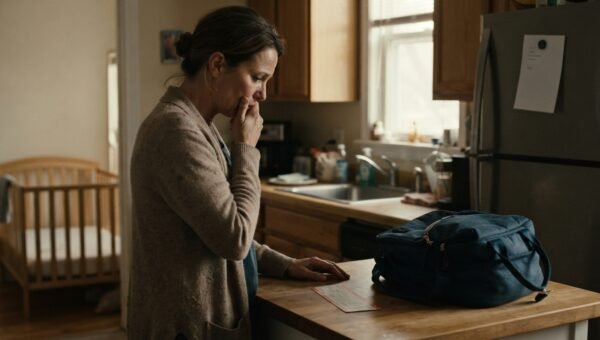
I was too angry to let it go. I grabbed a garbage bag and my phone flashlight, determined to see what kind of mess he had left inside the cab. Thomas was known for leaving greasy fast-food wrappers and energy drink cans wherever he sat.
I opened the passenger door. The cab smelled distinctly like cheap vanilla air freshener, overlaid with the sharp, clinical smell of rubbing alcohol. On the rubber floor mat were a couple of dirty paper towels and a child’s blue plastic hair clip.
Then I saw something small catch the beam of my phone light.
It had rolled all the way under the passenger seat, jammed tightly between the seat track and the center console carpet. I reached down, my fingers brushing against the cold metal runner, and pulled it free.
It was not trash. It was a tiny, molded pediatric hearing aid, made of pale pink silicone and clear tubing. Stamped along the curved casing in microscopic print was a serial number and the brand name Phonak.
My hand froze.
We do not have young children. Our two kids are in college up in Columbus. Greg and I haven’t had a car seat or a child in that truck since we bought it six years ago. And Thomas did not have children either. He lived in a rented studio apartment across town, claiming he was a confirmed bachelor who loved his freedom.
I stood there in the cold driveway, staring at that tiny pink device resting in my palm. A sickening knot formed in my chest. You do not lose an expensive piece of medical equipment like that while moving a sectional sofa for a buddy.
Something was deeply wrong, and I was not going to wait until morning to find out what it was.
PART 2
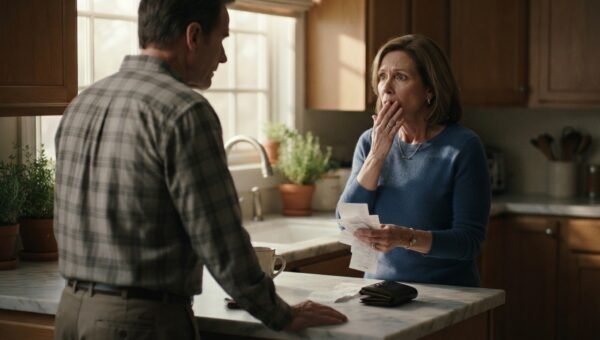
I went back inside the house, set the hearing aid on the kitchen island under the bright pendant lights, and dialed Thomas’s cell phone.
This time, on the fourth ring, he picked up. His breath was ragged, and in the background, I could hear the hum of highway tires.
“Thomas,” I said, keeping my voice level. “Whose child was in our truck today?”
There was a sudden, dead silence on the line.
“What are you talking about?” he stammered, his voice climbing an octave. “Nobody was in the truck except me and Dale. We hauled that couch, like I told you.”
“Thomas, I am holding a pink pediatric hearing aid that was wedged under the passenger seat. There is a child’s hair clip on the floor. Who was in our truck?”
“I don’t know!” he snapped, his tone turning instantly defensive and loud. “Dale has a niece. She must have ridden in his car and he had her stuff in his jacket or something. It probably fell out of his pockets when we were moving the cushions. I didn’t see anything. I gotta go.”
He hung up before I could ask another question.
Greg walked into the kitchen, buttoning his flannel shirt. He looked at the pink plastic sitting on the counter. “Sarah, leave it alone until tomorrow. If it belongs to his friend’s kid, we’ll get it back to them. Why are you turning this into an interrogation?”
“Because he’s lying, Greg. Listen to his voice. Look at this.” I tapped the hearing aid with my fingernail. “These things cost thousands of dollars. Parents don’t just misplace them, and men don’t carry their nieces’ hearing aids loose in their work coat pockets.”
I barely slept that night. At six in the morning, while Greg was leaving for work in his company car instead of the damaged truck, I sat at the kitchen table with my laptop and a mug of black coffee.
I opened our county’s community Facebook boards—the local yard sale groups, neighborhood watch pages, and community bulletin boards where people post about lost pets and road closures. If a child lost a hearing aid in our county, a frantic parent would be looking for it.
I typed “hearing aid” into the search bar of the largest county group. Nothing from the last week.
Then I checked the next group over, covering the adjoining rural township about twenty miles west.
At 7:15 AM, a post popped up at the top of the feed, timestamped just forty minutes earlier.
The post was written by a woman named Laura. It read:
“URGENT: Please share. Yesterday evening around 6:00 PM, during an emergency move from our rental on Elm Street, my eight-year-old daughter Maya’s medical pouch went missing. It was inside a purple canvas tote bag that was either lost or taken from our front porch. Her spare Phonak Sky hearing aid (soft pink) was inside, along with her daily medication. We cannot afford to replace this out of pocket and she cannot hear without it. If anyone picked this bag up by mistake or found it along Route 4, please call me immediately.”
Attached to the post was a photograph of a smiling little girl with dark curls tucked behind her ears, showing off that exact soft pink hearing aid.
My hands began to tremble. Route 4 was nowhere near the town where Thomas claimed he had moved a sectional sofa. Route 4 ran directly past the industrial edge of the county, heading out toward the state line.
At the bottom of the post was a phone number.
I didn’t hesitate. I picked up my phone and dialed.
The phone rang twice. A woman’s voice answered, breathless, strained, and exhausted. “Hello? Did someone find the bag?”
“Laura?” I said gently. “My name is Sarah Miller. I think I have your daughter’s hearing aid. I found it in the cab of a pickup truck late last night.”
A sob broke from Laura’s throat on the other end of the line. “Oh, thank God. Thank God. Where was it? Was the purple tote there too? Her medication was in it.”
“No,” I said, my heart sinking. “There was no tote bag. Just the hearing aid under the seat. But Laura, I need to ask you something important. How did it end up in my truck? My brother-in-law had the truck yesterday. Did you hire someone named Thomas?”
There was a sharp pause. The line went completely still.
“Wait,” Laura said, her tone suddenly guarded and cold. “What did you say your last name was?”
“Miller. My husband is Greg Miller. His brother is Thomas Miller.”
“Wait,” Laura whispered again, and I could hear genuine shock and disbelief bleeding through the receiver. “Are you related to Thomas Miller? Because Thomas told me his entire family died in a house fire six years ago.”
PART 3
The air left my lungs. I sat frozen at my kitchen table, staring at the salt and pepper shakers.
“Laura,” I said, struggling to find my voice. “Thomas’s family is very much alive. Greg is his older brother. Their mother is living in an assisted care apartment three miles from my house. What has Thomas been telling you?”
Laura didn’t answer right away. When she spoke again, her voice was shaking with anger and confusion. “He has been living with me for eight months. He told me he was an only child whose parents and brother died years ago. He told me he had nobody in the world.”
She gave me her address, a small duplex on the outskirts of town, and asked me to come over immediately.
I grabbed my coat, put the pink hearing aid into a clean ziplock bag, and drove across town. My mind was spinning through every lie Thomas had told us over the past year—the odd hours, the excuses about why he couldn’t come to Thanksgiving dinner because of “mandatory warehouse shifts,” the sudden requests for cash to cover “emergency dental work.”
When I pulled up to the duplex, the front yard told the entire story.
There were cardboard boxes stacked on the porch, taped shut with heavy brown packing tape. Two cheap plastic lawn chairs were sitting near the curb. Standing by the screen door was a woman in her late thirties, her eyes red-rimmed and dark circles bruising the skin beneath them. Beside her stood a little girl in blue jeans and a sweater, watching me with quiet, cautious eyes.
I stepped out of the car, walked up the steps, and pulled the ziplock bag from my pocket.
Laura took it, dropped to her knees, and gently slid the tiny device into her daughter’s ear. She turned on the small switch, whispered something into the girl’s ear, and the little girl’s face broke into a relieved smile. Laura sent her inside to watch cartoons before turning back to me.
“Come inside,” Laura said quietly. “We need to talk.”
The duplex was half-empty. A single lamp lit the living room where three duffel bags sat on the bare linoleum.
Laura sat down on an overturned crate and told me everything.
She had met Thomas on a dating app eight months ago. He introduced himself as an independent contractor, an orphan with no living relatives, who wanted nothing more than to settle down and help raise a family. Over the months, he had completely gained her trust. He knew she had received a modest eighteen-thousand-dollar settlement after a minor car accident two years prior—money she had set aside as an emergency fund for Maya’s future medical care and specialized schooling.
Three weeks ago, Laura’s landlord informed her that the duplex was being sold and she had thirty days to vacate.
“Thomas told me not to worry,” Laura said, wiping a tear from her cheek with the sleeve of her sweater. “He told me he found a beautiful three-bedroom rental house out in Greenfield with a big backyard for Maya. He said the landlord required first and last month’s rent plus a security deposit in cash because the market was so competitive. He told me it was four thousand two hundred dollars.”
She swallowed hard, looking toward the hallway where her daughter was.
“I gave him the cash on Monday,” she said. “Four thousand two hundred dollars out of my savings. Yesterday, he showed up in your truck around noon. He told me it belonged to his boss at the construction company and that he had permission to use it to start moving our heavy furniture.”
“He told us he was moving a couch for a bowling buddy,” I said, feeling sick to my stomach.
“He loaded up three loads of our boxes and our furniture,” Laura continued. “He told me to stay here and finish packing the kitchen while he took the loads over to the new house to unload. On his third trip, around five in the afternoon, he told me to give him Maya’s medical tote and my jewelry box so they wouldn’t get lost in the shuffle. He put them right on the front seat of your truck.”
She began to cry, no longer trying to stop the tears.
“By eight o’clock, he wasn’t back. By ten o’clock, his phone was off. At midnight, I drove out to the address in Greenfield he gave me for the new house. Sarah… that address doesn’t exist. It’s an empty cornfield behind a strip mall. He didn’t rent a house. He stole my furniture, my daughter’s medicine, my jewelry, and four thousand two hundred dollars of my emergency savings.”
The jagged scrape on the side of our truck suddenly made sickening sense. Thomas hadn’t been helping a friend. He had been backing up to rental garages or storage units in a hurry, loading up a single mother’s life to pawn or stash it, and when the hearing aid fell out of the bag during the rush, he didn’t even notice.
“Where is he now?” I asked.
“I don’t know,” Laura said. “The police took a report at two in the morning, but they told me because I gave him the money voluntarily and he lived here, it might be considered a civil dispute unless they can prove theft. But the jewelry and the medical bag make it grand larceny.”
“I know where he keeps his things,” I said, standing up. “And I know where he goes when he thinks nobody is watching.”
ENDING
I called Greg from my car while sitting in Laura’s driveway.
I didn’t sugarcoat a single word. I told him about the dead-family lie, the four thousand two hundred dollars in cash, the stolen medical tote, the nonexistent house in Greenfield, and the little girl who had spent the night in a half-empty house without her hearing aid.
Greg didn’t say anything for nearly a minute. All I could hear over the phone was his heavy, ragged breathing. When he finally spoke, the blind spot he had carried for his brother his entire life was completely gone.
“Meet me at his storage unit on County Road 9,” Greg said, his voice deadly quiet. “I pay the bill on that unit. My name is on the lease.”
County Road 9 was a fenced storage facility three miles past the interstate. Greg had rented the ten-by-ten space two years earlier to help Thomas store excess tools when his first apartment lease ended, and Greg had kept paying the eighty-dollar monthly fee just to keep his brother from losing his belongings.
When I pulled up to the security gate, Greg’s truck was already idling outside the keypad. Beside him was an Ohio State Highway Patrol cruiser and a local sheriff’s deputy. Greg had called them himself on his way over.
We walked down aisle D together, the two deputies trailing closely behind us.
Outside unit 114 sat the dark sedan that had picked Thomas up from our driveway at midnight. And standing inside the open roll-up door of the unit was Thomas.
He was surrounded by Laura’s life.
Her oak dining chairs were stacked against the corrugated metal wall. Maya’s purple canvas tote bag was sitting on top of an open plastic cooler. Thomas was holding a small wooden jewelry box in his hands, sorting through gold chains and costume earrings.
When he heard our boots on the gravel, he whipped around, his face draining of all color.
“Greg?” Thomas stammered, dropping the jewelry box back onto the cooler. “What are you doing here? I told you I’d pay for the gas today—”
“Shut your mouth, Thomas,” Greg said. It was the coldest, hardest tone I had ever heard come out of my husband’s mouth. “Don’t say another word.”
The sheriff’s deputy stepped past Greg, took one look at the purple canvas tote bag with Maya’s name embroidered on the strap, and unclipped his handcuffs.
“Thomas Miller, turn around and put your hands behind your back.”
Thomas began to babble, looking frantically between Greg and me. “Greg, tell them! Tell them this is just a misunderstanding! She was kicking me out, she gave me this stuff! Greg, I’m your brother!”
Greg didn’t move an inch. He stood with his arms crossed, his jaw clenched so hard the muscle jumped beneath his skin. “You told her we died in a fire, Thomas. As far as I’m concerned, today that’s true.”
The deputies cuffed him and led him toward the cruiser. In the trunk of the dark sedan, which belonged to a woman Thomas had been seeing on the other side of town, they found Laura’s remaining cash—thirty-six hundred dollars of the original forty-two hundred, stuffed into a bank envelope behind the spare tire.
Greg and I spent the rest of that afternoon doing what should have been done the day before.
We loaded Laura’s furniture back into our truck. We packed the purple tote bag with Maya’s medicine, the dining chairs, the clothes, and the jewelry box. Greg paid seventy dollars to fill our tank, drove out to the duplex, and spent three hours carrying every single box back inside for Laura and her daughter.
Before we left, Greg handed Laura the recovered cash envelope, along with an extra six hundred dollars pulled from our own savings to make up for the money Thomas had already spent.
“You don’t have to do that, Mr. Miller,” Laura said through tears, standing in her doorway.
“Yes, I do,” Greg replied quietly. “It’s the only way my family’s name means anything today.”
Thomas was charged with grand theft, possession of stolen property, and theft of prescription medications. He took a plea deal two months later, receiving eighteen months at the state correctional facility. Greg didn’t post his bail, didn’t attend his hearings, and didn’t accept any of the collect calls from the county jail.
The dent on our truck’s passenger side is still there. Greg refused to take it to the body shop to have it hammered out and painted over. He said he wanted to see it every single time he walked out to the driveway, as a permanent reminder of the day he stopped enabling a liar and finally saw his brother for who he really was.