PART 1
My mother looked me in the eye on a Tuesday afternoon and said there was nothing valuable left in the house. She was sitting in her yellow floral armchair, the one with the worn armrests where Dad used to rest his elbows. She told me she had gone through everything. She said the medical bills from Dad’s final two years had eaten up whatever small savings they had kept, and that any jewelry worth mentioning had been sold off long before his funeral.
I did not argue with her. I had spent the last eight months driving forty miles round-trip every Tuesday and Thursday to bring her groceries, pick up her prescriptions, and sit at her kitchen table paying her utility bills online because the screen made her dizzy. I never asked for gas money. I never asked for an inheritance. The only thing I had ever quietly hoped to keep was a small silver oval locket that Dad had carried in his pocket during his thirty years at the rail yard. It was scratched on the back, and inside was a black-and-white photo of him holding me when I was three months old.
Two days later, my sister Ruth invited me to Sunday brunch at a cafe near her subdivision. When she walked in, she was wearing a brand-new beige linen blouse, and hanging right against her collarbone was the silver locket.
On her fingers were three diamond rings that had belonged to our grandmother, stones Mom had sworn she sold in 2018.
I sat down across from her, my hands cold against the laminated menu. I asked her where she got them.
Ruth smiled, buttering a biscuit with deliberate slowness. She told me Mom had called her on Wednesday night and insisted she come take the entire jewelry box. Then she looked right across the table and said Mom wanted those pieces to stay with someone who actually appreciates family, someone who has a family of her own to pass things down to. Ruth has two grown daughters. I never had children, and my husband passed twelve years ago.
She let the locket rest against her fingers while she talked about her kitchen remodel. I paid for my half of the bill, walked out to my sedan, and sat in the parking lot until my hands stopped shaking.
I was not furious about the diamonds. I was sick over the lie, and the casual cruelty of being told my time, my care, and my grief meant nothing because my house was quiet.
I drove home, unable to sit still in my living room. I needed to move, so I began tearing apart the spare bedroom closet. Dad had given me an old wooden cantilever sewing box when I bought my house twenty-five years ago. He had built the pine frame himself in his workshop behind the garage. I pulled it off the top shelf, wiping away decades of gray dust.
Down in the deepest bottom compartment, under old spools of heavy black thread and metal bobbins, the floral contact paper lining was peeling at the left corner. Underneath that paper, wedged tight into the groove of the joint, was a yellowed slip of folded receipt paper.
I opened it carefully. It was a receipt from Miller and Sons Fine Jewelers on Fourth Street, dated six months before Dad died.
Scrawled across the bottom in Dad’s sharp, cramped pencil handwriting was a note:
“The locket is not what Ruth thinks it is. Claim 4082. For Claire only.”
My throat went dry. The date on that receipt was from the week Dad had asked me to drive him into the downtown district for an errand he insisted on running alone while I waited in the car. I picked up the phone and dialed the number printed at the top of the slip.
A man with a slow, raspy voice answered. When I read him the claim number and gave him my name, he went completely silent on the line for three long seconds.
“Claire Henderson?” he asked.
“Yes,” I said. “That’s me.”
“You need to come down to the shop tomorrow morning,” he said quietly. “Bring your driver’s license and your father’s death certificate. Do not bring anyone else with you.”
PART 2
The shop bell chimed as I walked into Miller and Sons the next morning at nine. The store smelled of velvet, metal polish, and old wood. Behind the counter stood an elderly man in a dark vest with jeweler’s loupes resting beside a leather tray. His name tag read Walter Miller.
I laid my driver’s license, the yellowed receipt, and Dad’s official death certificate onto the glass counter. He picked up the receipt, examined Dad’s handwriting under his magnifying light, and then checked my license against a thick, leather-bound ledger he pulled from beneath the register.
“Your father came to see me six months before he passed,” Mr. Miller said, keeping his voice steady and low. “He was a very thorough man, Claire. He knew his health was failing, and he knew exactly how things were going to unfold at home once he was gone.”
He unlocked a heavy steel safe set into the back wall and brought out a small gray velvet box. Inside rested an oval silver locket.
My breath caught. It was identical to the one Ruth had been wearing at brunch. The same faint scratches on the back edge, the same tarnished silver rim, the exact same chain.
“Your father bought two identical silver lockets thirty years ago,” Mr. Miller explained, opening the silver clasp. “The one your sister has contains a duplicate picture. But this one was customized. When your father found out he had late-stage cancer, he brought this locket to me. He had me install a precision-machined hollow compartment behind the photo backplate.”
Mr. Miller took a thin dental pick and pressed a microscopic notch hidden inside the hinge. The back plate popped forward with a faint metallic click.
Tucked tightly inside was a tiny micro-SD card and a folded key to a safe deposit box at First National Bank on Oak Street.
“Your father knew your mother would give everything to Ruth,” Mr. Miller said, looking at me with honest sadness. “He told me Ruth had been taking his social security checks out of his desk drawer for a year before he died, convincing your mother that you were secretly stealing from them. He kept a log. He said if your mother handed the jewelry box to Ruth without giving you a single remembrance, it meant the manipulation was complete, and you would need the truth to protect yourself.”
I took the velvet box, my chest aching. I left the jeweler and drove straight to First National Bank.
At the bank, I presented the key, Dad’s death certificate, and my identification. Because Dad had added my name as the sole surviving co-owner of the safe deposit box three years prior, the branch manager escorted me directly into the vault.
Inside the narrow metal box was an official bank ledger, Dad’s personal leather journal, and a cashier’s check made out to me for forty-two thousand dollars.
I opened Dad’s journal right there in the small viewing cubicle. Page after page, in his steady hand, he had documented every penny. My mother had not lost their money to medical bills. Over the last four years of his life, Ruth had systematically drained their joint savings, writing checks for her own credit card debts, her daughters’ college tuition, and a new roof for her home. When Dad confronted Mom, Mom had defended Ruth, refusing to believe her favorite daughter could do any wrong.
Dad had taken the forty-two thousand from his private life insurance policy payout, a small policy he had owned independently through the railroad union that bypassed his estate entirely, and put it in the box for me.
On the micro-SD card, which I loaded onto my laptop that afternoon, was a video Dad had recorded on his phone. His voice was frail, but his eyes were clear as he looked into the camera:
“Claire, if you’re watching this, it means Ruth took the silver locket off the dresser and Mom let her do it. Don’t be bitter about the trinkets, sweetheart. The silver isn’t worth fifty dollars. Ruth will sell those diamonds within a month to pay off her debts. Take the check in the box. It belongs to you. But you need to know what they’re planning next, because Mom signed over the deed.”
PART 3
My blood turned to ice. I replayed that sentence three times.
Dad explained in the video that during his final weeks in hospice, Ruth had brought a mobile notary to his bedside trying to get him to sign a quitclaim deed transferring the family house entirely to Ruth upon Mom’s death. Dad had refused to sign it, but he warned me that the moment he was gone, Ruth would convince Mom to sign her half over and file a transfer-on-death deed behind my back.
I closed my laptop and checked the county property records online.
There it was. Dated just three weeks after Dad’s funeral: a transfer-on-death deed signed by my mother, granting full ownership of the family home to Ruth alone.
Worse, Ruth had taken out a home equity line of credit against the property just two months ago, using Mom’s signature, pulling eighty-five thousand dollars out of the house. Mom was currently living in a house that was collateral for a massive debt she didn’t even understand.
The following Tuesday, I arrived at Mom’s house at my usual time with her groceries. Ruth’s crossover SUV was already parked in the driveway.
When I walked into the kitchen, Ruth was sitting at the table with Mom, a stack of brochures spread between them.
“Oh, Claire,” Ruth said, her voice dripping with artificial sweetness. She was still wearing the decoy locket around her neck. “Good, you’re here. We were just talking about Mom’s living arrangements. The stairs are getting too dangerous for her. We think it’s best if we sell the house and move Mom into an assisted living apartment over by my place.”
Mom looked down at her hands, nervous and guilty. “Ruth says the upkeep is too much, Claire. She says the roof is leaking and the taxes are too high. She’s going to handle the sale so I don’t have to stress.”
“And where does the sale money go, Ruth?” I asked, setting the carton of eggs on the counter.
Ruth’s face hardened immediately. “It goes into an account to pay for Mom’s care, of course. Not that it’s any of your business. Mom signed the house over to me. She trusts me to handle her affairs. You’ve always just wanted to control everything.”
I pulled a manila folder from my tote bag and laid it flat in the center of the kitchen table.
“Mom,” I said, looking directly at my mother. “Do you know you have an eighty-five thousand dollar loan on this house right now?”
Mom’s head snapped up. “What? No. The house has been paid off since nineteen ninety-eight.”
“Ruth took out an equity line two months ago,” I said, pointing to the public county filing on top of the stack. “The monthly interest payments are three hundred and eighty dollars. They’ve been auto-deducting from your checking account. That’s why you told me two weeks ago you couldn’t understand why your grocery money was running short.”
Ruth lunged forward and slammed her hand over the paperwork. “You have no right snooping through our mother’s business! Mom signed that paperwork willingly! It was to invest in family assets!”
“You used eighty thousand dollars of it to pay off your second mortgage and cover your trip to Europe with your daughters,” I said, pulling out the banking records Dad had documented, along with the recent public lien notices. “And Dad knew you would do it. He knew it before he died.”
Ruth scoffed, though her face had gone completely pale. “Dad was out of his mind on pain medication. He didn’t know what he was doing. And besides, I have his locket. Mom gave it to me because he loved me most.”
ENDING
I reached into my pocket and pulled out the small gray velvet box.
I opened it, lifted out the real locket, and laid it beside Ruth’s coffee mug.
Ruth stared at it, then reached up to touch the one around her neck. “What is that? That’s a fake.”
“No, Ruth,” I said calmly. “Yours is the fake. Dad bought a duplicate at a pawn shop thirty years ago because he didn’t want to lose the original at the rail yard. The one around your neck is nickel-plated brass. If you take it to a jeweler, they’ll give you about eight dollars for the scrap metal. And those diamond rings Mom gave you? Dad had the diamonds replaced with cubic zirconia back in 2017 when you first started stealing from his nightstand. He kept the real stones in a safety deposit box that belongs legally to me.”
Ruth’s mouth fell open. She yanked the locket off her neck, turning it over in her hands, her fingers trembling as she saw the slight green tarnish starting to form around the cheap clasp.
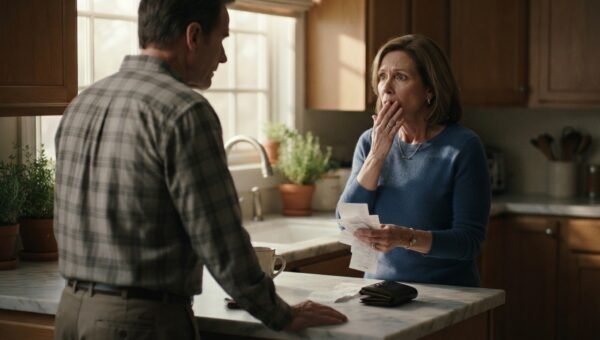
My mother began to weep. She looked between the two lockets, then at the bank records bearing Ruth’s signatures, the evidence too clear and too ugly to ignore anymore.
“Ruth,” Mom whispered, her voice cracking. “Tell me this isn’t true. Tell me you didn’t put a loan on my house.”
Ruth didn’t answer her. She grabbed her leather handbag from the chair, shoved her paperwork into it, and glared at me with pure hatred.
“You ruined this family,” Ruth spat. “You always had to be the perfect one.”
She slammed the back door so hard the glass pane rattled in the frame, tires squealing as she backed out of the gravel driveway.
The kitchen went dead quiet except for the hum of the refrigerator.
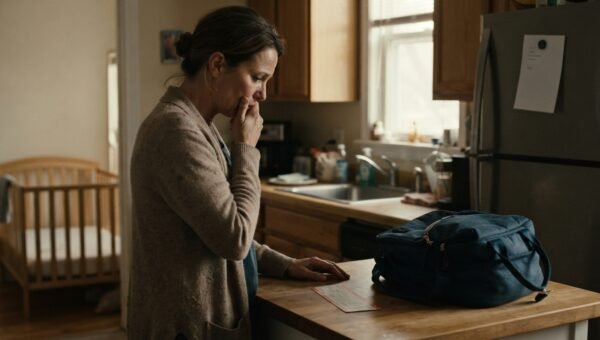
Mom sat in her chair, her hands shaking uncontrollably. She looked up at me, eyes filled with tears, shame, and fear. She opened her mouth to speak, probably to ask me to fix it, to beg me to pay off the lien, to make the mess disappear like I had always done.
I did not let her ask.
“I am going to help you hire an elder-law attorney tomorrow morning, Mom,” I said, my voice steady, but without the warmth I used to bring into that room. “We will revoke the transfer-on-death deed. We will force Ruth to refinance her own home to pay off that equity line, or the attorney will file criminal fraud charges against her. I will make sure you don’t lose the roof over your head.”
Mom reached out across the table, her withered hand reaching for mine. “Oh, Claire… thank God. What would I do without you?”
I picked up Dad’s real silver locket from the table and slipped it into my pocket. I did not take her hand.
“You would have been put into a state home by the daughter you gave everything to,” I said quietly.
I helped her with the groceries, made sure the doors were locked, and walked out to my car.
Over the next five months, the attorney did his work. Ruth was forced to take out a high-interest personal loan to pay off the bank lien on Mom’s house to avoid a felony fraud indictment. She hasn’t spoken to Mom or me since the day she signed the restitution agreement.
I still take Mom to her doctor’s appointments, and I still pick up her heart medications every other week. But I don’t stay for coffee, and I don’t sit in the yellow chair.
Every Sunday, I wear Dad’s real silver locket around my neck. It doesn’t hold any diamonds, but inside, right behind his smiling face, it holds the quiet truth that my father saw who I was, saw who they were, and made sure I walked away with my dignity intact.