PART 1
My son didn’t speak to me for seven years.
I pushed him into pre-med from the time he was a sophomore in high school. I bought the MCAT study guides before he even had his driver’s license. I laid out his life like a clean, straight sidewalk, because to my mind, there were only two kinds of men in this world: the ones who sat in climate-controlled offices giving orders, and the ones who ruined their backs in the cold for forty dollars an hour.
Luke wanted carpentry. In high school, he took apart our broken back porch and rebuilt the steps so level you could set a marble on any riser and it wouldn’t roll an inch. I didn’t praise him. I looked at his calloused knuckles and told him, “No son of mine will waste his brain swinging a hammer.”
I paid $62,000 a year for his private college tuition. I paid the lab fees, the campus housing, and the five-hundred-dollar organic chemistry textbooks. I paid for it all so I could hold the title deed to his future.
He dropped out in the middle of his sophomore year.
He didn’t call. He drove home on a Tuesday morning with three cardboard boxes in the trunk of his battered Honda Civic. He carried his things up to his old bedroom, walked down to my home office, and set his campus meal card on my blotter.
He didn’t yell. He just looked at me with tired, sunken eyes and said, “I can’t do it, Dad. I hate the hospital. I hate the labs. I spent three hours last night looking at the third-floor balcony outside the science hall. I’m done.”
My temper wasn’t hot. It was cold and sharp. I stood up behind my desk, picked up his meal card, and dropped it into the wastebasket.
“I didn’t sacrifice twenty years of my life so you could wear a tool belt,” I told him. “You want to throw away a quarter of a million dollars of my hard-earned money to play with sawdust? Pack your bags. Don’t come back until you have a real career.”
I expected him to flinch. I expected him to break down, apologize, and ask me to help him register for the spring term.
Instead, Luke looked at the wastebasket, then looked back at me. He nodded once, went upstairs, brought his three boxes down to the driveway, and drove away.
He didn’t call for Christmas. He didn’t call on my sixtieth birthday. Seven years went by, and his name became a quiet, aching wall between me and his mother, Martha. Martha stayed in touch with him, but she kept it behind closed doors. She went to lunch with him in diners three towns over. She kept her phone face down on the kitchen counter whenever she received a text. When I asked her about him, she gave me the same answer every single time: “He’s alive, Arthur. And he’s working.”
Last month, on a cold Sunday afternoon, Martha sat down across from me at the kitchen table. She didn’t say a word. She unlocked her phone, set it beside my coffee mug, and pushed play on a local news feature.
The screen showed a high-ceilinged workshop filled with natural light, industrial dust collectors, and massive slabs of black walnut and white oak.
Fourteen employees in matching gray work shirts moved around industrial table saws and hand-finishing benches. In the center of the frame stood my son. His shoulders were broader, his beard had flecks of premature gray around the chin, but his hands were steady and covered in fine amber dust.
A graphic banner ran across the bottom of the screen: *Lucas Vance, Founder of Vance Architectural Millwork. $1.2 million in annual revenue.*
The reporter asked him about his clientele. Luke spoke clearly, without boast or hesitation. He talked about custom dining tables shipped to private estates in Montana and custom cabinetry for high-profile clients in Chicago. Then the camera cut to the state capitol building. The state seal gleamed in gold leaf above an eight-foot executive desk made of book-matched American elm.
“Lucas Vance designed and built the governor’s official desk,” the narrator said. “A piece meant to endure for the next century.”
My throat burned. The air in my chest felt thin and bitter, like swallowing battery acid. I stared at the screen as the video faded out. Seven years of stubborn, righteous silence dissolved into ash right in front of me.
Martha didn’t say, “I told you so.” She just took her phone back and pulled a thick, cream-colored envelope from the pocket of her cardigan. She placed it squarely in the middle of the table.
“He told me to give you this after you saw the piece,” she said quietly.
My hands shook as I slit the paper. Inside was a single sheet of heavy stock with one short paragraph typed in the center:
*You told me a hammer wasn’t enough. I built everything with one. The chair in your living room. Mom commissioned it. I made it myself. I carved something underneath the seat. Go look. It says …*
PART 2
The letter ended right there, cut off mid-sentence with three dots.
I sat frozen at the kitchen table, staring at the creamy paper. My first instinct was confusion, then a strange, creeping panic that made my neck prickle with heat.
“The chair?” I said, looking up at Martha. “What chair is he talking about?”
Martha didn’t answer right away. She stood up, walked over to the sink, and rinsed her empty coffee cup under the tap. Her back was turned to me, her shoulders stiff inside her wool sweater.
“The reading armchair,” she said, her voice completely even. “The one beside the south window in the study. You’ve sat in it every single evening for the last four years.”
My mind spun backward. Four years ago, for my sixty-third birthday, Martha had surprised me with a heavy, custom-built reading armchair. It had a frame of solid quarter-sawn white oak, mortise-and-tenon joints, and dark brown full-grain leather cushions. I had marveled at it the day it arrived. I had run my hands over the broad armrests, admiring how the grain matched across the curves, how the wood felt like polished stone under my fingers. When I had asked Martha where she found it, she had brushed it off, telling me she ordered it through a boutique interior designer in Grand Rapids who worked with regional craftsmen.
I had spent hundreds of hours in that chair. I had graded engineering consulting reports in it. I had napped in it on rainy Sunday afternoons. When my lower back flared up during the winters, that chair was the only seat in the entire house that offered relief, shaped with an ergonomic curve so precise it felt tailored to my spine.
“You knew,” I whispered.
“Of course I knew,” Martha said, turning around to face me. “I saved my own substitute teaching checks for ten months to pay his deposit. He was sleeping on a cot in the corner of a drafty pole barn back then, Arthur. He didn’t have heat in his shop. He was twenty-three years old, working eighteen-hour days, living on peanut butter, and pouring every dime he made back into used machinery. When I told him your hip was bothering you, he asked for your measurements. He spent six weeks carving that frame by hand.”
“Why didn’t you tell me?” I demanded, my voice rising as the embarrassment clawed up my throat. “You let me sit in furniture built by the son I threw out?”
“You didn’t want to hear his name,” she answered, her voice dropping lower, colder. “You made that rule the morning he left. You said nobody who swings a hammer has a real career. If I told you Luke made it, you would have hauled that chair out to the curb before sundown. Don’t sit there and pretend you wouldn’t have.”
She was right. The bitter truth of it struck me right between the ribs. Four years ago, my pride was still an iron cage. If I had known Luke built that chair, I would have called it trash. I would have called it an insult.
I pushed my chair back from the table. The legs scraped harshly against the linoleum.
I walked down the dark hallway toward the study. The door was half-open. The late afternoon sun slanted through the south window, throwing a warm, honey-colored rectangle across the dark oak floor. The chair sat right in the center of the light.
I stood over it for a long time. For four years, I had believed some anonymous artisan had built this comfort for me. Now, every joint and bevel took on a different weight. I saw the tiny, microscopic tool marks along the under-curve of the armrest, where someone had smoothed the grain with a hand scraper instead of sandpaper to keep the wood fibers crisp.
My breath came fast and shallow. I knelt down on the rug. My knees cracked, a reminder of the years that had slipped through my fingers while I nursed my grievance.
I tilted the heavy chair back against my shoulder and looked up into the darkness beneath the solid oak seat.
PART 3
Underneath the seat, between two cross-braces reinforced with walnut dowels, the wood had been planed as smooth as glass.
Burned directly into the oak with a branding iron and finished with deep, precise chisel cuts was a short inscription. It wasn’t an insult. It wasn’t a demand for an apology.
It read:
*Built for my father’s rest.*
*October 14.*
*L.V.*
October 14 was my birthday.
Right below the date, fastened to the underside of the hardwood rail with two brass finishing screws, was a small, sealed clear plastic sleeve. Inside the sleeve was a folded slip of white paper.
I reached up with trembling fingers, worked the brass screws loose with my pocketknife, and pulled the sleeve free. I sat flat on the floor, my back resting against the front of the chair, and unfolded the paper.
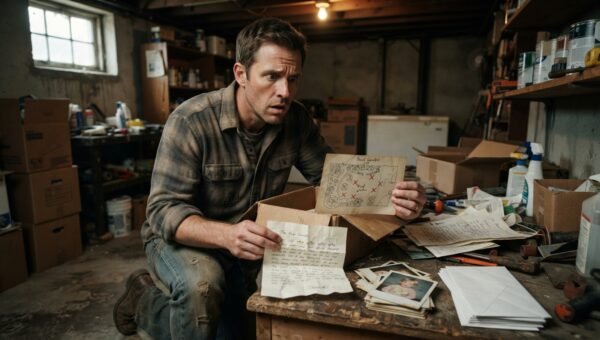
It was an official receipt from the state university bursar’s office, dated three years ago.
It showed a cashier’s check payment in the exact amount of $62,000.
Attached to the receipt was a brief carbon copy of an internal student ledger. Across the bottom, stamped in purple ink, were the words: *Tuition Reimbursement – Year One. Account Paid in Full by Lucas Vance.*
Paperclipped to the back of the ledger was a handwritten note in Luke’s hurried, upright handwriting:
*Dad,*
*You paid $62,000 for my first year because you thought you were buying my future. I couldn’t repay the second year yet when I made this chair, but I promised myself I wouldn’t leave you holding the bill for my choices. I paid the university back for the freshman grant balance they clawed back from you, and the rest went to the direct parent loan you took out. The loan balance is zero.*
*I never hated you. I hated who I was turning into trying to make you proud. A hammer builds homes, hospitals, and tables where families sit down to eat. It’s enough for me.*
*The door to the shop is unlocked every Saturday morning.*
I stared at the numbers. $62,000.
Three years ago, I had received a formal notification from the bank that my federal parent PLUS loan had been settled in full. At the time, I had assumed it was an administrative adjustment or an automated transfer error between accounts that my accountant had somehow cleared up. I had never questioned it deeply because I had plenty of savings and didn’t care to revisit the paperwork from Luke’s wasted semesters.
Luke hadn’t just built a million-dollar company out of scrap wood and sweat. While I was sitting in my comfortable study, telling myself that my son was an ungrateful failure who would come crawling back once the real world broke him, he had been paying off the debt of his own departure dollar by dollar. He had taken my most bitter accusation, the money I claimed he stole from my sacrifice, and laid it quietly back on the table without ever demanding credit.
A heavy, suffocating silence filled the room. The house, which had always felt solid and secure, suddenly felt like an empty museum. I had spent seven years protecting my pride, polishing my grievance like a silver coin, convinced that I was the wounded party.
I folded the paper carefully, slid it back into the sleeve, and put it in my shirt pocket right over my heart.
I stood up, walked into the kitchen, and picked up my truck keys from the counter.
Martha looked up from her tea. Her eyes were red, but she didn’t look surprised.
“Where is the shop?” I asked.
ENDING
The shop was located twenty miles north of town, down a secondary county road lined with bare maples and drainage ditches.
It sat behind an old grain elevator: a modern steel building with three tall roll-up doors and a neat gravel parking lot. The sign near the road was simple, carved from a solid beam of dark cedar: *Vance Millwork.*
It was Saturday morning. The lot had only one vehicle parked in front, Luke’s gray Ford pickup.
I parked my truck, stepped out into the crisp autumn wind, and stood by my driver’s door for several minutes. My stomach was tied in knots. I had spent forty years managing men and running complex industrial projects, but walking toward that glass entrance door felt heavier than anything I had ever done.
I pushed the door open. A small brass bell chimed overhead.
The smell hit me immediately: dry sawdust, linseed oil, and the sharp, clean scent of fresh-cut pine. It was an honest smell. In the main bay, classical music played softly from a radio mounted on a structural post.
Luke was standing at a long maple workbench, running a low-angle block plane across the edge of a walnut tabletop. Thin, translucent curls of wood peeled away from the blade and drifted to the floor around his work boots.
He didn’t look up right away. He finished the stroke, set the tool down gently on its side so the blade wouldn’t dull, and wiped his brow with the back of his forearm.
Then he looked at me.
Seven years. In my memory, he was still the nineteen-year-old boy standing on my office carpet with rounded shoulders and frightened eyes. The man standing across from me was thirty pounds heavier, solid as an oak beam, with calloused palms and steady, patient eyes.
Neither of us moved. The radio played quietly between us.
“Dad,” he said. His voice was deeper than I remembered, raspy from the shop air.
My throat tightened. All the speeches I had rehearsed on the drive up, the explanations, the justifications about why I had pushed him so hard, vanished completely. There was no defense for what I had done.
“I looked under the chair, Luke,” I said. My voice cracked on his name.
Luke nodded slowly. He wiped his hands on a clean shop rag, took a breath, and looked down at the tabletop he was shaping.
“I wasn’t sure you ever would,” he said quietly.
“I was a fool,” I told him. The words came out hard and flat, stripped of all pride. “I spent seven years being an arrogant, stubborn old fool. You didn’t waste your brain, son. You used it better than I ever did. And I’m sorry. I am so deeply sorry.”
Luke didn’t yell, and he didn’t rush across the floor to embrace me. Real wounds don’t close like they do on television. He stayed by his bench, but his jaw relaxed, and the defensive stiffness in his shoulders slowly gave way.
“You want some coffee?” he asked. “It’s just drip from the back room, but it’s hot.”
“I’d like that,” I said.
He walked to the small break area and came back with two ceramic mugs. We stood together beside the walnut slab, watching the steam rise into the cold shop air. We didn’t solve seven years of silence in ten minutes. We talked about wood drying cycles, the moisture content of local lumber, and how he had sourced the elm for the governor’s desk. I listened. For the first time in his life, I simply listened to what my son had to say.
When I finally left around noon, Luke walked me out to my truck. As I opened the door, he reached out and put a hand on my shoulder. His grip was rough and strong.
“Come back next Saturday, Dad,” he said. “I’m starting a dining set. I could use an extra set of hands on the glue-up.”
“I’ll be here at seven,” I told him.
I drove home along the county road with the window cracked open, letting the cold air clear my head.
That evening, I walked into the study and sat down in the armchair beside the window. I rested my arms on the smooth, curved oak and leaned my head back against the leather. The wood held the warmth of the room. It was strong, level, and completely sound.