PART 1
The garden behind our clapboard house in Mount Vernon was Jim’s sanctuary for four decades. He knew every turn of the soil, the exact week to plant the early beefsteak tomatoes, and how to coax sweet corn out of Ohio clay. We had been married forty-two years. Forty-two years of folded laundry, shared mugs of black coffee at five in the morning, squeaky porch floorboards, and the quiet comfort of knowing someone is sleeping right beside you.
Last August, on a Tuesday morning so humid the air felt like warm flannel, Jim walked out to the garden with an empty wire basket to pick pole beans. When he did not come back inside after an hour, I stepped out onto the back porch to call him in for lunch.
I found him lying between the third and fourth rows of tomatoes, the wire basket overturned in the dirt. He was seventy years old. The paramedics told me his heart stopped from a massive stroke before he even hit the ground. They said he felt no pain, but that did nothing to soften the silence that moved into our home the day we buried him in the churchyard.
For two months, I moved through the house like a ghost. I washed the same two coffee cups. I swept floors that were not dirty. I sorted through his flannel shirts and smelled the cedar woodsmoke and peppermint hard candies that always lingered in his pockets.
Jim had worked thirty-five years as a machinist at the hydraulic pump factory down by the railroad tracks. He was never a loud man. He did not brag, he never bought new cars, and he patched his own work boots with shoe goo until the leather wore paper-thin.
Whenever I balanced our household ledger at the kitchen table on the last Sunday of the month, the numbers always matched to the penny. We lived on his modest pension, my part-time bookkeeping wages from the grain elevator, and our monthly Social Security checks.
Then, on the second Tuesday of October, the kitchen landline rang.
I picked up the heavy plastic receiver. “Hello?”
“Ruth? Is that you?” The voice was raspy, deep, and familiar.
“Yes, Hank,” I said, recognizing Hank Miller immediately. Hank had run the independent auto repair garage on Route 6 for as long as Jim and I had lived in Knox County.
If your alternator squeaked or your brake pads wore down to the rivets, you towed your car to Hank. “Is everything all right?”
Hank went quiet for several seconds. I could hear the dull thud of an impact wrench working on a tire rim in the background, followed by the metallic chime of a shop door.
“Ruth, I am sorry to bother you,” Hank said, his voice dropping into a hesitant, gentle register. “I know it has only been two months since the service. But October is here, and I have a file sitting on my metal desk. Jim usually comes through that side door during the first week of October like clockwork. He has done it every autumn since 2008.”
I frowned, shifting the receiver to my other ear. “Jim went to see you every October? His truck had its oil changed in June. What file are you talking about, Hank?”
“You better come down to the shop, Ruth,” Hank replied softly. “Bring his truck keys if you still have them, but mostly just come on down. There is an account here that belongs to you now, and you need to see the books for yourself.”
PART 2
The Route 6 garage was a low cinderblock building with two bay doors and a gravel lot filled with rusted farm pickups and late-model sedans. The front office smelled of old tires, dark roast coffee, and grease solvent.
Hank was sitting behind a scarred steel desk, wearing his navy work coveralls with his name stitched in red thread over the pocket. When I walked through the door, he stood up, wiped his hands on a clean rag, and pulled a folding chair around from the corner so I could sit down.
“Sit down, Ruth. Let me pour you some decaf,” he said.
“I don’t need coffee, Hank,” I said, my heart beating with nervous confusion. “Just tell me what Jim had here. Did he order parts before he passed? If there is an unpaid bill, I brought my checkbook.”
Hank shook his head slowly. A sad, gentle smile touched his weathered mouth. “No, Ruth. Jim doesn’t owe me a dime. If anything, half this county owes Jim a debt they will never even know about.”
Hank reached onto the filing cabinet behind his desk and picked up a heavy, expandable cardboard accordion file. The cover was worn soft at the corners, held together by two thick rubber bands. Written across the front in black marker was a single word: “EVELYN.”
Hank slipped off the rubber bands and opened the flap. Inside were dozens of clear plastic sleeves, each holding receipts, carbon repair orders, and customer intake forms spanning sixteen years.
“In October of 2008,” Hank began, resting his calloused forearms on the desk, “Jim walked into this office on a Friday afternoon. The economy had just fallen apart, fuel prices were through the roof, and people were losing work left and right. Jim sat right in that chair where you are sitting now. He laid two thousand one hundred dollars in cash on this desk.”
I stared at Hank, my mouth slightly open. “Two thousand dollars? Where would Jim get that kind of cash?”
“He told me he saved forty dollars a week out of his personal allowance,” Hank said. “He told me he skipped his diner breakfasts, quit buying brand-name tobacco, and did small engine repairs on lawnmowers for folks out by the lake on Saturdays. He told me, ‘Hank, I want an open credit line set up here. Every year, you pick seven working single mothers whose cars are on their last legs. You fix their brakes, put safe tires on their rims, replace their dead batteries, or flush their heaters before winter hits. Three hundred dollars per car. No more, no less.'”
I pressed my hand against my collarbone. The air in the small office seemed to thin out.
“Jim paid for other people’s cars?” I whispered.
“Not just once, Ruth,” Hank said, turning the file so I could see the dates. “Every single October for sixteen straight years, Jim walked through that side door. Seven women every year. Three hundred dollars a piece. That is twenty-one hundred dollars every autumn. Over sixteen years, your husband handed me thirty-three thousand six hundred dollars out of his own pocket.”
Hank tapped a thick stack of white invoices. “One hundred and twelve repairs, Ruth. One hundred and twelve times a mother walked in here with a car seat in the back, crying because her transmission line was leaking or her front wheel bearings were grinding, terrified she was going to lose her job at the hospital or the school cafeteria. And every single time, I handed them their keys and told them an anonymous church fund had covered the ticket.”
Tears blurred my vision so fast they dripped down the collar of my wool sweater. Thirty-three thousand dollars. Jim had driven an eleven-year-old Chevrolet with manual windows. He had worn the same winter coat for twelve seasons, brushing off my suggestions to buy a new down jacket by telling me his old wool coat had plenty of warmth left in the lining.
“Why didn’t he tell me, Hank?” I asked, my voice cracking into a sob. “We shared everything. We never kept secrets about money.”
Hank reached into the very back of the folder. He pulled out a legal-sized cream envelope that was completely sealed. On the front, written in Jim’s neat, deliberate block print, was my name: “For My Ruth.”
“He told me if the good Lord called him home before October of this year, I was to hand this to you myself,” Hank said quietly. “He wanted you to understand where it came from.”
PART 3
Hank stepped out of the office into the repair bay, closing the wooden door behind him to give me privacy.
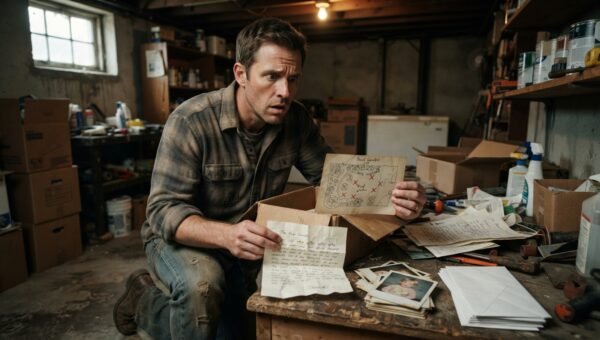
I took a pocket knife from my purse, slit the top of the envelope, and pulled out two folded sheets of notebook paper. The handwriting was unmistakable. Jim had written it in blue ballpoint ink, steady and careful.
“My dearest Ruth,” the letter began.
“If you are holding this paper at Hank’s counter, it means my earthly work is finished and I have left you behind for a little while. Forgive me for keeping this ledger out of our household book. I never kept it secret out of deceit, but because I knew your generous heart would worry we were shorting our own savings.”
I wiped my eyes with a tissue and kept reading.
“You know my father walked away from our porch when I was seven years old, leaving my mother, Evelyn, with four children, an empty fuel oil tank, and twelve dollars in an old coffee can. What you never saw was what happened every winter morning between 1959 and 1968.
My mother did not have a driver’s license, and she certainly never had a car. She worked the third shift at the textile mill on the far side of Mount Vernon, four miles from our front door. Every afternoon at three o’clock, in rain, sleet, or knee-deep Ohio snow, she would wrap two pairs of woolen stockings over her feet, put plastic bread bags inside her boots, and walk along the gravel shoulder of State Route 13.
I used to stand by the kitchen window watching her small frame disappear down that dark road. She came home at midnight with her fingers so stiff and blue she could not unbutton her own coat. She did that for nine years so my brothers and I could have hot oatmeal in our bellies and shoes on our feet. She died of pneumonia when she was only forty-nine years old, worn down to the bone before she ever had a chance to rest.
The day we got married, Ruth, I looked at you standing in that white lace dress, and I thanked Almighty God that you would never have to walk a dark road alone. But every autumn, when the cold air blows off the creek and the leaves turn brown, I see young mothers standing at the gas pumps on Route 6 with three kids in the back, checking their tires with bald treads, praying the engine starts so they can get to their shifts.
Every car I repair honors my mother, who walked alone. I vowed no woman would walk that road if I had a dollar to spare, but my greatest blessing was that you never had to.
Do not mourn the money, darling. We never lacked for bread, our roof never leaked, and my love for you has been full since the day we met. Everything I left in our savings is yours. Live well, keep the garden green, and remember that charity done in the open is just vanity, but charity done in secret is prayer.”
ENDING
I sat in that quiet garage office for a long time, holding Jim’s letter against my chest until the paper warmed against my skin.
When Hank came back inside, holding a wrench and a fresh pot of coffee, he looked at me with red-rimmed eyes of his own.
“Are you all right, Ruth?” he asked softly.
I folded Jim’s letter carefully, slipped it back into the envelope, and tucked it into my handbag.
“I am better than all right, Hank,” I told him. “I just finally understand the man I lived with for forty-two years.”
I stood up, walked over to the desk, and looked down at the open folder. Inside the front sleeve was an intake slip dated just three days prior. A young mother named Megan, who worked forty hours a week as a nurse’s aide at the county rest home, had brought in a battered 2011 sedan with worn-out front brakes and a cracked radiator hose. Hank had written an estimate of three hundred and twenty dollars on the bottom of the form, with a question mark penciled beside the total.
“Has Megan’s car been fixed yet, Hank?” I asked.
Hank scratched the back of his neck. “Not yet. She came in Monday morning. She looked at the estimate, started shaking, and told me she would have to wait until November when her tax advance comes in. I told her I would see what I could do.”
I opened my checkbook on Hank’s metal desk.
I picked up his pen and wrote out a check to the garage for twenty-one hundred dollars. I signed my name across the bottom, tore the paper from the register, and pressed it firmly into Hank’s palm.
“That is for this October, Hank,” I said. “Three hundred dollars for Megan, and three hundred dollars for six more mothers before the first snow flies.”
Hank stared down at the check in his hand, his eyes wide. “Ruth, you don’t have to do this. Jim’s arrangement was between him and me. You need your savings for your own winter.”
“Jim taught me how to live, Hank,” I said, looking out through the office window toward the highway where cars were hurrying past in the autumn wind. “And he showed me what real love looks like. As long as I have breath in my lungs and his pension coming into the mailbox, Evelyn’s fund stays open.”
I drove Jim’s old pickup back home along Route 6. The air was crisp, the maples along the creek were turning vibrant shades of gold and amber, and the cab smelled of cedar and sweet tobacco.
When I reached the house, I did not sit in the dark parlor. I walked through the kitchen, out the back door, and stood in the center of Jim’s garden. I looked at the dark earth, the wooden tomato stakes waiting for next spring, and the fence line he had built with his own two hands.
For the first time since August, the silence around me did not feel empty. It felt full, deep, and steady, like the quiet faith of a good man whose kindness would keep running long after his hands had come to rest.