PART 1
My seventy-two-year-old mother, Helen, had an appointment at nine in the morning for a $150 routine dental cleaning. She wrote it on the calendar hanging by her refrigerator, just like she did every six months. She laid her light gray cardigan across the back of the kitchen chair, set her purse on the counter, and told me she would pick up a loaf of sourdough on her way back.
By one in the afternoon, her Buick was still not in the driveway.
I called her cell phone four times. Every call clicked straight through to voicemail after five rings, which meant the phone was turned on but nobody was picking up. That was not like Helen. If she had to sit in a waiting room past her appointment time, she called to complain about the magazines. If she ran into a neighbor at the bakery, she sent a short text so I would not worry.
I logged into her checking account around two o’clock. We had set up shared online access three years ago after my father passed, mostly so I could help her balance utility bills and track property taxes. I expected to see a pending charge for $150 from Oakridge Dental Arts.
Instead, the pending transactions showed one single charge posted at 10:14 AM: $4,500 to Skyline International Travel, a small storefront agency three doors down from the clinic.
My mother lived on a fixed pension and social security. She kept her spending in three labeled envelopes in her desk drawer, and she argued over thirty-cent coupons on canned tomatoes. A $4,500 withdrawal made no sense.
I grabbed my keys and drove straight to the shopping plaza on Route 4. The travel office had a faded poster of the Greek islands in the front window. A woman with dark hair and reading glasses sat behind a laminate desk, typing slowly into an older computer terminal.
I pulled out my phone and brought up a picture of Helen from Thanksgiving. “Did this woman come in here this morning?”
The woman pushed her glasses down her nose and squinted at the screen. Her expression cleared right away. “Yes. She sat right there in that brown chair about four hours ago. Helen, right?”
“That’s my mother,” I said. “There is a four thousand five hundred dollar charge on her debit card from this office. What did she buy?”
“She purchased a one-way flight to Rome,” the agent said. She said it casually, as if people like Helen bought four-thousand-dollar international one-way tickets on a Tuesday morning all the time. “Departing late tonight from JFK.”
I stared at her. “Rome? That has to be a mistake. My mother despises flying. She took a train to Chicago for her sister’s funeral because she refuses to step foot on an airplane.”
The agent pulled up a file on her screen and turned the monitor slightly toward me. “She insisted on business class, and she paid in full. There were two tickets on that reservation.”
I leaned over the counter. “Who was the second ticket for?”
“A man named Dr. Richard Hayes,” she said.
Dr. Richard Hayes had been Helen’s dentist for eleven years. He had done her bridge, filled her cavities, and sent Christmas cards signed with a gold pen.
I ran out of the agency and hurried down the brick walkway to Oakridge Dental Arts. The heavy glass front door was locked tight. Taped to the inside of the glass was a freshly printed sign that read: Building For Sale. Inquire with Century Commercial.
I knocked hard. The reception desk inside was completely bare. No computer monitors, no appointment books, no clipboards. Through the frosted interior door, the treatment bay was dark.
I called the non-emergency dispatch line, and twenty minutes later two patrol officers pulled into the lot. When I showed Officer Miller the $4,500 travel receipt and pointed out that my seventy-two-year-old mother had disappeared into a closed medical office four hours earlier, he tested the rear service door with his shoulder. The latch gave way with a dry snap.
We walked inside with our flashlights cutting through the dust. The examination rooms were stripped. The rolling metal trays were empty, the cabinets hung wide open, and the supply closets had been swept down to the linoleum.
In the small private office at the very back of the hall, the desk drawers sat open on the floor. On top of the wood veneer desk, pinned under an empty glass paperweight, lay a single sheet of paper torn from a legal pad.
Officer Miller pointed his flashlight down at it, and my eyes caught the handwriting immediately. It was not my mother’s neat cursive. It was a sharp, hurried scrawl:
“Don’t search for me. The fronts are too hot. The flight leaves in eight hours, and the man…”
The sentence cut off right there, the pen trailing off the edge of the page where the paper had been violently jerked away.
PART 2
Officer Miller did not touch the paper. He reached into his pocket, pulled out a small evidence bag, and took three clear photos with his department phone before lifting the sheet with a pair of disposable tweezers.
“Do you know Hayes’s personal address?” Miller asked me.
“No,” I said. “He had a house over near the reservoir, but I only know the general road. He never talked about his home life. Helen just thought he was a quiet man who did good dental work.”
My hands were shaking, so I put them in my coat pockets to keep them steady. “What does ‘the fronts are too hot’ mean? A dental office is a business, not a front.”
Miller gave the empty room a slow look. The outlines where filing cabinets used to stand were visible against the pale yellow drywall. Square patches of clean paint marked where diplomas and certificates had hung only days earlier.
“When people strip an office down to the studs in twelve hours, they aren’t worried about tooth fillings,” Miller said. He stepped back into the hallway and called his watch commander.
While Miller spoke to the station, the second officer, a younger woman named Perez, walked around the perimeter of the parking lot behind the building. She found two empty cardboard file boxes sitting beside the commercial dumpster. Both boxes had the commercial shredding company’s seal broken off.
Inside the bottom of the second box was a manila folder that had fallen flat. It was labeled in black marker: Patient Records: Retain / Escrow.
Officer Perez carried it over to the trunk of the squad car and opened it under the dome light. I stood close enough to see the first page. It was not a dental chart. It was a photocopied lease agreement for a medical equipment leasing company called Hayes & Morrow Holdings, registered in Delaware, with an operating address listed right here in this strip mall.
Attached to the lease was a typed bank confirmation from three months ago. The account showed regular deposits coming in from an elder care advocacy network funded by the county, followed by immediate wire transfers out to an overseas account in Switzerland.
My mother’s name was not on the corporate papers, but her social security number was penciled into the upper right corner of a guarantor worksheet.
“Did your mother ever co-sign anything for him?” Perez asked.
“Never,” I said. “My mother would not co-sign a loan for her own brother. She kept her credit frozen with all three bureaus after my dad died because she was terrified of identity theft.”
“Then she didn’t know,” Perez said quietly.
The puzzle started shifting in front of me, and the pieces felt ugly and heavy. Hayes had not run off with my mother because of some late-in-life romance. If he had her social security number and had used her name on secondary guarantor forms, she was not his accomplice.
She was his cover.
I pulled out my phone and checked the time. It was 3:45 PM. The note on the desk had said the flight leaves in eight hours. From JFK to Rome, late-night flights usually boarded around ten or eleven o’clock. If they were heading to New York from our county in Pennsylvania, they were either already on the highway or getting ready to leave.
I walked back over to Miller. “You need to pull the highway toll cameras on Route 78 and Route 80. If Hayes is driving her car, or his car, they are heading east toward the airport right now.”
Miller shook his head. “I already requested an alert through state police, but we don’t have an active abduction warrant yet. We have an adult who walked into a travel agency, signed her own name on a credit card slip, and bought a plane ticket. Until we find physical evidence of coercion, the port authority will not hold a passenger.”
“She hates flying,” I said, my voice rising in the empty alley. “She has four thousand dollars to her name, and she just spent every dime of it. You read that note. He left half a sentence on his desk because he was running from something.”
“I hear you,” Miller said. “Believe me, I hear you. But the law has steps. Go home, wait by the landline in case she calls, and let us work the vehicle registration.”
I nodded, walked back to my car, and got behind the wheel. But I did not drive home.
I knew my mother’s habits better than any police procedure manual. If Helen had been rushed or frightened, she would have done what she always did when my father got sick or when life got out of hand: she carried a small spiral notebook in the zipper pocket of her purse where she wrote down every phone number she ever dialed.
And if Hayes had taken her car, she had an old toll transponder mounted behind the rearview mirror that still linked to my father’s old credit card account.
I opened the toll app on my phone while sitting in the parking lot with the engine idling. I refreshed the transaction history.
At 2:18 PM, the transponder had pinged at the Delaware River toll bridge heading into New Jersey.
At 3:12 PM, it pinged again at the Garden State Parkway interchange.
They were not sitting in a house waiting for nightfall. They were already ninety miles ahead of me, driving her tan Buick toward Queens.
PART 3
The drive through northern New Jersey in late afternoon traffic was a blur of brake lights and gray highway dividers. I kept one eye on the toll app, refreshing the screen every ten minutes at red lights and toll plazas.
The car pinged the Goethals Bridge at 4:45 PM. Then the Belt Parkway at 5:35 PM.
After that, the pings stopped. The Belt Parkway dumped directly into the approach roads for John F. Kennedy International Airport.
I reached Terminal 4 just before seven in the evening. The departures curb was three lanes deep with yellow cabs, shuttle buses, and travelers dragging heavy suitcases through the exhaust. I pulled my car into the long-term parking garage, took the ticket, and ran across the skybridge into the terminal.
The terminal was packed. Long lines curved around the ticket counters for the European departures. I walked straight to the international departures board hanging above the main concourse.
There was only one direct flight to Rome listed for the night: Alitalia Flight 611, scheduled to depart at 9:55 PM.
The gates for that concourse were past security checkpoint B. I could not get through the TSA line without a boarding pass, and the Port Authority police desk was tucked behind a glass partition near the baggage claim level.
I walked up to the officer standing by the checkpoint entrance, a tall man with a radio clipped to his collar.
“I need your help,” I said. “My seventy-two-year-old mother is on the passenger list for Flight 611 to Rome. There is an active missing-persons report filed with the Palmer Township police in Pennsylvania. She is traveling with a man named Richard Hayes.”
The officer looked at my driver’s license, then keyed his mic and spoke to his supervisor. “Give me ten minutes,” he told me. “Come over here by the podium.”
Those ten minutes felt like three hours. Around 7:35 PM, a port authority detective in plainclothes walked up the escalator. He had a printed passenger manifest in his hand.
“Are you the daughter?” he asked.
“Yes,” I said. “Did they check in?”
“Hayes checked in two bags at the curb forty minutes ago,” the detective said. “He used the self-service kiosk and scanned two passports. But only one boarding pass has cleared the security checkpoint so far.”
“Which one?”
“Richard Hayes,” the detective said. “He went through security twenty minutes ago. Your mother hasn’t scanned her pass at the gate yet.”
The detective turned to the checkpoint guard. “Bring her through on an escort pass.”
They took me through the employee lane, wanding my coat and checking my purse, and we walked down the long, carpeted concourse of Terminal 4. The gate for Flight 611 was near the very end, surrounded by blue carpet and rows of black vinyl seats.
I saw Dr. Hayes before he saw us.
He was sitting three rows back from the boarding podium, wearing a dark navy windbreaker and khaki pants. He had a leather briefcase resting between his feet and a newspaper open in his lap. He looked like an ordinary retired professional waiting for a vacation flight.
Beside him, in the seat against the window, sat my mother.
She was wearing her gray cardigan, the one she had left on the kitchen chair that morning. She had both hands gripped around the straps of her handbag, her knuckles white. She was not reading. She was staring straight down at the carpet between her shoes, her shoulders hunched forward as if she were trying to make herself smaller than the seat.
I walked directly across the carpet toward them. “Mom.”
Helen’s head snapped up. Her face was completely drained of color, her eyes wide and red around the rims. “Sarah?”
Hayes dropped the newspaper immediately. He stood up, his face hardening as he reached down for the handle of his briefcase. “Sarah, this is a family matter. You shouldn’t be here.”
The detective stepped around me, his badge held out flat in the palm of his hand. “Port Authority Police, Dr. Hayes. Keep your hands off the bag and sit back down.”
Two uniform officers moved in behind the chairs. Hayes looked at the badge, then looked down the long corridor toward the gate door, and slowly let go of the briefcase handle. He sat back down, his mouth clamped into a thin, tight line.
I knelt down on the carpet in front of my mother and took her cold hands in mine. “Mom, what happened? Why did you buy this ticket?”
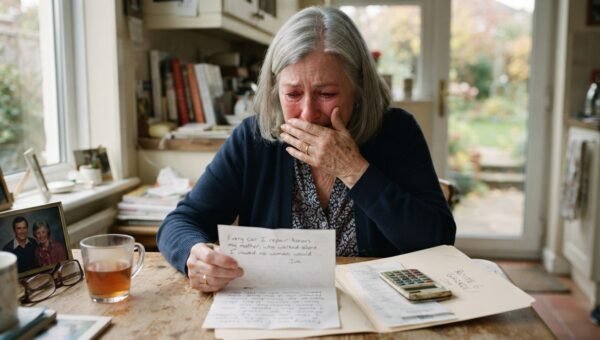
Helen began to cry, quiet and ragged, the tears running down into the wrinkles around her mouth.
“He told me they were coming for the house, Sarah,” she whispered. Her voice was shaking so hard she could barely get the words out. “He came out to the waiting room this morning and pulled me into his office. He said the state auditors found an unpaid lien from your father’s business, and that federal marshals were on their way to seize my checking account and place a freeze on the property.”
She looked at Hayes, then looked back at me, her fingers digging into my wrists. “He said he had an escrow account set up through an international medical trust. He told me if I bought the tickets with my card to verify my identity, we could get to Rome before the freeze hit, and he would transfer my house title into a safe trust overseas. He said if I called you, your accounts would be frozen too.”
The detective reached down, opened Hayes’s leather briefcase, and pulled out two thick manila envelopes. Inside the first envelope were four different cashier’s checks drawn on local bank accounts, made out to bearer, totaling over $300,000. Inside the second envelope was my mother’s deed to her three-bedroom ranch house, along with a quitclaim transfer form stamped with an unauthorized notary seal from two days ago.
Hayes had not just used her credit card for the plane tickets. He had spent the last two months preparing to steal her house from under her feet, using his position as her trusted dentist of eleven years to gather her tax records, her husband’s death certificate, and her personal signatures. When the state medical board and the county fraud unit served him with an audit notice on Monday morning, he panicked, cleaned out his office, and decided to take his most vulnerable, trusting patient with him as his legal cover.
The note on his desk was not a warning to a partner. It was the beginning of a letter he had started writing to his own brother, right before he realized the investigators were already pulling into the front lot, forcing him to grab my mother and run.
The detective snapped the handcuffs on Hayes’s wrists right there in front of the boarding gate. Passengers waiting for Flight 611 watched in silence as the two officers led him down the concourse toward the security exit.
ENDING
We did not leave the airport until three in the morning.
Officer Miller had coordinated with the Queens district attorney’s office and the Port Authority investigators, and we had to sit in a small, windowless conference room on the lower level while my mother gave her statement. She told them everything, from the moment Hayes called her into the back operatory under the pretense of checking an old molar, to the way he guided her hand at the travel agency counter.
By dawn, we were back in her kitchen in Pennsylvania.
The loaf of sourdough she had promised to buy was not on the counter, but the light gray cardigan was back on the kitchen chair. I put the kettle on and made two mugs of black tea, setting one down in front of her.
The $4,500 travel agency charge took three weeks to reverse through her credit union. Her fraud protection policy covered the transaction once the Port Authority filed the grand larceny charges against Hayes, but the bank still required seven different affidavits, certified copies of the police reports, and two trips to the main branch downtown to close the compromised checking account.
The house deed took longer. The county recorder’s office had to void the fraudulent quitclaim filing, which required a hearing before a county magistrate to strike the forged notary stamp from the property roll. The legal fees came to nearly $1,800, money we had to pull from her modest savings cushion, but the deed was finally returned to her name alone in mid-October.
Hayes is currently being held at the county correctional facility without bail, facing federal wire fraud charges, identity theft, and attempted grand larceny. The local paper ran a two-column story on the front page about how he had systematically drained the escrow accounts of four elderly patients over a three-year period to cover bad commercial investments in New Jersey.
My mother does not like to talk about that Tuesday.
She cancelled her next two dental cleanings with a new practice in town, and when she finally agreed to see a woman dentist recommended by her church group, she insisted that I sit in the operatory chair right beside her.
Yesterday afternoon, I went over to her house to help her rake the leaves in the front yard. When I came into the kitchen to get a glass of water, I noticed she had taken the wall calendar down from the side of the refrigerator.
In its place, taped neatly with four pieces of scotch tape, was a small index card. On it, she had written my cell phone number and the number for the local police station in thick, black ink.
Underneath the numbers, in her careful, steady handwriting, she had written one single line:
“Never sign anything in the dark.”
She came in from the porch, set her garden gloves on the counter, and saw me looking at it. She did not say a word. She just picked up her tea mug, took a sip, and looked out the window at the empty driveway.